

Intro
Temple meal offerings discussed in this sugya:1
Showbread (לחם הפנים)
Priests’ meal offering (מנחת כהנים)
Libation meal offering (מנחת נסכים)
Two loaves (שתי הלחם)
This sugya examines how the Torah’s rules of oil and frankincense for the omer offering are extended or restricted with respect to other meal offerings. It does so through a series of comparisons, weighing shared formal features between the omer and the other four meal offerings.
Taking into account these competing lists of similarities, the final determinations repeatedly turn on the homiletic interpretation of the word nefesh (נפש) in the verse.
Literary structure and formula for the three parts, two parts each
I number these parts as Part 1,2,3. Each part is made up of two sub-parts, I number these as A,B.
The repeating formula:
מסתברא מנחת כהנים הוה ליה לרבויי,
שכן
[...]
It stands to reason (מסתברא) [that] the priests’ meal offering should be included (לרבויי) in the requirement of oil and/or frankincense,
As (שכן) [the priests’ meal offering is similar in a number of ways to the omer meal offering that is the subject of the verse]
[...]
The Talmud then goes on to list the points of similarity between the two types of meal offerings. Each similarity is a single keyword.
The Talmud then--in the second part of each-- says “On the contrary (אדרבה)”, before following the same tactic, for the excluded cases. Ultimately, the derivation is from the word ‘nefesh’.
Outline of the sugya - as a table
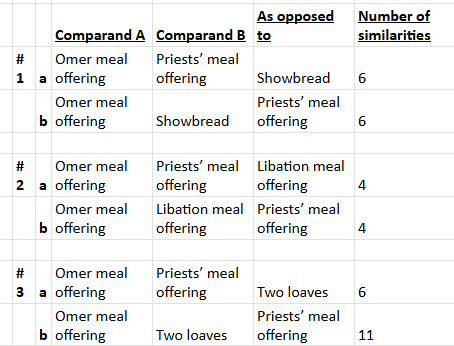
Outline
Intro
Literary structure for the three parts, two parts each
Outline - as table
Outline
The Passage
Part 1- Which is more similar to omer meal offering -- priests’ meal offering or showbread? In the context of oil requirement
Part 1a - Similarities between the priests’ meal offering and the omer meal offering, as opposed to showbread - A List of 6
Part 1b - Similarities between the showbread and the omer meal offering, as opposed to priests’ meal offering - A List of 6
Derivation from the word ‘nefesh’
Part 2 - Which is more similar to omer meal offering -- priests’ meal offering or libation meal offering? In the context of frankincense requirement (Leviticus 2:15)
Part 2a - Similarities between the priests’ meal offering and the omer meal offering, as opposed to libation meal offering - A List of 4
Part 2b - Similarities between the libation meal offering and the omer meal offering, as opposed to priests’ meal offering - A List of 4
Derivation from the word ‘nefesh’
Part 3 - Which is more similar to omer meal offering -- priests’ meal offering or two loaves? In the context of oil and frankincense requirement (Leviticus 2:15)
Part 3a - Similarities between the priests’ meal offering and the omer meal offering, as opposed to the two loaves - A List of 6
Part 3b - Similarities between the two loaves and the omer meal offering, as opposed to the priests’ meal offering - A List of 11
Derivation from the word ‘nefesh’
Appendix - Comparative table summarizing the features of each offering, according to the sugya
The Passage
(In ChavrutAI: starts at menachot/59a#12)
Part 1- Which is more similar to omer meal offering -- priests’ meal offering or showbread? In the context of oil requirement
אמר מר:
״עליה שמן״ –
ולא על לחם הפנים שמן.
The Talmud analyzes the halakhot stated in the baraita:
The Master said that the phrase:
“And you shall put oil upon it,”
teaches that one places oil upon the omer meal offering, but one does not place oil on the shewbread.
אימא:
״עליה שמן״ –
ולא על מנחת כהנים שמן!
The Talmud raises a difficulty: Why does the baraita conclude that this verse excludes the shewbread?
One can say instead:
“Upon it” you shall place oil,
but one does not place oil on the meal offering of priests.
Part 1a - Similarities between the priests’ meal offering and the omer meal offering, as opposed to showbread - A List of 6
מסתברא מנחת כהנים הוה ליה לרבויי,
שכן
עשרון,
כלי,
חוץ,
וצורה,
הגשה,
ואישים.
The Talmud answers:
It stands to reason that the meal offering of priests should be included in the requirement of oil,
as the meal offering of priests is similar in many ways to the omer meal offering that is the subject of the verse. The Talmud details the points of similarity between the two types of meal offerings:2
Both are prepared from a 1/10th (עשרון) of an ephah of flour,
whereas each of the 12 loaves of the shewbread is prepared from two-tenths of an ephah.
Furthermore, both are kneaded and consecrated in a service vessel (כלי),
whereas the shewbread is not consecrated in a service vessel but rather is baked in an oven in the Temple courtyard.
Thirdly, both the meal offering of priests and the omer meal offering are sacrificed outside the Sanctuary on the outer altar,
whereas the shewbread is placed on the Table inside the Sanctuary.
And in both cases the halakha of a change in form applies, i.e., if they were left overnight without being sacrificed they are disqualified,
whereas the shewbread is left on the Table for a week.
Furthermore, in both cases there is the obligation of bringing the meal offering near (הגשה) to the lower part of the altar, at the southwest corner,
an obligation that does not apply to the shewbread.
And finally, some portion of both the meal offering of priests and the omer meal offering is placed in the fire, as the handful of the omer meal offering is sacrificed, while the entire meal offering of a priest is burned on the altar.
By contrast, the shewbread is not sacrificed on the altar at all.
Part 1b - Similarities between the showbread and the omer meal offering, as opposed to priests’ meal offering - A List of 6
אדרבה,
לחם הפנים הוה ליה לרבויי,
שכן
ציבורא,
חובה,
טמיא.
דאכיל
פיגולא,
בשבתא.
The Talmud counters: On the contrary [adderabba],
it stands to reason that the shewbread, not the meal offering of priests, should be included in the requirement of oil,
as the shewbread has points of similarity with the omer meal offering in that both the shewbread and the omer meal offering are:3
Communal (ציבורא) meal offerings,
whereas the meal offering of priests is an individual meal offering.
Furthermore, they are both obligatory (חובה) offerings,
whereas the meal offering of priests is voluntary.
Additionally, both can sometimes be sacrificed in a state of ritual impurity, as the prohibition against performing the Temple service in a state of impurity is disregarded in cases involving the public.
Like the offering of an individual, the meal offering of priests is not brought in a state of impurity.
Also, there is the halakha that both the shewbread and the omer meal offering are eaten (אכיל) by priests,
while the meal offering of priests is entirely burned on the altar.4
Furthermore, the halakha of an offering that was sacrificed with the intent to consume it after its designated time5 applies to both the shewbread and the omer meal offering,
but not to the meal offering of priests.
And finally, both the shewbread and the omer meal offering are brought even on Shabbat, as they are communal offerings,
whereas the meal offering of priests is not sacrificed on Shabbat.
Derivation from the word ‘nefesh’
מסתברא ״נפש״.
The Talmud answers: Even so, it stands to reason that one should include the meal offering of priests, as in the same passage that deals with the omer meal offering the verse states: “And when anyone brings a meal offering to YHWH, his offering shall be of fine flour” (Leviticus 2:1).
This verse includes all meal offerings of individuals in the halakhot of meal offerings stated in this chapter, including the meal offering of priests.
Part 2 - Which is more similar to omer meal offering -- priests’ meal offering or libation meal offering? In the context of frankincense requirement (Leviticus 2:15)
אמר מר:
״עליה לבנה״ –
ולא על מנחת נסכים לבונה.
The Talmud further analyzes the baraita.
The Master said:
The phrase: “And lay frankincense upon it” (Leviticus 2:15),
teaches that one must place frankincense upon the omer meal offering, but one does not place frankincense upon the meal offering brought with libations.
אימא:
״עליה לבנה״ –
ולא על מנחת כהנים לבונה!
The Talmud asks: Why does the baraita state that this verse excludes the meal offering brought with libations?
One can say:
One places frankincense upon the omer meal offering,
but one does not place frankincense upon the meal offering of priests.
Part 2a - Similarities between the priests’ meal offering and the omer meal offering, as opposed to libation meal offering - A List of 4
מסתברא מנחת כהנים הוה ליה לרבויי,
שכן
עשרון
בלול בלוג.
מוגש,
בגלל עצם.
The Talmud answers: It stands to reason that the meal offering of priests should be included in the requirement of frankincense,
as the meal offering of priests is similar in many respects to the omer meal offering. The Talmud elaborates:6
Both are prepared from a 1/10th of an ephah of flour,
whereas the libations that accompany meal offerings come in various amounts, depending on the type of animal offering they accompany.
Furthermore, in both cases the flour is mixed (בלול) with a log of oil,
whereas in the case of the meal offering brought with libations, the amount of oil mixed with the flour depends on the type of animal offering it accompanies.
Additionally, both the meal offering of priests and the omer meal offering are brought near to the altar,
a ritual that is not performed with the meal offering brought with libations.
And finally, both are sacrificed due to themselves, i.e., they do not accompany any other offering,
whereas meal offerings brought with libations accompany animal offerings.
Part 2b - Similarities between the libation meal offering and the omer meal offering, as opposed to priests’ meal offering - A List of 4
אדרבה,
מנחת נסכים הוה ליה לרבויי,
שכן
ציבורא,
חובה,
ואיטמי.
בשבתא.
The Talmud counters: On the contrary,
it stands to reason that the meal offering brought with libations and not the meal offering of priests should be included in the requirement of frankincense.
This is because the meal offering brought with libations is similar to the omer meal offering in that:7
both the meal offering brought with libations and the omer meal offering are communal meal offerings,
whereas the meal offering of priests is that of an individual.
Furthermore, both the meal offering brought with libations and the omer meal offering are obligatory offerings,
while the meal offering of priests is a gift offering.
And both may sometimes be sacrificed in a state of ritual impurity, as the prohibition against performing the Temple service in a state of impurity is disregarded in cases involving the public;
whereas the meal offering of priests must be brought in a state of purity because it is an offering of an individual.
Finally, both are brought even on Shabbat,
whereas the meal offering of priests may not be brought on Shabbat.
Derivation from the word ‘nefesh’
מסתברא ״נפש״.
[...]
The Talmud answers: It stands to reason that one should include the meal offering of priests in the requirement of frankincense, as the verse states: “Anyone” (Leviticus 2:1), which is referring to all meal offerings of individuals.
[...]
Part 3 - Which is more similar to omer meal offering -- priests’ meal offering or two loaves? In the context of oil and frankincense requirement (Leviticus 2:15)
״היא״ –
להוציא שתי הלחם,
שלא יטענו לא שמן ולא לבונה.
The baraita teaches that the term:
“It is” (Leviticus 2:15),
serves to exclude the two loaves sacrificed on Shavuot,
to indicate that they will require neither oil nor frankincense.
ואימא להוציא מנחת כהנים?
The Talmud raises a difficulty:
But one can say that this serves to exclude the meal offering of priests from the requirements of oil and frankincense.
Part 3a - Similarities between the priests’ meal offering and the omer meal offering, as opposed to the two loaves - A List of 6
מסתברא מנחת כהנים הוה ליה לרבויי,
שכן
עשרון,
כלי,
מצה,
ועצם,
הגשה,
ואישים.
The Talmud answers:
It stands to reason that the meal offering of priests should be included in these requirements, while the two loaves should be excluded,
as the meal offering of priests is similar to the omer meal offering in several respects that do not apply to the two loaves. The Talmud elaborates:
Both are prepared from a 1/10th of an ephah of flour,
unlike the two loaves, which are prepared from two-tenths.
Furthermore, both are consecrated in a service vessel,
unlike the two loaves, which are consecrated by being baked in an oven.
Both come as matza,
whereas the two loaves are leaven.
And both come due to themselves, not with any other offering,
whereas the two loaves come together with the lambs on Shavuot.
With regard to both the meal offering of priests and the omer meal offering, there is an obligation to bring them near to the altar,
which does not apply to the two loaves.
And finally, they are both placed in the fire atop the altar,
whereas the two loaves are not sacrificed on the altar.
Part 3b - Similarities between the two loaves and the omer meal offering, as opposed to the priests’ meal offering - A List of 11
אדרבה, שתי הלחם הוה ליה לרבויי,
שכן:
ציבור,
חובה,
טמיא,
דאכל,
פיגולא,
בשבתא,
מתיר,
תנופה,
בארץ,
בזמן
חדש,
והני נפישן.
The Talmud counters: On the contrary, it stands to reason that the two loaves, not the meal offering of priests, should be included in the requirement of oil and frankincense,
as the two loaves have points of similarity with the omer meal offering. The Talmud elaborates:
The two loaves and the omer meal offering are communal meal offerings,
whereas the meal offering of priests is a meal offering of an individual.
Both are obligatory offerings,
whereas the meal offering of priests is a gift offering.
Both are sometimes sacrificed in a state of ritual impurity,
while the meal offering of priests may not be.
Also, they are similar in that priests eat the two loaves and the omer meal offering,
whereas the meal offering of priests is entirely burned upon the altar.
Furthermore, the halakha of piggul applies to the two loaves and the omer meal offering,
but not to the meal offering of priests.
And these offerings are sacrificed even on Shabbat,
whereas the meal offering of priests is not.
Additionally, both the two loaves and the omer meal offering render other items permitted, as the omer meal offering renders permitted the consumption of the new crop and the two loaves render permitted the sacrifice of meal offerings from the new crop;
whereas the meal offering of priests does not render anything permitted.
And both cases include the requirement of waving,
while the meal offering of priests is not waved.
In addition, the two loaves and the omer meal offering must come from the produce of Eretz Yisrael,
whereas the meal offering of priests may consist of produce from outside Eretz Yisrael.
Also, the two loaves and the omer meal offering are sacrificed at a fixed time, as the omer meal offering is brought on the day after the first Festival day of Passover and the two loaves are sacrificed on Shavuot.
By contrast, there is no fixed time for a meal offering of priests.
Finally, the two loaves and the omer meal offering must come from the new crop,
whereas the meal offering of priests may be brought from the old crop.
And these 11 points of similarity between the two loaves and the omer meal offering are more numerous than the 6 points of similarity between the meal offerings of priests and the omer meal offering.
Derivation from the word ‘nefesh’
מסתברא ״נפש״.
The Talmud answers: Nevertheless, it stands to reason that one should include the meal offering of priests in the requirement of oil and frankincense, as in the passage discussing the omer meal offering the verse states: “Anyone.”
This verse is referring to all meal offerings of individuals, including meal offerings of priests.
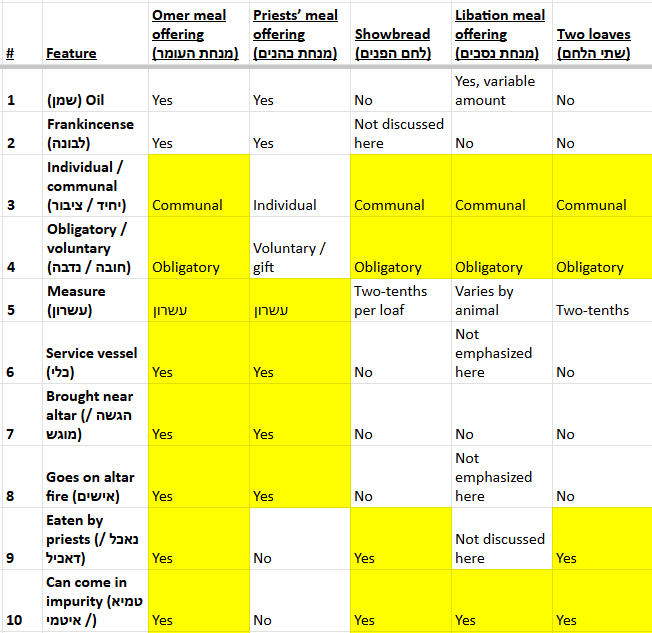
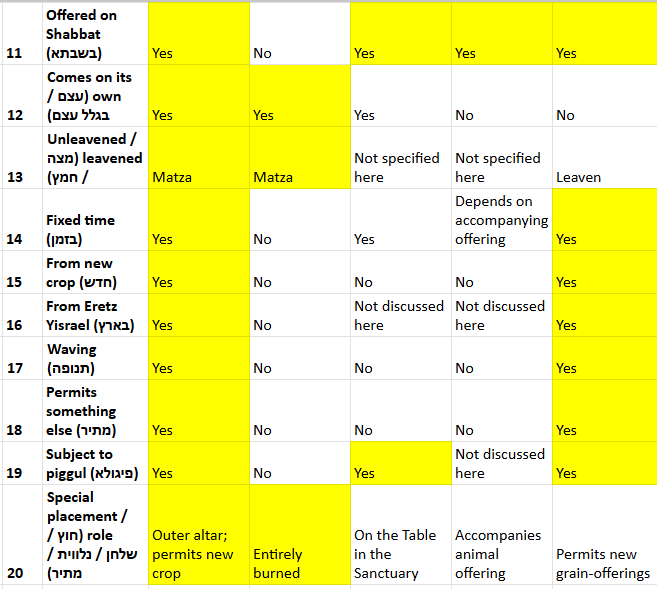
Appendix - Comparative table summarizing the features of each offering, according to the sugya
Yellow highlighting highlights the values in each row where the Talmud explicitly points out commonalities.8
This specific sugya was studied yesterday in the daf yomi schedule. See also my previous case studies of literary structure in halachic sugyot, especially in tannaitic texts. This is a topic I plan to return to.
Steinsaltz explains:
In total, there are therefore 6 points of similarity between the meal offering of priests and the omer meal offering, all of which are not shared by the shewbread. Consequently, the requirement of oil stated with regard to the omer meal offering should also apply to the meal offering of priests, not to the shewbread.
Steinsaltz explains:
Accordingly, there are also 6 points of similarity between the shewbread and the omer meal offering. Why, then, isn’t the verse interpreted as including the shewbread in the requirement of oil, and excluding the meal offering of priests?
See Hebrew Wikipedia, “איסור אכילת מנחת כהן”.
Based on the verse in Leviticus 6:16:
וכל מנחת כהן —
כליל תהיה
לא תאכל
And every grain offering of a priest (מנחת כהן) —
shall be a whole offering (כליל)
it shall not be eaten.
Steinsaltz explains:
There are therefore 4 points of similarity between the meal offering of priests and the omer meal offering that do not apply to the meal offering brought with libations.
Steinsaltz explains:
Accordingly, as there are also 4 points of similarity between the meal offering brought with libations and the omer meal offering, one can ask why the meal offering brought with libations is not included in the requirement of frankincense.
Compare also the table at Hebrew Wikipedia, “קורבן מנחה”, section “הכנת המנחה”.