


This digitization and translation project is a work-in-progress.1
In 1573–75 Azariah de’ Rossi (about 1511–1578), a Jewish physician and scholar of Mantua, printed Me’or Einayim (”The Light of the Eyes”). It began with an earthquake. In November 1570 Ferrara was shaken for weeks, and de’ Rossi, who had fled the city, spent the time in conversation with a Christian scholar about the Letter of Aristeas. The book that came out of this has three parts: Kol Elohim, an account of the earthquake; Hadrat Zekenim, the first Hebrew translation of the Letter of Aristeas; and Imrei Binah, sixty chapters of studies on Jewish history and rabbinic tradition.
Imrei Binah is the reason the book is still read. De’ Rossi compares the statements of the rabbis on history and nature with Philo, Josephus, the Church Fathers and the Latin and Italian historians of his own day, and he asks which is right. He reads the aggadah as a teacher’s art and not always as history. He argues that the Jewish count of years from Creation (=Anno Mundi) is late and uncertain. The book was banned for a time by rabbis in several Italian cities. It is a founding text of what much later became “Jewish studies”.
There is a complete English translation, by Joanna Weinberg (The Light of the Eyes, Yale, 2001), with annotations.2 It is in copyright, and it gives the English only. There is no open Hebrew text of the book. I wanted to know whether the tools that worked for Bochart’s Hierozoicon would work here: a corrected Hebrew text from the scan, and an English translation next to it, at a cost that makes the whole of Imrei Binah possible.
What is online now:3 https://ezrabrand.github.io/meor-einayim/
How it works
The Hebrew comes from the Vilna printing of 1863–66, on archive.org.
Three AI models read every page of the scan: Claude Opus, and two cheaper Gemini models. Where one of the cheaper models agrees with Opus, Opus stands. Where both cheaper models agree against Opus, their reading is taken. Where all three differ, I read the place on the scan.
Then code divides the text into segments of a clause or two, and Opus translates the chapter under fixed rules: keep the author’s references as he gives them, put supplied words in brackets, and mark every uncertain place with a note.
Screenshots
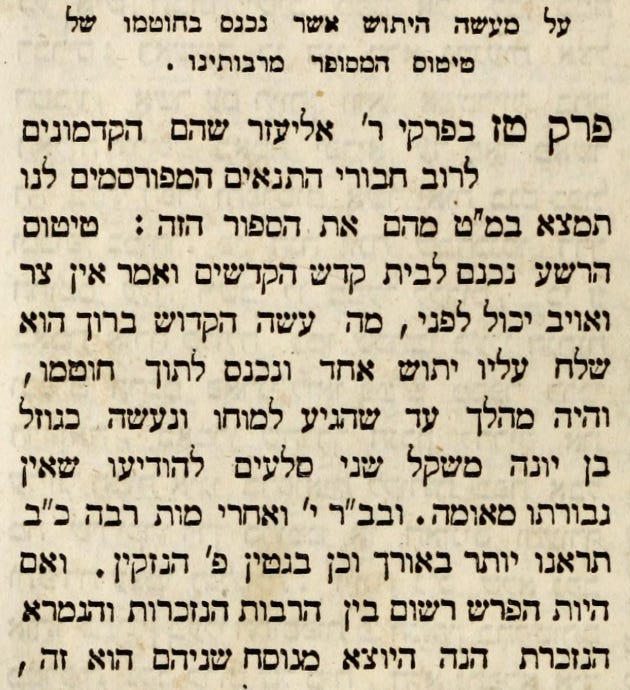
The original, https://archive.org/details/sefermeorenayim00ross/page/n226/mode/1up (beginning of chapter 16 [p. 203]):
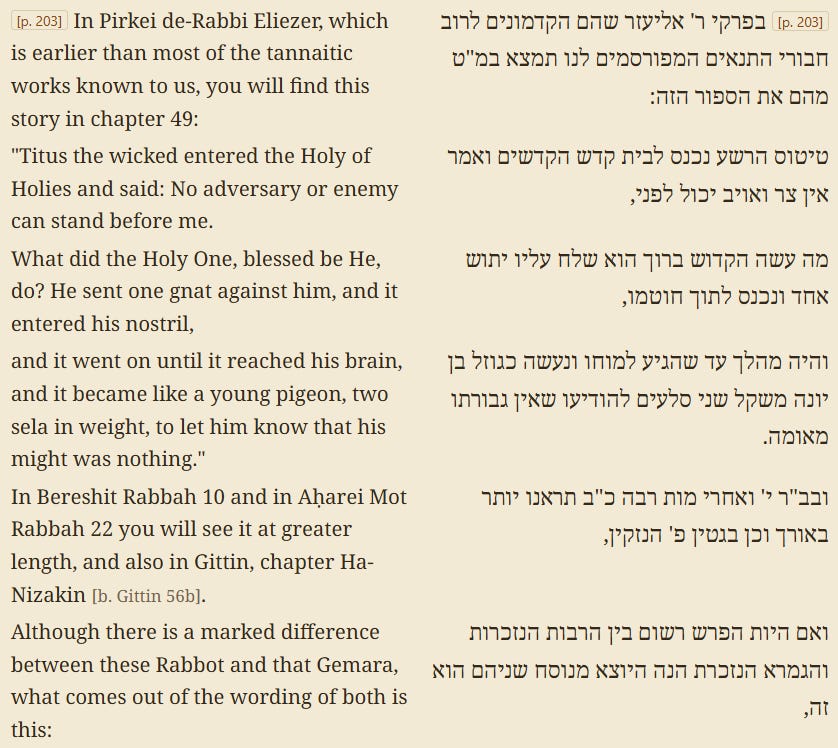
Digital version, with translation, https://ezrabrand.github.io/meor-einayim/imrei-binah-16.html :4
Some of the content of the work
The gnat of Titus (ch. 16). The rabbis tell that a gnat entered Titus’ nose and gnawed at his brain for seven years. De’ Rossi sets this beside the Roman historians, who report that Titus died of a fever, and beside the physicians, and he concludes that the story need not be read as history. A writer of his own time told the same death of Antiochus Epiphanes.
“The early generations had children at eight” (ch. 17). A saying in the Talmud, which de’ Rossi takes as a homily built on verses, not a fact about the past.
The era of contracts and the count from Creation (chs. 22–35). Here de’ Rossi shows that the reckoning of the Seleucid era is the same among Jews and non-Jews, that the count of years from Creation came into general use only after the Talmud was closed, and that the true number of years is probably larger than the one in use. These are the chapters that caused the scandal.
The Messiah and the year 1575 (ch. 43). Some of his contemporaries expected the redemption in [5]335, the year the book appeared. De’ Rossi argues that no year is to be expected more than any other.
Hebrew letters, vowel points and poetry (chs. 56–60). On the old Hebrew script and the coins, on the age of the vowel points and accents, and on Hebrew verse.
Appendix 1 - Prose is (relatively) easy; verse is an open question: Immanuel of Rome
I also recently ran a smaller pilot on a very different book: the Maḥberot of Immanuel of Rome (about 1261 to about 1335), 28 pieces of Hebrew rhymed prose with poems set into them, among them the first sonnets in Hebrew. There is no complete translation in any language. The Hebrew is the text of Dov Yarden’s edition (1957) from Project Ben-Yehuda, so here there was no OCR at all; the work is only translation. Two maḥberot are online, line by line next to the Hebrew (1,562 lines): https://ezrabrand.github.io/immanuel-mahberot/
This comes at a moment when several writers report that Claude now translates poetry very well. Amanda Luce (”Claude is Superhuman at Translating Poetry Now“, Letters From Bethlehem, 5-Nov-2026) compared Claude’s version of the opening of the Kalevala with the standard English verse translation and called the model “superhuman” at it. She stresses the major advantage is that a capable poet is now “working directly for you, on this particular thing”: a book that no human poet will ever spend years on.
Scott Alexander ( “Links for October 2026“, item 4) linked to Claude’s hexameter Odyssey and rhymed Romance of the Three Kingdoms, and noted that he cannot judge the Chinese.
The famous (pseudonymous) Gwern (Gwern, “Perished Paradise Graveyard“) keeps a long public log of attempts by successive models to put Paradise Lost into modern alliterative verse. Immanuel is exactly the kind of book Luce means.
My experience agrees with her on the first point and adds a caution on the second: The model writes rhymed English easily. For the first sonnet of the second maḥberet I asked for a version in the Hebrew rhyme scheme (abba abba cde cde), and then for a list of what the rhyme had added. In 14 lines it had added 7 phrases that are not in the Hebrew (”the hour late”, “choir”, “make all wonder tire”, ...). A bilingual commenter on the Kalevala post made the same objection there: the verse adds meanings. In a text like Immanuel’s, where almost every phrase is a biblical allusion, an added phrase is both a loss of accuracy as well as a (potentially) false/missed allusion.
So the pilot uses a plainer form: the rhymed prose as cadenced English prose, with rhyme only where it comes without added words; the poems line for line; every allusion in brackets after its phrase; and the English aligned with the Hebrew line by line, so that a reader who understands Hebrew can see each original line.
Appendix 2 - Technical
Source. Sefer Me’or Einayim, Vilna 1863–66 (series Kiryat Sefer), archive.org sefermeorenayim00ross, 534 scan images.
Imrei Binah begins at scan image 87. Printed page = image − 24 in the first part; the second part (from Yemei Olam, ch. 29, image 289) starts a new page count, page = image − 288. Odd pages carry Hebrew folio letters, even pages Arabic page numbers.
The archive.org IIIF server was too slow for some pages (30-second time-outs at the model providers), so the images are downloaded once from the /download/ page URLs and kept locally.
Model test (chapter 16, 7 pages, against a hand-corrected text, corrected again after the test). Word error of the main-text OCR:
Opus 5.5 - 0.8% (0.047/page)
Gemini 3.1 Pro - 1.0% (0.019)
Gemini 3.8 Flash - 1.5% (0.004)
Sonnet 5.5 - 2.4% (0.024)
GPT-5.6 Terra and Qwen did not follow the instruction to leave out the notes.
Translation: Opus 5.5 @low best; Sonnet and Gemini Pro accurate but with fewer identifications; Flash, DeepSeek and GPT invented names or changed numbers; Haiku broke the alignment.
OCR and vote. Each page is read by the three models (prompt: main text only, no running heads, notes or catchwords). The texts are aligned word by word with the Opus text.
Rules: one Gemini agrees with Opus → Opus; both agree against Opus → theirs; else a crop is checked on the scan. Insertions at a page start, or insertions that repeat the previous word, are dropped (catchwords).
On chapter 16 the vote reduced the Opus errors from 17 to 11, with one place left for the scan.
Errors that all three models share are not found.
Chapters. A chapter starts at the heading after its title (the small-type title, matched with up to ten words), because the models sometimes misread the chapter number or leave out the title.
Translation. Opus 5.5 @low, one call per chapter (the longest, ch. 35, has 487 segments), JSON out: one string per Hebrew segment and a list of notes. Code numbers the notes, checks the segment count, removes the note marks of the Rashi-type notes, and applies a list of reviewed corrections (data/en_fixes.json). Every note that says the English departs from the print is read before publishing.
Site. Static HTML from scripts/build_page.py, GitHub Pages: Hebrew on the right and English on the left (Hebrew first on a phone), scan thumbnails, inline page marks found by matching each page’s first words in the corrected text, links to every paragraph and segment, four colour themes.
Cost.
Test $2.70.
Chapters 17–39 (and the first pages of ch. 40), direct calls: OCR $9.46 for 128 pages, translation $5.10.
Chapters 1–15 and 40–60 through the Batch API (half price; images pushed for the run to a public GitHub repository).
Meaning, it has not yet been completed for this work (there were some technical delays, relating to the batch-send to Openrouter).
This is part of a larger ongoing exploratory project, see my recent pieces:
“Translating Lewysohn’s ‘Zoologie des Talmuds’ (1858) with AI“ (Nov 11, 2026)
“Reading Bochart’s ‘Hierozoicon’ with AI: The Animals of the Bible, in English for the First Time” (Nov 10, 2026)
“Reading Löw’s ‘Flora der Juden’ with AI: A Test“ (Nov 06, 2026)
“Reading ‘The Great Parchment’ (Yeriah Gedolah) With AI: A medieval Hebrew manuscript, an AI orchestrator, and a new digital edition“ (Sep 28, 2026)
Note other similar projects: Source Library, launched in March 2026. It uses AI to transcribe and translate medieval and early modern texts, particularly works on Hermeticism, alchemy, Kabbalah, mysticism, and occult philosophy. A smaller, similar project is Scriptorai, focused on AI transcription and translation of historical esoteric and astrological texts.
Unrelated, note that I revamped the blog’s design.
Also: note this previous series related to this week’s Torah portion, Vayetzei: Pt1, Pt2, Pt3. Talmud starts at: Chullin/91a#14; relevant Torah passage starts at: Genesis/28#10 (Jacob’s Journey to Haran; see the appendix to the series).
See the blurb there, for a good description of Me’or Enayim:
This book is an annotated translation of the pioneering Hebrew work of Azariah de’ Rossi, an outstanding figure in the history of Jewish scholarship. First printed in Mantua in 1573, the book established the foundations of critical Jewish historiography.
The book contains innovative studies on a wide range of subjects, including chronology, the origins of the Septuagint, the antiquity of the Hebrew language, and the nature of biblical poetry.
De’ Rossi lends unprecedented attention to the evidence of Josephus while his critique of Philo of Alexandria was the first attempt to assess the Jewish status of this Hellenistic philosopher.
The hallmark of his work is the presentation of arguments drawn from an impressive array of diverse sources ranging from the texts of rabbinic tradition to Augustine and to Pico della Mirandola.
His critical approach to rabbinic texts and his demonstration that the Jewish creation-era calendar was a late, post-Talmudic invention generated controversy that at one time led to a ban on the book.
Familiar with the works of contemporary Catholics and Protestants, de’ Rossi was also a mediator between Jewish and Christian scholarship, clarifying problems posed by Jewish tradition in relation to non-Jewish evidence, while signaling the importance of Jewish sources for the topics discussed by his non-Jewish neighbors.
The code, the Hebrew text and the English are free to use (MIT license): https://github.com/EzraBrand/meor-einayim
Imrei Binah, in Hebrew and English side by side, segment by segment. Each chapter has a row of thumbnails of its scan pages, and a mark in the text where each printed page begins, with a link to the scan.
Note in the screenshot: the original page numbers, that hyperlink to the original scans, and added citations in brackets.