

I have been revising the BDB and Jastrow dictionary readers on Bekiut, with much of the recent work concentrated in September and early October. Both readers use text supplied by Sefaria; I add opened-up abbreviations, easier navigation within long entries, and formatting changes intended to make definitions and references easier to follow.
Brown–Driver–Briggs covers biblical Hebrew, while Jastrow covers the language of the Targumim, the two Talmuds, and midrashic literature. Both dictionaries compress a substantial amount of information into their entries: A definition can include grammatical labels, references to manuscripts and ancient translations, citations of other scholars, and several levels of numbered or lettered subdivisions. My work concerns how that information is presented, especially opening up obscure abbreviations.
Keeping the abbreviation visible
I initially relied on inline expansion: replacing a recognized abbreviation with its full meaning. This is especially useful when the notation is very unfamiliar.
I have now added an alternative in which abbreviations remain visible. Hovering over or focusing on a recognized abbreviation shows its explanation; clicking or tapping keeps the explanation open.1 Readers who prefer the expanded text can select “Expand abbreviations inline.” I first introduced this arrangement in BDB, and then applied it to Jastrow.
The two modes serve different reading habits: Someone familiar with the dictionary can leave common forms alone and inspect an occasional unfamiliar reference. Someone using it less frequently can read the expanded version throughout (this is my personal preference). In Jastrow, the setting is retained when moving to another entry or reloading in the same browser tab.
I have continued adding mappings alongside this interface change. The public mapping tables2 list the expressions and their explanations.
Some replacements also modernize English: “thou art” becomes “you are,” and “proselyte” becomes “convert”.3 The explanation mode leaves the source expression visible.
Checking what an abbreviation means in context
Adding a mapping can introduce an error elsewhere if the same expression has another use. I have therefore been checking longer references and the text surrounding short forms.
Jastrow’s ch. provides an example. It can refer to Aramaic (“Chaldaic”), but in a clause like Sifra K’dosh. ch. III, Par. 2 it means “chapter.” I added a rule that recognizes the chapter meaning before an Arabic or Roman numeral. Elsewhere, the existing language explanation remains.
Longer expressions need to take precedence over their components. Matt. now maps to “Matot” (one of the weekly parashot) while Matt. K. retains “Matnot Kehunah” (a commentator on midrash). Similarly, Sm. maps to “Smith,” but Sm. Ant. identifies Smith’s “Dictionary of Antiquities”.
In an October review, I examined a sample of 191 distinct Jastrow entries returned by 132 source queries. I compared the forms used in those entries with the existing Jastrow mappings and with BDB’s mappings. That review produced 18 additions, including forms for “construct form,” “infinitive,” and “transposition.” It also identified cases where borrowing a BDB expansion would have been misleading.
Roman numerals present a related challenge. I extended Jastrow’s multi-letter numeral mappings through 49; for example: XXXII for 32. Single letters remain excluded from general conversion. A more specific rule handles I, before a numeric page reference, so I, 27a can become 1, 27a without changing an isolated I.
Navigating the entry
BDB’s longer entries can have several layers of subdivisions. I have worked on an outline that links to recognized verbal stems, numbered senses, lettered sections, and Greek submarkers. A floating outline remains accessible further down the page, and the main index can be collapsed.
I added a collapsible index to Jastrow as well. Its definition snippets now use opening italicized words rather than continuing into surrounding explanations and citations. The labels are extracted from source formatting; help locate a specific sense and provide an outline of the entry.
Paragraph spacing has required adjustment too. BDB offers optional additional splitting at semicolons. Jastrow offers additional breaks at dashes and certain citation boundaries. I reduced the excessive gaps in the latter display, then adjusted them again when the result became too compressed. The extra-splitting setting now persists alongside the abbreviation setting within the same tab.
I also corrected a problem with Jastrow’s index links: Clicking a section link could rerun the entry search and remove the section target from the address. The reader now distinguishes navigation within an entry from a new search. A direct link to a section waits for the entry to load before scrolling to it.
Recovering information that was being lost
Several fixes came from comparing what the reader displayed with what Sefaria supplied.
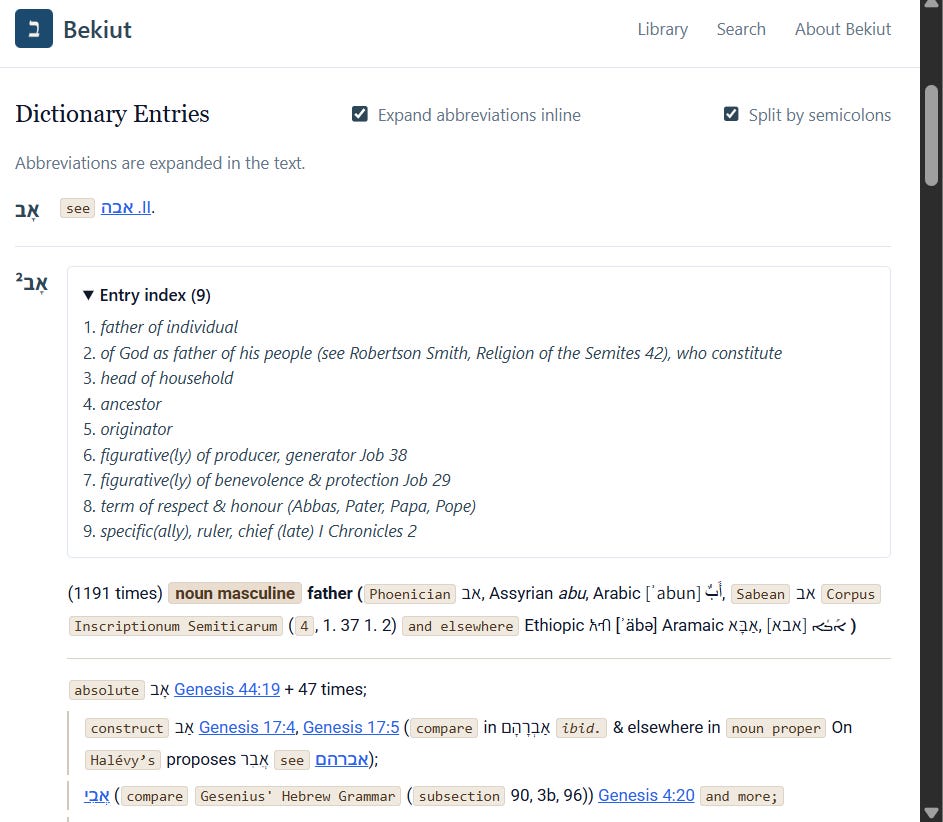
In BDB’s אָב², the occurrence count of 1,191 was missing. The source supplied it separately from the definition text, so formatting the definition alone could not recover it. I updated the reader to include occurrence metadata where available.
References to similarly spelled entries needed attention as well. Roman numerals and superscripts can distinguish different headwords or homographs. I improved the handling of those suffixes in both readers so that a reference can select the intended entry rather than simply return a group of similarly spelled results. Jastrow’s exact-entry addresses retain the stable entry identifier.
In BDB, I separated the displayed citation, its destination, and additional qualifiers. Expanding a biblical book name should preserve the words and numbers supplied alongside it. Where the displayed reference disagrees with the link metadata, retaining the source label leaves a discrepancy that still needs checking against the edition.
I also corrected the treatment of the Greek letter psi, ψ or Ψ. Standing alone in BDB, it can represent “Psalm(s)”; treating it as ordinary Greek produces an unwanted transliteration. The reader now recognizes the abbreviation while leaving the letter unchanged inside Greek words.
Some failures were less visible in the source. In Jastrow’s כָּבַשׁ, the period of &c. sits inside a separate italic tag. In כּוֹבֶד, fem is italicized while its period sits outside the tag. Both look like complete abbreviations to a reader, but the formatter was encountering separate pieces. I added normalization for these cases so the complete expression can be recognized without removing the surrounding emphasis.
Tests
I have added tests for the mappings and for cases where punctuation, formatting, or a longer reference affects the result, helping establish that an intended rule behaves consistently.
Screenshot, for example
Entry “Av (2)” :
Appendix - Technical
Implementation and sequence
The principal reader files are bdb.tsx and jastrow.tsx under artifacts/chavrutai/src/pages/. Shared formatting is in src/lib/dictionary-format.ts; Jastrow’s source normalization and index preparation are in src/lib/jastrow-presentation.ts. The two mapping dictionaries are JSON files under src/shared/data/lexicon-mappings/.
For Jastrow, I first normalize known malformed links and origin-note continuations. I then identify source headings, attach section identifiers, and apply optional paragraph breaks. Before abbreviation matching, I normalize known expressions split by emphasis markup. Abbreviation expansion, link conversion, and transliteration annotation follow. The index links point to identifiers retained in the rendered entry.
The abbreviation matcher isolates text from HTML tags so that replacements do not alter attributes or link destinations. It finds candidate matches using boundary checks, then resolves overlaps by position and length. At the same starting position, the longer match takes precedence. Context rules inspect following text before accepting particular expansions. The display mode determines whether a match becomes expanded text or an original expression with explanation metadata.
Challenges and resolutions
Overlapping references. Short forms can occur within longer citations. I test expressions such as
Matt. K.andSm. Ant.alongside their component mappings, including both display modes.Ambiguous numerals and language labels. General numeral conversion excludes single letters. Separate rules recognize forms such as
I, before a numeric page locator andch.before an Arabic or Roman numeral.Formatting inside abbreviations. HTML can separate an abbreviation from its period. Normalization joins recognized forms such as <i>fem</i>. before matching, while leaving ordinary italic prose and surrounding punctuation intact.
Missing information outside definitions. BDB occurrence counts may arrive as separate metadata. I include that metadata where available; I do not calculate new biblical occurrence counts.
Asynchronous section navigation. A section target may not exist when a direct URL first opens. The reader scrolls after the entry is rendered and avoids treating fragment-only navigation as a new search.
Verification and scope
I used selected source entries, the documented 191-entry Jastrow sample, and automated tests for mapping precedence, text boundaries, and formatting.
I was inspired in this by Efraim Meiri’s presentation of the CAL dictionary; he told me about his website at the recent workshop that I’ve written about.
In general, note my updated and revised Guide to online resources.
Of course, these involve a different kind of judgment from expanding a bibliographical abbreviation. I might eventually give abbreviation expansion and vocabulary modernization separate controls.