

I’ve added a new feature to Bekiut’s Talmud Bavli reader that moves much of the explanatory commentary in the English Talmud Bavli into expandable footnotes. While developing it, I also found that it provides (in my opinion) an interesting heuristic to identify Talmud Bavli passages that require unusually extensive explanation.
The William Davidson English edition of Talmud Bavli, based on Rabbi Adin Steinsaltz’s commentary, combines translation and explanation in a continuous text. This is often very helpful; a brief Talmudic statement about marriage, sacrifices, or the calendar may be almost impossible to understand without additional background.
But the format has a drawback; sometimes a short statement is followed by a long explanation, and the two are presented together. It’s easy to lose track of the original argument, especially when you’re trying to follow a sequence of questions and answers.
With the new Move Talmud Commentary to Footnotes feature, I’ve separated many of these explanatory passages from the main text. The notes are numbered and collapsed by default. Clicking a superscript opens the explanation and takes you to it, and a return link takes you back to where you were reading.1
The feature works with the edition’s existing text, after Bekiut’s usual processing, and simply changes how it’s displayed.
An example from Tractate Rosh Hashanah
In Rosh Hashanah 20b, section 12, the main text is just sixteen words:
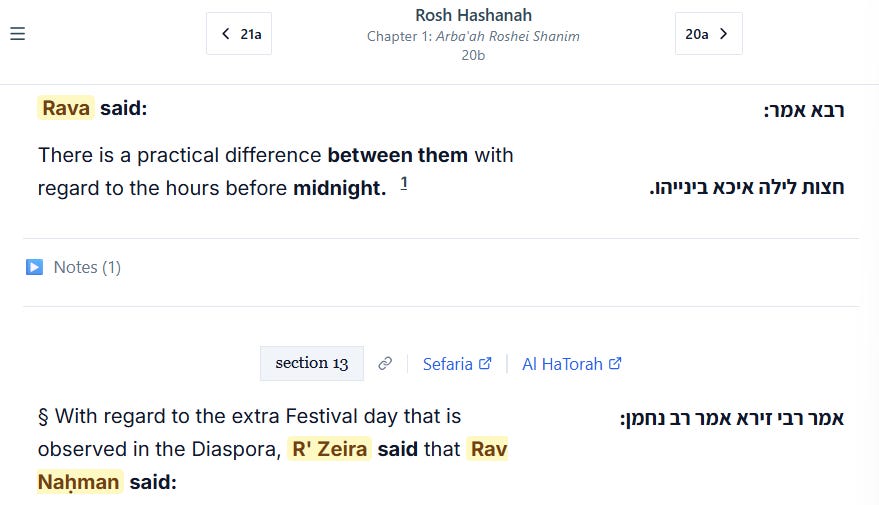
Rava said: [There is a practical difference] between them [with regard to the hours before] midnight.2
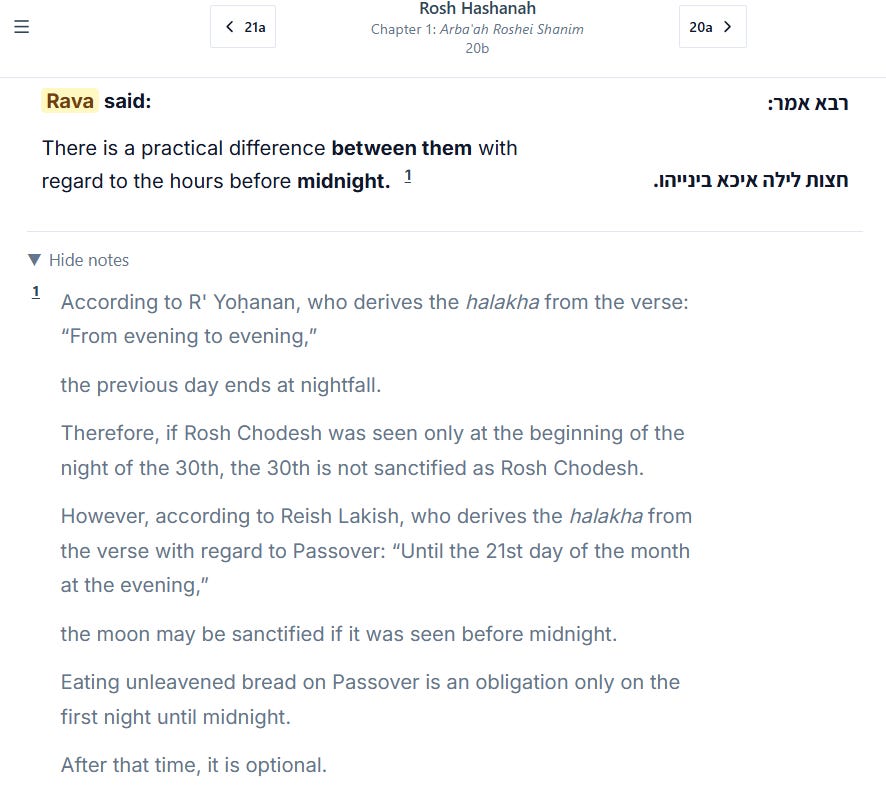
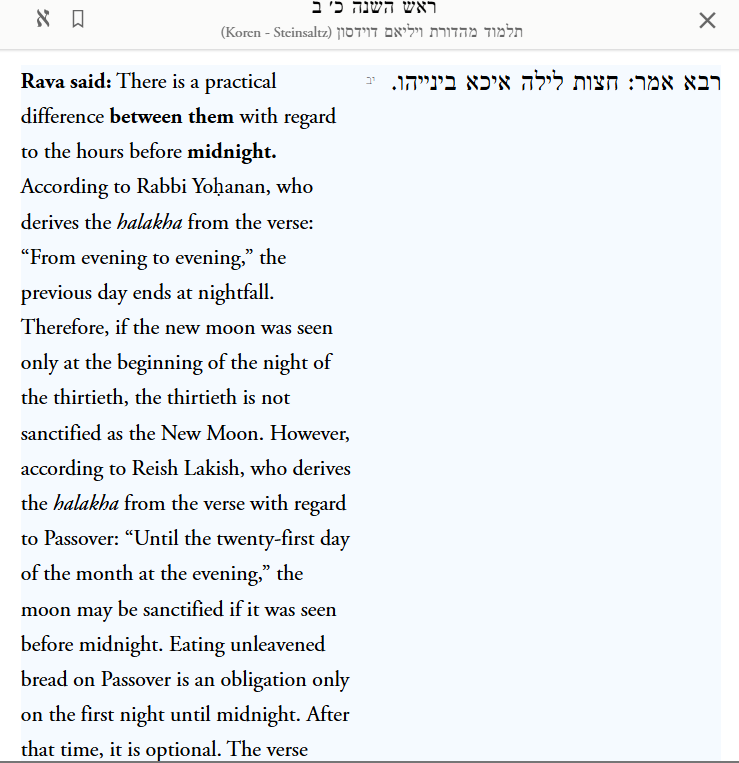
But the explanation that follows is 201 words long. It goes through the scriptural derivations of R’ Yoḥanan and Reish Lakish, the significance of nightfall and midnight, and the connection to eating matza on Passover.
All of this is relevant; someone unfamiliar with the discussion may need the explanation to understand why midnight matters. But keeping it inline also makes it harder to see that Rava’s actual statement is quite short.
With the new feature, the main text is sixteen words, and the other 201 words appear in a footnote. The original section was 217 words in total. Nothing has been removed; I’ve just made it easier to distinguish the statement from its explanation.
This should be particularly useful for review. If you’ve already learned the passage, you can follow the argument without having to read through the explanatory material again.
Screenshots:
Footnote collapsed (default):
Footnote opened:
Compare the presentation of the same section at Sefaria:3
Another example from Tractate Ketubot
A similar case appears in Ketubot 55b, section 1:
And [the halakha is also in accordance with his opinion] with regard to the teruma of the tithe from doubtfully tithed produce [demai].4
The ruling is 23 words long, while the accompanying explanation is 171 words. It explains what demai is, discusses a case where the separated portion becomes mixed back into the produce, and shows why asking the seller about tithes can make a legal and financial difference.
Again, the explanation is important; without it, many readers wouldn’t know what case the ruling is talking about. But it’s useful to be able to read the ruling itself, see how it fits with the surrounding discussion, and then open the explanation as needed.
Previously, the whole section appeared as 194 continuous words. Now the 23-word ruling remains in the main text, with the rest available in a note.
A second use for the feature: finding difficult passages
Once I’d developed the footnote extraction, I realized the notes might also be useful for a different kind of analysis: If a passage needs a particularly long explanation, that’s likely an indication that it’s unusually complex.
To explore this, I ran Bekiut’s new text-processing and footnote-extraction functions across Steinsaltz’s full ~80k sections of the Bavli. The result was ~30k notes. Their median length was 24 words; with 210 of them 100+ words long, and three of them 200+ words.
Long notes tend to occur where a brief statement assumes a lot of background knowledge or requires several steps of legal reasoning. For example, Yevamot 31b, section 6 has a 170-word note explaining dates on divorce and betrothal documents. To make sense of the statement, the commentary has to reconstruct a possible sequence of events and explain its consequences.
Of course, length isn’t a direct measure of difficulty. It also reflects editorial decisions, the assumed reader, and how the commentary is written. Some very difficult passages don’t have long notes. Still, I think it’s a useful heuristic for identifying more complex passages.5
Which tractates stand out?
I first compared tractates by the number of substantial notes per 1,000 sections (ie percentage), rather than simply counting notes (ie net). Otherwise, longer tractates would have an obvious advantage.6
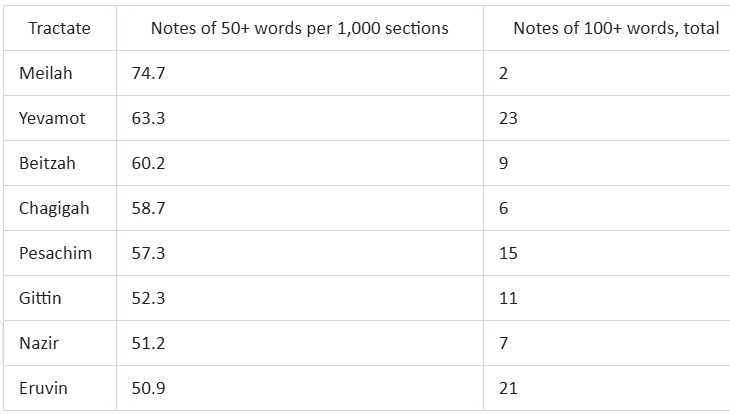
Yevamot stands out most consistently. It has a high concentration of substantial notes, a large number of exceptionally long notes, and several clusters where lengthy explanations occur close together. Eruvin also stands out at the long end, with 21 notes of at least 100 words, compared with Yevamot’s 23.
Beitzah ranks quite high despite being relatively short. Pesachim, Gittin, and Nazir also have substantial concentrations of explanatory material.
Meilah and Chagigah are at the top of the table, but their smaller datasets, 509 and 732 sections respectively, make the figures more sensitive to a few individual passages. For comparison, Berakhot has 17.5 notes of at least 50 words per 1,000 sections, versus 63.3 in Yevamot. (Of course, that doesn’t mean that Yevamot is literally 3.6 times harder; it simply means that in the Steinsaltz edition, its explanations cross that threshold much more often.)
Some particularly complex stretches
I also looked for places where several long notes appeared close together. These are some of the strongest clusters I found. These clusters are based on notes of at least 50 words in the linked stretches. They’re not section-by-section measurements of complete chapters or sugyot; chapter assignments follow folio-level boundaries.
Yevamot, chapter 3: Arba’ah Achin
In Yevamot 28b–29b, there are twelve notes of at least 50 words, totaling 920 words. The discussion involves sisters, surviving brothers, levirate marriage, co-wives, betrothal, and ḥalitza. A change in one relationship can affect several other legal statuses.
Another cluster, 33a–34a, has seven substantial notes totaling 640 words. Here the issue is overlapping prohibitions and liability for multiple sin-offerings. It’s not enough to know which prohibitions apply; you also have to track when each one takes effect.7
Eruvin, chapter 4: Mi She’hotziuhu
Eruvin 49a–50a has twelve substantial notes totaling 844 words. It deals with eruv arrangements and questions of simultaneous or retroactive designation, alongside comparisons to tithes and animal tithes. Much of the difficulty comes from determining when a particular designation becomes legally effective.
Bava Kamma, chapter 1: Arba’ah Avot
Bava Kamma 7b–8b has eleven substantial notes totaling 927 words. These sections move between damages, loans, ketubah obligations, different grades of land, and the rights of creditors after property has changed hands. There are multiple parties and transactions to keep track of.
Beitzah, chapter 5: Mashilin
Beitzah 36b–37b has eleven substantial notes totaling 866 words. The discussion covers restrictions on Shabbat and festivals, preventing financial loss, eruv boundaries, and retroactive designation.
What makes the discussion complicated is that actions that look similar may be treated differently depending on ownership, intention, timing, or the particular prohibition involved.
Sanhedrin: Eilu Hen HaNechnakin
Sanhedrin 87a–88a has eleven substantial notes totaling 857 words. The discussion of the rebellious elder draws examples from purity law, court composition, consecration, sotah, and other areas.
Here, part of the difficulty is simply the range of background knowledge the discussion assumes.
Appendix - List of the twenty longest notes
Compare Bekiut’s Talmud Yerushalmi, where there are native footnotes, based on Sefaria’s Guggenheimer edition.
Original Hebrew text:
רבא אמר: חצות לילה איכא בינייהו.
Settings: side-by-side, no nikud.
Original Hebrew:
ובתרומת מעשר של דמאי.
Note that the longest note overall, Yevamot 2a, section 1, is introductory material rather than a normal explanation within an ongoing discussion. I’ve kept it in the appendix, but don’t treat it as a representative example.
For this comparison, I excluded the introductory note on Yevamot 2a, see previous note, though I kept the full section counts as denominators.
This was found independently, but this chapter is indeed known in yeshivot as one of the hardest in Shas, I distinctly remember studying it in 9th grade, and how difficult it was!