


I added a reader for Eliezer Ben-Yehuda’s dictionary to Bekiut, alongside the existing BDB and Jastrow readers. It supports Hebrew search with or without vowel points, alphabetical browsing, and links between entries. The definitions remain in Hebrew. I have kept the dictionary’s wording, source references, and notes, while changing how the text is presented on the screen.
Ben-Yehuda’s dictionary covers Hebrew across biblical, rabbinic, medieval, and modern usage. Its entries often combine definitions with quotations, grammatical discussion, comparisons with other languages, and references to earlier scholarship. That makes it a useful complement to BDB, which focuses on biblical Hebrew, and Jastrow, which covers rabbinic Hebrew and Aramaic. The three dictionaries serve overlapping purposes, but they give readers different kinds of information about a word.
The digital text comes from Sefaria,1 which credits Project Ben-Yehuda’s volunteer digitization.
Finding a word
The reader accepts both pointed and unpointed Hebrew. Typing שלום offers suggestions from the headword index. A search can return several distinct forms: in the sample I checked, שלום returned שָׁלוֹם, שִׁלּוּם, and שָׁלוּם. Readers can therefore begin with the consonants they know and use the displayed vocalization to distinguish the results.
Some entries also have Roman numerals attached to their headwords. These distinguish separate entries and must survive searching, browsing, and linking. אָב I and אָב II are separate destinations. A link to one should open that entry rather than silently substituting the other. When Sefaria supplies a stable entry identifier, the reader preserves it in the URL.
For browsing, I retrieved a snapshot containing 21,999 unique headwords across the 22 Hebrew letters. The cache comes from Sefaria’s dictionary-specific autocomplete service. The browsing page identifies the list as a snapshot.
Reading a long definition
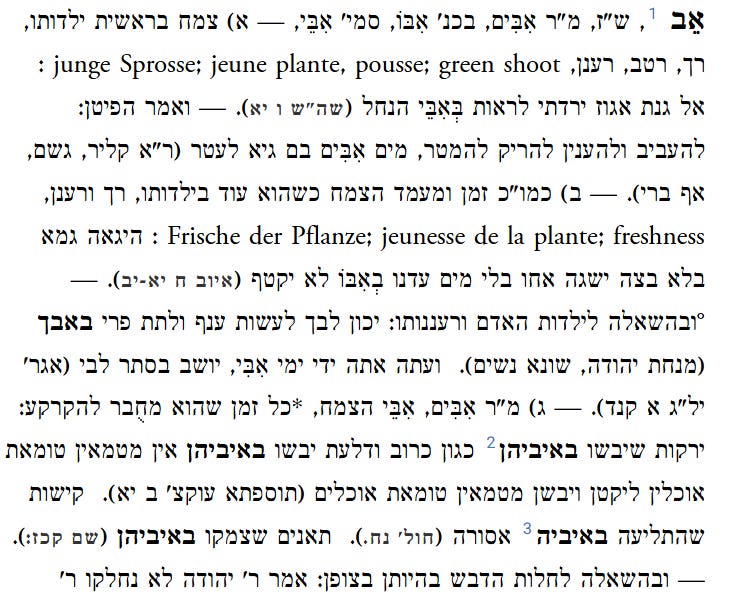
Long definitions can still be difficult to read when a source paragraph contains several successive discussions. I added a display option that starts a new paragraph at an em-dash. It is enabled by default, and can be switched off to return to the source paragraph divisions (the dash itself remains visible).
The splitting happens within the displayed definition without discarding bold text, links, or notes. Footnote bodies are excluded from this extra splitting. Copying selected text preserves paragraph breaks, including the additional breaks when the option is enabled.
Screenshots, of entry “אֵב”, comparing Bekiut vs Sefaria:
At Sefaria, https://www.sefaria.org.il/Ben_Yehuda_Dictionary%2C_%D7%90%D6%B5%D7%91 :
At Bekiut, https://bekiut.com/ben-yehuda?q=%D7%90%D6%B5%D7%91 :
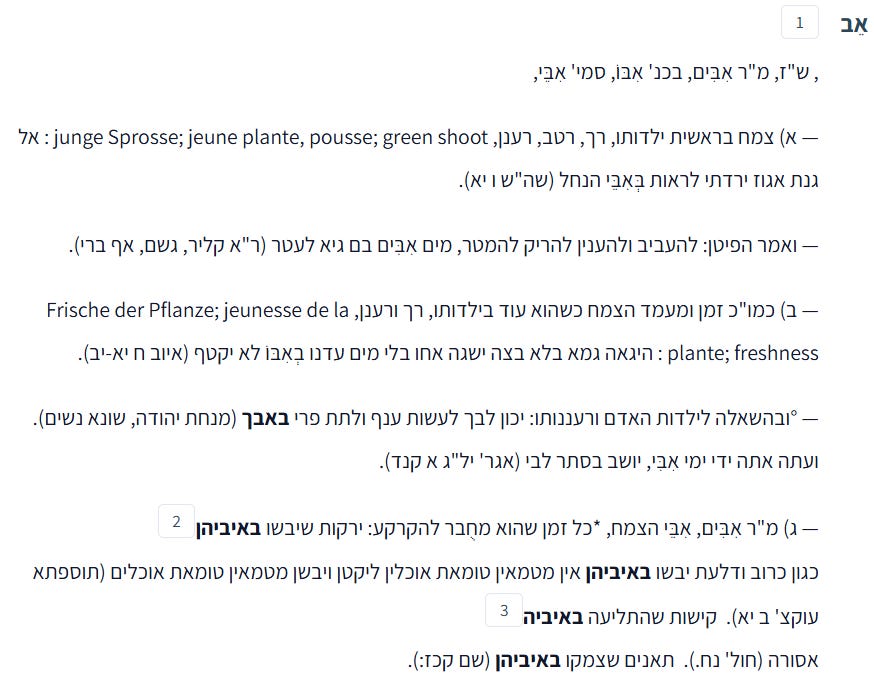
Notes can be opened individually or displayed inline through a separate setting. There is also an option for larger Hebrew text. These choices are saved for this dictionary independently of BDB and Jastrow. The settings panel starts open for new users so that the available choices are visible.
I have kept the reader within Bekiut’s existing layout and Hebrew typography. On a desktop, the entry area has a fixed maximum width, following the Talmud reader’s width limit. The Hebrew letter grids run from right to left. Previous-entry navigation appears on the right and next-entry navigation on the left, with Hebrew labels.
Appendix - Technical
Sources and index reproduction
The index-building script is scripts/snapshot-ben-yehuda.py, written in Python using the standard library. It requests each Hebrew letter through Sefaria’s scoped completion endpoint with an explicit positive limit of 100,000:
/api/words/completion/<letter>/Ben%20Yehuda%20Dictionary?limit=100000
The script validates the response shape, deduplicates exact headword strings, and checks the expected total of 21,999. It records per-letter counts, source URLs, retrieval time, and a content hash. When an index already exists, additions or removals cause the script to stop for investigation.
The sort key removes Hebrew pointing and folds final-letter forms to their ordinary counterparts. The untouched source spelling supplies a deterministic secondary key. Both the browser and crawler listings preserve this committed order.
Entry retrieval and rendering
Entries come from /api/words/<headword>, filtered to records whose parent lexicon is Ben Yehuda Dictionary. Their definitions are arrays of paragraphs rather than Jastrow-style senses. The adapter retains actual identifiers and neighboring headwords. Requests have deadlines, and a bounded in-memory cache avoids repeatedly retrieving successful results.
Optional em-dash splitting operates on text nodes in sanitized content. Ancestor formatting is cloned across each split, and footnote disclosures are kept whole. Turning the option off rebuilds the display from the original source paragraphs.