

This piece is based on work I’m doing in preparation for a presentation I’ll be giving on October 6, 2026, at Hemdat Academic College in Sdot Negev, as part of the workshop “Artificial Intelligence in the Service of Talmudic and Rabbinic Literature Research: Challenges and Opportunities.” 1
“Everything an AI ever has or will do is presumably going to be within reach of a sufficiently dedicated human analyst or a large enough team of them.”
I think this comment is an insightful way of thinking about the current state of AI. Current AI can’t do something that no human could possibly do (at present, in all cases, a sufficiently skilled and sufficiently large team of humans could do the same thing); the difference is cost, time, and scale. A research task that might previously have taken weeks, or required a programmer, a designer, and a research assistant, can increasingly be carried out by one researcher working with AI.
Over the last year, this has substantially changed how I use AI in my own work on rabbinic texts. In previous presentations of mine on AI and digital humanities, I discussed many of the major uses of large language models relevant to rabbinic research: translation, summarization, outlining, drafting, classification, and so on. Those uses remain valuable; but (in my opinion), the center of gravity has shifted from AI as a chatbot to AI as an agent.
From answers to work
The underlying models are substantially better. OpenAI’s current GPT-6 Astra, for example, is explicitly designed around computer use, browsing, software engineering, and other forms of extended work. Anthropic has made a similar progression with its Claude models (currently Claude Fable 5.1).
An even bigger practical change for me has been the emergence of agentic coding tools such as Claude Code and OpenAI’s Codex. Until the end of last year, I would ask a chatbot to write a Python script, copying the script into an editor, running it, discovering that it fails, copying the error back into the chatbot, and repeating the process. Now, I can give a local agent a task, and let it work through the cycle itself: It can inspect files, write code, run it, see what went wrong, modify the code, and rerun it.
For digital humanities, this is extremely powerful. For illustration, a task might be:2 take a corpus of the Talmud, identify references to biblical figures using a gazetteer, deal with ambiguous names and overlapping expressions, output a concordance, inspect the results for obvious errors, revise the matching logic, produce an HTML page or PDF presenting the results, and publish this publicly as a user-friendly Github Page.
All of these steps were far less accessible in the past.
Bekiut.com as an example
My largest current project is Bekiut.com, an open-source web interface for studying the Talmud and other major works.3 I began building it in August 2025; the public repository is now a substantial TypeScript application, alongside a separate repository containing corpora, gazetteers, concordances, and NLP scripts that I have developed for Talmudic research.
A year ago, building something like this would have seemed to me primarily like a software-development project; today, I think of the programming much more as an extension of the research itself: I can describe a feature in ordinary language, have an agent inspect the existing codebase, implement it, run the application, and iterate on the result.
The same applies to corpus work. I have used AI-assisted coding for name extraction, word counts, tagging, regular expressions, concordances, text alignment, and other forms of historically time-consuming text processing.
This extends even to presentation: An agent can write a research script and then build a webpage for publishing the results, or it can generate a long report, convert it into a designed PDF, inspect images of the rendered pages, notice layout problems, and revise them.
Better access to the “outside” (Internet) world
Another major improvement is access to external information. Older chatbots were notoriously unreliable at citations; they could give impressive-looking bibliographies containing books or articles that did not exist. AI search is now much more reliable. Current state-of-the-art systems can search the web, open sources, follow links, and synthesize information while retaining the connection between a claim and its source.
The same capability is useful for programming. An agent can figure out how an unfamiliar API works, inspect documentation, download a Python library, query a public dataset, or discover how a corpus is exposed through something like a Google Cloud bucket.4 I often still have to point it toward the right resource (thus, domain knowledge remains valuable); but once pointed in the right direction, it can typically work out the technical details itself.
Vibe coding
This change is also visible in the rise of what is now called “vibe coding”: building software primarily through natural-language instructions. Tools such as Replit, Lovable, and Wix’s Base44 have made this available to people who are not professional programmers.5
“Vibe coding” is sometimes used dismissively (and obviously it can produce bad software), but for researchers, the minimum level of technical expertise required to build a custom research tool has fallen dramatically. Previously, a humanities researcher might have had an idea for a specialized interface or corpus-analysis tool but no realistic way to build it without finding a technical collaborator; now the researcher can often simply start building.
The chatbot form-factor is now overrated
The chatbot remains the dominant public image of AI, presumably because chatting is technically and conceptually easy: You type a question; it types an answer. But I personally now believe that chatbots are one of the less interesting applications of AI, especially in niche scholarly domains. Early in the generative-AI boom (i.e. starting c. late 2022), there was considerable excitement about ideas such as an AI “rabbi,” an AI posek, or an AI chavruta.6
I have become considerably more skeptical of this framing. A general-purpose model producing expert answers is being asked to substitute for niche domain expertise, but gaps in the training data, as well as in the generalized “persona”, make this problematic. By contrast, using AI to help a search, organize, process, and inspect a corpus plays much more directly to its strengths.
Sefaria’s new Library Assistant is a good example. Sefaria describes it primarily as a tool for discovering and exploring its library: locating relevant sources, finding related texts, and producing ad-hoc translations; its answers are designed to be grounded in and linked back to the texts in the Sefaria corpus. I think this is a smart direction.
Dicta illustrates both approaches. Its “Rav Dicta” explicitly presents itself as a “virtual rabbi” designed to answer halakhic questions. Its newer Iluy product is framed more broadly as a tool for Torah study and source discovery, and Dicta explicitly states that Iluy is not a substitute for a rabbi or a halakhic ruling; this latter form strikes me as considerably more promising.
What has really changed
So if I had to summarize what changed over the last year, the important change is that AI systems can increasingly do sustained work: They can search, code, manipulate large corpora, use external tools, debug their own scripts, inspect their output, build interfaces, turn an experiment into a webpage or a PDF, and iterate through all these stages with much less human micromanagement than was possible even a year ago.
Special thanks to Prof. Menachem Katz for organizing the workshop and inviting me to present; and thanks to the Israel Science Foundation (ISF) for sponsoring.
For good general popular discussions of shifts that I discuss in this piece, I highly recommend Ethan Mollick’s excellent Substack blog, “One Useful Thing“.
All these I’ve done.
As an aside, note a number of recent updates to Bekiut, at the Changelog page, section “September 2026“ (I plan to post more in the future about some of these changes):
BDB: Abbreviation Expansions
Mishneh Torah: Paragraph Breaks (September 17)
English paragraphs and list items now retain the translation’s original line breaks, including in Hilchot Repentance, without extra blank lines.
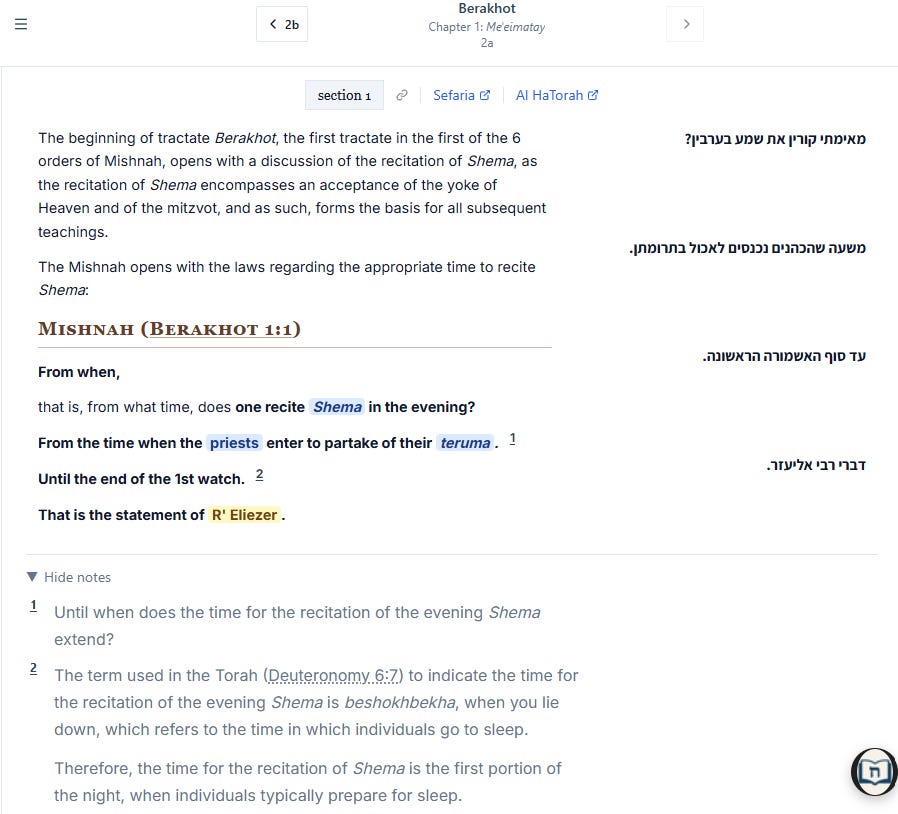
Talmud: Commentary in Section Notes (September 11)
Complete standalone English commentary blocks now appear in collapsible notes below their section, including questions and linked clauses that finish with a full stop, question mark, or exclamation mark. Incomplete blocks and continuations of translation stay inline. Consecutive eligible commentary paragraphs stay together in one note.
Each commentary block must contain at least 13 words in total; shorter paragraphs can join adjacent commentary in the same note. Section-opening paragraphs, blocks below the minimum, bold translation, and paragraphs mixing translation with commentary remain in the main text. Notes preserve paragraph breaks, formatting, and links.
Prominent superscript references open the relevant note and scroll only as far as needed to bring it into view. Click the number in a note to return to its reference in the main text.
Try it in Berakhot 2a, section 1.
For example of the new “Talmud: Commentary in Section Notes” feature, see screenshot, https://bekiut.com/talmud/Berakhot/2a#1:
Compare vs Sefaria, https://www.sefaria.org.il/Berakhot.2a.1 (set side-by-side, nikud off):
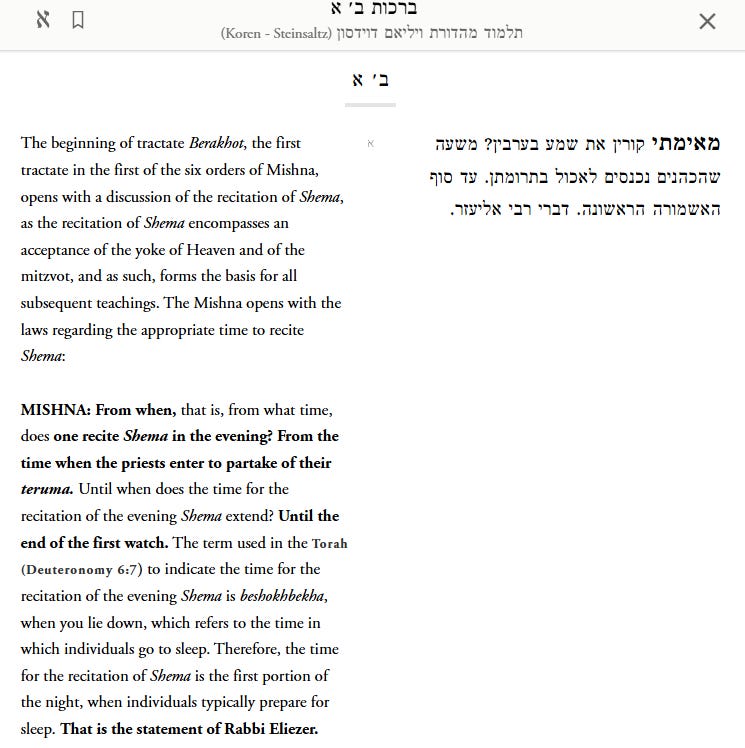
Compare my work with Sefaria’s GCP bucket.
Bekiut itself is built as a Replit project on the backend.
Indeed, my own project was originally called “ChavrutAI”, for that reason.