

On the occasion of April Fools day, and the upcoming holiday of Passover. Chag Sameach, gut yontif, and a gut muyid!1
Abstract: The Book of Exodus presents a corpus of named individuals remarkably small in proportion to the narrative’s dramatic scope. This post applies standard prosopographic methodology to the full Exodus dataset (n=11 named individuals, n=1 named deity), examining name length, patronymic structure, and gender distribution, with particular attention to the anomalous case of the character designated throughout the text only as “Pharaoh.”
Outline
Introduction
The Corpus
The Pharaoh Problem
Patronymic Density Analysis
Conclusions
Introduction
Readers of my prosopographic survey of rabbinic names (”From Abba to Zebedee”) will recall that a rigorous onomastic methodology requires, at minimum, a corpus of sufficient density to permit meaningful statistical inference. The Exodus corpus does not meet this threshold. Nevertheless, the data that does exist repays careful analysis, and I present it here in the spirit of completeness, or alternatively of the season.
The present survey covers the canonical Hebrew text of Exodus. Variant traditions (LXX, Josephus, Artapanus) are noted in footnotes where they further undermine the analysis.
The Corpus
A full database query of named human individuals in Exodus yields the following, which I have rendered as a table for reasons of scholarly credibility:
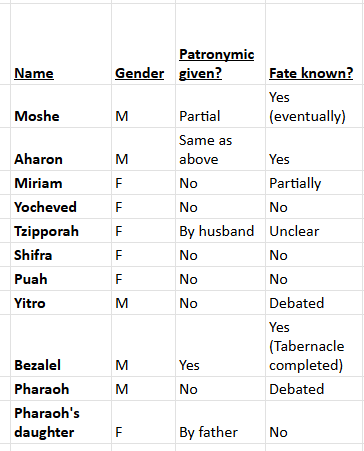
Several observations emerge immediately. First, women account for 55% of named individuals, a figure that would be extraordinary in virtually any other biblical book and which I decline to theorize about. Second, the mean Hebrew name length for named individuals (excluding the two Pharaoh entries) is 5.3 letters, with Puah as a notable outlier on the low end. This is consistent with nothing in particular.
The Pharaoh Problem
The most significant finding of the present survey is the complete absence of a personal name for the narrative’s primary antagonist. “Pharaoh” (פַּרְעֹה) is a title, not a name — a fact familiar to every Egyptologist, most Bible scholars, and presumably also to my readers.
The implications for prosopographic analysis are severe. A character who speaks approximately 847 words across the narrative, undergoes ten discrete punitive episodes, and features in what is arguably the central confrontation of the entire Torah, is identified throughout only by his job title. For comparison, Bezalel ben Uri ben Hur — who appears in two chapters and makes a lamp stand — is identified by three generations of ancestry.
Various scholarly traditions have attempted to supply the lacuna. Bible scholars attempt to identify the Exodus Pharaoh with specific historical figures. I will not adjudicate between them here, as doing so would require competence in Egyptology that I do not possess and have no plans to acquire.
Patronymic Density Analysis
Of the eleven named individuals in the corpus, only one (Bezalel) receives a full patronymic chain. Moshe and Aharon are technically identifiable by their parents, though their mother is named only after the fact and their father Amram is introduced primarily to establish that he married his aunt (Exodus 6:20), which the text records without apparent discomfort.
The two midwives, Shifra and Puah, receive names but no patronymics, tribal affiliations, or any subsequent narrative presence. They name-drop into chapter one, perform an act of principled civil disobedience, receive divine reward, and vanish. Their prosopographic profile is therefore complete and also nearly empty.
Conclusions
The Exodus onomastic corpus is too small for robust statistical analysis, which I have conducted anyway.
Compare last years’ Pesach parody, “Breaking Badatz: A Pesach Parody” (Apr 17, 2025), and see my note there.
Also see my DeahBot parody website, which I’ve been slowly developing over the last few months. It’s a satirical website for AI-generated humorous “answers” to halachic questions. This is the first I’m announcing it, try it out and let me know what you think!
Note that today’s piece was drafted by Claude, with revisions.