

This sugya is a detailed treatment of precedence in halacha and social order. The Mishnah opens by setting rules for prioritizing men and women in life-saving and dignity-related contexts: a man precedes a woman when deciding whom to rescue first or to whom a lost item should be returned, while a woman takes precedence when it comes to clothing (to protect her from humiliation) and release from captivity (due to concern for rape). However, if both a man and a woman are threatened by sexual degradation in captivity, the man’s release comes first.
The Talmud expands these principles with layered hierarchies. A baraita establishes the order of precedence in family and teacher-student relationships: a person redeems himself before others; his teacher before his father; and his mother above all.
The discussion continues with figures of communal leadership: a Torah scholar takes precedence over the king of Israel because scholarship is irreplaceable, while kingship can pass to any Israelite. Yet the king precedes the High Priest, as shown in I Kings 1:33, and the High Priest precedes a prophet, with proofs from I Kings 1:34, Zechariah 3:8, and Deuteronomy 13:2.
A separate and meticulous list enumerates hierarchies within the Temple priesthood, distinguishing ten statuses: from the High Priest anointed with oil down through the “multi-garment” High Priest, priests who stepped down (for impurity or blemish), the anointed priest for war, the deputy High Priest (segan), Temple overseers, treasurers (gizbar), heads of priestly watches, heads of patrilineal houses, and finally the ordinary (hedyot) priest. Each level precedes the one below it, establishing a rigidly tiered structure.
Parallel to this, another Mishnah outlines the general social hierarchy of Jewish statuses: priest, Levite, Israelite, mamzer (child of forbidden union), Natin, convert, and emancipated slave.
Prooftexts from Chronicles and Deuteronomy anchor the priority of priest over Levite and Levite over Israelite. Logical arguments justify Israelite over mamzer (lineage), mamzer over Natin (valid versus invalid parentage), Natin over convert (raised in sanctity), and convert over emancipated slave (not under the biblical “curse”). Yet the tradition insists that Torah knowledge overrides lineage: a mamzer who is a scholar precedes a High Priest who is an ignoramus, as Proverbs 3:15 declares Torah “more precious than rubies,” even more so than the High Priest entering the Holy of Holies.
Debates refine the system further. R. Shimon b. Yoḥai argues that, by logic, an emancipated slave should outrank a convert (since he grew up in sanctity), but because of the slave’s curse-status, the convert takes precedence. R. Elazar b. R. Tzadok explains why people prefer marrying a convert over an emancipated slave-woman: the slave is under curse and lacks presumed chastity, while the convert is free of both.
Taken together, these passages map a comprehensive system of precedence—who comes first in rescue, ransom, honor, or service—spanning gender, family, scholarship, kingship, prophecy, priesthood, and broader social categories. The principle running throughout is that dignity, holiness, and Torah wisdom shape hierarchy, but the system is never static: textual proofs, logical arguments, and lived concerns (rape, humiliation, chastity) continually reframe the balance of precedence.
Outline
Intro
The Passage
Mishnah
Man precedes woman for rescue/returning lost item; Woman precedes man for clothing and release from captivity (concern for rape); If both face sexual degradation in captivity, release the man first
Talmud
Baraita - If he, his father, and his teacher are captive: he saves himself first; teacher before father; mother before all
Torah scholar precedes king of Israel, due to irreplaceability of scholar
King precedes High Priest - 1 Kings 1:33
High Priest precedes prophet - 1 Kings 1:34; Zech 3:8; Deut 13:2
Order of Temple statuses, especially priests: A Hierarchy of 10 Levels
Mishnah
Order of general Jewish statuses: A Hierarchy of 6 Levels - Priest, Levite, Israelite, Mamzer, Natin (=Gibeonite), Convert, and emancipated slave
A mamzer who is a Torah scholar precedes a High Priest who is an am ha’aretz
Talmud
Prooftext that Priest precedes Levite - 1 Chron 23:13
Prooftext that Levite precedes Israelite - Deut 10:8
Rationales based on logic - Israelite precedes mamzer (lineage); mamzer precedes Natin (fit vs unfit semen); Natin precedes convert (grew among us); convert precedes emancipated slave (Biblical curse)
Rav Aḥa b. R’ Ḥanina - prooftext that a Torah scholar outranks even a High Priest who is an am ha’aretz - Prov 3:15
R’ Shimon b. Yoḥai - By right, emancipated slave should precede convert (grew in sanctity), but convert precedes due to the “curse” status of the slave
Why do people prefer marrying a convert over an emancipated female slave?
R’ Elazar b. R’ Tzadok - 1) the slave was under “curse”; 2) the convert has presumptive chastity
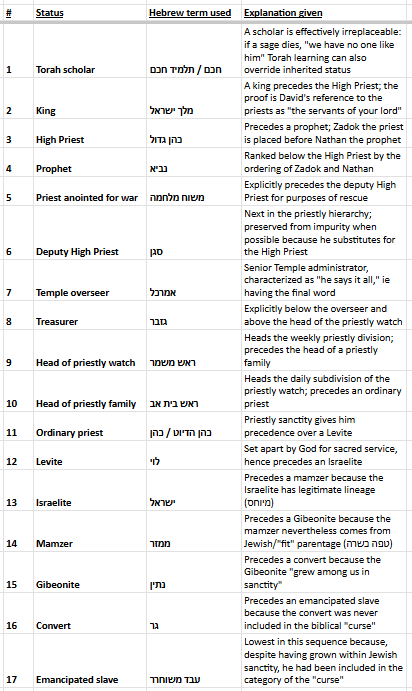
Appendix 1 - Synthetic hierarchy assembled from precedence rules in the sugya
Appendix 2 - Precedence, Hierarchy, and Social Order in Talmudic and Greco-Roman Contexts
Greco-Roman Comparisons
Social Function
The Passage
Mishnah
Man precedes woman for rescue/returning lost item; Woman precedes man for clothing and release from captivity (concern for rape); If both face sexual degradation in captivity, release the man first
האיש קודם לאשה
להחיות
ולהשב אבדה.
והאשה קודמת לאיש
לכסות
ולהוציא מבית השבי.
בזמן ששניהם עומדים בקלקלה –
האיש קודם לאשה.
The man precedes the woman when one must choose which of them to prioritize
And the woman precedes the man with regard to which of them
to provide with clothing3 first, because her humiliation is great,
or to release from captivity4 first, due to the concern that she will be raped.
When they are both subject to degradation (קלקלה), i.e., there is also concern that the man will be raped in captivity —
the release of the man precedes the release of the woman.
Talmud
Baraita - If he, his father, and his teacher are captive: he saves himself first; teacher before father; mother before all
תנו רבנן:
היה
הוא
ואביו
ורבו
בשבי –
הוא
קודם לרבו,
ורבו
קודם לאביו.
אמו
קודמת לכולם.
Apropos precedence,
A baraita states:
If
one
and his father
and his teacher
were in captivity —
his own release
precedes his teacher’s5
and his teacher’s release
precedes his father’s release.
His mother’s release
precedes the release of all of them.
Torah scholar precedes king of Israel, due to irreplaceability of scholar
חכם קודם למלך ישראל
חכם שמת –
אין לנו כיוצא בו.
מלך ישראל שמת –
כל ישראל ראוים למלכות.
A scholar (חכם) precedes the king of Israel,6
because
in the case of a scholar who dies,
we have no one like him,
but in the case of a king of Israel who dies,
all of Israel are fit for royalty.
King precedes High Priest - 1 Kings 1:33
מלך קודם לכהן גדול,
שנאמר:
״ויאמר המלך (אליהם) [להם]:
קחו עמכם (או מעבדי) [את עבדי] אדניכם וגו׳״.
A king precedes a High Priest,
as it is stated:
“And the king said unto them:
Take with you the servants of your lord” (I Kings 1:33).
King David was referring to himself as lord when speaking to Zadok the priest.
High Priest precedes prophet - 1 Kings 1:34; Zech 3:8; Deut 13:2
כהן גדול קודם לנביא,
שנאמר: ״ומשח אתו שם צדוק הכהן ונתן הנביא״.
הקדים צדוק לנתן.
A High Priest precedes a prophet,
as it is stated: “And let Zadok the priest and Nathan the prophet anoint him there” (I Kings 1:34);
Zadok is written before Natan.
ואומר:
״שמע נא יהושע הכהן הגדול אתה ורעיך וגו׳״.
יכול הדיוטות היו?
תלמוד לומר: ״כי אנשי מופת המה״,
ואין ״מופת״ אלא נביא,
שנאמר: ״ונתן אליך אות או מופת״.
And similarly, the prophet says:
“Hear now, Joshua the High Priest, you and your colleagues who sit before you, for they are men that are a sign; for behold, I will bring forth My servant Zemah” (Zechariah 3:8).
One might have thought that these colleagues were commoners (הדיוטות).
Therefore, the verse states: “For they are men that are a sign (מופת)”,
and “sign” means nothing other than a prophet,
as it is stated: “And he gives you a sign or a wonder” (Deuteronomy 13:2).
Order of Temple statuses, especially priests: A Hierarchy of 10 Levels
Hierarchy of precedence among priests:7
anointed-with-oil High Priest
“multiclothes” High Priest
anointed High Priest who stepped down for seminal emission
anointed High Priest who stepped down for blemish
priest anointed for war
deputy (סגן)
overseer (אמרכל)
treasurer (גזבר)
head of watch
head of patrilineal house
ordinary priest
משוח בשמן המשחה
קודם למרובה בגדים.
מרובה בגדים
קודם למשיח שעבר מחמת קריו.
משיח שעבר מחמת קריו
קודם לעבר מחמת מומו.
עבר מחמת מומו
קודם למשוח מלחמה.
משוח מלחמה
קודם לסגן.
סגן
קודם לאמרכל [...]
אמרכל
קודם לגזבר,
גזבר
קודם לראש משמר,
ראש משמר
קודם לראש בית אב,
ראש בית אב
קודם לכהן הדיוט.
[...]
A High Priest anointed with anointing oil
precedes a priest consecrated by donning multiple garments (מרובה בגדים).
A High Priest consecrated by donning multiple garments
precedes an anointed High Priest who stepped down, even if he did so due to his seminal emission.
An anointed High Priest who stepped down due to his seminal emission
precedes an anointed High Priest who stepped down due to his blemish (מומו).
An anointed High Priest who stepped down due to his blemish
precedes a priest anointed for war (משוח מלחמה).
A priest anointed for war
A deputy High Priest
The overseer
precedes the Temple treasurer (גזבר).
The treasurer
The head of the priestly watch
precedes the head of the patrilineal family (בית אב). Each patrilineal family performed the Temple service for one day during the week of its priestly watch.
The head of the patrilineal family
precedes an ordinary (הדיוט) priest.
[...]
Mishnah
Order of general Jewish statuses: A Hierarchy of 6 Levels - Priest, Levite, Israelite, Mamzer, Natin (=Gibeonite), Convert, and emancipated slave
Order of general Jewish statuses:8
priest
Levite
Israelite
mamzer
Natin (=Gibeonite)
convert
emancipated slave
כהן
קודם ללוי,
לוי
לישראל,
ישראל
לממזר,
וממזר
לנתין,
ונתין
לגר,
וגר
לעבד משוחרר.
A priest
precedes a Levite.
A Levite
precedes an Israelite.
An Israelite
precedes a son born from an incestuous or adulterous relationship [mamzer],
and a mamzer
precedes a Gibeonite,
and a Gibeonite
precedes a convert,
and a convert
precedes an emancipated slave.
A mamzer who is a Torah scholar precedes a High Priest who is an am ha’aretz
אימתי?
בזמן שכולם שוים.
אבל אם היה
ממזר
תלמיד חכם
וכהן גדול
עם הארץ –
ממזר תלמיד חכם
קודם ל
כהן גדול עם הארץ.
When do these halakhot of precedence take effect?
In circumstances when they are all equal in terms of wisdom.
But if there were
a mamzer
who is a Torah scholar
and a High Priest
who is an am ha’aretz,
a mamzer who is a Torah scholar
precedes
a High Priest who is an am ha’aretz, as Torah wisdom surpasses all else.
Talmud
Prooftext that Priest precedes Levite - 1 Chron 23:13
כהן קודם ללוי –
שנאמר:
״(ובני) [בני] עמרם:
אהרן ומשה
ויבדל אהרן (להקריב) [להקדישו] קדש (הקדשים) [קדשים]״.
A priest precedes a Levite,
as it is stated:
“The sons of Amram:
Aaron and Moses,
and Aaron was separated that he should be sanctified as the most sacred” (I Chronicles 23:13).
Prooftext that Levite precedes Israelite - Deut 10:8
לוי קודם לישראל –
שנאמר:
״בעת ההיא
הבדיל ה׳ את שבט הלוי (מתוך) וגו׳״.
A Levite precedes an Israelite,
as it is stated:
“At that time
YHWH separated the tribe of Levi,
to bear the Ark of the Covenant of YHWH, to stand before YHWH to minister unto Him, and to bless in His name, unto this day” (Deuteronomy 10:8).
Rationales based on logic - Israelite precedes mamzer (lineage); mamzer precedes Natin (fit vs unfit semen); Natin precedes convert (grew among us); convert precedes emancipated slave (Biblical curse)
ישראל קודם לממזר –
שזה מיוחס,
וזה אינו מיוחס.
ממזר קודם לנתין –
זה בא מטפה כשרה,
וזה בא מטפה פסולה.
נתין קודם לגר –
זה גדל עמנו בקדושה,
וזה לא גדל עמנו בקדושה.
גר קודם לעבד משוחרר –
זה היה בכלל ארור,
וזה לא היה בכלל ארור.
An Israelite precedes a mamzer
because this Israelite is of legitimate lineage
and that mamzer is not of legitimate lineage and is disqualified from entering into the congregation of Israel.
A mamzer precedes a Gibeonite
because this mamzer comes from a fit drop of semen, i.e., from Jewish parentage,
and that Gibeonite comes from an unfit drop of semen, from non-Jew parentage.
A Gibeonite precedes a convert,
as this Gibeonite grew up among us (=Jews) in sanctity and conducted his life as a Jew,
and that convert did not grow up among us in sanctity.
A convert precedes an emancipated non-Jewish slave
as this emancipated non-Jewish slave was included in the category of the curse9 while he was enslaved,
and that convert was not included in the category of the curse.
Rav Aḥa b. R’ Ḥanina - prooftext that a Torah scholar outranks even a High Priest who is an am ha’aretz - Prov 3:15
אימתי?
בזמן שכולן שוין כו׳.
מנא הני מילי?
אמר רב אחא ברבי חנינא,
דאמר קרא: ״יקרה היא מפנינים״,
מכהן גדול שנכנס לפני ולפנים.
The Mishnah teaches: When do these halakhot of precedence take effect?
In circumstances when they are all equal in terms of wisdom.
The Talmud asks: From where are these matters derived?
Rav Aḥa, son of R’ Ḥanina, said:
This is derived from a verse, as the verse states: “She is more precious than rubies [mi-peninim]” (Proverbs 3:15).
The Torah is more precious than the High Priest who enters the innermost sanctum [lifnai ve-lifnim], the Holy of Holies.
R’ Shimon b. Yoḥai - By right, emancipated slave should precede convert (grew in sanctity), but convert precedes due to the “curse” status of the slave
תניא,
רבי שמעון בר יוחאי אומר:
בדין הוא שיקדים עבד משוחרר לגר,
ש
זה
גדל עמנו בקדושה,
וזה
לא גדל עמנו בקדושה.
אלא
זה
היה בכלל ארור,
וזה
לא היה בכלל ארור.
It is taught in a baraita that
R’ Shimon bar Yoḥai says:
By right,10 an emancipated non-Jewish slave should have preceded a convert,
because
this emancipated non-Jewish slave
grew among us in sanctity,
and that convert
did not grow among us in sanctity.
But the convert precedes the non-Jewish slave because
this non-Jewish slave
was in the category of the curse,
and that convert
was not in the category of the curse.
Why do people prefer marrying a convert over an emancipated female slave?
שאלו תלמידיו את רבי אלעזר ברבי צדוק:
מפני מה
הכל רצין
לישא גיורת,
ואין הכל רצין
לישא משוחררת?
The students of R’ Elazar, son of R’ Tzadok, asked him:
For what reason does
everyone, i.e., do many people,
run (=pursue) to marry a female convert,
and not everyone
runs to marry an emancipated non-Jewish female slave?
R’ Elazar b. R’ Tzadok - 1) the slave was under “curse”; 2) the convert has presumptive chastity
אמר להם:
זו
היתה בכלל ארור,
וזו
לא היתה בכלל ארור.
דבר אחר:
זו
היתה בחזקת שמור,
וזו
לא היתה בחזקת שמור.
He said to them:
This non-Jewish female slave
was in the category of the curse,
and that convert
was not in the category of the curse.
Alternatively, the reason is that
this convert
has the presumptive status of chastity,
and that non-Jewish female slave
does not have the presumptive status of chastity.
Appendix 1 - Synthetic hierarchy assembled from precedence rules in the sugya
This is a synthetic hierarchy assembled from several different precedence rules in the sugya.
(Note that Torah learning can override inherited rank: a learned mamzer precedes an ignorant High Priest.)
Appendix 2 - Precedence, Hierarchy, and Social Order in Talmudic and Greco-Roman Contexts
The passage in Horayot is distinctive in rabbinic literature because it systematizes kedimut (precedence) across multiple spheres: rescue, dignity, ransom, priestly service, and social stratification. While many rabbinic texts discuss specific cases (e.g., redeeming captives, honoring parents, or the authority of scholars), Horayot organizes these into comprehensive hierarchies. This reflects the rabbis’ concern with order and categorization, particularly in moments of crisis where choices must be made about limited resources (who to save, clothe, ransom).
At the heart of the passage is a tension between lineage and wisdom. On one hand, hierarchies prioritize descent (priest over Levite, Israelite over mamzer, freeborn over slave). On the other, Torah knowledge disrupts this order: a scholar, even one of compromised lineage, outranks a High Priest who is ignorant. This inversion highlights rabbinic ideology that Torah study is the ultimate currency of status, superior to inherited sanctity. The repeated reliance on prooftexts (Chronicles, Deuteronomy, Proverbs) anchors these claims within scripture, legitimating new social valuations.
Gender dynamics surface in the Mishnah’s rules about men and women. The system assumes male priority in rescue and property restitution, but makes exceptions where female vulnerability to sexual violence is at stake. Here, the rabbinic hierarchy bends to practical concerns of shame and degradation. Yet even this is reversed when both genders face potential violation — suggesting a cultural unease with male sexual vulnerability and the need to prioritize its mitigation.
Greco-Roman Comparisons
The rabbinic hierarchies resonate with broader Mediterranean practices of ranking and precedence. In Roman law and custom, questions of whom to save or honor were similarly tied to status categories such as citizenship, lineage, office, and gender. For example, in maritime law and military codes, Roman sources discuss the order in which individuals should be rescued, often prioritizing men over women, freeborn over slaves, and citizens over foreigners. The Roman concept of dignitas (honor, social worth) parallels the rabbinic emphasis on kavod (honor) and the avoidance of humiliation.
The rabbinic lists of priestly and social hierarchies also mirror Roman and Greek obsession with ranked orders: senators before equestrians, freeborn before freedmen, legitimate heirs before illegitimate. Similarly, in Roman religion, priests were stratified by function and prestige, with the pontifex maximus at the top. The Jewish High Priest hierarchy shows the same impulse toward fine distinctions among sacred roles.
Yet rabbinic thought diverges in elevating the scholar above king and priest. While Roman society prized orators and philosophers, they did not displace political or priestly authority. The rabbinic move to crown the Torah scholar as the supreme figure represents a distinctive valorization of learning as the highest form of capital — a radical counterbalance to aristocratic birth and political power.
Social Function
In both contexts, these hierarchies served to manage communal resources and resolve conflicts. For the rabbis, they also had a didactic function: teaching that while lineage, office, and gender mattered, the pursuit of Torah study could overturn the natural order. This reflected the lived reality of the rabbinic class, who sought to legitimate their authority against priests, kings, and lay elites in late antiquity.
כסות. Compare the husband’s halachic obligation of שאר כסות ועונה.
להוציא מבית השבי - literally: “to remove from the house of captivity”.
Compare Wikipedia, “Pidyon shvuyim“:
Pidyon shevuyim (Hebrew: פִּדְיוֹן שְׁבוּיִים, romanized: piḏyon šəvuyim, literally: “Redemption of Captives”) is a religious duty in Judaism to bring about the release of a fellow Jew captured by slave dealers or robbers, or imprisoned unjustly.
Reconciliation, ransom negotiations, or unrelenting pursuit typically secured the release of the captive.
Note that a major form of captivity in the Talmud is enslavement following military conquest or putdown of rebellions, especially at the hands of Roman forces after the rebellions in year 70 CE (leading to the destruction of the Second Temple) and in the Bar Kochba revolt. This is not the same as modern imprisonment/incarceration; rather, captives were often treated as slaves, sold, transferred, or held for ransom.
Steinsaltz explains the reason: “because one’s own life takes precedence”.
For a general discussion of the halachic laws governing the treatment of a king, see Hebrew Wikipedia, “מצוות מינוי מלך“, section “היחס למלך – כבודו ומוראו“.
The literary formula of the list is as follows:
משוח בשמן המשחה
קודם למרובה בגדים.
מרובה בגדים
קודם למשיח שעבר מחמת קריו.
[A - status]
Precedes (קודם) [B - status]
[B - status]
Precedes [C - status]
Etc.
The literary formula is similar to that above, in the Talmud.
On this hierarchical list, compare the famous Mishnah at the beginning of the fourth chapter of tractate Kiddushin (4:1 , = Kiddushin/69a#12):
עשרה יוחסים עלו מבבל:
כהני,
לויי,
ישראלי,
חללי,
גירי,
וחרורי,
ממזירי,
נתיני,
שתוקי,
ואסופי
There were 10 categories of lineage (יוחסים), with varying restrictions on marriage, among the Jews who ascended from Babylonia to Eretz Yisrael with Ezra before the building of the Second Temple (c. 5th century BCE). They are as follows:
Priests;
Levites;
Israelites;
priests disqualified due to flawed lineage [חללי - ḥalalim];
converts,
and emancipated slaves (חרורי);
mamzerim;
Gibeonites, i.e., the descendants of the Gibeonites who converted in the time of Joshua;
children of unknown paternity [shetuki];
and foundlings.
Referring to the biblical curse of Ham in Genesis, condemning Ham’s/Canaan’s descendants to slavery.
בדין - i.e., logically.