


Aaron Hyman (1863–1937) was born in Slutsk, studied at the Volozhin yeshiva under the Netziv, and served as a rabbi in London for about 45 years before he settled in Tel Aviv in 1932. His main work, Toldot Tannaim ve-Amoraim (”The Lives of the Tannaim and Amoraim”, London 1910, three volumes), is a dictionary of the sages of the Mishnah and the Talmud. For each name Hyman collects the places where the sage appears in the Bavli, the Yerushalmi, the Tosefta and the midrashim. From them he works out the sage’s teachers and students, his generation, where he lived, and which of the people who share a name are really the same man.
The book is still a standard reference. As far as I know, it has never been translated into English. Earlier this month I made a sample of two entries, translated with Claude and checked by hand. This post is about the next step: an English machine translation of every entry that is available as text, next to the Hebrew.
The new pages are here:1 https://openseforim.org/hyman/mt/
What is there
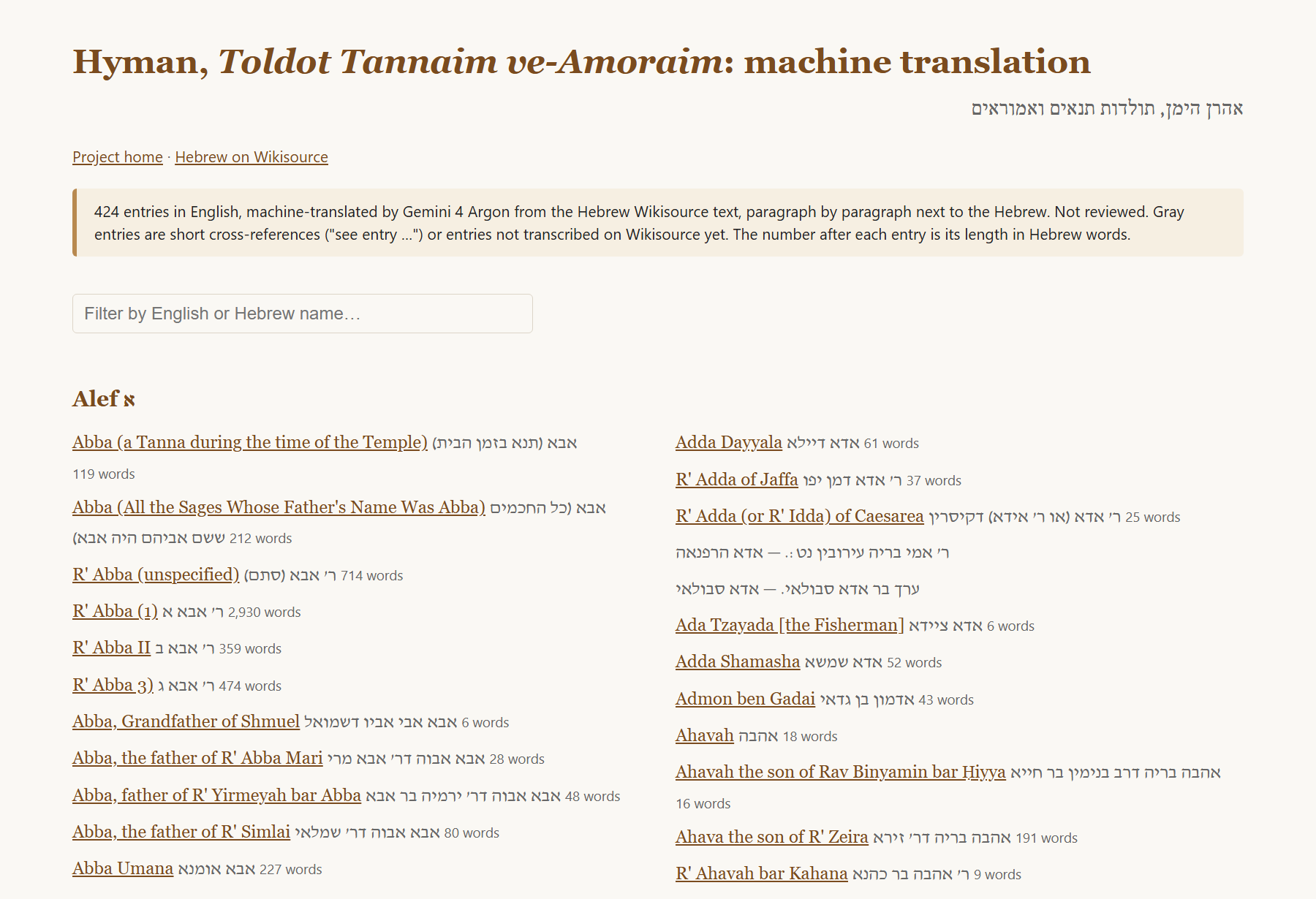
The index lists the entries in Hyman’s order, letter by letter, with the English name, the Hebrew name, and the length of the entry in Hebrew words. The lengths vary a great deal. The median entry is 28 words. A few are long essays: the entry on Rav (under his name Abba bar Aivu) has 13,319 words. Short entries that only say “see the entry X” are listed in gray.
Screenshot: the index, with the length of each entry in Hebrew words:
Each entry page shows the English and the Hebrew paragraph by paragraph, with links to Hebrew Wikisource and to the scan of the printed page. Hyman’s own parentheses are kept; words that the translation adds for sense are in gray square brackets.
Screenshot: the entry on Avimi:
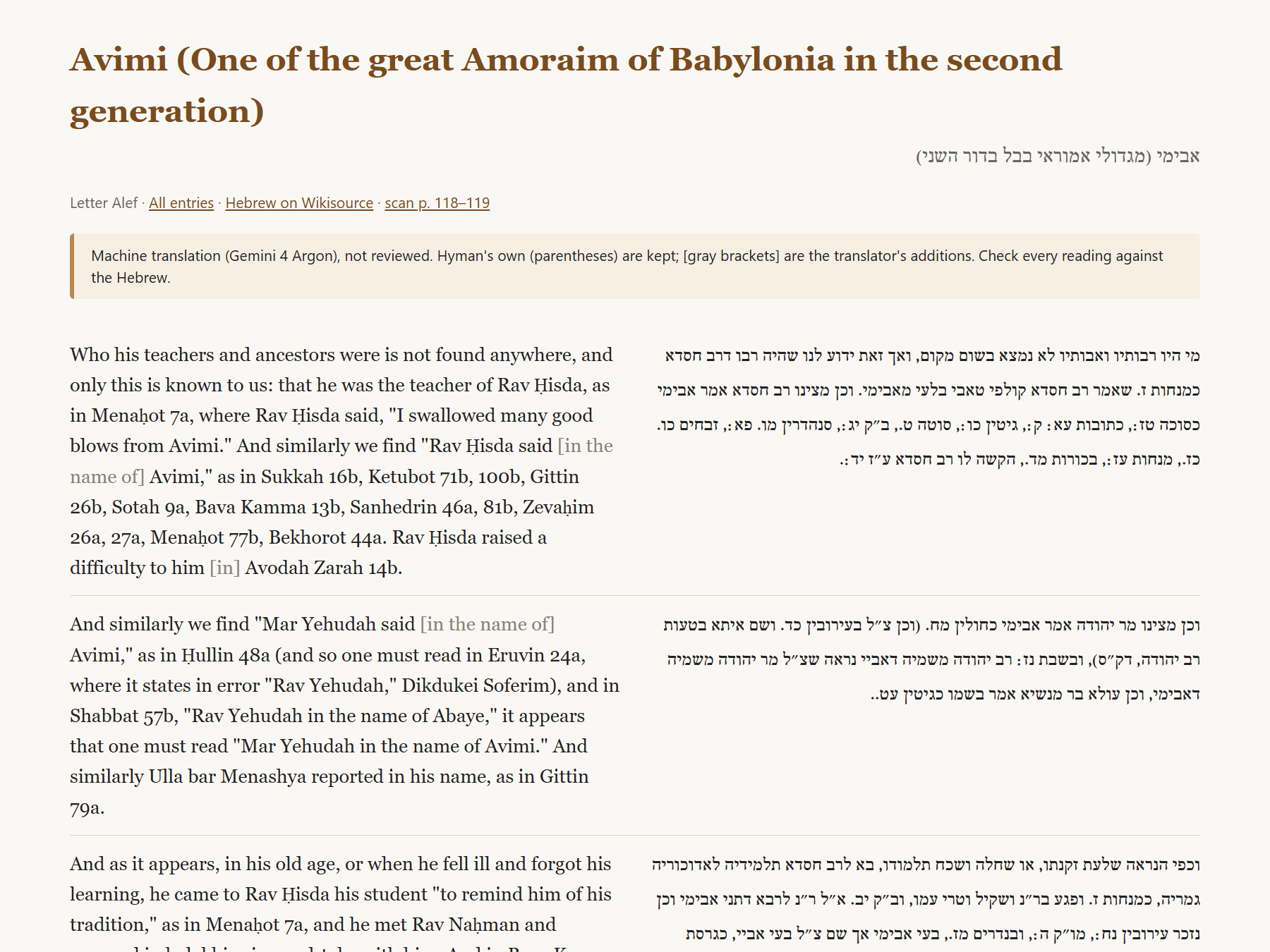
Avimi is a good example of Hyman’s method. Nothing is known of his teachers or family, Hyman says, except that he taught Rav Ḥisda, who said of him (Menaḥot 7a): “I swallowed many good blows from Avimi.” Then Hyman lists every place where Rav Ḥisda quotes him, and corrects the places where the printed Talmud has the wrong name. In his old age, or after an illness, Avimi forgot his learning and came to his own student Rav Ḥisda “to remind him of his tradition.”
Or take R’ Abba bar Zavda. Hyman argues that he studied under R’ Ḥanina in Eretz Yisrael, went down to Babylonia with his grandfather, studied under Rav, came back, and was still alive when the young Rava sent him a question. Then he does the arithmetic: Rava was about 20 at the time, so R’ Abba bar Zavda was over ninety.
Choosing a model
Hyman’s Hebrew is somewhat challenging. It is dense with abbreviations (א”ר, בל”ס, צ”ל), references in the old short form, Aramaic quotations, and dates in the Seleucid era.
Before translating the whole book, I gave the same two entries to seven current models from three companies, and read the results against the Hebrew. On ten hard points in one entry, the best model made one error and the worst six or more. The errors are typical of the material:
Dates. Hyman writes that Rava died in 663, meaning the Seleucid era (352 CE). Two models turned it into a year from the creation of the world.
Aramaic. “A myrtle that stands among the willows is still called a myrtle” became “among thorns” in two translations.
References. A midrash chapter 36 became chapter 30; Yevamot 83b became 3b.
The best model also noticed an error in Hyman’s own text: he cites the seventh chapter of Yerushalmi Kiddushin, which has only four. It marked the reference and suggested the right place. I chose that model (Google’s Gemini). It is also cheap: the whole test cost 55 cents, and the translation costs about a cent per thousand Hebrew characters. The whole translation, 1,889 entries, cost $13.55.
Getting the text
The Hebrew comes from Hebrew Wikisource, where volunteers have been transcribing the book from the scans of the 1910 edition. Not every entry is transcribed yet; those that are not are listed in gray.
The download was the slowest part. Wikisource limits how fast an anonymous program may ask for pages, and each entry is assembled from the scanned pages when it is shown. The solution was to ask for twenty entries at a time and to wait between requests.
Next
Every entry that is transcribed on Wikisource is now translated. Wikisource has no entries yet for the Hebrew letters Mem, Ayin and Pe; when volunteers add them, rerunning the pipeline will translate them too. Next I would like to link each reference to the text it points to, and the “see entry” notes to their entries. Corrections are welcome as issues in the repository.
The code and the translations are free to use (MIT license):2 https://github.com/openseforim/hyman
This is part of a series of tests with AI tools on classic reference works on the Talmud, with Bochart’s Hierozoicon, Lewysohn’s Zoologie des Talmuds and Löw’s Flora der Juden.
Appendix - Technical
Source. Hebrew Wikisource, all pages under the prefix
תולדות תנאים ואמוראים/
2,242 non-redirect pages, of which 22 are the letter index pages.
An entry page is a book template plus <pages index=”Aaron Hyman. Toldoth Tannaim veAmoraim. I. 1910.pdf” onlysection=”…” from=… to=…/>, so the text lives on the scan pages (namespace עמוד) and is only assembled when rendered.
The 01-Nov-2026 XML dump (469 MB) has the raw wikitext of both; the rendered HTML dump (Enterprise) is from Mar-2025.
Fetch. fetch_wikisource.py, MediaWiki API with a descriptive User-Agent. One action=parse call renders 20 entries: the request text transcludes 20 entry pages separated by marker paragraphs, and the result is split on the markers. Wikitext comes from one prop=revisions call per 50 pages. Calls are 3 s apart. At 0.2 s between single-page calls, the API returned HTTP 429 after about 15 pages; at 20 per call it still returns an occasional 429, and the script waits and retries. About 20 pages per 30–40 s.
Extraction. extract.py with BeautifulSoup: the abbreviation tooltips (Wikisource adds the expansion of בל”ס etc. as a hidden span), edit links and page markers are removed; h2/h3/p/li become paragraphs. Book order comes from the links on the letter index pages.
All letters: 1,889 entries with text (≥ 40 characters), about 285,000 Hebrew words. Letter Alef alone: 727 entries, 626 with text, 593,976 Hebrew characters.
Model test. translate_test.py: one call per entry, paragraphs as a numbered JSON list, answer as a JSON list of the same length. Entries: R’ Abba (stam), 3,482 characters (a checked translation existed), and R’ Abba bar Zavda, 4,253 characters. Both entries together:

Claude Haiku 5.5 (default reasoning) and Gemini 3.8 Flash at high effort spent the 20,000-token limit on reasoning and returned a cut answer on the longer entry. Total test cost $0.55.
Translation. translate.py: Gemini 4 Argon, reasoning effort low, through OpenRouter.
Chunks of up to 6,000 Hebrew characters; a chunk whose answer does not have one string per paragraph is retried once.
The prompt gives the expansions of common abbreviations, the reference format (final “.” = a, “:” = b; פ”א ה”ב = chapter 1, halakhah 2; ס”ה = end of halakhah), name forms (ḥ for ח, “Eretz Yisrael”), and asks for Hyman’s parentheses to be kept and additions to be bracketed.
First 150 entries: 83,301 characters, $0.81, 5.5 minutes with 8 parallel calls, no failed chunk. All 1,889 entries: $13.55, including the re-translation of 125 paragraphs that a number check flagged.
Calls are not deterministic: the R’ Abba bar Zavda passage on Rava’s age was right in the test and wrong in the full run.
Site. build_site.py writes static HTML (mt/index.html and one page per entry, with paragraph anchors #p1, #p2 …) for GitHub Pages and refreshes a status table in the README.
Code and translations: https://github.com/EzraBrand/hyman-toldot-translation (MIT).
Note the new website, where I’ve consolidated all my digitization and translation projects: https://openseforim.org/
Note the new Github organization, to support this broader project (see previous footnote): https://github.com/openseforim. If anyone wants to get involved/join forces on this project, please reach out by email! (See my About page.)