

Notes on three days at the ISF workshop “Artificial Intelligence in the Service of Talmudic and Rabbinic Literature Research: Challenges and Opportunities” (Hemdat Academic College, 6–8 October 2026)
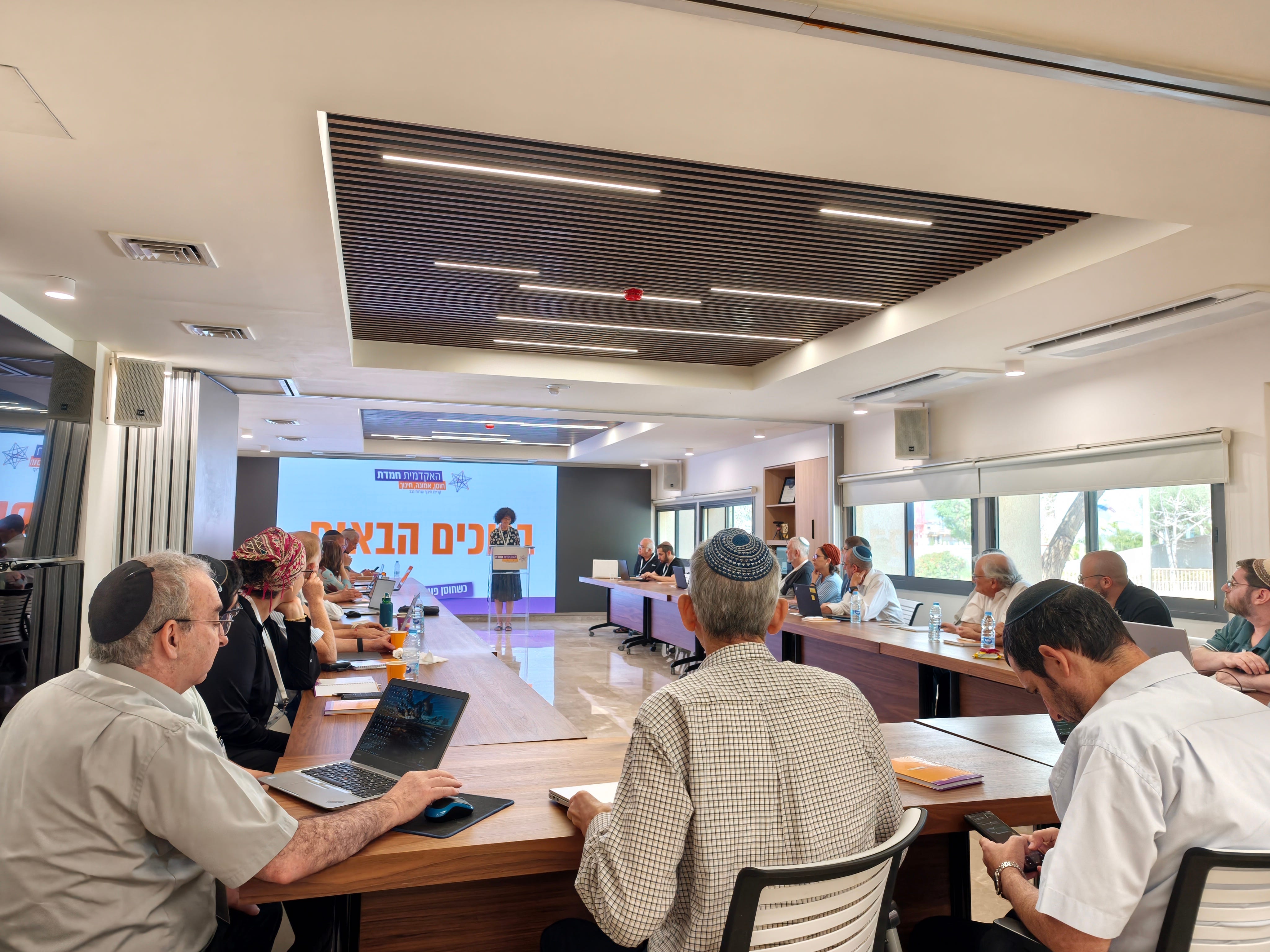
This past Tuesday to Thursday I attended the Israel Science Foundation workshop on AI and rabbinic literature, hosted by Hemdat Academic College in Sdot Negev. The main organizer, and the person who invited me, was Menachem Katz, and he did a great job of putting it all together. The format was sessions throughout the day, with shared meals in between, and everything was in English. It was an international gathering: people came from Scotland (Aberdeen), from elsewhere in Europe (e.g. Italy), and a good number from the US, especially the East Coast and New England.
I already wrote up my own talk separately, in “AI Coding Agents for Research in Rabbinic Literature: Recent Developments and Case Studies.” This post is about everything else: the people, the projects, and the conversations. The workshop revolved around AI, and specifically LLMs, and the many ways people are now putting them to work on rabbinic texts.
Faces, old and new
Part of the pleasure of a small workshop like this is the people. Some I knew from previous conferences, especially scholars from Bar-Ilan such as Leib Moscovitz and Michael Avraham. Others I had only ever corresponded with and never met in person: Michael Satlow, Joshua Waxman, and Moshe Pinchuk among them. It was great to finally meet them in real life.
It was also very nice to be able to talk shop with the people who are, like me, playing with the cutting-edge tools: agentic coding, building things with the latest models, and trying to keep on top of what is available from month to month. Joshua Waxman and Hillel Gershuni are in that category, as is Asaf Corem, who is essentially the CTO and technical lead of Menachem Katz’s Talmud Yerushalmi Digital Edition. I enjoyed getting to know him and getting into the more technical side of things.
Modernizing the Talmud page
One cluster of talks was especially close to my heart, because it overlaps with what I’ve been doing in Bekiut: projects that try, in different ways, to rebuild the Talmud as a digital, structured, linked object.
Joshua Waxman is someone who has always worked on projects similar to mine. In fact, he was working on them well before I was, and he was something of an inspiration for me. For a long time he has worked on the names of the Tannaim and Amoraim and the relationships between them, and on girsaot (manuscript variants) of Talmud Bavli. He is now bringing it all together in a new website called Girsology. It will reproduce the traditional tzurat ha-daf (the Bomberg/Vilna page layout), and on top of that, add full tagging of the text: knowledge graphs of the Talmudic sages, an “interaction graph” of who asks, objects to, or transmits in the name of whom, discourse roles for every statement in the sugya, and even a formal encoding of the logic of individual sugyot in Prolog, to see whether the argument actually “compiles.” He has also received permission to use the manuscript digitizations from Hachi Garsinan, including the Munich manuscript, which covers the whole Talmud.1
Michael Avraham and his group presented a project that is similar in many ways: also digitizing the tzurat ha-daf, also using LLMs to map out the logic of the sugya, and linking the different sugyot to each other. It looked very impressive.2 Waxman’s access to the Hachi Garsinan manuscripts is a significant addition to that.
Several talks were about tagging rabbinic corpora at scale:
Michael Satlow (Brown) described using LLMs to turn classic rabbinic literature into RDF datasets, based on the Sefaria printed edition, and then running network analysis on the results.
Hillel Gershuni and Asaf Corem presented the LLM tagging pipeline for the Yerushalmi Digital Edition. Gershuni gave the conceptual considerations, and Corem gave a clear, more technical breakdown of how the LLM tagging actually works.
Binyamin Katzoff and his team presented Digital Mapping of Intellectual Affinities in the Literature of the Rishonim, which has a public website. They use LLMs to tag the names of authorities cited across medieval rabbinic literature, link them, and display the intellectual networks that result.
Yair Furstenberg and his team presented the Local Law under Rome project. As a historian, Furstenberg is also tagging the Talmud, but specifically for its legal content, in order to connect it with the surrounding Greco-Roman legal traditions.
Search, manuscripts, and catalogues
Hillel Gershuni also presented his new Dicta Genizah Search, a platform for searching the new Genizah OCR transcriptions. I found it very impressive how much functionality he was able to build. Like me, he openly admits that he doesn’t come from a strong technical background; he comes from Talmud. And yet he has built a robust web application, with powerful search over the recent OCR transcriptions and a good manuscript display. This is exactly the shift I tried to describe in my own talk: a single scholar can now build what once required a team.
Yitzchack Gila of the National Library of Israel spoke about the history of the Institute of Microfilmed Hebrew Manuscripts: from its founding at Ben-Gurion’s initiative, through card catalogues and early computerization, to Ktiv and the large-scale OCR now under way in the MiDRASH project.
Nachum Dershowitz talked about more “traditional” AI (i.e., not specifically LLMs). He has been in this field for decades, and he spoke about his continuing work on paleography and on identifying joins between Genizah fragments. I found this one of the most interesting talks, because I think it is one of the few areas where AI, very broadly speaking, can currently do something that is inherently very difficult for humans to do.
Elyashiv Cherlow could not attend, so Hillel Gershuni presented on his behalf. His talk was on indexing and describing the manuscripts of the Talmud Yerushalmi (”From Fragment to Codex”), and it was quite impressive. Moshe Pinchuk presented the next stage of his Talmud Yerushalmi citation database, using LLMs to find “silent,” unattributed citations of the Yerushalmi in medieval literature. (He gave me a walkthrough of the database a few months ago; it is behind a paywall.) Aharon Shweka (with Nadav Aharoni) talked about text reuse in Geonic halakhic literature, comparing classical parallel-passage algorithms with newer tools.
Rabbi Hayyim Soloveitchik’s writings, authentic and spurious
The second day opened with a session on Rabbi Hayyim Soloveitchik, with Leib Moscovitz and Mayer Lichtenstein. (Note that the two projects, despite the shared subject, are unrelated.)
Moscovitz’s talk was especially interesting. He traced the term yesh laḥqor (”we may inquire”) through R. Hayyim’s writings: when it appears, what it means, and how its usage changes. He used it as a tool for separating the authentic R. Hayyim from the spurious. Along the way he discussed an interesting case of forgery: material that was supposedly from R. Hayyim’s notes, but was actually interpolated, with a lot of spurious additional writing, published in the 1990s.
Lichtenstein spoke about the evolution of the Brisker method, comparing R. Hayyim’s early Volozhin-era writings with his mature Ḥiddushei Rabbeinu Ḥayyim ha-Levi.3
Talmudic stories for distant reading
Itay Marienberg-Milikowsky gave a very interesting presentation on his project of preparing the Talmudic stories for so-called “distant reading,” with full tagging of them for emotions and various other features.4
The round tables
There were also broader discussions, mostly in the “round tables.” Nachum Dershowitz had a great sense of humor, and his takes struck me as very practical and realistic, quite close to my own, though probably a bit more pessimistic. Lynn Kaye spoke about the impact of AI on education, and how she deals with it as a teacher. That was a perspective we didn’t hear as much about elsewhere in the program, and I found it quite interesting.
Sderot
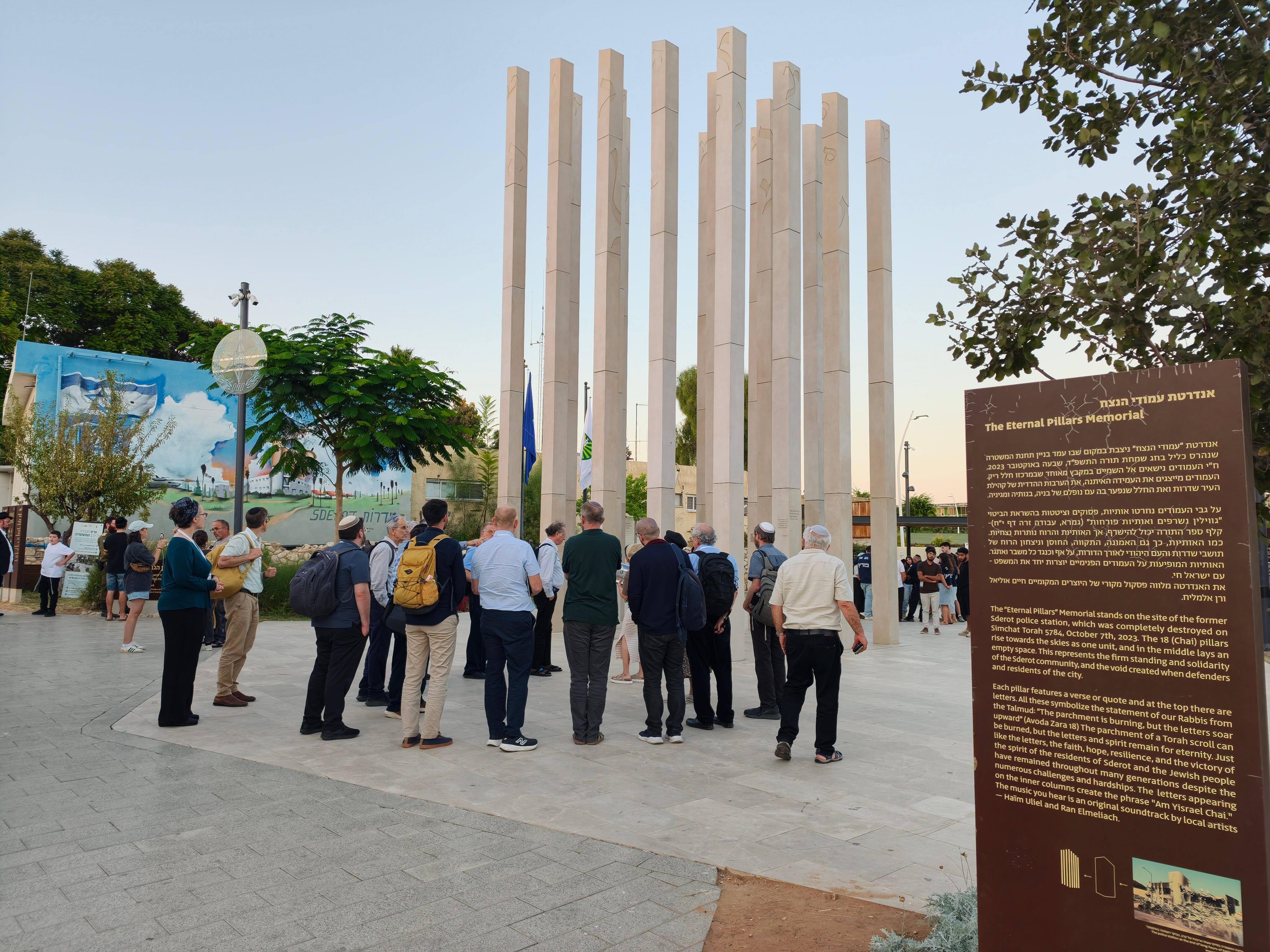
On October 7th, the participants went to Sderot for a commemoration and a tour of what happened there. It was very meaningful, and I’m glad I was able to take part.
Closing thoughts
What struck me most, looking back, is how much the field has converged. Almost everyone is working from the same base text (Sefaria), using LLMs for the same core tasks (tagging, linking, structuring), and building toward similar end products: networks, linked sugyot, a richer digital page. At the same time, the people doing some of the most interesting building were often individual scholars from a Talmud background, not engineering teams, which says a lot about where the tools now are. Thanks again to Menachem Katz and to Hemdat for a very well-organized workshop.
I told him I thought it might be a little too ambitious. He is confident that it is possible now; I hope he’s right.
One thing many in this space has in common, myself included, is that we build on the Sefaria text, which is based on the mainstream late printed editions. (As an aside, note that someone from Sefaria presented.)
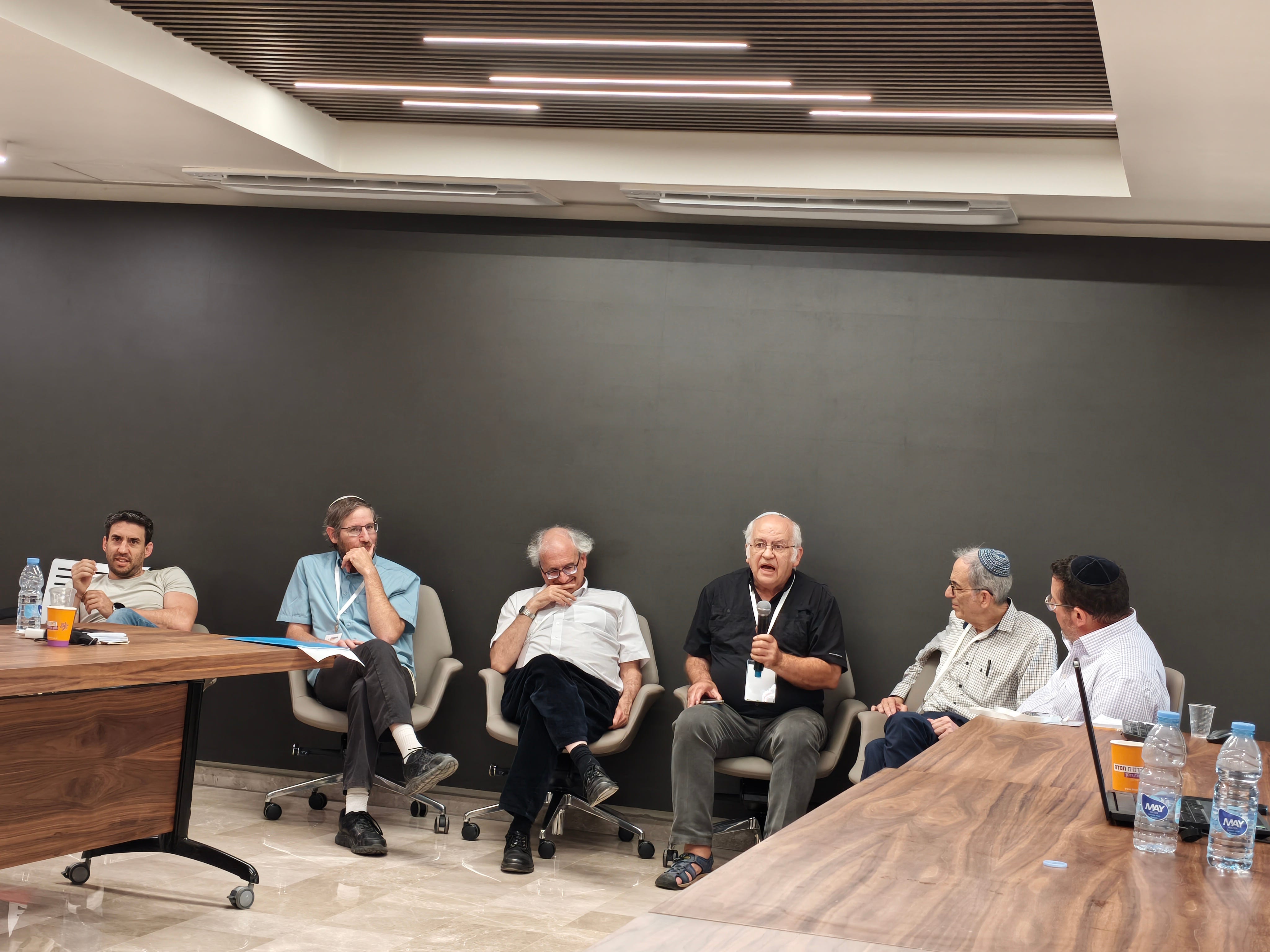
The use of Sefaria was something Menachem tried to argue against during one of the Q&A sessions, seeking, for example, to interest one of the projects in using his more accurate text of the Jerusalem Talmud, which is based on the manuscripts and early printed editions. From Menachem’s perspective, the importance of using an accurate text cannot be dismissed. A few others made similar arguments.
During the Q&A, I pushed back on him a bit about what exactly R. Hayyim’s ḥiddush was. Lichtenstein’s view was that R. Hayyim made Talmudic analysis more methodologically consistent and developed a terminology for it. My view is that, at least from an outsider’s perspective, it is in a way more reductive than that: R. Hayyim was basically saying that we will talk only about the abstraction and nothing else whatsoever.
I spoke to him briefly, just before his talk. I would love to hear more about how he defines what a “story” is in the Talmud. He seems to have a fairly broad, maximalist definition. As someone very interested in Talmudic aggadah myself, I’m looking forward to seeing results from this.