


For two weeks I have been steadily making my way through transcribing and translating Samuel Bochart’s massive ~3k pp. Hierozoicon (1663), the great study of the animals of the Bible, using AI models.1 The first post described the project; the site now has about 790 pages in Latin and English, side by side: https://openseforim.org/bochart/
The Latin is the (relatively) “easy” part. A large part of Bochart’s arguments lives in his lengthy quotations: Hebrew and Aramaic, Arabic, Syriac, and now and then Samaritan and Ethiopic, all set in the type of a Leipzig printer of the 1790s. Almost every error that survives to the end of my pipeline is in one of these right-to-left (RTL) scripts.
Letters that are one stroke apart
In this type, ד and ר differ by a tiny corner. So do ו /ז, ח /ת, and sometimes י and ו. Three readers look at every page: Claude, Gemini, and the library’s own OCR. When they disagree, the line goes back to Claude as an image, and a word changes only when two readers agree. This vote catches most errors. It cannot catch an error that all three readers make together, and with ד/ר they often do.
The example from this week is one page, p. 277 of volume 3, on Nahum 3:15, הִתְכַּבֵּד כַּיֶּלֶק, “multiply like the locust”. Bochart discusses the verb כבד in the sense of sweeping, which the Talmud uses. On that page the word and its relatives appear seven times. All seven came out of the main reader with ר: התכבר, כבר. The vote flagged three of them. A second check found two more, and a plain search found the last two.
Screenshot of p. 277, “R. Selomo exponit ... התכבד כילק התכבדי כארבה” (crop of the printed line):

The same holds for ו and ז. In the Aramaic of the Targum on Jeremiah 51:27 the locust is זחלא, zachla. Two of the readers saw וחלא, and the next word, דמצלהב, came out with ר.
Screenshot of p. 275, “quorsum pro ילק סמר habeat זחלא דמצלהב” (both pairs of look-alike letters in two words):

The best referee turned out to be Bochart himself. He usually gives a Latin transliteration next to a Hebrew word (kippoz, gazam, zachal), and a program can test whether the letters fit it. A second program compares every Hebrew quotation with the Masoretic text. Neither uses an AI model, and neither changes the text: they list suspects, to be read on the scan. In the early chapters, a model spot-check listed 12 words that did not fit Bochart’s transliteration; 8 were wrong on the scan.
Dots
Arabic has the opposite problem. The letter shapes are clear; the dots decide. In this type a medial ف, ق and غ can look almost the same, a ذ is cup-shaped like a ن, and the lead-in stroke of ج or خ looks like an alif.
On p. 276 Bochart quotes an Arabic manuscript, قفزت, “I leapt like a locust”. The print can be read as قغزت. Here Bochart’s Latin, saltavi, settles it.
On p. 297 the print looks like انا, “I”, where the sense, and Bochart’s Latin, need اذا, “when”.
Screenshot of p. 276, “In Arabe MSS. ... legitur قفزت, Saltavi sicut locusta”:

Which way does the line run?
A Latin line runs left to right. A Syriac or Arabic phrase inside it runs right to left. More than once the model wrote the words of such a phrase in the order in which the eye meets them, from left to right, so the phrase came out backwards.
On p. 283 Rosenmüller quotes three Syriac words, “and they were wingless locusts”. The main reader gave them in reverse order. Each word was right; the phrase was wrong. The vote does not see this, because it compares words, not their order.
Screenshot of p. 283, right column, “Sic vertenda videntur verba ... quae Bruns reddidit: et irruerunt muscae”:

The wrong script, and no script at all
Arabic and Syriac have related alphabets whose letters largely match, though their shapes differ.
On p. 280 Bochart quotes an Arabic translation of Proverbs 30:27; the main reader wrote all five Arabic words in Syriac letters. Each Syriac word was (in theory) a fair rendering of the Arabic one.
Screenshot of p. 280, “Et Arabs, بعسكره امره واخذه بحسن ترتيب”:

Syriac is the weakest script for every reader.2 The library’s OCR drops it entirely. The models read a word or a phrase well enough, but on p. 283 Rosenmüller prints two long Syriac quotations from the chronicle of Barhebraeus (c. 13th century) and its continuation, 14 and 10 lines. Screenshot:
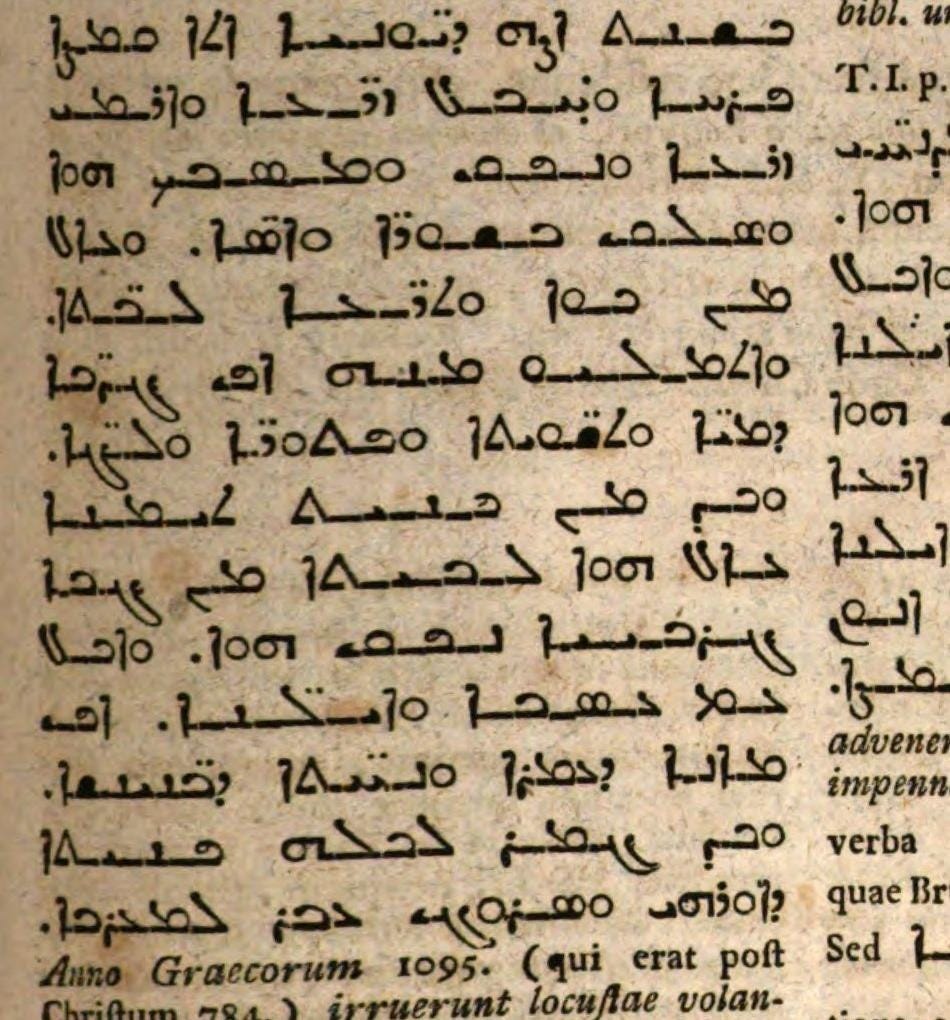
The main transcription model left them blank (i.e., it didn’t transcribe these passages at all). When I sent each block again by itself, Opus produced fluent Syriac that differed from the scan in most words: a plausible chronicle text, not the printed one. Flash’s reading was closer but also wrong in many words. I did not put either version on the site. The edition marks the two blocks as “not transcribed”, and Rosenmüller’s Latin translation of each follows.
Screenshot of p. 283, left column, the Syriac of Barhebraeus’ Chronicle, then “Anno Graecorum 1095”:
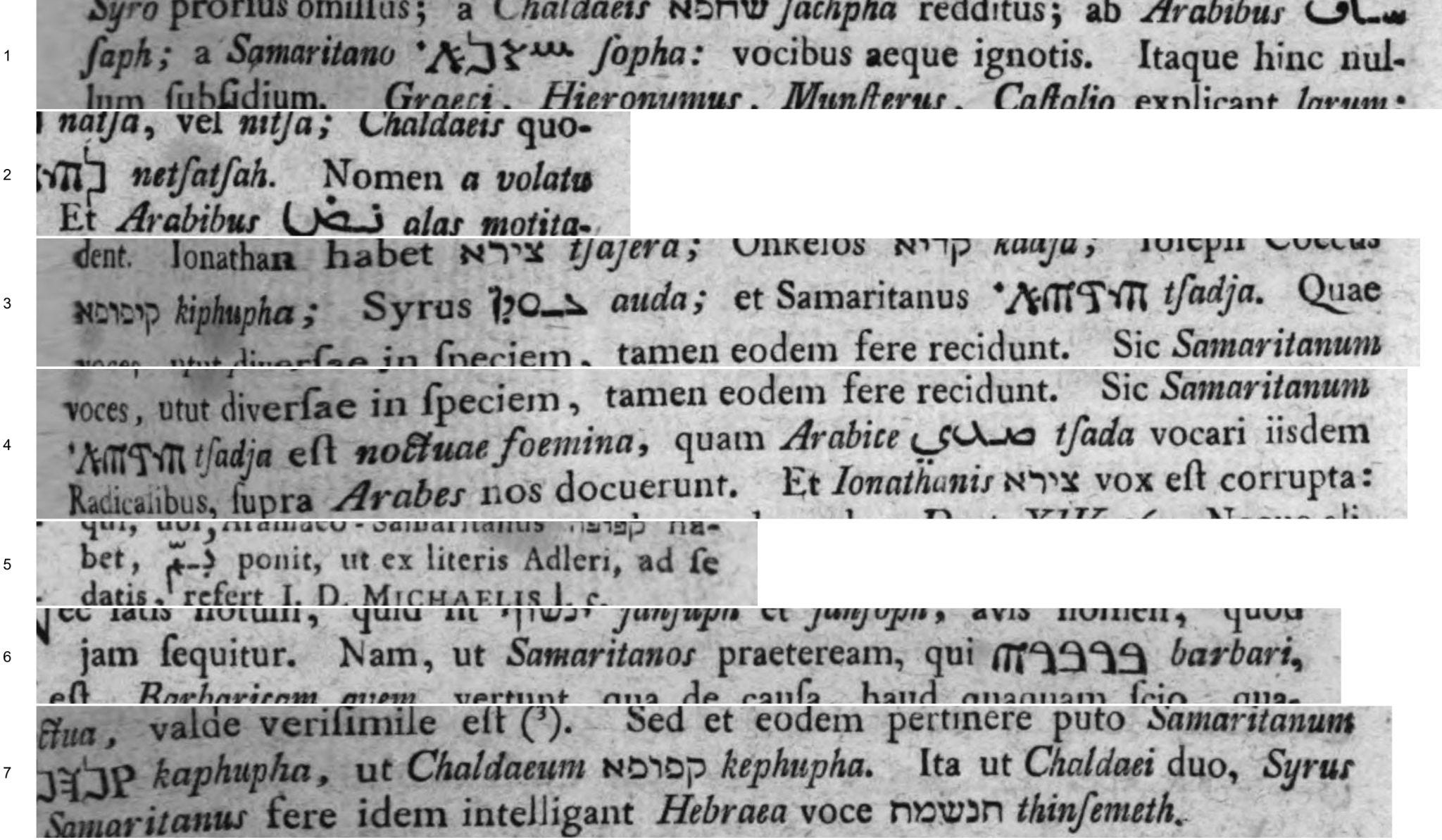
Samaritan is the rarest script in the book and the hardest; no LLM reader (even the most advanced frontier ones) knows it well.3 Each Samaritan word is read from the letter shapes, the number of letters, and Bochart’s transliteration next to it, and each is listed as not certain.
Screenshot of Samaritan words of vol. 3, pp. 1-101, with Bochart’s transliterations (sopha, tsadja, kaphupha):
What I take from it
Agreement is not evidence when the readers share a weakness. Two AI models trained on similar text make the same guesses, and three readers can agree on a letter that the type does not separate. The useful checks come from outside the image: Bochart’s own transliteration and Latin, the Masoretic text, and a reader that knows nothing.
What it is not. I am not a specialist in Syriac, Samaritan or Ethiopic, and the readings in these scripts are the weakest part of the edition. They are listed as “not certain” in the repository. The Hebrew has had the most checking, by program and by eye, but a ד/ר or ו/ז error can still be in a word that has no transliteration and no Bible verse to compare. Every page links to the scan.
Next
The work goes on through the book of the insects (the locusts, then the fly and the bee). The open readings in the right-to-left scripts are listed in the README, and corrections are welcome: https://github.com/openseforim/bochart
Appendix 1 - Technical
Readers and vote.
Main OCR: Claude Opus 5.5 at low reasoning effort, two half-page images at full resolution (about 2,100 × 2,830 px a page).
Second reader: Gemini 3.8 Flash.
Third: the MDZ hOCR layer of the Bavarian State Library scans.
check.py aligns the three word by word; each difference goes back to Opus as a line crop with only the question “what is printed” (judge.py); vote.py changes a word only when the judge agrees with Flash or MDZ.
Letter pairs that this type does not separate (ד/ר, ذ/ن, medial ف/غ/ق) are listed for the scan check and never changed by the vote.
Hebrew checks.
hebcheck.py matches Bochart’s romanization (119 strings in tranche 10) to the letters, with a table of look-alike pairs: a word that fits only after one swap is listed.
biblecheck.py indexes the Tanakh (Sefaria export) by look-alike classes and places every Hebrew string of two words or more, then compares letter by letter (83 strings in tranche 10; 3 look-alike differences, 2 of them the ד/ר errors of p. 277).
Both are free and report-only. concordance.py writes the Hebrew concordance page used for my own review (https://ezrabrand.github.io/bochart-hierozoicon/hebrew.html).
Scan check. Review items are sorted by rule first (triage_t7.py; in tranche 10 about a third need no look, about 45% in recent tranches), the rest are cropped at 2× and laid out 8 to an image (sheets_t4.py) and read by Claude in the main session.
Tranche 10: 155 items, 56 by rule, 99 read. Verdicts become vote.ACCEPT/REJECT lines or entry.FIXES pairs (find/replace on a page’s text, which must match exactly once).
Direction. The OCR output is plain logical-order Unicode inside a Latin line. A phrase in eye order is not flagged by the word alignment; it shows only as a “not similar” pair of swapped words, or in the English. Found so far on p. 159 (two phrases, one Syriac, one Arabic) and p. 283 (vol. 3).
Syriac re-read test (18-Nov-2026). The two blocks of p. 283 were cropped and sent alone to Opus 5.5 (high effort: no text returned within 6,000 tokens; low effort: fluent text, mostly not the print).
Cost of the four calls: $0.38. Flash’s page reading was closer but also wrong in many words.
Both blocks are marked [Syriaca, versus XIV / X, hic non transcripta].
Cost. Tranche 10 (vol. 3, pp. 272-326, 55 pages): $11.62, $0.21 a page, all calls synchronous.
At about $0.22 a page, the rest of the work (about 2,000 pages) is about $440.
Appendix 2 - Syriac, a second try: what finally worked best
Added 20-Nov-2026, after the rest of this post was written.
As part of the project and research, I found a recent piece that also describes the continuing major challenges of general LLM vision-model transcription of Syriac script,4 which was very helpful: Matthias Benabdellah, “Transcribing Syriac Manuscripts with AI: An Assessment as of October 2026” (Oct 21, 2026), at etcbc.nl, sections “Conclusion” and “Limits”:5
On this page, the best text is obtained with
eScriptoriumand a Syriac model trained on several manuscripts,Sophro Mhiro, after about ten minutes of layout correction: a text to proofread rather than to retype.eScriptoriumtakes more time to get started with thanTranskribus, but it is open-source and gives the best result here.Three steps matter: reading direction set from right to left, regions and lines checked, lines attached to their column before export.
Transkribus is convenient to start with; on this manuscript its results depend on its public Syriac models, each trained on a single manuscript.
None of the conversational assistants tested,6 free or paid, read the page [...]
This is one page, from one manuscript, in one script, tested on 8 and 9 October 2026; another manuscript may give a different ranking between close results.
The scope is limited to free, immediately accessible tools, with one paid model for comparison.
And ibid., “Digitising Printed Syriac Editions with AI: An Assessment as of October 2026” (Nov 2, 2026), section “Conclusion”:
For printed Syriac editions, automatic recognition is already usable. On these two pages,
eScriptoriumwith the general modelPP-OCRv6gives, without any correction, a text to proofread rather than to retype. It requires access to an instance, provided by an institution or installed locally, but it is open-source and gives the best result here. Also, check the segmentation, from which most of the remaining errors come.
With what I learned and developed, I started a pilot transcription here: https://ezrabrand.github.io/barhebraeus-chronography/
In the original draft above I gave up on the two long Syriac quotations of p. 283: the models wrote fluent Syriac that was not on the page. I then noticed a short Syriac line in the chapter on the sephiphon (GitHub issue 4). Bochart’s point there is that the Semitic letters Kof and Ayin change places in the Semitic languages: “earth” is ארקא and ארעא, “to smoke” is קטר and עטר. The OCR had read ܛܪ as ܦܣ in both Syriac words, and a Hebrew place name קסם as רקם, so the examples no longer showed what Bochart wanted them to show. So I spent dedicated time on the Syriac alone.
A test set. First I needed a way to measure. I collected 50 printed lines with a known answer: Syriac quotations of the Bible that a program can match to the Peshitta (the Syriac Bible, in the ETCBC’s open text), and the Syriac words that my own scan checks had already corrected. The second group is the especially challenging one; the pipeline had all of them wrong at first.
Short words: no single model is better, but several together are. I sent each line again, alone, to Opus, to two Gemini models, to GPT and to Sonnet, with and without a table of the Serto letter shapes. No single re-reading beat the pipeline, and the letter table did not help. Tesseract’s Syriac model got 87 percent of the characters wrong. But the models are wrong in different places. On the 48 hard words, the pipeline had 17 right; a simple majority of six readers had 27 right, and it did not spoil the words that were already right. That is now a cheap step to add, about five cents a line.
Long blocks: find the source, and read it twice. Rosenmüller names the source of the first block of p. 283: the chronicle of Barhebraeus as printed by Bruns and Kirsch at Leipzig in 1789, page 134. The Internet Archive has that volume, scanned by Google at about twice the resolution of my page, in a very similar Serto type.
Screenshot of Rosenmüller’s note, vol. 3 p. 283 (MDZ scan), the 14 lines of Syriac:
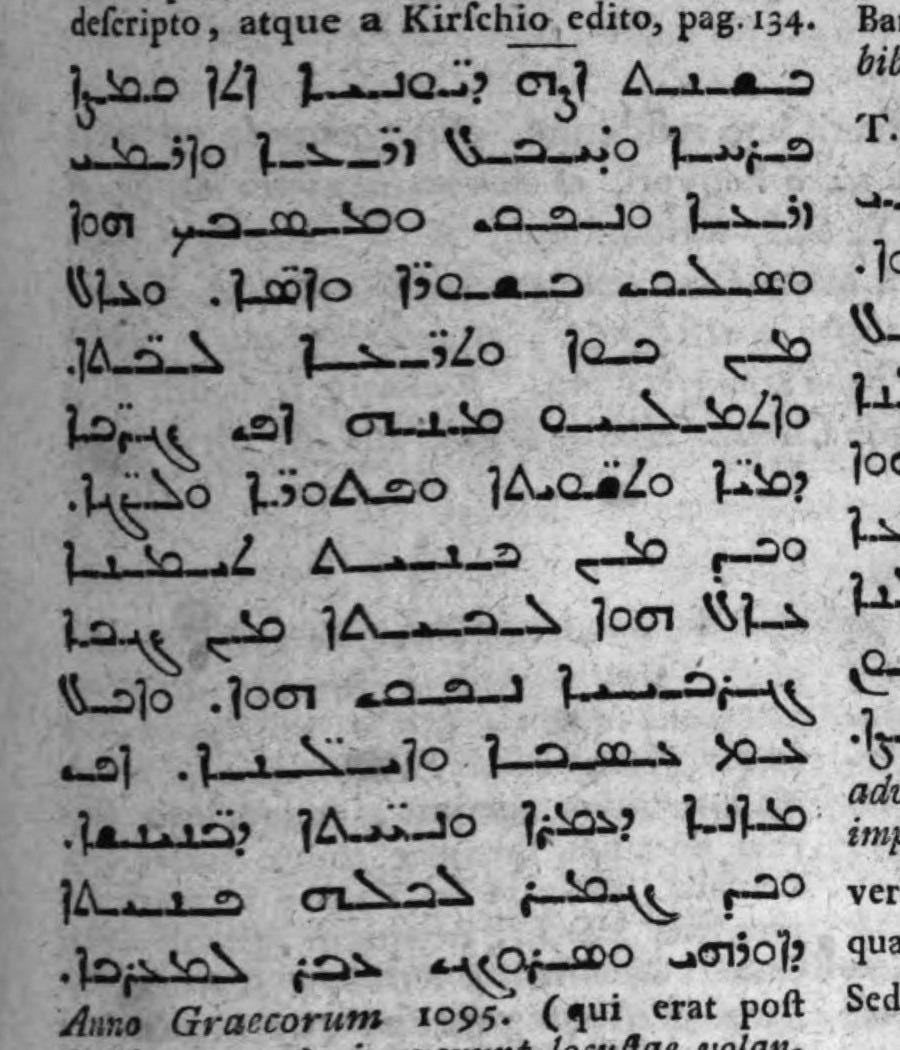
Screenshot of the same passage in its source, Bruns and Kirsch, Bar-Hebraei Chronicon Syriacum (Leipzig 1789), vol. 2, p. 134:7

Two prints of one text make a good test, because there is no need to know the answer: a reader that can read Serto must give the same words for both. The vision models failed it completely. On the clean 1789 page, Opus, Gemini Flash, Gemini Argon and GPT agree with each other on 3 to 6 percent of the words, and each model’s reading of Rosenmüller’s block agrees with its own reading of the 1789 page on 2 to 4 percent. They are not misreading letters; they are writing a different text.
Kraken. The ETCBC posts quoted at the top pointed to the other kind of tool: open OCR engines with models trained on Syriac. Beth Mardutho (the Syriac Institute) publishes such models for Kraken, the engine behind eScriptorium, under the name Qoruyo, one of them for printed Serto (Zenodo, October 2025, CC-BY 4.0, zenodo.org/records/17406677).
Kraken runs on my laptop, without eScriptorium, free, in about four seconds a line. I cut both prints into lines and gave each line to it. The first line, from Rosenmüller’s page, came back as ܟܫܢܬ ܐܓܗ ܕܝ̈ܘܢܝܐ ܐܬܐ ܩܡܬܐ; the print has ܒܫܢܬ ܐܨܗ ܕܝ̈ܘܢܝܐ ܐܬܐ ܩܡܨܐ, “in the year 1095 of the Greeks came the locust”. Three letters wrong, every word in its place.
On the whole block:

Screenshot of the first line in both prints, Rosenmüller (above) and Bruns-Kirsch (below):

The two Kraken readings follow each other word for word, and where one has a wrong letter the other usually has the right one: ܩܡܨܐ against ܩܡܬܐ, ܙܪܥܐ against ܙܢܥܐ, ܥܡܪܐ against ܥܪܐ. The rest was decided by Rosenmüller’s own Latin translation, which follows the block (irruerunt locustae volantes, corruperunt semina, posuerunt ova…), and by a look at both scans where the readings still differed. The block is now on the site, with two words marked as not certain. It runs, in Rosenmüller’s Latin: the flying locusts came, spoiled the crops, laid their eggs; the young climbed the walls, came in by the windows and doors, filled the water jars, the tables and the dishes; they went into the houses from the south and came out on the north, and ate the grass, the trees and even woollen clothes, until the whole country of Edessa and Serug was laid waste and they passed on to the west.
Limits. Kraken knows only Syriac. On a Latin line with one Syriac word inside it, it returns almost nothing, so the short words still go to the models’ vote until I crop the Syriac words alone. Its output came out in visual order, left to right, and had to be reversed.
Two details of the setup cost time: Kraken’s own download command did not know the Qoruyo models (I downloaded the files from Zenodo directly), and on Windows one dependency had to build from source.
The second block of p. 283, by Barhebraeus’ continuator, comes from another book (Paulus’ Neues Repertorium, 1790), which I have not yet found in a scan.
What I take from it. For a script that the large models have seen little of, a small model trained on that script beats them by a wide margin, and it runs on a laptop.
The large models are still useful for the short words, as a group, and for everything around the Syriac: finding the source, aligning the two prints, and checking the reading against the Latin.
And a second print of the same text turned out to be the best tool of the day: it is a reader that does not share the first print’s flaws, which is what the agreement of models cannot give.
Technical note.
Test set and scripts: SYRIAC.md, syriac_lab.py, syriac_block.py and peshcheck.py in the repository.
Character error rates on the 50 test lines (one re-read of the line crop):
Opus 5.5 - 34%,
Opus with a letter guide - 36%
Gemini 4 Argon - 41%
Gemini 3.8 Flash - 46%
GPT-6.1 Sol - 53%
Sonnet 5.5 - 66%
Tesseract 5.4 (
syr) - 87%the voted page OCR - 22%
Kraken 7.1.1 with serto_print_best_02.mlmodel, run per line with --no-segmentation on line crops cut by a projection profile.
peshcheck.py places 40 Syriac runs of vols. 2-3 in the Peshitta; 25 have a word that differs.
Cost of the day’s Syriac tests: about $5; the Kraken runs were free.
See Appendix 2 at the end of this piece, for an update to the main piece.
In general, for a good recent open-access discussion of some aspects of Bochart’s life and work (which focuses on Bochart’s study and usage of Arabic scholarship), see Pierre Ageron, “Dans le cabinet de travail du pasteur Samuel Bochart. L’érudit et ses sources arabes”, in Érudition et culture savante: De l’Antiquité à l’époque moderne, pp. 117–143.
I’d love help with this, if any readers are good with Syriac!
But compare Appendix 2 at the end, for my subsequent successful use of Kraken for OCR of Syriac script; I haven’t seen if Kraken could help with reading Samaritan script.
I.e., Handwritten Text Recognition (= HTR).
He refers to LLMs as “conversational assistants”, as he uses the chatbot interfaces for the general AI models, as opposed to the API’s.
I.e., Claude, ChatGPT, Gemini
The archive.org page of the 1789 edition, item “ChroniconSyriacum”, “Chronicon_Syriacum 2”, p. 134.
The Syriac volume is paged from the back, so p. 134 is leaf 503 of 645.