


Over the past few weeks I’ve put several old books online as reading editions: Samuel Bochart’s Hierozoicon, Ludwig Lewysohn’s Zoologie des Talmuds, Jacob Emden’s Megillat Sefer and others. Each one had its own small website, its own colors, its own way of citing a passage. As the number grew, that stopped making sense; a reader who found one of them had no way to know the others existed.
So they now live together at openseforim.org. Seforim is the ordinary word for Jewish books, and open means two things here:
These works are (metaphorically) being opened up to a wider audience
The texts are in the public domain, the translations and data are free to reuse (with attribution), and the code that builds each site is public
This post describes what is on the site, what changed in the move, and how new works are chosen.1
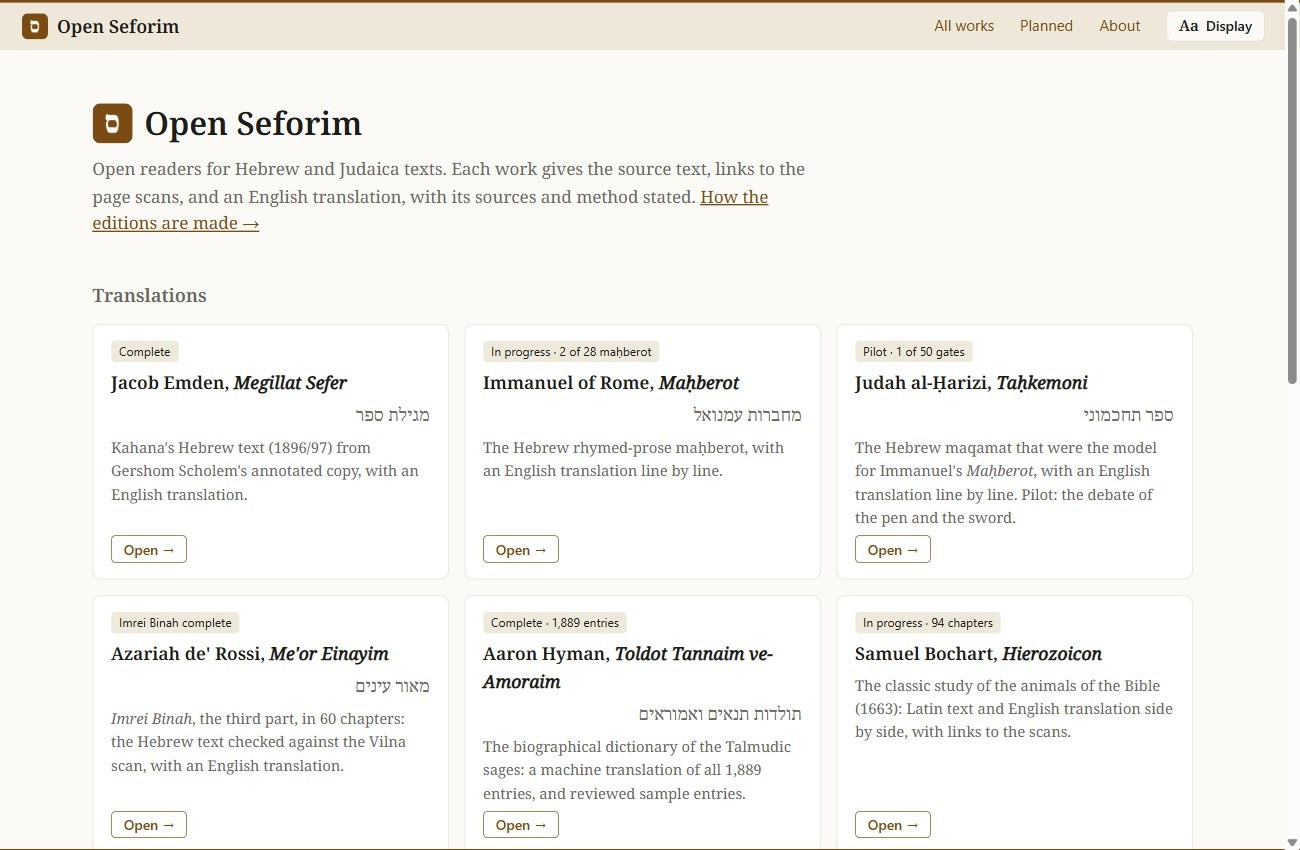
Screenshot of the front page of openseforim.org, with the first six works:
What is there
Ten works, at different stages:
Jacob Emden, Megillat Sefer. His memoir, from Kahana’s edition of 1896/97 in Gershom Scholem’s annotated copy, with an English translation. Complete.
Immanuel of Rome, Maḥberot. The rhymed-prose maḥberot, Hebrew and English line by line. Two of the twenty-eight so far.
Judah al-Ḥarizi, Taḥkemoni. The book Immanuel imitated. Two gates of fifty.
Azariah de’ Rossi, Me’or Einayim. The third part, Imrei Binah, in sixty chapters, with a translation.
Aaron Hyman, Toldot Tannaim ve-Amoraim. The biographical dictionary of the Talmudic sages: a translation of all 1,889 entries.
Samuel Bochart, Hierozoicon. The 1663 study of the animals of the Bible, Latin and English. In progress, 94 chapters.
Ludwig Lewysohn, Die Zoologie des Talmuds. The 1858 study of the animals of the Talmud, German and English. Complete.
Immanuel Löw, Die Flora der Juden. Sample pages and the contents lists of his study of plants.
Barhebraeus, Chronography. Bedjan’s 1890 edition of the Syriac text, 600 pages, with a transliteration into Hebrew letters.
Defus. A catalogue of open scans of printed Hebrew books, 1469 to 1920, gathered from the libraries that hold them.
Each card on the front page gives the status in a few words, so a reader can see at once what is finished and what is a sample.
One look, one set of controls
Every page now has the same header strip, with links to all works, the planned works and an about page. Especially useful (I believe) is the Display button: It opens a small panel with three settings that apply across the whole site: a color theme (light, paper or dark), four text sizes, and a choice of Hebrew typeface. The typefaces are shown with a vocalized sample, בְּרֵאשִׁית בָּרָא אֱלֹהִים, so you can see how each handles the vowel points before you choose.2
Screenshot of the display panel open over Immanuel’s first maḥberet; the “This passage” bar at the foot:
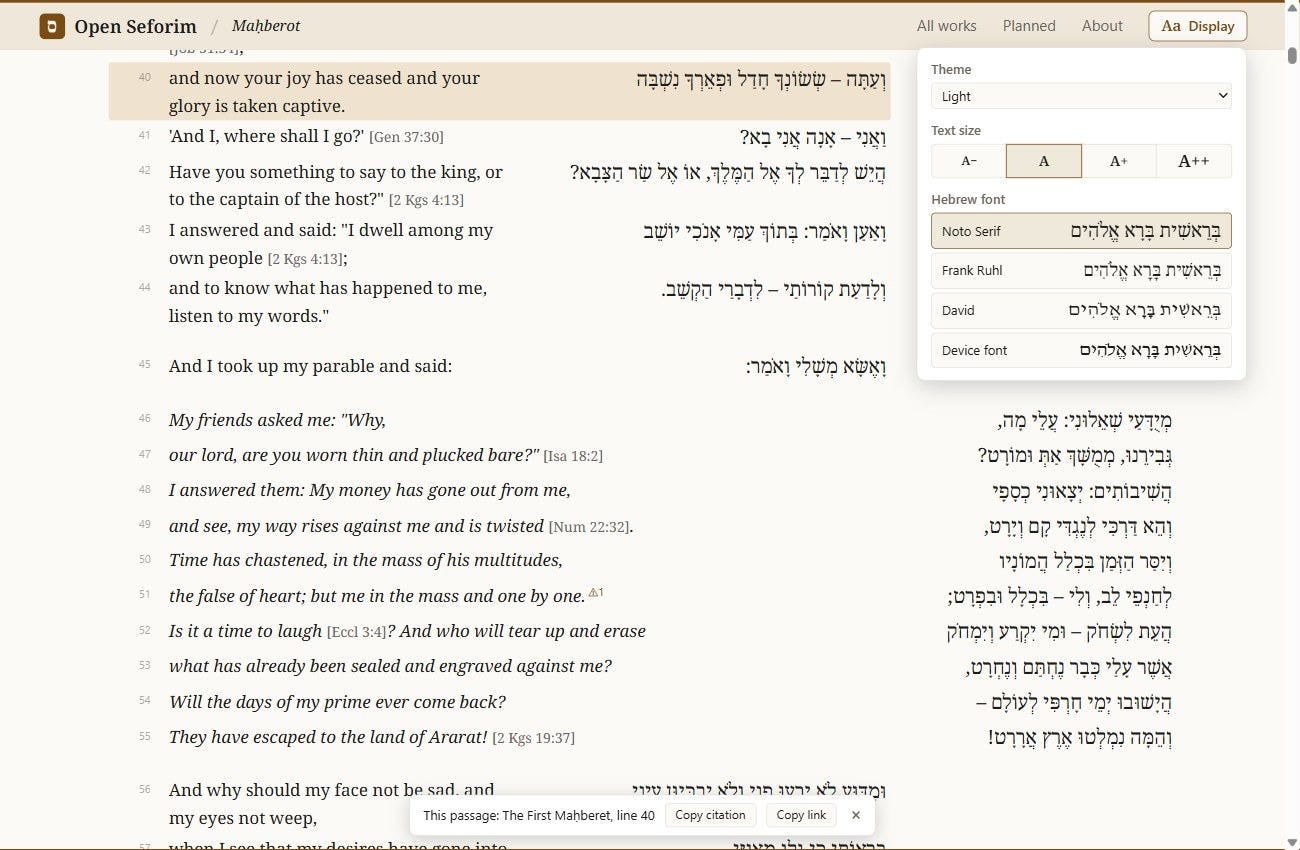
The setting follows you: If you choose the paper theme and a larger size in the Emden reader, Bochart opens the same way. Where a reader has its own bar that stays on screen while you scroll, as Emden’s does, the Display button sits in that bar; elsewhere the site header itself stays on screen.
Screenshot of Emden’s reader, with the bar of chapters and controls, the Hebrew and English, and the printed page beside them:
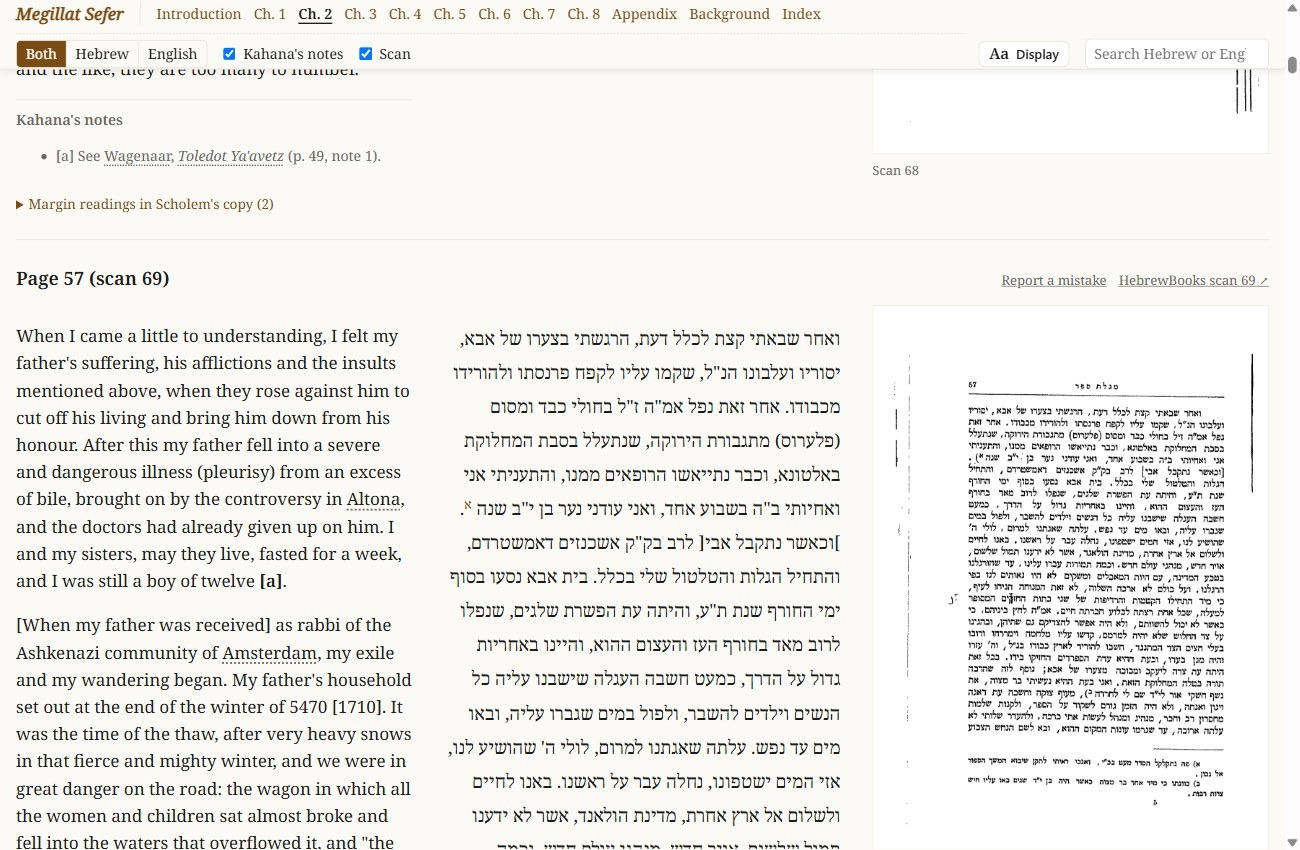
Under the shared frame, each reader keeps the layout that suits its book. Emden’s shows the printed page beside the text. Bochart’s can show the printed lines of a single paragraph above its text. Immanuel’s and al-Ḥarizi’s go line by line, because rhymed prose is built from short units that rhyme in pairs.
Citing and reusing
The footer of every page has the same three parts: what the edition is and where its text comes from, how to cite and reuse it, and how to report a mistake.
Screenshot of the footer of a reader, with the source edition, the citation box, the license, the downloads and the DOI:
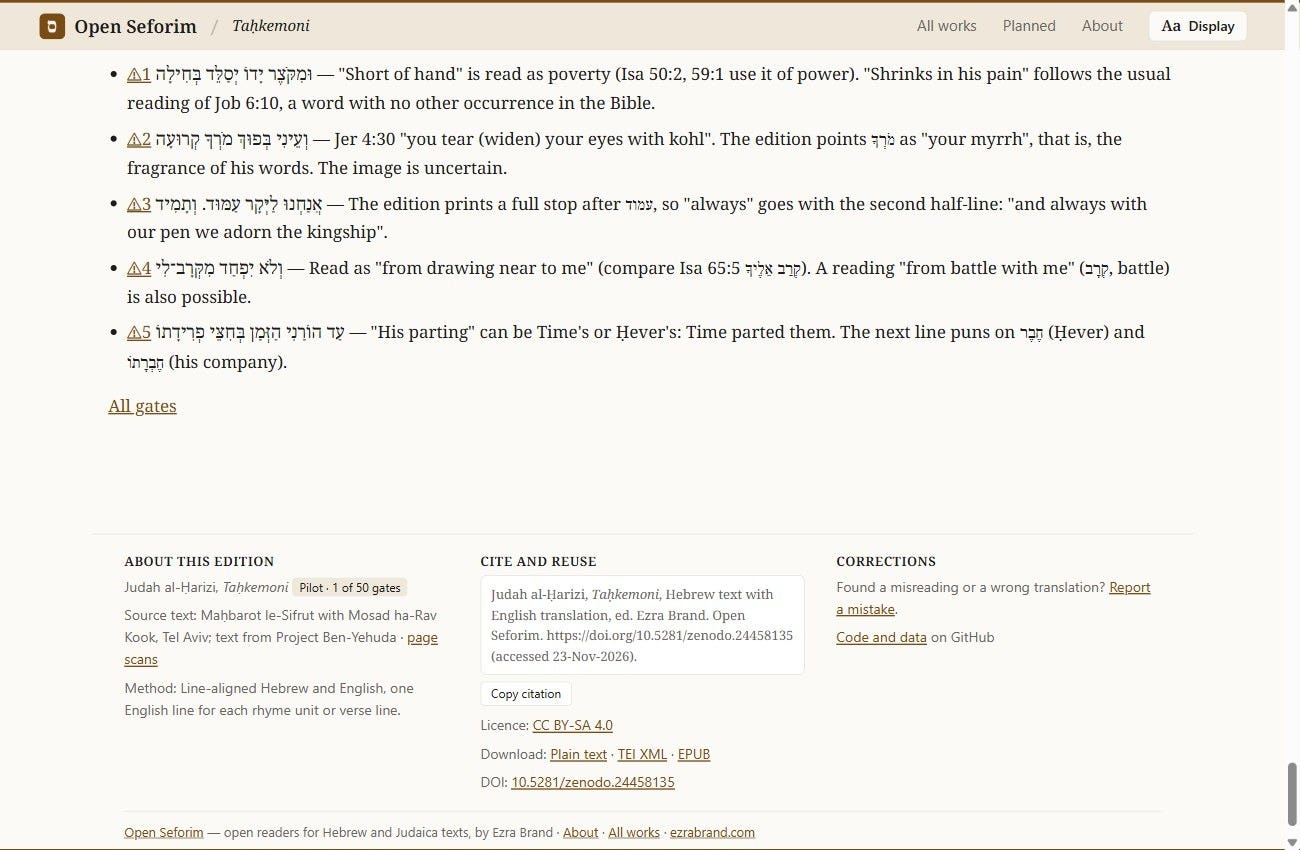
The citation box has a copy button and fills in the date you accessed the page. If you arrive at a link to a single line or paragraph, a small bar offers a citation of that passage alone: “Maḥberot, The First Maḥberet, line 40”, with its link.
Each work now also has a DOI, a permanent identifier for citation, through Zenodo, the open archive run by CERN. Zenodo keeps a copy of each release of the work’s repository, so a citation still points somewhere even if the website were to go away. The DOI always leads to the newest version.
Every text work can be downloaded whole, in three forms: plain text, an EPUB for an e-reader, and TEI, the XML standard that scholarly text projects use. Texts and translations are under a Creative Commons license (CC BY-SA 4.0): copy and adapt them freely, with credit.
Old links still work. The earlier addresses of the readers, about 2,700 pages, now forward to the same page on the new site, so the links in my earlier posts and in anyone’s notes keep working.
What comes next, and how it is chosen
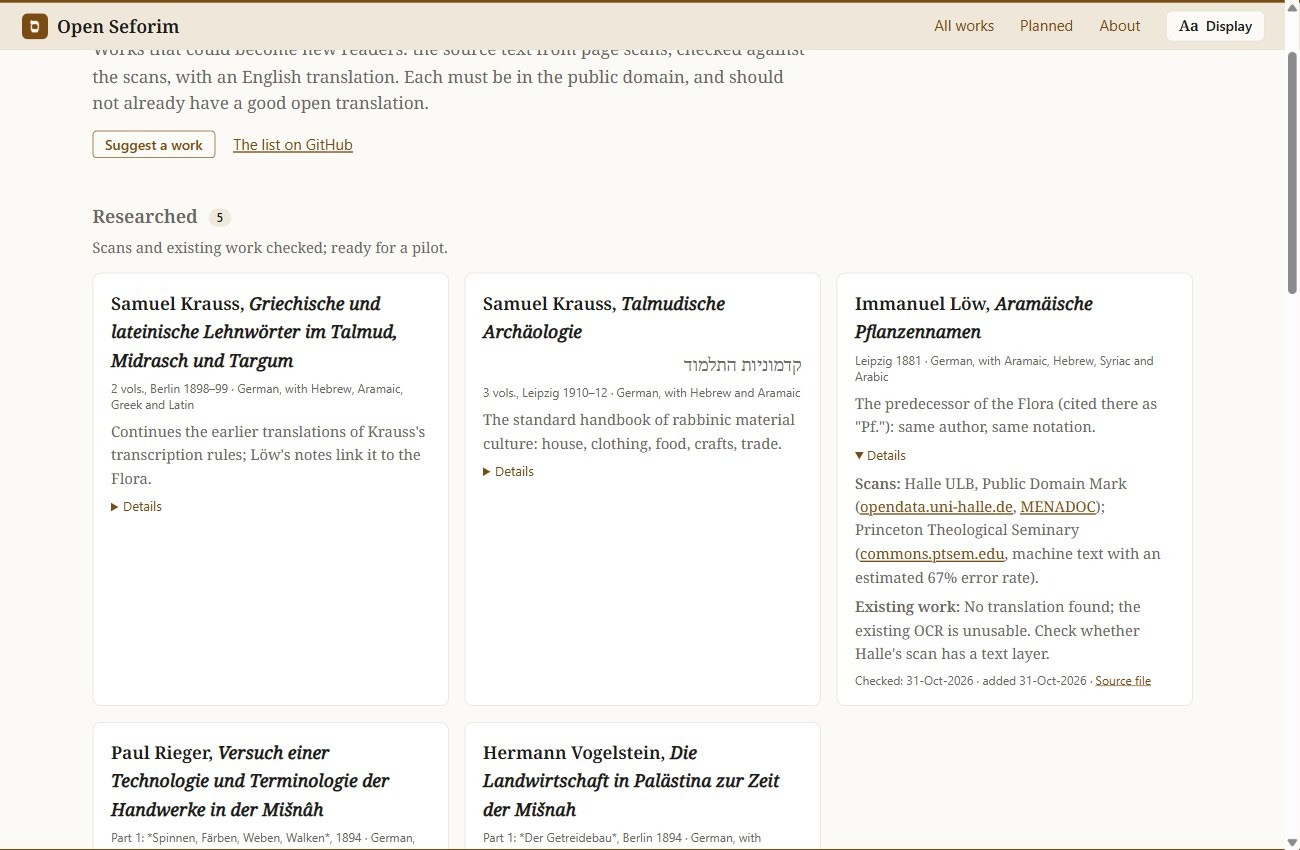
Until this week, the list of possible next works was a file in the Löw project. It is now its own page: openseforim.org/next/, built from a public list with one entry per work. Each entry says why the work matters, where the scans are, what translations already exist, whether it is in the public domain, and what has actually been checked. There are twenty works on it: five researched, nine only proposed, three started, and three set aside, each with the reason (Preuss’s Biblisch-talmudische Medizin, for example, was translated into English in 1978).
Screenshot of the planned works page, with the researched works and one entry opened:
The Bochart project began with a reader’s suggestion, and I would like more of those. Feel free to suggest a work, either on GitHub, through the “Suggest a work” button on that page, or by email to me at ezrabrand@gmail.com.
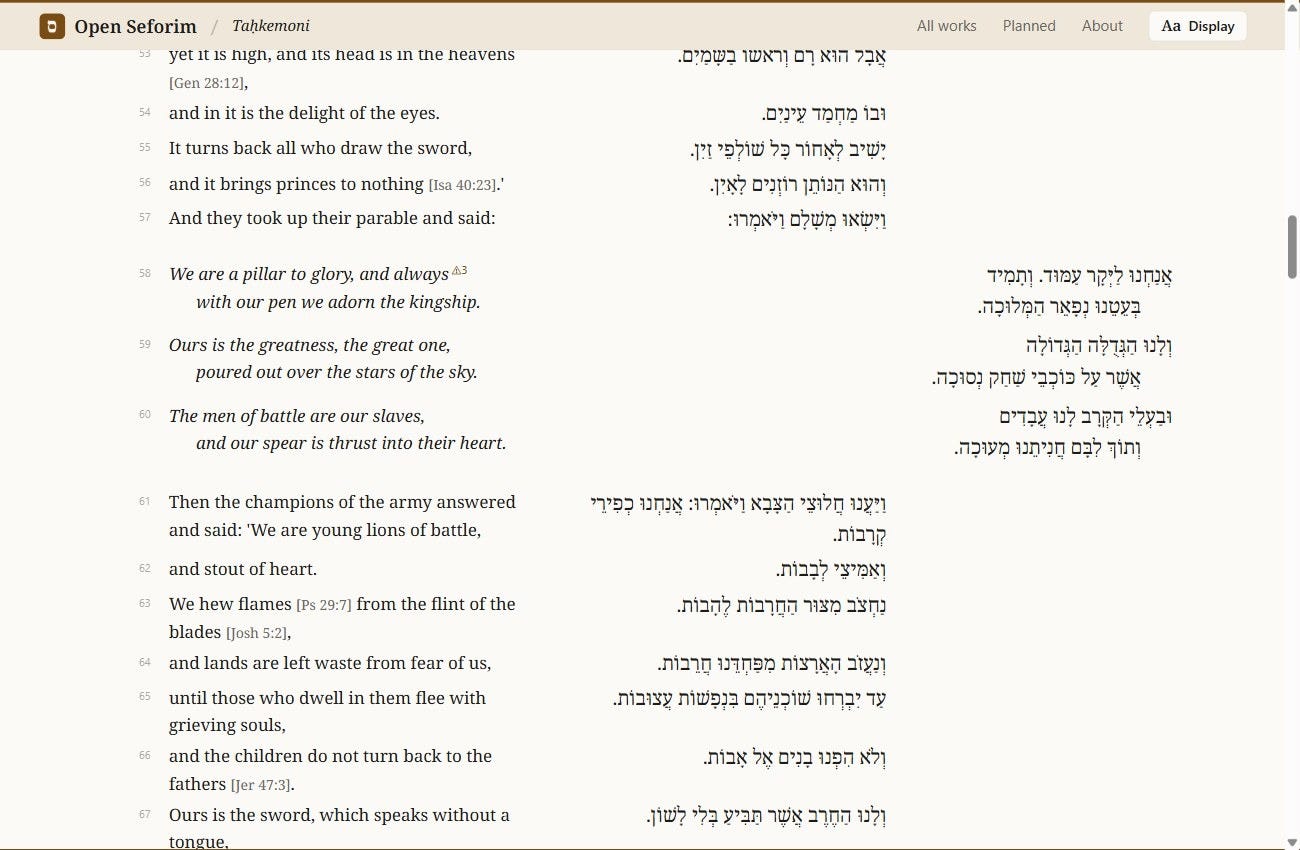
The first work started from this list is al-Ḥarizi’s Taḥkemoni, the thirteenth-century book of fifty Hebrew maqamat that Immanuel of Rome took as his model. It turned out that Project Ben-Yehuda, the volunteer library of Hebrew literature, already has the whole vocalized text, so no OCR was needed. The pilot is the fortieth gate, a debate between the pen and the sword over which one kings need more: 206 lines of rhymed prose and three short poems. The pen has the last word, as it would in a book by a writer.
Screenshot of the fortieth gate of the Taḥkemoni, prose and a poem, Hebrew and English line by line:
Next
More gates of the Taḥkemoni and more maḥberot of Immanuel, the rest of Bochart, and whatever readers suggest. The site, each work and the list of candidates are open at openseforim.org and github.com/openseforim.
The editions are free, but making them is not: it takes my time, and the model calls cost money. If you appreciate this work, please consider upgrading to a paid subscription to this newsletter.
Appendix - Technical
Hosting. A GitHub organization, openseforim, with one repository per work. Each repository publishes its own GitHub Pages site, and the organization’s site repository (openseforim.github.io) holds the custom domain, so every work is served at openseforim.org/<work>/. The .com domain forwards to the .org.
One manifest per work. Each reader’s Pages folder has a work.json: title (book titles marked *...*), Hebrew title, author, status label, summary, base edition and scan link, method, citation text, license, repository and DOI. The site’s build.py reads all of them and writes the front page cards, works.json, the /next/ page and sitemap.xml (2,704 URLs).
Shared theme. One stylesheet and one script, loaded by every reader after its own CSS. The stylesheet maps the readers’ own color variables onto one palette and uses selectors with ID weight so that it wins over each reader’s theme rules. The script adds the header strip, the display panel and the footer (from work.json), and the “this passage” citation bar for #anchor links. Settings are kept in localStorage under shared keys; Bochart’s old text-size setting is taken over once.
Post-build pass. postbuild.py (standard library only) runs at the end of every reader’s build. It writes a marked block in <head>: canonical URL, Open Graph tags, Google Scholar citation_* tags (with citation_doi), icons, and JSON-LD on each work’s home page. It puts a small script first in <head> that applies the saved theme, a matching color-scheme, the text size and the Hebrew font before the page paints. It adds lang=”he”, syr or ar to right-to-left elements and version stamps to local CSS and JS links. Pages also use a cross-document view transition, so the old page stays on screen until the new one is ready.
Hebrew fonts. Noto Serif Hebrew (default), Frank Ruhl Libre and David Libre from Google Fonts, loaded only when chosen, and a “device font” stack (SBL Hebrew, Ezra SIL, Taamey Frank CLM, Frank Ruehl CLM, David). Noto Sans Hebrew was tested and dropped: it lost most of the vowel points in Immanuel’s text.
Downloads. export.py reads each reader’s pages and writes a plain text file, a TEI file (source segment and translation paired with corresp) and an EPUB: 27 files, about 60 MB, in /downloads/<work>/.
DOIs. Zenodo’s GitHub integration is switched on for the ten repositories. A GitHub release (v2026.11.23) in each one made a Zenodo record with metadata from the repository’s .zenodo.json. The site cites the concept DOI (for example 10.5281/zenodo.24458135 for the Taḥkemoni), which resolves to the newest version. Each repository also has a CITATION.cff for GitHub’s “Cite this repository”.
Old addresses. The old user site has about 2,700 small pages, generated from the new sitemap, each with a meta refresh and a canonical link to the new address.
Candidates. A public repository, openseforim/candidates, with one Markdown file per work and a short key: value header (status proposed, researched, started or set-aside). A GitHub issue form takes suggestions. build.py renders the list as /next/.
Compare earlier posts, which covered how the individual texts are made.
In general, on these relatively new capabilities of AI, and their application in practice, compare Yeedle Neuwirth, “Machines That Write Seforim: Can Artificial Intelligence Become a Mechaber and Do We Want to Be Its Talmid?”, at Seforim Chatter (23-Nov-26), and see the comments there.
I tested a fifth font and dropped it because it lost most of the points in Immanuel’s fully vocalized text.