

This is the first part of a two-part series. The outline of the series is below.
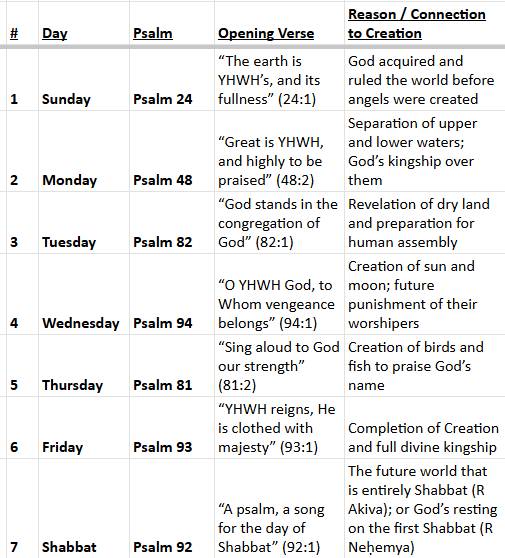
This sugya discusses the daily psalms sung by the Levites in the Temple and the theological meanings attached to them.1 Citing R. Yehuda in the name of R. Akiva, the Talmud explains the psalm appointed for each day of the week and ties it directly to the corresponding act of Creation. On Sunday, Psalm 24 (“The earth is YHWH’s and its fullness”) was sung, recalling God’s acquisition of the world before the angels were made. On Monday, Psalm 48 celebrated the separation of upper and lower waters and God’s kingship over them. On Tuesday, Psalm 82 marked the revelation of dry land and preparation for human society. On Wednesday, Psalm 94 recalled the creation of the sun and moon and the eventual punishment of their worshipers. On Thursday, Psalm 81 corresponded to the creation of birds and fish to praise God. On Friday, Psalm 93 declared divine majesty as God completed His labor. On Shabbat, Psalm 92 pointed to a future world wholly at rest and peace.
A debate follows: R. Neḥemya objects to the distinction between weekdays referring to the past and Shabbat to the future. For him, all psalms look back—Shabbat’s song commemorates God’s resting on the first Shabbat of Creation. This difference reflects a broader dispute, tied to Rav Ketina’s teaching that the world lasts six thousand years, followed by a thousand years of desolation, a “day” of divine exaltation (Isaiah 2:11; Psalms 90:4).2 Abaye extends this to two thousand years, citing Hosea 6:2. Thus, R. Akiva’s forward-looking Shabbat is aligned with Rav Ketina, while R. Neḥemya resists that eschatological reading.
The sugya then turns to the Levites’ liturgy on Shabbat itself. For the additional (musaf) offering, Rav Anan bar Rava records that the song of Ha’azinu (Deuteronomy 32) was divided into six sections following the mnemonic “הזיו לך,” a division mirrored in synagogue Torah reading. At the afternoon (minḥa) offering, according to R. Yoḥanan, they recited the Song of the Sea (Exodus 15) and the Song of the Well (Numbers 21:17), in a rotation where each section was sung week by week.
Part 2
Then, the Talmud shifts to a related theme: the gradual withdrawal of the Shekhina from the Temple before its destruction. R. Yoḥanan lists ten stages, from the Temple Ark cover (kaporet) to the Temple cherubim, from the Temple threshold (מפתן) to the Temple courtyard, then to the Temple altar, Temple roof, Temple wall, city (=Jerusalem), mountain, wilderness, and ultimately Heaven (based on verses in Ezekiel, Amos, Micah, Hosea). R. Yoḥanan adds that the Shekhina lingered in the wilderness for six months, awaiting Israel’s repentance, before finally departing.
Parallel to this, the Sanhedrin underwent ten exiles, from the Temple’s Chamber of Hewn Stone to Ḥanut, to Jerusalem, to various towns in Roman-era Galilee: Yavne, Usha, Shefaram, Beit She’arim, Tzippori, and Tiberias, the lowest point of descent (Isaiah 29:4). R. Elazar counts six main exiles instead, and R. Yoḥanan concludes with hope: from Tiberias, the lowest place, redemption will begin (Isaiah 52:2).
Outline
Intro
The Passage
R’ Yehuda citing R’ Akiva - weekly cycle of Psalms Sung by the Levites in the Temple, and reasons
R’ Neḥemya - Rejects distinction between weekdays (past) and Shabbat (future) All psalms refer to past; Shabbat psalm refers to God’s resting on the first Shabbat - Psalms 92:1
Rav Ketina - World exists 6,000 years, then 1,000 years of destruction Shabbat psalm anticipates future rest - Isaiah 2:11; Psalms 90:4
Abaye - destruction lasts 2,000 years - Hosea 6:2
Rav Anan bar Rava citing Rav - At Shabbat musaf, Levites recited Ha’azinu divided into 6 sections, following mnemonic (הזיו לך) - Deuteronomy 32
Rav Ḥanan bar Rava citing Rav - Division of Ha’azinu in Temple corresponds to synagogue reading - Deuteronomy 32
R’ Yoḥanan - At Shabbat afternoon, Levites recited Song of the Sea (Exodus 15:1) and Song of the Well (Numbers 21:17)
Part 2
Rav Yehuda bar Idi citing R’ Yoḥanan - Shekhina departed Temple in 10 stages; paralleled by 10 exiles of the Sanhedrin
Shekhina departed the Temple in 10/11 stages: Ark cover → Cherub #1 → Cherub #2 → Threshold → Courtyard → Altar → Roof → Wall → City → Mountain → Wilderness → Heaven
Shekhina departed Temple in 10/11 stages - prooftexts
R’ Yoḥanan - Shekhina lingered in wilderness 6 months hoping Israel would repent; when they did not, it abandoned them - Job 11:20
The Exile of the Sanhedrin in 10/11 stages: Chamber of Hewn Stone (in the Jerusalem Temple) → Ḥanut → Jerusalem → Yavne → Usha → Yavne → Usha → Shefaram → Beit She’arim → Tzippori → Tiberias - Isaiah 29:4
R’ Elazar - 6 exiles of the Sanhedrin - Isaiah 26:5
R’ Yoḥanan - Redemption will begin from Tiberias, the lowest point of exile - Isaiah 52:2
The Passage
At ChavrutAI, start at: Rosh_Hashanah/31a#2
R’ Yehuda citing R’ Akiva - weekly cycle of Psalms Sung by the Levites in the Temple, and reasons based on the Creation narrative in Genesis 1
Table visualizing:
תניא,
רבי יהודה אומר, משום רבי עקיבא:
בראשון מה היו אומרים?
״לה׳ הארץ ומלואה״,
על שם שקנה והקנה ושליט בעולמו.
בשני מה היו אומרים?
״גדול ה׳ ומהולל מאד״,
על שם שחילק מעשיו ומלך עליהן.
בשלישי היו אומרים:
״אלהים נצב בעדת אל״,
על שם שגילה ארץ בחכמתו, והכין תבל לעדתו.
ברביעי היו אומרים:
״אל נקמות ה׳״,
על שם שברא חמה ולבנה, ועתיד ליפרע מעובדיהן.
בחמישי היו אומרים:
״הרנינו לאלהים עוזנו״,
על שם שברא עופות ודגים לשבח לשמו.
בששי היו אומרים:
״ה׳ מלך גאות לבש״,
על שם שגמר מלאכתו ומלך עליהן.
בשביעי היו אומרים:
״מזמור שיר ליום השבת״,
ליום שכולו שבת.
§ The Talmud expands on the topic of the daily psalms recited by the Levites.
It is taught in a baraita that
R’ Yehuda said in the name of R’ Akiva:
On Sunday, what psalm would the Levites recite?
The psalm beginning with the phrase: “The earth is YHWH’s, and its fullness” (Psalms 24:1),
in commemoration of the first day of Creation, because on that day He acquired the world and transferred it to man, and He was the only ruler in His world, as the angels were not created until the second day.
On Monday what psalm would the Levites recite?
The psalm that begins: “Great is YHWH, and highly to be praised in the city of our God, His sacred mountain” (Psalms 48:2).
This is because on the second day of Creation He separated His works, dividing between the upper waters and the lower waters, and ruled over them as King; and this psalm speaks of Jerusalem as “The city of a great King” (Psalms 48:3).
On Tuesday they would recite
the psalm beginning: “God stands in the congregation of God” (Psalms 82:1),
because on the third day of Creation He revealed the land in His wisdom and thereby prepared the world for His assembly that could now live on the dry land.
On Wednesday they would recite
the psalm beginning: “O YHWH God, to Whom vengeance belongs” (Psalms 94:1),
because on the fourth day of Creation He created the sun and the moon, and in the future He will punish and take vengeance upon those who worship them.
On Thursday would recite
the psalm beginning: “Sing aloud to God our strength” (Psalms 81:2),
because on the fifth day of Creation He created birds and fish to praise His name.
On Friday they would recite
the psalm beginning: “YHWH reigns, He is clothed with majesty” (Psalms 93:1),
because on that day He completed His labor and ruled over all of creation in full glory.
On Shabbat they would recite
the psalm beginning: “A psalm, a song for the day of Shabbat” (Psalms 92:1),
as the future world will be a day that is all Shabbat.
R’ Neḥemya - Rejects distinction between weekdays (past) and Shabbat (future) All psalms refer to past; Shabbat psalm refers to God’s resting on the first Shabbat - Psalms 92:1
אמר רבי נחמיה:
מה ראו חכמים לחלק בין הפרקים הללו?
R’ Neḥemya said:
What did the rabbis see that led them to distinguish between these chapters,
as they interpret the psalms recited on the six weekdays as referring to the past, whereas the psalm recited on Shabbat is referring to the future.
אלא:
בראשון —
ש
קנה
והקנה
ושליט בעולמו.
בשני —
שחילק מעשיו
ומלך עליהם.
בשלישי —
שגילה ארץ בחכמתו
והכין תבל לעדתו.
ברביעי —
שברא חמה ולבנה
ועתיד ליפרע מעובדיהן.
בחמישי —
שברא עופות ודגים לשבח לשמו.
בששי —
שגמר מלאכתו
ומלך עליהם.
בשביעי —
על שם ששבת.
Rather, all of the psalms refer to the past.
The first six are as explained above:
On Sunday,
the reason is that
He acquired3 the world
and transferred (הקנה) it to man,
and He was the only ruler (שליט) in His world;
on Monday,
the reason is that He separated (חילק) His works
and ruled over them as King;
on Tuesday,
the reason is that He revealed the land in His wisdom
and thereby prepared the world (תבל) for His assembly.4
On Wednesday,
the reason is that He created the sun and the moon,
and in the (messianic) future He will punish5 those who worship them;
on Thursday,
the reason is that He created birds and fish to praise His name;
on Friday,
the reason is that He completed His labor
and ruled over all of creation.
However, on Shabbat,
the reason is that He rested from His work, as the phrase “A psalm, a song for the day of Shabbat” is referring to the first Shabbat of Creation.
Rav Ketina - World exists 6,000 years, then 1,000 years of destruction Shabbat psalm anticipates future rest - Isaiah 2:11; Psalms 90:4
וקמיפלגי בדרב קטינא,
דאמר רב קטינא:
שיתא אלפי שני הוה עלמא
וחד חרוב,
שנאמר: ״ונשגב ה׳ לבדו ביום ההוא״.
The Talmud comments: And these tanna’im disagree with regard to a statement of Rav Ketina,
as Rav Ketina said:
The world will exist for 6,000 years,
and for one thousand years it will be destroyed,
as it is stated: “And YHWH alone shall be exalted on that day” (Isaiah 2:11),
and one day for God is 1,000 years, as indicated in the verse: “For 1,000 years in Your sight are but as yesterday when it is past” (Psalms 90:4).
Rav Ketina’s statement is in accordance with the opinion of R’ Akiva.
Abaye - destruction lasts 2,000 years - Hosea 6:2
אמר אביי:
תרי חרוב,
שנאמר: ״יחיינו מיומים״.
Conversely, Abaye said:
The world will be destroyed for two thousand years,
as it is stated: “After two days He will revive us” (Hosea 6:2).
According to the opinion of Abaye that the destruction will be for two “days”, there is no connection between the future world and the day of Shabbat, which is only one day.
Rav Anan bar Rava citing Rav - At Shabbat musaf, Levites recited Ha’azinu divided into 6 sections, following mnemonic (הזיו לך) - Deuteronomy 32
ה – “Ha’azinu” (verse 1)
ז – “Zekhor” (verse 7)
י – “Yarkivehu” (verse 13)
ו – “Va-yar” (verse 19)
ל – “Lulei” (verse 27)
כ – “Ki” (verse 36)
במוספי דשבתא מה היו אומרים?
אמר רב ענן בר רבא, אמר רב:
״הזיו לך״.
§ The Talmud further asks: When it came to the additional offerings (מוספי) of Shabbat, what would the Levites recite?
Rav Anan bar Rava said that Rav said:
They would recite in accordance with the mnemonic
hei,
zayin,
yod,
vav,
lamed,
kaf.6
They would divide the song of Ha’azinu into six sections, each of which began with a letter of the mnemonic:
“Give ear [ha’azinu], you heavens” (Deuteronomy 32:1);
“Remember [zekhor] the days of old” (Deuteronomy 32:7);
“He made him ride [yarkivehu] on the high places of the earth” (Deuteronomy 32:13);
“YHWH saw it [va-yar] and spurned” (Deuteronomy 32:19);
“Were it not [lulei] that I dread the enemy’s provocation” (Deuteronomy 32:27);
“For [ki] YHWH will judge His people” (Deuteronomy 32:36).
Rav Ḥanan bar Rava citing Rav - Division of Ha’azinu in Temple corresponds to synagogue reading - Deuteronomy 32
ואמר רב חנן בר רבא, אמר רב:
כדרך שחלוקים כאן —
כך חלוקין בבית הכנסת.
And Rav Ḥanan bar Rava said that Rav said:
In the manner that the verses of the song of Ha’azinu are divided here for the recitation of the additional offerings of Shabbat in the Temple --
so too are they divided when they are read in the synagogue on Shabbat.
R’ Yoḥanan - At Shabbat afternoon, Levites recited Song of the Sea (Exodus 15:1) and Song of the Well (Numbers 21:17)
במנחתא דשבתא מה היו אומרים?
אמר רבי יוחנן:
״אז ישיר״,
ו״מי כמוך״,
ו״אז ישיר״.
[...]
The Talmud asks another question: When it came to the daily afternoon offering (מנחתא) on Shabbat, what would the Levites recite?
R’ Yoḥanan said:
“Then sang Moses” (Exodus 15:1),
and: “Who is like You” (Exodus 15:11), the two halves of the Song of the Sea,
and: “Then Israel sang this song” (Numbers 21:17), the entire Song of the Well.
[...]
See Wikipedia, “Shir shel yom”; the list first appears in final Mishnah of tractate Tamid, Mishnah_Tamid.7.4.
קנה - or: “created”.
עדתו - or: “his congregation”, likely referring to the Jews.
ליפרע - literally: “collect (payment)”.