

This is the first part of a three-part series. The outline of the series is below.1
Part 1
This sugya moves from a legal distinction about a married woman’s affiliation for the Paschal offering into a long aggadic sequence about marriage, Israel, prophecy, exile, and redemption. Its opening distinction is technical: when a woman wishes to be counted for the Paschal offering, the ruling depends on whether she is “eager” or “pursued” to return to her father’s house. If she is still strongly drawn to her father’s house, the baraita assumes she may be included in her father’s group even after the first year of marriage. If she is not, the Mishnah assumes she belongs with her husband’s group. This legal distinction becomes the entry point for a broader symbolic use of bride imagery: the bride’s movement between father’s house and husband’s house becomes a model for Israel’s relationship to God.
R. Yoḥanan develops this imagery through Song of Songs and Hosea. Song of Songs 8:10, “then I was in his eyes as one who finds peace,” is read as describing a bride who is accepted and found complete in her father-in-law’s house, yet eagerly returns to her father’s house to report her praise. Hosea 2:18, “you shall call Me: My husband, and shall call Me no more: My master,” is read as a future stage in which Israel relates to God like a bride settled in her husband’s house, not like a bride still in her father’s house during betrothal. The same cluster of verses then generates further interpretations: “our little sister, and she has no breasts” is interpreted as Elam (a region south-east of Babylonia), a Jewish community that merited Torah study but not public Torah teaching; “I am a wall” is interpreted by R. Yoḥanan as Torah, and “my breasts like towers” as Torah scholars. Rava gives a parallel national-institutional reading: “I am a wall” means the nation of Israel, and “my breasts like towers” means synagogues and study halls.
The sugya then turns to another praise of Israel, from Psalms 144:12. Rav Zutra bar Toviya in the name of Rav reads “our sons as plants grown in their youth” as the young men of Israel who have not sinned, and “our daughters as corner pillars” as Israelite virgins who preserve themselves for their husbands. Supporting verses from Zechariah 9:15 and Psalms 144:13 establish that “corner” can imply fullness or sealed wholeness. The continuation, “carved after the fashion of a palace,” is read as saying that such young men and women are credited as though the Temple had been built in their days. Here the sugya continues the same symbolic field: bodily integrity, sexual restraint, marriage, and Temple imagery are all linked.
Part 2
The main body of the sugya then shifts to Hosea (c. 8th century BCE). Hosea 1:1 introduces the prophet as active in the days of Uzziah, Jotham, Ahaz, and Hezekiah of Judah (the 10th-13th kings of Judah), and Jeroboam son of Joash of Israel (the 13th king of Israel). The Talmud states that four prophets prophesied in one era: Hosea, Isaiah, Amos, and Micah. R. Yoḥanan explains that Hosea was “first” not among all prophets from Moses onward, but among these four prophets of his generation. This chronological point introduces a much larger theological story about Hosea’s failure as a prophet.
God tells Hosea, “Your children have sinned.” Hosea should have defended Israel by saying that they are God’s children, descendants of Abraham, Isaac, and Jacob, and asking God to extend mercy to them. Instead, Hosea says that the whole world belongs to God and suggests that God replace Israel with another nation. In response, God gives Hosea a lived prophetic lesson: he is commanded to marry a prostitute and have children of prostitution. After Hosea becomes attached to this wife and these children, God tells him to separate from her. Hosea replies that he cannot, because he has children from her. God then rebukes him by a fortiori reasoning: Hosea cannot abandon a wife of prostitution and children whose paternity is uncertain, yet he suggested that God abandon Israel, who are God’s children, descendants of the biblical Patriarchs, and one of God’s four acquisitions.
The four divine acquisitions are Torah, heaven and earth, the Temple, and Israel. Torah is derived from Proverbs 8:22, “YHWH acquired me as the beginning of His way.” Heaven and earth are derived from Genesis 14:19, “Creator/acquirer of heaven and earth.” The Temple is derived from Psalms 78:54, “this mountain which His right hand acquired.” Israel is derived from Exodus 15:16, “the nation that You acquired.” This list turns the rebuke into a theological claim: Israel is not replaceable, because Israel belongs to the core set of divine possessions in the created order.
Hosea realizes his error and begins to seek mercy for himself, but God tells him first to seek mercy for Israel, since three decrees were issued because of him. These decrees are symbolized by the names of Hosea’s children: Jezreel, Lo-ruḥamah, and Lo-ammi. Hosea prays for Israel, and the decrees are reversed into blessings. Hosea 2:1–2 transforms “not My people” into “children of the living God,” and Hosea 2:25 transforms “not pitied” and “not My people” into objects of compassion and covenantal belonging: “I will have compassion upon her that had not received compassion,” and “I will say to them that were not My people: You are My people.” The sugya thus reads Hosea’s family drama as a staged divine correction of prophetic accusation and as the source of Israel’s restored status.
The sugya gives special attention to the name of Hosea’s wife, Gomer daughter of Diblaim, reading them as interpretive keys to Hosea’s symbolic marriage. Rav reads “Gomer” from the root GMR (גמר), “to finish,” meaning that all would “finish” (=climax) with her sexually. “Diblaim” (DBLYM) is read as having root DBH - דבה רעה בת דבה רעה, “ill repute, daughter of ill repute.” Shmuel instead connects “Diblaim” with DBLH (דבילה), a pressed fig-cake, saying she was sweet in everyone’s mouth like a fig-cake, while R. Yoḥanan sharpens the same image by saying that all tread upon her like a fig-cake. The sugya then adds a national-historical reading: R. Yehuda says “Gomer” alludes to enemies seeking to “finish” Israel’s wealth in her days, and R. Yoḥanan says they actually plundered and finished it, citing II Kings 13:7. Gomer’s name therefore functions on two levels: it marks the degraded character of Hosea’s marriage partner within the prophetic drama, and it also encodes Israel’s political and economic vulnerability in the period of Aramean oppression.
Part 3
Several related teachings follow. R. Yoḥanan says that political authority buries its holders, supported by the fact that prophets outlived multiple kings. He also explains why Jeroboam son of Joash is listed alongside the Judean kings in Hosea 1:1: he did not accept slander against Amos. Amaziah priest of Beth-El reported to Jeroboam that Amos had conspired against him and prophesied his death, but Jeroboam refused to punish Amos, saying that if Amos had said it, the Shekhina had spoken through him. This becomes an example of restraint toward a prophet and refusal to accept lashon hara.
R. Elazar then states that even in God’s anger, He remembers mercy, deriving this from Hosea 1:6, where the very decree “I will no more have compassion” still mentions compassion. R. Yosei bar R. Ḥanina derives the same idea from the phrase “I will surely bear them,” read as implying eventual forgiveness. R. Elazar also explains Israel’s exile among the nations as a way to add converts to them, interpreting Hosea 2:25, “I will sow her to Me in the land,” through an agricultural analogy: a person sows a small amount of seed in order to harvest a much larger yield. R. Yoḥanan offers a related reading from the same verse: those who had been “not My people” will become “My people,” meaning converts from the nations will join Israel.
This produces a general rule, stated by R. Yoḥanan in the name of R. Shimon bar Yoḥai: even when a generation is wicked, one must not slander God’s servants to their Master. Proverbs 30:10 warns against slandering a servant to his master, and the next verse describes a generation that curses its father and does not bless its mother. The juxtaposition means that even such a corrupt generation must not be denounced before God. The proof is Hosea, whose criticism of Israel was treated as a sin even though the generation itself was wicked.
The sugya then turns to the location of exile, especially Babylonia. R. Ḥiyya interprets Job 28:23 to mean that God understood Israel could not endure Roman decrees, and therefore exiled them to Babylonia (to live under Persian rule). R. Elazar says Israel was exiled to Babylonia because it is deep like Sheol, connecting it to Hosea 13:14, “I shall ransom them from the power of Sheol.” R. Ḥanina says the reason was linguistic: Aramaic is close to Hebrew, the language of Torah. R. Yoḥanan says God sent Israel to its mother’s house, comparing exile to a husband angered at his wife who sends her back to her mother’s home. R. Alexandri generalizes this into a list of three things that returned to their origin: Israel to Babylonia, the wealth of Egypt back to Egypt, and the writing of the Tablets upward when the Tablets were broken and the letters flew away.
Ulla gives a more concrete explanation: Israel was exiled to Babylonia so they could eat dates and engage in Torah. This leads to a comic anecdote. When Ulla visits Pumbedita (a major Jewish center in Babylonia) and learns that dates are extremely cheap, he criticizes the Babylonian rabbis: with such inexpensive food, they should be learning more Torah. But after eating dates and suffering that night, he reverses himself and praises them: even though these dates function like “lethal poison,” the Babylonians nevertheless engage in Torah.
The sugya concludes with redemptive motifs. R. Elazar interprets Isaiah 2:3, where the nations say, “Let us go up to the mountain of YHWH, to the house of the God of Jacob.” The verse mentions Jacob specifically because the future Temple will correspond to Jacob’s term “house,” not Abraham’s “mountain” or Isaac’s “field.” Abraham called the site a mountain, Isaac encountered it as a field, but Jacob called it Beth-El, the house of God. The final teaching, from R. Yoḥanan, states that the ingathering of exiles is as great as the creation of heaven and earth. This is derived from the word “day” in Hosea 2:2, “great shall be the day of Jezreel,” and Genesis 1:5, “one day.”
The sugya thus ends by turning Hosea’s language of punishment, names like Jezreel, Lo-ruḥamah, and Lo-ammi, into a language of return, restoration, and creation-scale renewal.
Hosea 1:1-3
Hosea 1:1-3:
דבר יהוה אשר היה אל הושע בן בארי
בימי
עזיה
יותם
אחז
יחזקיה
מלכי יהודה
ובימי ירבעם בן יואש מלך ישראל
The word of YHWH that came to Hoshea, the son of Be’eri,
in the days of
Uzziyya,
Yotam,
Aḥaz,
and Yeḥizqiyya,
kings of Yehuda,
and in the days of Yorov’am the son of Yo’ash, king of Yisra’el.
תחלת דבר יהוה בהושע
ויאמר יהוה אל הושע
לך קח לך אשת זנונים
וילדי זנונים
כי זנה תזנה הארץ מאחרי יהוה
When YHWH spoke at first with Hoshea,
YHWH said to Hoshea:
Go take to you a wife of prostitution (זנונים)
and children of prostitution;
for the land has lewdly gone astray from YHWH.
וילך ויקח את גמר בת דבלים
ותהר ותלד לו בן
So he went and took Gomer the daughter of Divlayim;
who conceived, and bore him a son.
Outline
Intro
Hosea 1:1-3
The Passage
Talmud Resolves contradiction: one source concerns a woman eager to return to her father’s house; the Mishnah concerns one who is not eager
R’ Yoḥanan - Song of Songs’ “finding peace” describes a bride accepted in her father-in-law’s house, eager to report praise in her father’s house - Song of Songs 8:10
R’ Yoḥanan - Hosea’s “My husband” means Israel will relate to God like a bride in her father-in-law’s house, not still in her father’s house - Hosea 2:18
R’ Yoḥanan - “Our little sister with no breasts” refers to Eilam, which merited learning Torah but not teaching it publicly - Song of Songs 8:8
R’ Yoḥanan - “I am a wall” = Torah; “my breasts like towers” = Torah scholars - Song of Songs 8:10
Rava - “I am a wall” = Congregation of Israel; “my breasts like towers” = synagogues and study halls - Song of Songs 8:10
Rav Zutra bar Toviya citing Rav - Israel’s young men are pure, its young women are modest virgins - Psalms 144:12
Alternative prooftexts - Psalms 144:13; Zechariah 9:15
They’re credited as if the Temple were built in their days
Part 2
R’ Yoḥanan - Hosea was first among the four prophets of his generation: Hosea, Isaiah, Amos, Micah - Hosea 1:1–2
God rebuked Hosea for not defending Israel when God said they had sinned; Hosea instead suggested replacing them with another nation
God commanded Hosea to marry Gomer and have children, then challenged him to separate from her, to teach him why God would not abandon Israel
Prooftext - Hosea 1:2–9
Rav - “Gomer” name read homiletically to mean that all “finished” with her; “Diblaim” means “ill repute, daughter of ill repute” - Hosea 1:3
Shmuel - “Diblaim” means she was sweet to all like a fig-cake
R’ Yoḥanan - “Diblaim” means all tread upon her like a fig-cake
R’ Yehuda - “Gomer” also alludes to enemies seeking to finish Israel’s wealth in her days
R’ Yoḥanan - Enemies actually plundered and finished Israel’s wealth - II Kings 13:7
Hosea 1:3–9
Jezreel
Lo-ruhamah
Lo-ammi
God rebuked Hosea: if Hosea cannot abandon uncertain children, how can God abandon Israel, His children and one of His four acquisitions?
Four divine acquisitions - Torah, heaven and earth, Temple, and Israel - Proverbs 8:22; Genesis 14:19; Psalms 78:54; Exodus 15:16
Hosea realized his sin, prayed for Israel, nullified the three decrees (symbolized by his three children), and turned them into blessings
Prooftext - Hosea 2:1–2; Hosea 2:25
R’ Yoḥanan - political authority buries its holders
Prooftext - prophets outlived four kings - Isaiah 1:1
R’ Yoḥanan - Jeroboam son of Joash was counted with Judean kings because he refused to accept slander against Amos - Hosea 1:1; Amos 7:10–11
Prooftext that Jeroboam did not accept slander - Amos 7:10-11
Part 3
R’ Elazar - Even in God’s anger, He remembers mercy
Prooftext - Hosea 1:6
R’ Yosei b. Ḥanina - God’s mercy is also implied by “I will surely bear them,” meaning eventual forgiveness - Hosea 1:6
R’ Elazar - Israel was exiled among the nations so converts would be added to them, like seed producing a larger harvest - Hosea 2:25
R’ Yoḥanan - The same idea is derived from God having compassion on “not pitied” and calling “not My people” His people - Hosea 2:25
R’ Yoḥanan citing R’ Shimon ben Yoḥai - Even when a generation is wicked, one must not slander God’s servants to their Master - Proverbs 30:10–11
... and this is learned from Hosea
R’ Ḥiyya - God exiled Israel to Babylonia because He knew they could not endure Roman decrees - Job 28:23
R’ Elazar - Israel was exiled to Babylonia because it is deep like Sheol, fitting redemption from Sheol - Hosea 13:14
R’ Ḥanina - Israel was exiled to Babylonia because Aramaic is close to Hebrew (“the language of Torah”)
R’ Yoḥanan - Israel was exiled to Babylonia as to its mother’s house
... like a wife sent back to her mother’s home
R’ Alexandri - Three things returned to their origin: Israel to Babylonia, Egyptian wealth to Egypt, and the writing of the Tablets upward
Prooftexts - I Kings 14:25–26; Deuteronomy 9:17; Baraita - When the Tablets broke, the letters flew away
Ulla - Israel was exiled to Babylonia so they could eat dates and study Torah
Anecdote about Ulla - he first criticized Babylonians for not learning more despite cheap dates
... then after indigestion, praised them for learning despite the dates’ harmful effect
R’ Elazar - The future Temple is called specifically “God of Jacob,” because Abraham called it a mountain, Isaac a field, but Jacob called it a house - Isaiah 2:3; Genesis 22:14; Genesis 24:63; Genesis 28:19
R’ Yoḥanan - The ingathering of exiles is as great as the creation of heaven and earth
Prooftexts - based on “day” in both passages - Hosea 2:2; Genesis 1:5
Appendix - the sugya’s homiletic material on Hosea, ordered by biblical verse sequence
The Passage
Sefaria: Pesachim.87a.5-88a.5
ChavrutAI: from Pesachim/87a#5 to 88a#5
Talmud Resolves contradiction: one source concerns a woman eager to return to her father’s house; the Mishnah concerns one who is not eager
לא קשיא:
כאן,
ברדופה לילך.
כאן,
בשאינה רדופה.
This is not difficult.
There,
the baraita is referring to the case of a woman who eagerly hurries as one pursued (רדופה) to go to her father’s house. It is therefore reasonable that, even after the 1st year of her marriage, she wishes to be included in her father’s group.
However, here
the Mishnah is referring to the case of a woman who does not eagerly hurry as one pursued to go to her father’s house, and it is therefore presumed she wishes to be included in her husband’s group.
R’ Yoḥanan - Song of Songs’ “finding peace” describes a bride accepted in her father-in-law’s house, eager to report praise in her father’s house - Song of Songs 8:10
דכתיב:
״אז הייתי בעיניו כמוצאת שלום״,
ואמר רבי יוחנן:
ככלה שנמצאת שלימה בבית חמיה,
ורדופה לילך להגיד שבחה בבית אביה.
There is a homiletic interpretation of verses that conveys a similar idea, as it is written:
“I am a wall, and my breasts are like towers; then I was in his eyes as one who finds peace” (Song of Songs 8:10).
And R’ Yoḥanan said:
She is like a bride who was found perfect2 and was thus warmly received in her father-in-law’s house.
And she eagerly hurries, as one pursued, to go to tell of her praise (שבחה), i.e., her warm welcome, in her father’s house.
R’ Yoḥanan - Hosea’s “My husband” means Israel will relate to God like a bride in her father-in-law’s house, not still in her father’s house - Hosea 2:18
כדכתיב:
״והיה ביום ההוא
נאם ה׳
תקראי אישי
ולא תקראי לי עוד בעלי״,
אמר רבי יוחנן:
ככלה בבית חמיה,
ולא ככלה בבית אביה.
As it is written:
“And it shall be at that day,
says YHWH,
that you shall call Me: My Husband,
and shall call Me no more: My Master” (Hosea 2:18),
of which R’ Yoḥanan said:
She shall be like a bride in her father-in-law’s house, where she experiences a close relationship with her husband.
And she shall not be like a bride still in the betrothal period and living in her father’s house, during which time her relationship with her husband has still not developed.
R’ Yoḥanan - “Our little sister with no breasts” refers to Eilam, which merited learning Torah but not teaching it publicly - Song of Songs 8:8
״אחות לנו קטנה
ושדים אין לה״,
אמר רבי יוחנן:
זו עילם,
שזכתה ללמוד,
ולא זכתה ללמד.
Apropos the verse from Song of Songs cited previously, the Talmud homiletically interprets an adjacent verse:
“We have a little sister,
and she has no breasts” (Song of Songs 8:8).
R’ Yoḥanan said:
This is an allusion to the Jewish community of Elam,
which was privileged to study Torah and become Torah scholars,
but was not privileged to teach and influence the masses.3
R’ Yoḥanan - “I am a wall” = Torah; “my breasts like towers” = Torah scholars - Song of Songs 8:10
״אני חומה
ושדי כמגדלות״,
אמר רבי יוחנן:
״אני חומה״ —
זו תורה,
״ושדי כמגדלות״ —
אלו תלמידי חכמים.
The Talmud interprets another verse:
“I am a wall
and my breasts are like towers” (Song of Songs 8:10).
R’ Yoḥanan said:
“I am a wall”;
this is a reference to the Torah.
“And my breasts are like towers”;
these are the Torah scholars, who, by disseminating their Torah and influencing the masses protect them like watchtowers.
Rava - “I am a wall” = Congregation of Israel; “my breasts like towers” = synagogues and study halls - Song of Songs 8:10
ורבא אמר:
״אני חומה״ —
זו כנסת ישראל,
״ושדי כמגדלות״ —
אלו בתי כנסיות ובתי מדרשות.
And Rava said:
“I am a wall”;
this is the Congregation of Israel.
“And my breasts are like towers”;
these are the synagogues and study halls in which the Congregation of Israel is nurtured by the Torah, from which it draws its spiritual strength.
Rav Zutra bar Toviya citing Rav - Israel’s young men are pure, its young women are modest virgins - Psalms 144:12
אמר רב זוטרא בר טוביה, אמר רב:
מאי דכתיב:
״אשר בנינו כנטעים מגדלים בנעוריהם
בנותינו כזוית,
מחטבות תבנית היכל״
Rav Zutra bar Toviya said that Rav said a homiletic interpretation of another verse in praise of Israel:
What is the meaning of that which is written:
“We whose sons are as plants grown up in their youth;
whose daughters are as corner pillars (זוית),
carved (מחטבות) after the fashion of a palace (היכל)” (Psalms 144:12)?
״אשר בנינו כנטעים״ —
אלו בחורי ישראל שלא טעמו טעם חטא.
״בנותינו כזוית״ —
אלו בתולות ישראל שאוגדות פתחיהן לבעליהן.
He interprets each phrase of this verse:
“We whose sons are as plants” indicates they are healthy and undamaged;
these are the young men of Israel who have not tasted the taste of sin.4
“Whose daughters are as corner pillars”
indicates that they are filled and sealed; these are the virgins of Israel, who bind (אוגדות) and seal their openings5 exclusively for their husbands.
Prooftexts for the meaning of “corner” - Psalms 144:13; Zechariah 9:15
וכן הוא אומר:
״ומלאו כמזרק, כזוית מזבח״,
איבעית אימא מהכא:
״מזוינו מלאים, מפיקים מזן אל זן״,
And similarly, another verse demonstrates that a “corner” (זוית) refers to something full: It is stated:
“And they shall be filled like the basins (מזרק), like the corners (זוית) of the altar” (Zechariah 9:15).
If you wish, say an alternative support for this idea from here:
“Our corners (מזוינו) are full, affording all manner of store” (Psalms 144:13).
They’re credited as if the Temple were built in their days - Psalms 144:12
״מחטבות תבנית היכל״ —
אלו ואלו מעלה עליהן הכתוב כאילו נבנה היכל בימיהן.
The Talmud returns and interprets the final phrase of the verse in Psalms 144:12:
“Carved after the fashion of a palace”;
the verse ascribes to both these and those, the young men and women who vigilantly preserve their modesty, as though the Sanctuary6 were built in their days.
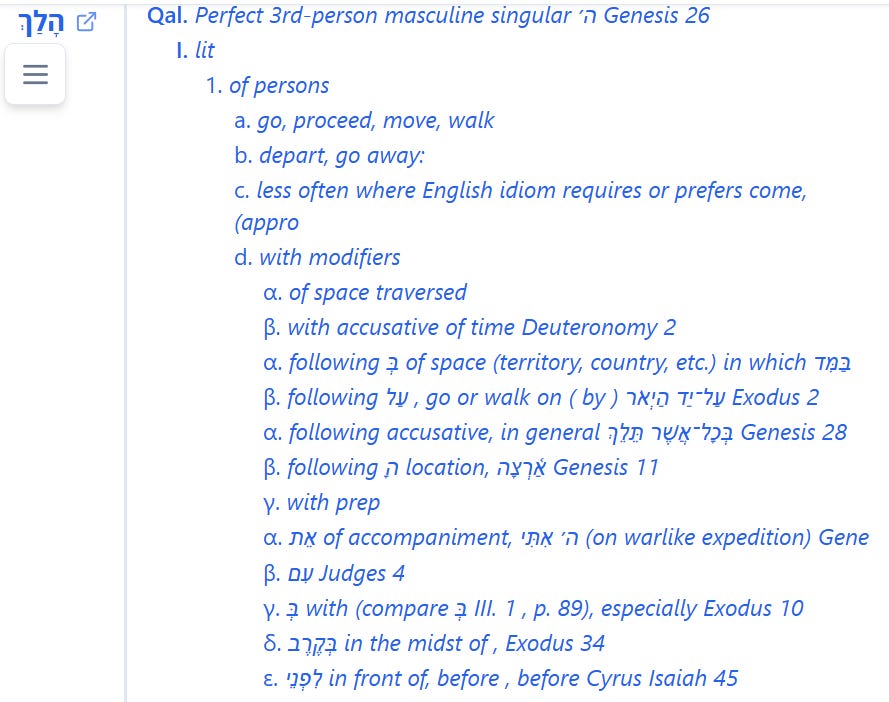
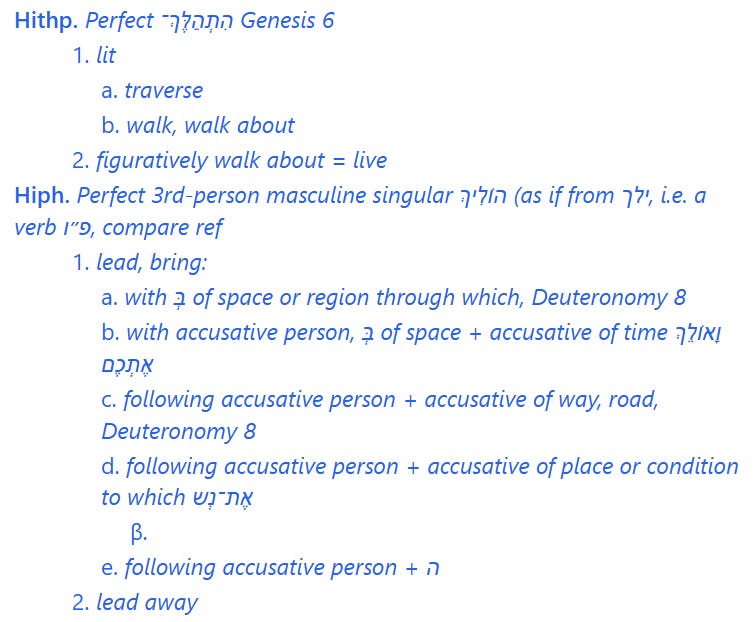
As an aside (unrelated to the main piece), note continuing work on the BDB dictionary reader at the ChavrutAI website. See the updates documented at the Changelog page, section “May 2026“:
BDB: Person/Number/Gender Abbreviations:
Person markers that BDB uses for verb conjugations — 1 s., 2 s., 3 s., 1 pl., 2 pl., 3 pl., plus their gendered variants 3 fs., 3 ms., 3 mp./3 mpl., 3 fp./3 fpl., and the spaced forms 3 m. s., 3 f. pl., etc. — now expand to readable labels like 3rd-person feminine singular and 3rd-person masculine plural
Added c. → with (the Latin cum, used heavily in BDB syntax notes like “γ. c. preposition”). The expander is careful not to touch the lettered section label c. when it appears in bold as a sub-sense marker
The abbreviation loc. now expands to location (previously the more confusing “local, locality”)
Fixed Greek sub-markers not showing up in the BDB outline for entries like הָלַךְ. BDB uses two surface forms for these markers — α. with a period, and parenthesised (α) with no period — and the outline previously only recognised the period form. Now both forms appear as outline rows and the closing paren stays visible in the body text
BDB: Outline Hamburger, Scroll Tracking & Section-Header Polish:
Added a hamburger menu fixed to the top-left of the viewport that opens a floating outline panel for the BDB entry you’re currently reading. The button stays in place as you scroll so the outline remains one click away even deep inside long entries like הָלַךְ, and the panel highlights the section you’re currently in
Sense headers whose abbreviations get expanded into pills (e.g. Niph. → Niphal, Hithp. → Hithpael) now stay visually bold and body-sized, so they still read as clear section headers rather than collapsing into small monospace pills mid-prose
The Split by semicolons toggle is now on by default — most BDB entries are easier to scan with parallel clauses indented
BDB: Hierarchical Entry Outline, Pill Wrapping & Semicolon Splitting Fixes:
Added a hierarchical, hyperlinked outline at the top of multi-section BDB entries. Long entries like הָלַךְ now show a nested jump list covering all five BDB structural levels — verbal stems (Qal, Niph., Hithp., Hiph., …), Roman-numeral super-sections (I., II.), numbered senses (1., 2., …), lettered sub-sections (a., b., c., …) and inline Greek-letter sub-sub-markers (α., β., γ., δ., …) that appear mid-sense for things like preposition-grouped usages. Each row shows a short italic gloss extracted from the entry text and smooth-scrolls to its section. Greek markers that repeat within a sense (BDB reuses α./β./γ. across sub-groups) each get their own unique anchor so you land on the right occurrence
Outline levels normalize to the shallowest level present, so a flat entry with only numbered senses (like אָב²) renders flush-left while a deeply-structured entry indents stems / numbers / letters proportionally
Fixed long abbreviation pills (e.g. Corpus Inscriptionum Semiticarum) that previously stretched the page horizontally — pills now wrap at spaces while keeping their rounded background on each line
Fixed a bug where Split by semicolons only divided paragraphs from the second one onward; the first paragraph of each entry is now also split at semicolons when the option is enabled
Screenshots of the beginning of now-generated outline, at entry “ הָלַךְ“, for illustration:
שלימה - literally “complete”, playing on shalom of the verse.
“Breasts” in the verse are homiletically understood to be a metaphor for teaching, akin to breasts which provide milk.
I.e. illicit sex.
פתחיהן - a euphemism for genitalia.
Compare the same euphemism in my “Perfume, Pleasure, and Moral Decay in Late First Temple Samaria and Jerusalem: Interpretations of Amos 6 and Isaiah 3 (Shabbat 62b-63a)“, section “Rav and Shmuel - “their secret parts” either means their innards poured out like a jug, or their orifices (=genitalia) became (hairy) like a forest - Isaiah 3:17“.
And see also my “The Geonic Bracha on Virginity (ברכת בתולים)“, section “The text of the Bracha of Virginity“, where I note:
The text of the bracha [on virginity] is quite allusive. It uses a euphemistic symbol for virginity: “sealed spring” - מעין חתום. This symbol is an allusion to the verse in Shir Hashirim 4:12.
היכל - in straightforward reading of the verse in Psalms, heichal is a generic term for a palace; the Talmud homiletically interprets it according to the rabbinic meaning, where the word always refers specifically to the Temple in Jerusalem.