

This is the first part of a two-part series. The outline of the series is below.
Part 1
This sugya addresses whether a boy as young as 8 years old can be regarded as physiologically capable of fathering a child.1 The immediate legal dispute is between Beit Shammai and Beit Hillel. According to Babylonian amoraim cited by the sugya, they disagree about an 8-year-old: Beit Shammai hold that the capacities attested among “earlier (=biblical) generations” can be used to establish what is biologically possible, whereas Beit Hillel reject such an inference. The ensuing discussion therefore becomes an extended attempt to prove from biblical chronology that males in earlier generations did in fact father children at age 8.
The Talmud’s method is genealogical and arithmetical. It combines biblical statements about parentage with fixed ages and chronological intervals, then subtracts the time occupied by pregnancies. If several successive generations can be fitted into a sufficiently short span, the resulting calculation can establish unusually early paternity. Much of the sugya consists of proposing such calculations and then testing whether the biblical evidence actually requires the assumed ages and birth order.
The first attempted proof uses the family of Ahithophel. II Samuel identifies Bathsheba as the daughter of Eliam2 and elsewhere identifies Eliam as the son of Ahithophel, making Bathsheba Ahithophel’s granddaughter. The Talmud then reconstructs the chronology between Solomon’s birth and Ahithophel’s death during Absalom’s rebellion. Solomon had already been born before the events surrounding Amnon and Absalom. Two years passed before Absalom’s sheepshearing and the killing of Amnon; Absalom then spent 3 years in Geshur and another 2 years in Jerusalem before being fully reconciled with David. His rebellion followed thereafter, and Ahithophel died during that rebellion. The sugya therefore treats Solomon as at least 7 years old at Ahithophel’s death.
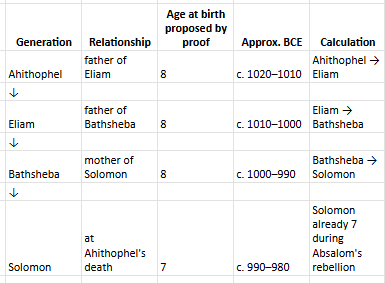
A baraita supplies another crucial figure: Ahithophel lived only 33 years. This is connected with Psalms 55:24, “bloody and deceitful men shall not live out half their days,” and the same tradition gives Doeg a lifespan of 34 years. Subtracting Solomon’s 7 years from Ahithophel’s 33 leaves 26 years between Ahithophel’s own birth and Solomon’s birth. The chain from Ahithophel to Solomon contains 3 births: Ahithophel fathered Eliam, Eliam fathered Bathsheba, and Bathsheba bore Solomon. After subtracting 2 years for the 3 pregnancies, 24 years remain for the ages of the 3 parents at conception or birth. Divided evenly, this produces an age of 8 for each generation.
The proof, however, is rejected because the arithmetic does not establish that the 24 years were distributed equally. Ahithophel and Eliam could each have fathered children at age 9, while Bathsheba could have given birth at age 6. The Talmud specifically allows for the possibility that females could become reproductively capable earlier than males. Bathsheba’s history makes this possibility especially relevant, since Solomon was not her first child by David. The chronology therefore establishes an unusually compressed genealogy, but it does not specifically prove male paternity at age 8.
Part 2
The sugya next turns to the family of Terah. Genesis lists his sons as Abram, Nahor, and Haran. Reading the list as birth order would make Abraham one year older than Nahor and two years older than Haran. The argument then identifies Sarah with Iscah, daughter of Haran, following R. Yitzhak. This identification prompts a short exegetical digression on Sarah’s alternate name. One explanation derives “Iscah” from her capacity to perceive through the Holy Spirit, connected with God’s instruction to Abraham to listen to Sarah. Another derives the name from the fact that everyone gazed upon her beauty.
Genesis 17 states that Abraham was 100 and Sarah 90, establishing a 10-year age difference between them. If Abraham was 2 years older than Sarah’s father Haran, then Haran was only 8 years older than Sarah. Haran must therefore have fathered Sarah at age 8. This would provide precisely the case sought by the sugya: an identifiable male in an earlier biblical generation becoming a father at that age.
Here too, however, the proof depends on an assumption that can be challenged. The listing of Abram, Nahor, and Haran need not represent birth order. Abraham could have been the youngest brother but listed first because of his superior wisdom. The Talmud demonstrates the legitimacy of this reading by comparing Noah’s sons. Genesis lists Shem, Ham, and Japheth in that order, but other chronological data show that Shem cannot have been the oldest.
Noah was 500 when he began fathering the sons listed in Genesis 5, and he was 600 when the Flood began. Genesis 11 nevertheless states that Shem was 100 years old when he fathered Arpachshad 2 years after the Flood. If Shem had been Noah’s oldest son, the chronology would make him approximately 102 at that point. His stated age of 100 shows that the order “Shem, Ham, Japheth” is not straightforward birth order. Shem is placed first because of his wisdom or importance. By analogy, Abraham’s placement first among Terah’s sons cannot establish that he was the oldest.
Rav Kahana then reports a variant tradition from Rav Zevid of Neharde’a. Rather than deriving Japheth’s seniority through the numerical chronology, this tradition reads it directly from Genesis 10:21, which describes Shem in relation to “Japheth the elder.” On this reading, Scripture itself identifies Japheth as the oldest brother. The broader methodological point remains the same: biblical lists of siblings may be arranged according to status or wisdom rather than age, so genealogical chronology cannot automatically infer birth order from sequence of names.
The sugya finally arrives at a proof from the genealogy of Bezalel. Exodus identifies Bezalel as “son of Uri, son of Hur,” while I Chronicles presents Hur as the son of Caleb and Ephrat. The resulting line is Caleb → Hur → Uri → Bezalel. Unlike the earlier examples, the ages at the two ends of this genealogy can be established independently.
Bezalel was at least age 13 when he worked on the Tabernacle, because Exodus refers to those performing the work as “men,” which the sugya takes to imply legal adulthood (which halachically is at age 13). A baraita states that Moses made the Tabernacle in the 1st year after the Exodus and erected it in the 2nd year, the same year in which he sent the Spies. Bezalel was therefore at least 14 by the time of the mission of the Spies. Caleb, meanwhile, explicitly states in Joshua that he was 40 when Moses sent him from Kadesh Barnea to spy out the land.
The chronological span between Caleb’s birth and that point is therefore 40 years. Subtract Bezalel’s 14 years, leaving 26 years for the preceding 3 generations of reproduction. Subtract another 2 years for the 3 pregnancies leading to the births of Hur, Uri, and Bezalel, and 24 years remain. Distributed across Caleb, Hur, and Uri, the calculation yields 8 years for each father at the birth of his son. The sugya thus reaches its desired example of males in an earlier generation fathering children at age 8.
The discussion is thus built around a narrow legal question but proceeds through detailed biblical chronological reconstruction. Each proposed proof depends on several kinds of evidence: genealogical relationships, explicit ages, elapsed time between events, assumptions about pregnancy, and the ordering conventions of biblical genealogies. The first two arguments fail because the numerical result can be explained differently: the Ahithophel chronology permits unequal reproductive ages between males and females, while the Terah genealogy depends on assuming that brothers are listed by age. The Bezalel calculation supplies the stronger case because the chronological endpoints are independently fixed by Caleb’s stated age and Bezalel’s minimum age at the construction of the Tabernacle. The sugya thereby makes biblical chronology itself the evidentiary basis for defining the exceptional reproductive capacities attributed to the earliest generations.
Outline
Intro
The Passage
Beit Shammai / Beit Hillel - If a woman engages in intercourse with her minor son: Beit Shammai say that the intercourse can disqualify her from the priesthood; Beit Hillel say it does not
R” Hiyya b. Rabba b. Nahmani citing Rav Hisda; alternatively Rav Hisda citing Ze’eiri - All agree that intercourse by a boy age 9 counts as intercourse, and that intercourse by a boy under age 8 does not
They dispute only an 8-year-old: Beit Shammai derive the law from the capacities of earlier generations; Beit Hillel do not
Attempts to establish that males in earlier generations could father children at age 8
Attempted Proof #1 - from the genealogy of Ahithophel, Eliam, Bathsheba, and Solomon (c. 11th century BCE)
Ahithophel lived only 33 years; subtracting Solomon’s age and the time needed for 3 pregnancies appears to leave 24 years for 3 generations, implying fatherhood at age 8 - Il Samuel 11-17; Psalms 55:24
Baraita - Doeg lived only 34 years and Ahithophel only 33, based on the verse that “bloody and deceitful men do not live out half their days” - Psalms 55:24
Rejection of the Ahithophel calculation: Ahithophel and Eliam may each have fathered children at 9, while Bathsheba may have given birth at 6, since females can mature earlier Bathsheba’s earlier child supports the possibility - Il Samuel 11:27
Part 2
Attempted Proof #2 - from Terah’s family (c. 20th century BCE)
If Abram was 2 years older than Haran, and Sarah/Iscah was Haran’s daughter and 10 years younger than Abraham, Haran must have fathered Sarah at age 8 - Genesis 11:27, 29: 17:17
R” Yitzhak - Iscah is Sarah
Sarah was called Iscah because she perceived through the Holy Spirit - Genesis 11:29; 21:12
Alternatively, Sarah was called Iscah because everyone gazed upon her beauty
Rejection of the proof from Haran: Abraham may actually have been the youngest brother, with Scripture listing Terah’s sons according to wisdom rather than age - Genesis 11:27
Proof that biblical sibling lists need not follow birth order from Noah’s sons
If Shem were oldest the chronology would make him 102 when Arpachshad was born, whereas Scripture says he was 100; Shem was listed first because of wisdom, not age - Genesis 5:32: 7:6; 11:10
Rav Kahana citing Rav Zevid of Neharde’a - rather than deriving Shem’s younger status by chronological calculation, his tradition derives it directly from the description of Shem as “the brother of Japheth the elder,” showing Japheth was older - Genesis 10:21
Attempted Proof #3 - Proof from Caleb, Hur, Uri, and Bezalel (c. 13th century BCE): Bezalel was at least 13 when he made the Tabernacle, and 14 when the spies were sent Caleb was then 40; Subtracting Bezalel’s 14 years and 2 years for 3 pregnancies leaves 24 years for 3 generations, so each generation fathered a child at age 8 - Exodus 38:22; I Chronicles 2:19-20; Exodus 36:4; Joshua 14:7, 10
Baraita - Moses made the Tabernacle in the 1st year after the Exodus; in the 2nd year he erected it and sent the Spies
The Passage
Sanhedrin/69b#5 thru #19
Beit Shammai / Beit Hillel - If a woman engages in intercourse with her minor son: Beit Shammai say that the intercourse can disqualify her from the priesthood; Beit Hillel say it does not
תנו רבנן:
המסוללת בבנה קטן,
והערה בה –
בית שמאי אומרים: פסלה מן הכהונה,
ובית הלל מכשירין.
§ A baraita states:
If a woman was acting lewdly3 with her minor son
and he had partial sex (הערה) with her,
Beit Shammai say that he has thereby disqualified her from marrying into the priesthood.
And Beit Hillel deem her fit to marry into the priesthood, because they maintain that the sex of a minor is not regarded as sex.
R” Hiyya b. Rabba b. Nahmani citing Rav Hisda; alternatively Rav Hisda citing Ze’eiri - All agree that intercourse by a boy age 9 counts as intercourse, and that intercourse by a boy under age 8 does not
אמר רבי חייא בריה דרבה בר נחמני, אמר רב חסדא,
ואמרי לה: אמר רב חסדא, אמר זעירי:
הכל מודים
בבן תשע שנים ויום אחד
שביאתו ביאה,
פחות מבן שמנה
שאין ביאתו ביאה.
R’ Ḥiyya, son of Rabba bar Naḥmani, says that Rav Ḥisda says,
and some say that Rav Ḥisda says that Ze’eiri says:
All, i.e., both Beit Shammai and Beit Hillel, concede
with regard to a boy 9 years and one day old
that his sex is regarded as sex and disqualifies a woman from marrying into the priesthood as well as results in her liability to receive the death penalty, even though he himself is not liable to receive it.
And they also all concede concerning a boy less than 8 years old
that his sex is not regarded as sex vis-à-vis these halakhot.
They dispute only an 8-year-old: Beit Shammai derive the law from the capacities of earlier generations; Beit Hillel do not
לא נחלקו אלא בבן שמנה,
דבית שמאי סברי:
גמרינן מדורות הראשונים,
ובית הלל סברי:
לא גמרינן מדורות הראשונים.
They disagree only about a boy who is 8 years old,
as Beit Shammai maintain that
we learn from earlier generations, when people were able to father children at that age, and we apply that reality to the present;
and Beit Hillel maintain that
we do not learn from earlier generations.
Attempts to establish that males in earlier generations could father children at age 8
Attempted Proof #1 - from the genealogy of Ahithophel, Eliam, Bathsheba, and Solomon (c. 11th century BCE)
ודורות הראשונים מנלן דאוליד?
The Talmud asks: And from where do we derive that in earlier generations men fathered children at this age?
Ahithophel lived only 33 years; subtracting Solomon’s age and the time needed for 3 pregnancies appears to leave 24 years for 3 generations, implying fatherhood at age 8 - Il Samuel 11-17; Psalms 55:24
אילימא
מדכתיב:
״הלוא זאת בת שבע בת אליעם, אשת אוריה החתי״,
וכתיב:
״אליעם בן אחיתפל הגלני״,
וכתיב:
״וישלח ביד נתן הנביא, ויקרא את שמו ידידיה, בעבור (כי) ה׳ (אהבו)״.
וכתיב:
״ויהי לשנתים ימים, ויהיו גזזים לאבשלום״,
וכתיב:
״ואבשלום ברח, וילך גשורה, ויהי שם שלש שנים״.
וכתיב:
״וישב אבשלום בירושלים שנתים ימים, ופני המלך לא ראה״.
וכתיב:
״ויהי מקץ ארבעים שנה, ויאמר אבשלום אל המלך: אלכה נא, ואשלמה את נדרי, אשר נדרתי לה׳ בחברון״.
וכתיב:
״ואחיתפל ראה כי לא נעשתה עצתו, ויחבש את החמור, ויקם וילך אל ביתו ואל עירו, ויצו אל ביתו, ויחנק״.
If we say that we know this from the following calculation:
It is written:
“Is this not Bathsheba, daughter of Eliam, wife of Uriah the Hittite?” (II Samuel 11:3).
And it is also written:
“And Eliam, son of Ahithophel the Gilonite” (II Samuel 23:34), which teaches that Bathsheba was the granddaughter of Ahithophel.
And it is written with reference to the birth of Solomon:
“And he sent by the hand of Nathan the prophet, and he called his name Jedidiah, for YHWH’s sake” (II Samuel 12:25).
And later it is written:
“And it came to pass after 2 years, that Absalom had sheepshearers” (II Samuel 13:23), and at that time Amnon was killed (see II Samuel 13:23–29), this being at least 2 years after Solomon was born.
And afterward it is written:
“So Absalom fled, and went to Geshur, and was there 3 years” (II Samuel 13:38), so that this was 5 years after Solomon was born.
And it is written:
“So Absalom dwelt 2 years in Jerusalem, and did not see the king’s face” (II Samuel 14:28), bringing the tally to 7 years after Solomon was born.
And it is written:
“And it came to pass after 40 years, that Absalom said to the king: I pray you, let me go and pay my vow, which I have vowed to YHWH, in Hebron” (II Samuel 15:7). This was the beginning of Absalom’s rebellion against David. Accordingly, at that time Solomon was at least 7 years old.
And at some point during the rebellion it is written:
“And when Ahithophel saw that his counsel was not followed, he saddled his donkey, and arose, and went to his house, to his city, and put his household in order, and strangled himself and died” (II Samuel 17:23).
Baraita - Doeg lived only 34 years and Ahithophel only 33, based on the verse that “bloody and deceitful men do not live out half their days” - Psalms 55:24
וכתיב:
״אנשי דמים ומרמה לא יחצו ימיהם״.
ותניא:
כל שנותיו של דואג
אינן אלא שלשים וארבע,
ושל אחיתפל
אינן אלא שלשים ושלש.
And it is written:
“Bloody and deceitful men shall not live out half their days” (Psalms 55:24).
And it is taught in a baraita:
All of Doeg’s years
were only 34
and Ahithophel’s
were only 33.4
Neither reached the age of 35, half of the normal life span of 70 years.
כמה הויא להו?
תלתין ותלת.
Based on this, one can calculate:
How many years did Ahithophel live?
33.
דל שבע דהוה שלמה,
פש להו עשרים ושית.
Subtract 7 years, Solomon’s age at the time of Ahithophel’s death,
which leaves Ahithophel 26 years old at the time of Solomon’s birth.
דל תרתי שני לתלתא עבורי,
אשתכח דכל חד וחד בתמני אוליד.
Subtract two more years for 3 pregnancies,5
It turns out that 3 generations were born in 24 years, and that each and every parent begot a child at the age of 8.
Rejection of the Ahithophel calculation: Ahithophel and Eliam may each have fathered children at 9, while Bathsheba may have given birth at 6, since females can mature earlier Bathsheba’s earlier child supports the possibility - Il Samuel 11:27
ממאי?
דלמא תרוייהו בתשע אוליד,
ובת שבע אולידא בשית,
משום דאיתתא בריא.
The Talmud refutes this proof:
From where do you prove this?
Perhaps both Ahithophel and his son Eliam fathered children when they were each 9 years old,
and Bathsheba gave birth to Solomon when she was 6,
because a woman is stronger and can conceive at an earlier age.
תדע,
דהא הוי לה ולד מעיקרא.
Know that this is true that women conceive at an earlier age,
as Bathsheba had already given birth to a child from David before giving birth to Solomon (see II Samuel 11:27).
Therefore, no proof can be derived from here.
Typically, the Talmud considers 9 years old to be the age when a male can first have sex; see my “Pt2 Trending Talmud: Top Queries, Popular Posts, and Plain Readings of Controversial Talmudic Passages“, section “Intro to Ages of Sexual Maturity and Legal Status in the relevant Talmudic passages“, and the passages cited there, and see my notes there.
And see later in the sugya, section “Rejection of the Ahithophel calculation: Ahithophel and Eliam may each have fathered children at 9, while Bathsheba may have given birth at 6, since females can mature earlier Bathsheba’s earlier child supports the possibility - Il Samuel 11:27“.
מסוללת.
On this word, see Jastrow (modernized), entry “סָלַל I”, section “Pi’el - סִלֵּל, , Polel סוֹלֵל”:
to sport; (euphemism) to commit lewdness.
Tosefta Sotah 5:7 - המְסַלֶּלֶת בבנה קטן (ed. Zuckermandel המְסַלְסֶלֶת, Variant המסולס׳) - “a woman that commits lewdness with her little son”;
Sanhedrin 69b:5 - המְסוֹלֶלֶת (Manuscript Karlsruhe: המסלסלת; see Rabbinowicz, ‘Dikdukei Sofrim’ there, note 300);
Yerushalmi Gittin 8, 49c bottom of page - המְסַלֶּדֶת.
Yevamot 76a:8 - נשים המְסוֹלְלוֹת זו בזו - “women that commit lewdness with one another”
Yerushalmi see above המְסַלְּדוֹת.
See סִלְסֵל.
And see also Ben-Yehuda Dictionary, entries “ד. סָלַל” and “ה. סָלַל“.
And see Hebrew Wikipedia, “להט”ב ויהדות“, section “מעמד בהלכה“, sub-section “לסביות“.
The same derivation from this verse regarding Doeg and Ahithophel is paralleled in my “The Wicked Doeg and His Relationship With David in 1 Samuel 21-22 and in Psalms (Sanhedrin 106b)“, section “R’ Yoḥanan - they only reached age 34 or 35; Baraita cites prooftext re premature death of violent, deceitful men - Psalms 55:24”.
And the same derivation from this verse is said also re Balaam, see my “Pt2 The Prophet, the Prostitutes, and the Curses Reversed: The Biblical Story of Balaam in Numbers 23-25 (Sanhedrin 105b-106b)“, section “Heretic Questions R’ Ḥanina on Balaam’s Age at Death, Aligns With “The Notebook of Balaam” - Psalms 55:24“.
And see also the quotation of this verse about Balaam in my “Pt2 Aggadic Lists of Ten, Seven, Four, and Two Items in Tractate Avot Chapter 5 (Avot 5:1-19)“, section “Generosity & Humility - 2 archetypes - Abraham (generosity, humility) vs Balaam (greed, arrogance), each with differing fates in this world and the next (5:19)“:
אבל תלמידיו של בלעם הרשע --
יורשין גיהנם
ויורדין לבאר שחת,
שנאמר (תהלים נה)
ואתה אלהים תורידם לבאר שחת,
אנשי דמים ומרמה לא יחצו ימיהם,
ואני אבטח בך
But the disciples of Balaam, the wicked --
inherit Gehinnom,
and descend into the nethermost pit (באר שחת),
as it is said:
“For you, O God, will bring them down to the nethermost pit
those murderous and treacherous men; they shall not live out half their days;
but I trust in You” (Psalms 55:24).
Steinsaltz explains (I added formatting and numbering):
one preceding the birth of Eliam
the son of Ahithophel,
one preceding the birth of Bathsheba,
daughter of Eliam,
and one preceding the birth of Solomon,
son of Bathsheba.