

This is the first part of a two-part series. The outline of the series is below.
Part 1
This sugya begins with the Mishnah’s ruling that one who reads the Megilla (=Book of Esther) out of order does not fulfill the obligation. The Talmud derives this rule from Esther 9:27, which describes the observance of Purim “according to their writing and according to their appointed times.” Just as the 14th and 15th of Adar must occur in chronological order, the written text of the Megilla must be read in its proper sequence. A baraita extends the same rule to Hallel (Psalms 113–118), the Shema (Deuteronomy 6:4), and the Amida (=Shemoneh Esreh): each must be recited in its established order.
The Talmud offers several scriptural allusions for the requirement that Hallel be recited in sequence. Rabba cites “From the rising of the sun until its setting” (Psalms 113:3), treating the movement from sunrise to sunset as a model of irreversible order. Rav Yosef cites “This is the day that YHWH has made” (Psalms 118:24), since a day unfolds in a fixed sequence. Rav Avya derives the rule from “Blessed be the name of YHWH” (Psalms 113:2), interpreting the wording as requiring the text to remain as stated. Rav Naḥman bar Yitzḥak, or according to another attribution Rav Aḥa bar Ya’akov, cites the continuation, “from now and forever,” which likewise describes a forward movement through time.
The discussion of the Shema turns to the language in which it may be recited. R’ Yehuda HaNasi holds that the Shema must be recited “as it is written,” meaning in Hebrew. The Rabbis permit its recitation in any language that the speaker understands. The larger discussion derives additional laws from the words and sequence of Deuteronomy 6, including the requirement to recite the passages in order.
The sugya then turns to the Amida. A baraita states that Shimon HaPakuli (fl. Late-1st century CE) arranged the 18 blessings before Rabban Gamliel at Yavne. R’ Yoḥanan, or an anonymous baraita, adds that the original sequence had already been established by the 120 Elders (=the Great Assembly - fl. 6th-4th century BCE), including several prophets. Shimon HaPakuli’s activity at Yavne is therefore presented as a restoration or formal arrangement of an older liturgical structure.
Part 2
The Talmud proceeds to explain why each blessing in the Amidah occupies its particular position.1
The first three blessings are derived from Psalms 29:1–2. “Ascribe to YHWH, mighty ones” is interpreted as a reference to the Patriarchs and supplies the basis for the first blessing, Avot (אבות). “Ascribe to YHWH glory and strength” provides the theme of divine mighty deeds, Gevurot (גבורות). “Ascribe to YHWH the glory of His name; bow to YHWH in the beauty of holiness” provides the third blessing, Kedushat HaShem (קדושת השם). These blessings introduce the prayer through the Patriarchs, God’s power, and God’s holiness.
The middle blessings begin with understanding. Isaiah 29:23–24 places sanctification immediately before understanding: “They shall sanctify the Holy One of Jacob,” followed by “those who erred in spirit shall come to understanding.” The blessing for understanding (חונן הדעת) therefore follows the blessing of holiness. Repentance follows understanding on the basis of Isaiah 6:10: “His heart will understand, and he will repent, and he will be healed.” Understanding leads to repentance, and repentance leads to healing or forgiveness. The blessing of forgiveness (תשובה) thus follows repentance because repentance creates the possibility of pardon.
The blessing of redemption (גאולה) is placed seventh. Rava explains that the Jewish people are destined to be redeemed in the seventh year of the messianic cycle. Although full redemption is associated elsewhere with the following year, the process begins in the seventh, which accounts for the position of the blessing.
Healing (רפואה) occupies the eighth position. R’ Aḥa explains that circumcision occurs on the eighth day and requires healing. The numerical position of the blessing is therefore linked to the timing of circumcision. The blessing for prosperous years (השנים) is ninth. R’ Alexandri associates it with those who manipulate food prices. Psalms 10 condemns the wicked who exploit the vulnerable, and according to the rabbinic counting of Psalms, in which Psalms 1 and 2 form a single unit, this is the ninth psalm. The prayer for agricultural abundance counters scarcity and the economic exploitation that follows it.
The ingathering of exiles (#10 - קיבוץ גלויות) comes after agricultural prosperity. Ezekiel 36:8 addresses the mountains of Israel: “You shall put forth your branches and bear your fruit for My people Israel, for they are soon to come.” The renewed fertility of the land precedes and signals the return of the exiles.
The following blessings form an extended sequence of Israel’s national restoration in the future messianic era. Once the exiles have gathered, judgment is imposed on the wicked. Isaiah 1:25–26 first describes the removal of dross and then the restoration of judges: “I will restore your judges as at first.” The blessing for justice (#11- משפט) therefore follows the ingathering. Once justice is established, transgressors, sinners, and the arrogant are eliminated, as stated in Isaiah 1:28. This provides the position of the blessing against heretics (#12 - מינים) and other enemies of the community.
After the wicked are removed, the righteous are exalted. Psalms 75:11 states: “All the horns of the wicked I will cut off; the horns of the righteous shall be exalted.” Converts are included with the righteous because Leviticus 19 places the command to honor the elderly and learned immediately before the laws concerning the resident stranger. The blessing for the righteous (#13 - על הצדיקים) thus includes elders, scholars, and righteous converts.
The exaltation of the righteous is associated with Jerusalem (#14 - ירושלים). Psalms 122:6 joins the peace of Jerusalem with the prosperity of those who love it. The blessing for Jerusalem therefore follows the blessing for the righteous. Once Jerusalem is rebuilt, the Davidic kingdom is restored (#15 - מצמיח קרן ישועה). Hosea 3:5 describes Israel returning to seek “YHWH their God and David their king,” which places the Davidic Messiah after the restoration of Jerusalem.
The coming of the Davidic ruler is followed by prayer (#16 - שומע תפילה). Isaiah 56:7 states that God will bring the people to His sacred mountain and make them rejoice “in My house of prayer.” The blessing in which God hears prayer therefore follows the blessing for the Davidic dynasty. The same verse continues, “Their burnt offerings and sacrifices shall be accepted upon My altar,” placing the restoration of the Temple service (#17 - עבודה) after prayer.
Thanksgiving (#18 - הודאה) follows the Temple service because thanksgiving is expressed through Temple sacrifice. Psalms 50:23 states, “One who sacrifices a thanksgiving offering honors Me.” The blessing of thanksgiving, Modim, therefore follows the blessing for the restoration of the sacrificial service.
The Priestly Benediction follows thanksgiving and sacrificial worship. Leviticus 9:22 states that Aaron raised his hands and blessed the people after completing the sin offering, burnt offering, and peace offerings. The blessing associated with the priests is accordingly placed after the blessings of service and thanksgiving.
The Amida concludes with peace (#19 - שים שלום). Numbers 6:27 states, after the Priestly Benediction, “They shall place My name upon the children of Israel, and I will bless them.” The Talmud identifies God’s blessing with peace, citing Psalms 29:11: “YHWH will bless His people with peace.” The sequence that began with the Patriarchs and divine holiness thus ends with the restoration of worship, blessing, and peace.
The sugya closes by limiting the freedom to add further praises of God. R’ Elazar interprets Psalms 106:2, “Who can recount the mighty acts of YHWH, or declare all His praise?,” to mean that only someone capable of expressing all divine praise would be entitled to recount it. Since no human being can do so, praise must remain within the fixed formula established by the sages. R’ Yoḥanan states that one who praises God excessively is uprooted from the world, citing Job 37:20 as a warning against presuming that human speech can encompass God.
R’ Yehuda of Kefar Gibboraya, or Kefar Gibbor Ḥayil, interprets “For You silence is praise” (Psalms 65:2) to mean that silence is the best response to the inadequacy of human language. Rav Dimi reports a related proverb from Eretz Yisrael: a word is worth one sela, but silence is worth two. The sugya thus links the fixed order of prayer with a fixed limit on its wording. The established liturgy governs both the sequence of the blessings and the extent of the praise.
Outline
Intro
The Passage
Part 1
Rava - The Megilla may not be read out of order, just as the appointed days of Purim cannot occur out of order - Esther 9:27
Baraita - Hallel, Shema, and the Amida must also be recited in their proper order
Prooftexts that Hallel must be recited in its proper order
Rabba - Hallel must be recited in order, like the progression from sunrise to sunset - Psalms 113:3
Rav Yosef - Hallel must be recited in order because it describes “this day,” which follows a fixed sequence - Psalms 118:24
Rav Avya - Hallel must be recited as its wording stands - Psalms 113:2
Rav Naḥman bar Yitzḥak, alternatively Rav Aḥa bar Ya’akov - Hallel must follow chronological order, “from now and forever” - Psalms 113:2
R’ Yehuda HaNasi - Shema must be recited in Hebrew, “as it is”
Rabbis - Shema may be recited in any language
Baraita - Shimon HaPakuli arranged the 18 blessings of the Amida in their fixed order before Rabban Gamliel at Yavne
R’ Yoḥanan, alternatively Baraita - The 120 Elders, including several prophets, originally established the 18 blessings in their proper order
Part 2
The Logic of the Sequence of the Amida Blessings Based on Biblical Prooftexts (Shemoneh Esreh)
Baraita - Prooftexts for the first three blessings of the Amida - Patriarchs (אבות - Blessing #1), Mighty Deeds (גבורות - #2), and Holiness (קדושת השם - #3) - Psalms 29:1–2
Understanding (#4 - חונן הדעת) follows Holiness because Scripture places understanding immediately after sanctifying God - Isaiah 29:23–24
Repentance (#5 - תשובה) follows Understanding because understanding leads to repentance - Isaiah 6:10
Rava - Redemption (#7 - גאולה) is the 7th blessing because redemption begins in the 7th year of the messianic cycle
R’ Aḥa - Healing (#8 - רפואה) is the 8th blessing because circumcision occurs on the 8th day and requires healing
R’ Alexandri - The blessing for prosperous years (#9 - השנים) is 9th because it opposes price manipulators
Prooftext - condemned in the 9th psalm according to the traditional count - Psalms 10:15
The ingathering of exiles (#10 - קיבוץ גלויות) follows agricultural prosperity because Israel’s land will produce fruit when the exiles are about to return (in the future messianic era) - Ezekiel 36:8
Judgment of the wicked (#11- משפט) follows the ingathering of exiles, and restoration of judges follows that judgment - Isaiah 1:25–26
Once judgment is imposed, transgressors and sinners disappear; therefore the blessing against heretics (#12 - מינים) follows the restoration of justice - Isaiah 1:28
Once the wicked disappear (in the future messianic era), the righteous will be exalted (#13 - על הצדיקים) - Psalms 75:11
Converts are included with the righteous - Leviticus 19:32–33
The righteous will be exalted in Jerusalem (in the future messianic era), so the blessing for Jerusalem (#14 - ירושלים) follows the blessing for the righteous - Psalms 122:6
The Davidic Messiah (#15 - מצמיח קרן ישועה) will come (in the future messianic era) after Jerusalem is rebuilt - Hosea 3:5
Prayer (#16 - שומע תפילה) follows the coming of the Davidic Messiah - Isaiah 56:7
Restoration of Temple service (#17 - עבודה) in the future messianic era follows prayer - Isaiah 56:7
Thanksgiving (#18 - הודאה) follows Temple service because thanksgiving is associated with Temple sacrifice - Psalms 50:23
The Priestly Benediction follows thanksgiving because Aaron blessed the people after completing the sacrifices - Leviticus 9:22
Peace (#19 - שים שלום) follows the Priestly Benediction because God’s concluding blessing is peace - Numbers 6:27; Psalms 29:11
Limiting the freedom to add further praises of God
R’ Elazar - Only someone capable of recounting all of God’s praise would be fit to recount His mighty acts; since no one can, one must limit praise - Psalms 106:2
Rabba bar bar Ḥana citing R’ Yoḥanan - One who praises God excessively is uprooted from the world
Prooftext - because human speech cannot encompass God’s praise - Job 37:20
R’ Yehuda of Kefar Gibboraya, alternatively Kefar Gibbor Ḥayil - Silence is the best form of praise of God - Psalms 65:2
Rav Dimi citing an Eretz Yisrael proverb - A word is worth one sela, but silence is worth two
The Passage
Megillah/17a#12 thru 18a#11
Rava - The Megilla may not be read out of order, just as the appointed days of Purim cannot occur out of order - Esther 9:27
מנא הני מילי?
אמר רבא,
דאמר קרא:
״ככתבם
וכזמנם״
It was taught in the Mishnah that one who reads the Megilla out of order has not fulfilled his obligation.
The Talmud asks: From where are these matters derived?
Rava said:
The verse states concerning Purim:
“That they should unfailingly observe these two days according to their writing,
and according to their appointed times every year” (Esther 9:27),
and the word “times” is referring to the two days of Purim, the 14th and the 15th of Adar.
מה זמנם
למפרע לא,
אף כתבם
למפרע לא.
[...]
And we learn by way of analogy:
Just as their appointed times
cannot be out of order,2 as the 15th of Adar cannot possibly come before the 14th,
so too, their writing
must not be out of order.
[...]
Baraita - Hallel, Shema, and the Amida must also be recited in their proper order
תנא:
וכן בהלל,
וכן בקריאת שמע
ובתפלה.
§ The rabbis taught in a baraita:
This halakha of not reading out of order applies
also to Hallel,
and also to the recitation of Shema,
and also to the Amida prayer,
meaning that to fulfill one’s obligation he must recite the text of each of these in order.
Prooftexts that Hallel must be recited in its proper order
Rabba - Hallel must be recited in order, like the progression from sunrise to sunset - Psalms 113:3
הלל מנלן?
רבה אמר,
דכתיב:
״ממזרח שמש עד מבואו״.
The Talmud asks: From where do we derive that Hallel may not be recited out of order?
Rabba said:
As it is written in Hallel:
“From the rising of the sun until its setting YHWH’s name is to be praised” (Psalms 113:3).
Just as the sunrise and sunset cannot be reversed, so too, Hallel may not be recited out of order.
Rav Yosef - Hallel must be recited in order because it describes “this day,” which follows a fixed sequence - Psalms 118:24
רב יוסף אמר:
״זה היום עשה ה׳״.
Rav Yosef said:
It is derived from the verse in Hallel that states: “This is the day that YHWH has made” (Psalms 118:24);
just as the day follows a certain order, so too, Hallel must be recited in its proper order.
Rav Avya - Hallel must be recited as its wording stands - Psalms 113:2
רב אויא אמר:
״יהי שם ה׳ מבורך״.
Rav Avya said:
It is derived from the verse in Hallel: “Blessed be the name of YHWH” (Psalms 113:2),
indicating that the blessing of God must “be” (יהי) just as it is written.
Rav Naḥman bar Yitzḥak, alternatively Rav Aḥa bar Ya’akov - Hallel must follow chronological order, “from now and forever” - Psalms 113:2
ורב נחמן בר יצחק,
ואיתימא רב אחא בר יעקב אמר:
מהכא:
״מעתה ועד עולם״.
Rav Naḥman bar Yitzḥak said,
and some say that it was Rav Aḥa bar Ya’akov who said:
It is derived from here, the end of the aforementioned verse:
“From now and for evermore” (Psalms 113:2),
i.e., it should be like time, which cannot be reversed.
R’ Yehuda HaNasi - Shema must be recited in Hebrew, “as it is”
קריאת שמע,
דתניא:
קריאת שמע ככתבה,
דברי רבי,
From where do we know one has not fulfilled his obligation of reciting the Shema if he recited it out of order?
As it is taught in a baraita:
The recital of the Shema must be as it is written, i.e., in Hebrew;
this is the statement of R’ Yehuda HaNasi.
Rabbis - Shema may be recited in any language
וחכמים אומרים:
בכל לשון.
[...]
But the Rabbis say:
The recital of the Shema may be in any language.3
[...]
Baraita - Shimon HaPakuli arranged the 18 blessings of the Amida in their fixed order before Rabban Gamliel at Yavne
תפלה מנא לן?
דתניא:
שמעון הפקולי הסדיר שמונה עשרה ברכות לפני רבן גמליאל על הסדר ביבנה.
§ The baraita cited previously taught that the halakha against reciting a text out of order applies to the Amida prayer as well.
The Talmud asks: From where do we derive this?
As it is taught in a baraita:
Shimon HaPakuli arranged (הסדיר) the 18 blessings of the Amida prayer before Rabban Gamliel in their fixed order in Yavne,
which indicates that there is a specific order to these blessings that must not be changed.
R’ Yoḥanan, alternatively Baraita - The 120 Elders, including several prophets, originally established the 18 blessings in their proper order
אמר רבי יוחנן,
ואמרי לה במתניתא תנא:
מאה ועשרים זקנים,
ובהם כמה נביאים,
תיקנו שמונה עשרה ברכות על הסדר.
R’ Yoḥanan said,
and some say that it was taught in a baraita:
120 Elders, i.e., the Men of the Great Assembly,
and among them several prophets,
established the 18 blessings of the Amida in their fixed order,
which also shows that the order of these blessings may not be changed.
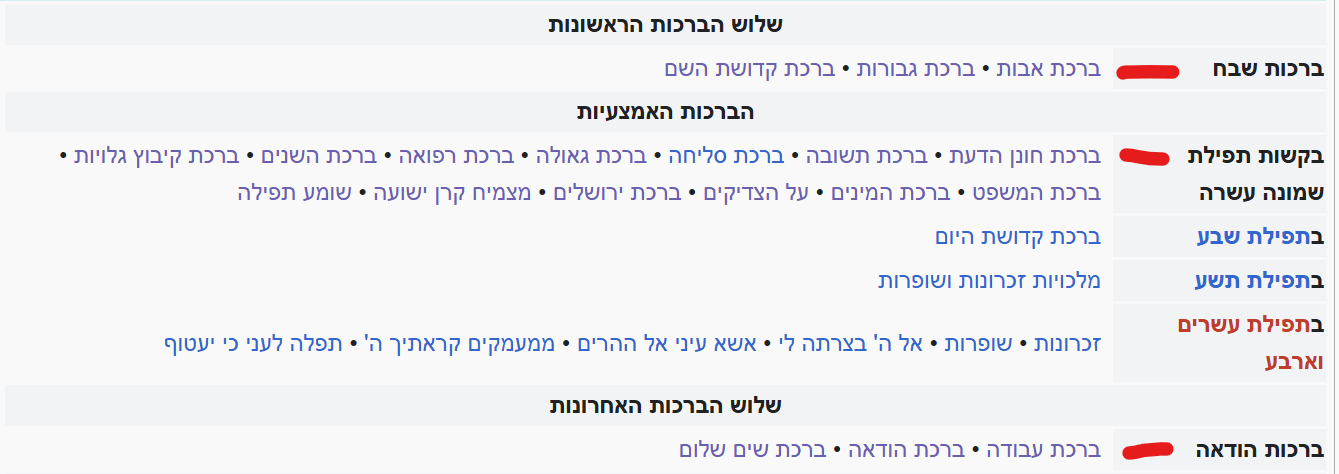
For a summary and breakdown of the Amidah’s structure, see Wikipedia, “Amidah”, section “Structure of Weekday Amidah”, and the template box at the end of the Hebrew Wikipedia entry “תפילת שמונה עשרה”, screenshot (red ticks added, noting the relevant rows for the weekday Amidah):
On this word, see Jastrow (modernized), entry “מִפְרֵעַ”:
(פָּרַע) upsetting; לְמִ׳ (adverb; compare הפך)
1) irregularly, out of order.
Mishnah Megillah 2:1 - הקורא … למפרע - “he who reads the Book of Esther in an irregular way” (corresponding to סירוסין, ibid. 18b top).
Ibid. 17a (referring to Esther 9:27) - מה זמנם למפרע לא אף כתבם למפרע לא - “as you cannot disregard the order of these days in celebrating their season, so you must not transpose the order in which the events of these days are described”
Ibid. (referring to Esther 9:28) - מה עשייה למפרע לא אף זכירה למפרע לא - “as you cannot subvert the celebration, so you must not subvert the order of recitation”
and elsewhere.
2) backward, retroactively, retrospectively, as opposed to מכאן ולהבא.
Sanhedrin 27a:2 - למפרע הוא נפסל - “he becomes disqualified as witness retroactively,” i.e. his testimonies are invalidated from the time that he perjured himself (as opposed to מיכן ולהבא, see בָּא III).
Eruvin 37b, sq … - ונמצא … למפרע - “and the retroactive result would be that he drank untithed wine at the time”;
Jerusalem Talmud Demai 7:4:3 למִפְרֵעוֹ.
Jerusalem Talmud Gittin 3:8:4 - למפרעו הוא נעשה חומץ - “is it to be considered as sour wine at the time,” i.e. from the day that he was bound to examine it?
Tosefta Sotah 11:9 - מְנֵה … למפרע - “count thirty-three days backward”
Bereishit Rabbah 49 - חזור בך למפרע - “take up the argument going back gradually” (from fifty to forty-five etc.);
and frequently.
Tosefta Berakhot 4:19, sq. לברך למפרע - “to say the blessing after meal”, as opposed to כתחלה(ל);
This dispute is also cited in Berakhot/13a#25.
Note that the Mishnah in Sotah follows the majority view (as opposed to the opinion of R’ Yehuda HaNasi here) that the Shema may be recited in any language; see my “Sacred Speech: The Languages of Ritual Recitations and the Historical Blessings and Curses at Mount Gerizim and Mount Ebal in Deuteronomy 27 and Joshua 8 (Mishnah Sotah 7:1-5)“, section “Ritual Texts Recitable in Any Language: A List of Seven“, list item #3.