

Part 1
This is the first part of a two-part series. The outline of the series is below.1
This sugya develops a sustained treatment of middah keneged middah—the principle that actions generate proportionate and corresponding consequences—beginning with the ritual of the sota and expanding outward to encompass divine punishment, historical catastrophe, biblical precedent, and general moral accounting. Although the immediate point of departure is the ordeal of the suspected adulteress (the sota), the discussion broadens into a comprehensive framework for understanding how actions, intentions, and accumulated behaviors are repaid over time, whether through ritual humiliation, bodily affliction, historical downfall, or deferred reckoning.
The Talmudic discussion opens by extending the Mishnah’s logic beyond the Sotah context. Rav Yosef asserts that although formal judicial “measure”—that is, court-administered corporal and capital punishment—has ceased since the destruction of the Second Temple, divine “measure” has not ceased. Human courts may no longer act, but proportional retribution administered by Heaven continues uninterrupted. This claim is reinforced by a baraita cited by Rav Ḥiyya, which states that although the Sanhedrin has ceased, the four modes of capital punishment have not ceased. The Talmud explains: the punishments no longer exist as judicial procedures, but their “law” persists, expressed through events that occur outside the courtroom.
Each of the four court-imposed deaths is then mapped onto a corresponding mode of death that occurs through ordinary or political circumstances. Stoning is mirrored by falling from a height or being mauled; burning by fire or snakebite; execution by sword by death at the hands of authorities or bandits; strangulation by drowning or death from seronekhi (diphtheria). (These mappings preserve the experiential core of each punishment while removing them from institutional adjudication. The sugya thereby reframes legal categories as templates for interpreting misfortune and death.)
R’ Yehuda HaNasi then anchors the principle of middah keneged middah in Scripture, citing Isaiah 27:8 (“In full measure, when you send her away, you contend with her”). The verse is read as asserting proportionality in divine punishment. The baraita proceeds to elaborate this proportionality through the language of weights and measures. Beginning with the se’a as a metaphor for significant sin, it systematically descends through smaller units—tarkav, kav, rova, toman, and ukla—asserting that even minimal actions receive proportionate response. Isaiah 9:4 is invoked to support the claim that no measure, however small, escapes reckoning.
This logic is then extended temporally through the idea of cumulative accounting. A verse from Ecclesiastes (7:27) is cited to teach that each peruta—each minimal act—joins with others to form a larger total. Punishment may be delayed, but nothing is discarded; accumulation eventually triggers consequence.
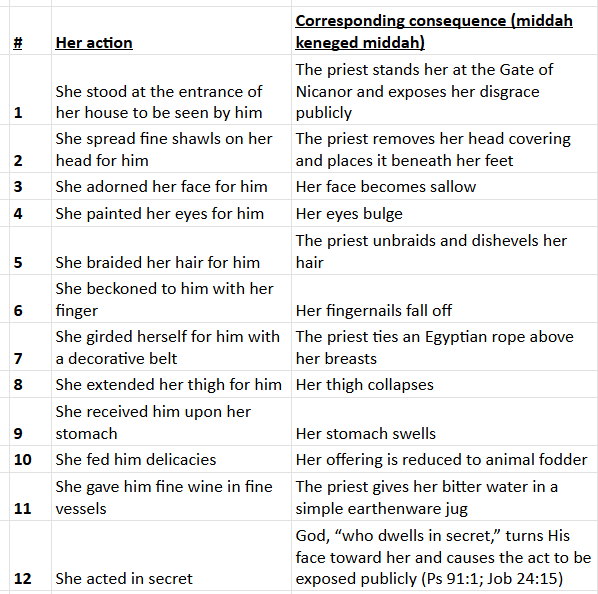
The sugya then returns to the sota, now through an extended baraita that applies middah keneged middah with exhaustive concreteness. A catalogue of paired actions and consequences is presented, each following the same syntactic structure: “She did X for him—therefore Y is done to her.” The list traces a systematic reversal of erotic self-presentation: standing at the doorway becomes public display at the Second Temple’s Gate of Nicanor; fine garments become removal and trampling; cosmetic enhancement becomes physical distortion; gestures of invitation become bodily degradation; luxury food and drink are replaced by animal fodder and bitter water in a clay vessel. (Private action is thus consistently answered with public exposure; adornment with abasement; pleasure with physiological collapse.)
The catalogue concludes with secrecy as the final axis of reversal. Because the act was done in secret, God—described as “dwelling in secret”—turns His face toward her and causes the matter to be revealed. Verses from Psalms, Job, and Proverbs are cited to establish that concealed wrongdoing is ultimately exposed before the congregation.
Part 2
From here, the sugya again broadens its scope. Rav Ḥinnana bar Pappa derives from Isaiah 27:8 that God does not punish a nation until its moment of banishment arrives. Rava interprets the three cups in Pharaoh’s dream as three historical punishments of Egypt across different eras. R’ Yehuda recounts a legal anecdote involving an Egyptian convert (named Minyamin) to demonstrate the continuing halachic identity of Egypt across generations. Ameimar reformulates Rav Ḥinnana bar Pappa’s teaching by reading Malachi 3:6 as asserting that God does not strike a nation twice, while Israel, though repeatedly struck, is not consumed. Rav Hamnuna introduces the notion that punishment is withheld until one’s “measure” is filled, citing Job 20:22.
The sugya then briefly shifts to preservation rather than punishment. Rav Ḥinnana bar Pappa interprets Psalms 33:1 to assert that Moses’ and David’s works were not ruled over by enemies: David’s gates sank into the earth rather than being destroyed, and the Mishkan’s components were hidden beneath the Temple precincts.
Finally, the sugya returns to desire and misdirection. A baraita states that the sota set her eyes on one unfit for her and therefore lost both what she sought and what she had. This rule is generalized: anyone who covets what is not his loses both the desired object and existing possessions. The primeval snake (at the beginning of Genesis) is presented as the archetype, followed by a catalogue of prominent biblical wicked figures—Cain, Korah, Balaam, Doeg, Ahithophel, Gehazi, Absalom, Adonijah, Uzziah, and Haman—each of whom sought what was not allotted to them and suffered total reversal.
Across its length, the sugya moves from ritual detail to cosmic accounting, from individual bodies to nations and empires, while maintaining a consistent logic: actions generate corresponding outcomes; measures fill and overflow; secrecy gives way to exposure; and desire directed toward the unfit results in comprehensive loss.
Outline
Intro
Outline
The Passage
Rav Yosef - Even though court “measure” (ie, judicial punishments) has ceased (post-Second Temple), “measure” in Heaven has not (i.e. proportional divine retribution continues)
R’ Ḥiyya citing Baraita / Rav Yosef - From the (Second) Temple’s destruction, although the Sanhedrin ceased, the 4 capital modes persists as Heaven-administered outcomes
Each court death maps to “natural” analogs: stoning → fall/mauling; burning → fire/snakebite; sword → state/robbers; strangling → drowning/diphtheria (seronekhi)
R’ Yehuda HaNasi - Derives middah keneged middah (“with the measure one measures…”) from Isaiah’s “in full measure” - Isa 27:8
Extends the “measure” idea from large sins (se’a) down to tiny “measures” (tarkav, kav, etc): small sins also get matched punishment - Isa 9:4
Cumulative accounting: each peruta (small unit) joins to a large total—small misdeeds aggregate into eventual large punishment - Eccl 7:27
Applies middah keneged middah concretely to sota ritual humiliations - A List of 12: Specific seductive act → mirrored, degrading reversal administered publicly or bodily
“She acted in secret” → God (“dwells in secret”) “sets His face” against her; secrecy triggers exposure - Ps 91:1; Job 24:15
Part 2
Rav Ḥinnana bar Pappa - God delays punishment of a nation/king until its “sending away” (banishment)
Prooftext - Isa 27:8
Rava - 3 cups of Egypt correspond with the multiple punishments across eras (Moses, Pharaoh Neco, future) - Gen 40:11–13
R’ Yehuda’s anecdote about Minyamin the Egyptian convert - Counters the “those Egyptians are gone” move: in R’ Akiva’s circle Egypt still treated as biblical Egypt (re: 3rd-generation rule) - Deut 23:8–9 (Egyptian convert, 3rd generation)
Ameimar’s version of Rav Ḥinnana bar Pappa’s statement - Reads “I, YHWH, have not changed” as “I do not strike a nation twice”; contrasts Israel: struck repeatedly yet not consumed - Mal 3:6; Deut 32:23
Rav Hamnuna - God does not punish a person until his “se’a” is filled (punishment waits for a threshold) - Job 20:22
Rav Ḥinnana bar Pappa - Moses and David’s achievements (sanctuary/city gates) were not ruled over by enemies - Ps 33:1
Prooftext for David: “her gates sunk into the ground” (ie, not destroyed)
Moses: Mishkan equipment hidden
Rav Ḥisda citing Avimi - Mishkan equipment was hidden under the Sanctuary tunnels
Baraita - Sota set her eyes on one unfit → she loses both what she sought and what she had; generalizes: one who covets what is not his loses both
Primeval snake desired Eve → didn’t get her
Primeval snake lost former status; curse details (belly, dust, enmity) - Gen 3:14–15
Catalogue of Biblical figures who desired the unfit--they lose sought goal and existing holdings: A list of 10 figures (Cain, Korah, Balaam, Doeg, Ahithophel, Gehazi, Absalom, Adonijah, Uzziah, Haman)
Appendix - Summary table of all instances in the sugya of action / condition, and corresponding consequential outcome
The Passage
In Sefaria: Sotah.8b.12-9b.2
In ChavrutAI: Sotah/8b#12 and on
Rav Yosef - Even though court “measure” (ie, judicial punishments) has ceased (post-Second Temple), “measure” in Heaven has not (i.e. proportional divine retribution continues)
אמר רב יוסף:
אף על גב דמדה בטילה,
במדה לא בטיל.
Rav Yosef says:
Although the measure with regard to court-imposed capital punishment has ceased, as there is no court today empowered to adjudicate and apply corporal punishment —
punishment that is suitable to be applied with a measure by God has not ceased, as a person is punished by Heaven in accordance with his sin.
R’ Ḥiyya citing Baraita / Rav Yosef - From the (Second) Temple’s destruction, although the Sanhedrin ceased, the 4 capital modes persists as Heaven-administered outcomes
דאמר רב יוסף,
וכן תני רבי חייא:
מיום שחרב בית המקדש,
אף על פי שבטלה סנהדרי —
ארבע מיתות לא בטלו.
As Rav Yosef says,
and R’ Ḥiyya similarly teaches:
From the day that the Temple was destroyed,
although the Sanhedrin ceased,
the four types of court-imposed capital punishment have not ceased.
והא בטלו?!
אלא:
דין ארבע מיתות לא בטלו.
The Talmud asks:
But they have ceased;
court-imposed capital punishment is no longer given.
Rather,
the intention is: The law of the four types of court-imposed capital punishment has not ceased.
Each court death maps to “natural” analogs: stoning → fall/mauling; burning → fire/snakebite; sword → state/robbers; strangling → drowning/diphtheria (seronekhi)
מי שנתחייב סקילה —
או נופל מן הגג,
או חיה דורסתו.
מי שנתחייב שריפה —
או נופל בדליקה,
או נחש מכישו.
מי שנתחייב הריגה —
או נמסר למלכות,
או ליסטין באין עליו.
מי שנתחייב חניקה —
או טובע בנהר,
או מת בסרונכי.
The Talmud explains: How so?
One who is liable to be executed by stoning --
either falls from a roof
or an animal mauls him and breaks his bones.
This death is similar to the experience of stoning, in which the one liable to be executed is pushed from a platform and his bones break from the impact of the fall.
One who is liable to be executed by burning --
either falls into a fire and is burned
or a snake bites him (מכישו),
as a snakebite causes a burning sensation.
One who is liable to be executed by slaying of the sword --
either is turned over to the ruling government authorities (מלכות) and they execute him with a sword,
or robbers (ליסטין) come upon him and murder him.
One who is liable to be executed by strangling --
either drowns in a river and is choked by the water
or dies of diphtheria [seronekhi],
which causes his throat to become clogged, and he dies.
R’ Yehuda HaNasi - Derives middah keneged middah (“with the measure one measures…”) from Isaiah’s “in full measure” - Isa 27:8
תניא,
היה רבי אומר:
מנין שבמדה שאדם מודד --
בה מודדין לו?
It is taught in a baraita in the Tosefta (3:1–5) that
R’ Yehuda HaNasi would say:
From where is it derived that with the measure that a person measures --
he is measured with it?
שנאמר:
״בסאסאה
בשלחה
תריבנה״.
As it is stated:
“In full measure [be-sase’a],
when you send her away,
you contend with her” (Isaiah 27:8).
In other words, in the measure, be-se’a, that one used in one’s sin, God will contend with, i.e., punish, him.
Extends the “measure” idea from large sins (se’a) down to tiny “measures” (tarkav, kav, etc): small sins also get matched punishment - Isa 9:4
אין לי אלא סאה,
מנין לרבות
תרקב
וחצי תרקב,
קב
וחצי קב,
רובע
וחצי רובע,
תומן
ועוכלא,
מנין?
The baraita continues:
I have derived only the relatively large measurement of a se’a, which alludes to a significant sin.
From where do I know to include even lesser sins that are comparable to smaller measurements, e.g.,
a half-se’a [tarkav]
and a half-tarkav;
a kav
and a half-kav;
a 1/4th-kav (רובע)
and half of a 1/4th-kav;
an 1/8th-kav [toman]
and an ukla, which is 1/32nd of a kav.
From where is it derived that all these lesser sins are also dealt with in accordance with the measure of the sin?
תלמוד לומר:
״כי כל סאון סאן ברעש״.
The verse states:
“For every boot [sa’on] stamped with fierceness,
and every cloak rolled in blood, shall even be for burning, for fuel of fire” (Isaiah 9:4),
indicating that every sa’on, which R’ Yehuda HaNasi interprets as a small se’a, is “stamped with fierceness” and doesn’t go unpunished.
Cumulative accounting: each peruta (small unit) joins to a large total—small misdeeds aggregate into eventual large punishment - Eccl 7:27
ומנין שכל פרוטה ופרוטה מצטרפת לחשבון גדול?
And from where is it derived that each and every peruta combine to add up to a great sum,
alluding to the notion that even if one is not immediately punished for a small transgression, in the final accounting all misdeeds will combine together and be addressed by the imposition of a large punishment?
תלמוד לומר:
״אחת לאחת
למצא חשבון״.
The verse states:
“Behold, this have I found, says Koheleth,
adding one thing to another,
to find out the account” (Ecclesiastes 7:27).
Applies middah keneged middah concretely to sota ritual humiliations - A List of 12: Specific seductive act → mirrored, degrading reversal administered publicly or bodily
Table summarizing:2
וכן מצינו בסוטה,
שבמדה שמדדה --
בה מדדו לה:
היא עמדה על פתח ביתה ליראות לו —
לפיכך כהן מעמידה על שער נקנור, ומראה קלונה לכל.
היא פרסה לו סודרין נאין על ראשה —
לפיכך כהן נוטל כפה מעל ראשה, ומניחו תחת רגליה.
היא קשטה לו פניה —
לפיכך פניה מוריקות.
היא כחלה לו עיניה —
לפיכך עיניה בולטות.
היא קלעה לו את שערה —
לפיכך כהן סותר את שערה.
היא הראתה לו באצבע —
לפיכך ציפורניה נושרות.
היא חגרה לו בצילצול —
לפיכך כהן מביא חבל המצרי, וקושר לה למעלה מדדיה.
היא פשטה לו את יריכה —
לפיכך יריכה נופלת.
היא קיבלתו על כריסה —
לפיכך בטנה צבה.
היא האכילתו מעדני עולם —
לפיכך קרבנה מאכל בהמה.
היא השקתהו יין משובח בכוסות משובחים —
לפיכך כהן משקה מים המרים במקידה של חרש.
היא עשתה בסתר —
״יושב בסתר עליון״ שם בה פנים,
The baraita continues:
And we found this with regard to a sota,
that with the measure with which she measured --
she is measured with it:
She stood by the opening of her house to exhibit herself to her lover,
therefore a priest has her stand at the Gate of Nicanor, and exhibits her disgrace (קלונה) to all;
she spread beautiful shawls [sudarin] on her head for her paramour,
therefore a priest removes her kerchief (כפה) from her head, and places it under her feet;
she adorned her face for her paramour,
therefore her face becomes sallow (מוריקות) after drinking the bitter water;
she painted her eyes (כחלה) for her paramour,
therefore her eyes bulge (בולטות) after she drinks;
she braided her hair for her paramour,
therefore a priest unbraids her hair and makes it disheveled;
she indicated to her paramour with a finger that he should come to her,
therefore her fingernails fall off;
she girded herself for her paramour with a ribbon (צילצול) as a belt,
therefore a priest brings an Egyptian rope, and ties it for her above her breasts;
she extended her thigh for her paramour,
therefore her thigh falls away after drinking.
She received her paramour upon her stomach,
therefore her stomach swells;
she fed him delicacies of the world,
therefore her offering is animal food, as it is from oats;
she gave him fine wine to drink in fine cups,
therefore a priest gives her bitter water in an earthenware mekeida, a simple clay vessel, to drink.
She acted in secret;
therefore, God, referred to in the verse “Who dwell in secret, with the Most High” (Psalms 91:1), turns His face to her,
“She acted in secret” → God (“dwells in secret”) “sets His face” against her; secrecy triggers exposure - Ps 91:1; Job 24:15
שנאמר:
״ועין נאף שמרה נשף
לאמר:
לא תשורני עין וגו׳״.
as it is stated:
“The eye of the adulterer waits for the twilight,
saying:
No eye shall see me;
and the Hidden Face will turn” (Job 24:15).
The adulterer acts in the twilight of the night to act in secrecy, and therefore God, Who is concealed, arranges that the matter is revealed in public.
דבר אחר:
היא עשתה בסתר —
המקום פירסמה בגלוי,
Alternatively,
she acted in secret,
and therefore God revealed it in the open,
שנאמר:
״תכסה שנאה במשאון --
תגלה רעתו בקהל (וגו׳)״.
[...]
as it is stated:
“Though his hatred be concealed with deceit --
his wickedness shall be revealed before the congregation” (Proverbs 26:26),
i.e., concealed acts of sin are ultimately revealed in public.
[...]
This sugya is going off the Mishnah in Mishnah Sotah 1:7 (=Sotah 8b#11). See my discussion of that Mishnah in “Divine Reciprocity: Biblical Instances of Measure-for-Measure (‘Midah Keneged Midah’) Punishment and Reward (Mishnah Sotah 1:7-9)”.
In the sugya, each item follows the same literary formula:
“She [previously, sinfully] did X for him [=her lover] — therefore Y is [now] done to her [as punishment, by the priests in the Temple]”
This creates a series of paired clauses.
Specific seductive act → mirrored, degrading reversal administered publicly or bodily
Across the list, the baraita maps:
Private, voluntary action → public, involuntary exposure
Adornment → disfigurement
Invitation → repulsion
Pleasure-giving acts → physiological collapse
Luxury → deliberate abasement
Secrecy → forced revelation
On this list of a sota’s measure-for-measure punishment, compare the parallel Tosefta, which I cite in an appendix in the piece cited in an earlier footnote: “Appendix 1 - Excerpts from the corresponding Tosefta (Tosefta Sotah 3-4)“, section “The Sotah Ritual as Enacted Retribution (Numbers 5:18) - A List of 12 parallels (Tosefta Sotah 3:1)“.