

This is the first part of a five-part series, on the occasion of the upcoming Jewish holiday of Yom Kippur. The outline of the series is below.
Part 1
This sugya develops one of the Talmud’s most extensive treatments of repentance (teshuva) and atonement (kappara). The sugya is organized around a basic question: what actually produces forgiveness? Yom Kippur, repentance, suffering, death, confession, restitution, and reconciliation all appear as possible mechanisms, but their force varies according to the nature and severity of the offense. The discussion begins with the Mishnah’s classification of different forms of atonement and gradually expands into a broader account of repentance, public reputation, confession, punishment, and interpersonal forgiveness.
The sugya’s point of departure is the final Mishnah of tractate Yoma (the tractate concerned with the laws of Yom Kippur), which assigns different forms of wrongdoing to different mechanisms of expiation. Animal sacrifices (korban) atone for certain sacrificial offenses; repentance atones for relatively minor transgressions; more serious offenses require Yom Kippur in addition to repentance; and death itself may form part of the atonement process. The Mishnah then introduces a second distinction that becomes especially important later in the sugya: sins between a person and God can be atoned for through Yom Kippur, but sins against another person are not atoned for until the injured party has been appeased.
The result is a graded system: Different offenses require different combinations of repentance, Yom Kippur, suffering, death, confession, restitution, or reconciliation. The Talmud repeatedly asks which element does what: Does repentance itself erase the sin? Does it merely suspend punishment until Yom Kippur? Does Yom Kippur operate independently of repentance? Can suffering complete an incomplete process of expiation? Are some offenses so serious that even repentance and Yom Kippur leave a residue that only death can remove?
The Mishnah establishes the basic hierarchy. Repentance atones for “minor” offenses, while for “severe” offenses it merely suspends punishment until Yom Kippur arrives. It also denies atonement to a person who deliberately sins in reliance on the future availability of repentance or Yom Kippur. The offender cannot turn the mechanism of forgiveness into advance permission to sin.
Part 2
The Talmud complicates the Mishnah by citing R. Yehuda HaNasi, who holds that Yom Kippur itself atones for ordinary transgressions whether or not the sinner has repented. Only a small group of especially serious acts, including rejection of the Torah’s authority, distortion of Torah, and repudiation of circumcision, require repentance before Yom Kippur can be effective.
Other tannaitic sources construct different hierarchies. R. Yehuda places taking God’s name in vain at a major threshold: repentance alone is sufficient for offenses below that level, whereas for that offense and more serious ones repentance only suspends punishment until Yom Kippur completes the atonement. Another baraita distinguishes positive commandments and prohibitions reparable through a positive act from full prohibitions, offenses punishable by karet, and capital crimes. The former can be atoned for by repentance alone; the latter require both repentance and Yom Kippur.
The most systematic version of this hierarchy appears in the teaching attributed to R. Yishmael. Four increasingly severe categories are described, although R. Elazar ben Azarya characterizes them as three “divisions” accompanied in every case by repentance. Violation of a positive commandment is forgiven immediately upon repentance. Violation of an ordinary prohibition requires repentance followed by Yom Kippur. Offenses punishable by karet or judicial execution require repentance and Yom Kippur to suspend punishment, while suffering completes the expiation. Desecration of God’s name (hillul ha-shem) stands at the top of the hierarchy: repentance, Yom Kippur, and suffering can only suspend punishment, and death finally completes the atonement.1
This last category leads the sugya from abstract classifications of sin into questions of public conduct and reputation. Hillul ha-shem is illustrated through the behavior of prominent scholars. Rav imagines taking meat from a butcher and failing to pay immediately in circumstances where observers might interpret the delay as dishonesty. R. Yohanan imagines appearing publicly negligent in Torah study or donning tefillin. Other formulations define desecration of God’s name through social reaction: when a scholar’s reputation embarrasses his colleagues, or when observers look at his behavior and say, “May his Master (=God) forgive him.”
The inverse is sanctification of God’s name. A baraita explains that a person who studies Torah and conducts business honestly and pleasantly causes observers to praise Torah, his teachers, and his upbringing. Conversely, a scholar whose commercial dealings or interpersonal behavior are objectionable causes others to disparage Torah itself. Religious reputation is thus treated as a social consequence of behavior. The conduct of a recognized Torah scholar affects not only that person but also how outsiders evaluate the tradition with which he is identified.
Part 3
From here the discussion broadens into a series of sayings about the power of repentance. Repentance brings healing, reaches the divine throne, hastens redemption, lengthens life, and can transform the status of past wrongdoing. Several passages distinguish among repentance motivated by love, fear, or suffering. Repentance from love receives the strongest formulation: it can remove the status of rebellion more completely than repentance from fear. Reish Lakish similarly describes repentance as capable of transforming intentional sins into something analogous to unwitting transgressions.
The biblical book of Hosea supplies many of the prooftexts for this section, especially its closing call to Israel to return to God. Hosea’s language of return, healing, love, and verbal appeal allows the rabbis to portray repentance as a process in which speech itself becomes effective. One teaching contrasts God with human beings: when one person verbally injures another, there is no guarantee that words alone will secure reconciliation. God, however, can be appeased through words of repentance. Hosea’s phrase “take with you words and return to YHWH” is interpreted as indicating that verbal repentance can function in place of sacrifice, even being credited as though the penitent had brought an offering.
This contrast between divine and human forgiveness anticipates one of the main themes of the latter part of the sugya. Reconciliation with God and reconciliation with another person operate differently. God may accept verbal repentance, but an injured human being retains an independent claim upon the offender. This distinction is already explicit in the Mishnah’s formulation that Yom Kippur does not atone for offenses “between a person and another” until the offender appeases the injured party.
Before returning directly to interpersonal offenses, however, the Talmud examines the internal structure of repentance. Complete repentance is defined behaviorally. Rav Yehuda describes the fully repentant person as someone who encounters the same opportunity to commit the same offense under substantially the same circumstances and nevertheless refrains. Repentance is thereby demonstrated not merely by remorse or confession but through changed conduct when the original temptation reappears.
The Talmud also considers how sins should be confessed. One teaching distinguishes public from private wrongdoing: a publicly known offense should be publicly acknowledged, while a private offense should remain private. Another version distinguishes interpersonal sins from sins against God: the former may require public confession, whereas the latter should not be unnecessarily exposed. This produces a broader concern with the proper management of moral publicity. Concealment can either protect legitimate privacy or become dishonest suppression, depending on the type of offense and the circumstances.
Part 4
A similar dispute concerns repeated confession. One baraita states that a sin confessed on one Yom Kippur should not be confessed again the following year if it has not been repeated. Reconfessing an already forgiven sin is compared to a dog returning to its vomit. R. Eliezer ben Yaakov takes the opposite position: continued recollection of one’s past sins is praiseworthy because it preserves humility. The disagreement reflects two competing conceptions of repentance. One emphasizes closure once forgiveness has been granted; the other emphasizes permanent moral memory.
Another dispute concerns the amount of detail required in confession. R. Yehuda ben Bava requires the sinner to specify the particular offense, citing Moses’ explicit reference to Israel’s making of the Golden Calf. R. Akiva invokes the statement “fortunate is he whose transgression is forgiven, whose sin is hidden” and holds that detailed specification is unnecessary. The Talmud then reinterprets Moses’ reference to the Golden Calf as an argument in Israel’s defense rather than as proof that confession must name the particular sin.
The issue of publicity leads into a comparison between Moses and David. Moses is portrayed as wanting his transgression publicly recorded, whereas David prefers concealment. Moses’ concern is explained through a parable: a woman punished for a relatively minor offense may want the offense identified so that observers do not assume that she committed a much more serious one. Publicizing Moses’ sin therefore protects his reputation by clarifying precisely what he did. The discussion likewise maintains that hypocrites should sometimes be exposed, because mistaken public admiration for someone secretly corrupt can itself produce desecration of God’s name.
Several teachings then extend the theme of moral accountability into punishment and political authority. Prosperity can be harmful to the wicked if it allows wrongdoing to continue without correction, whereas punishment in this world can benefit the righteous by expiating sin. Ahab and Moses serve as examples. The sugya also warns repeatedly about the dangers of judicial and political power. Rav and Rava describe judging as an occupation entered at grave personal risk and without material reward. Rava and Rav Zutra remind themselves, when surrounded by honor, that political status and public acclaim are temporary.
Part 5
The discussion returns explicitly to interpersonal wrongdoing near the end of the sugya. R. Abbahu interprets I Samuel 2:25 to mean that an offense against another person requires human or judicial rectification. The injured party cannot simply be bypassed through prayer or ritual atonement. R. Yitzhak extends this principle even to verbal injury: one who has merely angered or insulted another person must still seek appeasement.
The Talmud gives this requirement increasingly concrete procedural form. If money is owed, it must be repaid. If the offense is nonmonetary, others may be enlisted to help secure reconciliation. Rav Hisda describes seeking appeasement before groups of three people, while R. Yosei bar Hanina limits the offender’s obligation to three attempts. If the injured person has died, the offender should bring ten people to the grave and publicly confess the wrong.
These rules are then illustrated through a sequence of narratives. R. Yirmeya sits at R. Abba’s doorway in order to seek forgiveness and is accidentally humiliated when dirty water is poured on him. R. Abba then considers himself obligated to seek R. Yirmeya’s forgiveness in turn. R. Zeira makes himself deliberately accessible to people who have wronged him so that they can apologize easily. These stories shift part of the burden from the offender to the injured party: although the wrongdoer must seek forgiveness, the offended person may also facilitate reconciliation rather than making it unnecessarily difficult.
The dramatic story of Rav and the butcher presents the opposite outcome. A butcher who has offended Rav refuses to seek reconciliation. On the eve of Yom Kippur, Rav goes to him personally, apparently attempting to make reconciliation easier despite being the injured party. The butcher rejects him and immediately dies in an accident. The narrative gives extreme form to the Mishnah’s claim that Yom Kippur cannot repair an interpersonal offense when the relationship itself remains unresolved.
The final anecdote complicates matters further. Rav repeatedly seeks forgiveness from R. Hanina after offending him, returning on thirteen successive Yom Kippur eves despite the rule that one need ask forgiveness only three times. R. Hanina repeatedly refuses. The story therefore creates tension between formal limits and exceptional persistence. It also raises the question of the responsibility of the injured party: at what point does justified resentment become an improper refusal to reconcile?
Across the sugya, repentance is consequently treated as both theological and social. It concerns the sinner’s relationship with God, but also reputation, restitution, speech, behavioral change, punishment, public acknowledgment, and reconciliation with other people. Yom Kippur occupies an important place within this system, but it is not presented as a universal mechanism that automatically removes every form of guilt. Its power depends upon the offense, the offender’s repentance, and, in interpersonal cases, the response of the injured party.
The passage therefore constructs atonement as a layered process. Some sins can be repaired immediately through repentance. Others require the temporal and ritual intervention of Yom Kippur. More severe offenses require suffering or even death. Interpersonal wrongdoing introduces a different logic altogether: divine forgiveness cannot substitute for human reconciliation. At the same time, the injured party is encouraged in several narratives to make reconciliation possible. The resulting system distributes responsibility among sinner, victim, community, and God, while preserving a strong distinction between ritual expiation and the actual repair of damaged human relationships.
Outline
Intro
The Passage
Mishnah (Yoma 8:8)
Sin-offering and definite guilt-offering atone
death and Yom Kippur atone together with repentance
Repentance alone atones for minor sins
... while serious sins require Yom Kippur
Deliberately sinning in reliance on repentance or Yom Kippur blocks atonement
Sins against another person require appeasing that person
R’ Elazar ben Azarya - Yom Kippur atones for sins against God, but not interpersonal sins until the injured party is appeased - Leviticus 16:30
R’ Akiva - Israel is purified by God
Prooftexts
Ezekiel 36:25
Like an impure person purified by a mikveh - Jeremiah 17:13
Part 2
Talmud
R’ Yehuda HaNasi - Yom Kippur atones even without repentance for ordinary transgressions
... but not for rejecting the Torah’s yoke, distorting Torah, or violating circumcision unless one repents
R’ Yehuda - Repentance alone atones for offenses less severe than taking God’s name in vain; for offenses at that level or above, repentance suspends punishment and Yom Kippur completes atonement - Exodus 20:7
Baraita - God “absolves” ordinary repentant offenders, but the prohibition of taking God’s name in vain is exceptionally severe - Exodus 34:7; Exodus 20:7
Baraita - Repentance alone atones for positive commandments and prohibitions repaired by a positive act; for full negative commandments, karet, and capital offenses, repentance suspends punishment until Yom Kippur
R’ Elazar - The tension between “absolves” and “does not absolve” means that God absolves those who repent, but not those who do not - Exodus 34:7
R’ Elazar ben Azarya citing R’ Yishmael - Three levels of atonement
1) Repentance immediately atones for violating a positive commandment - Jeremiah 3:22; 2) repentance plus Yom Kippur for ordinary prohibitions - Leviticus 16:30; 3) repentance, Yom Kippur, and suffering for karet or capital offenses - Psalms 89:33; 4) Desecration of God’s name additionally requires death - Isaiah 22:14
Rav - Desecration of God’s name can consist of behavior by a prominent scholar that looks dishonest, such as delaying payment where credit is not customary
R’ Yoḥanan - For a prominent scholar, even appearing publicly lax in Torah study or tefillin constitutes desecration of God’s name
Yitzḥak of R’ Yannai’s School - Desecration of God’s name is conduct whose reputation embarrasses one’s colleagues
Rav Naḥman bar Yitzḥak - Desecration occurs when people react to someone’s conduct by saying, “May his Master forgive him”
Baraita - A Torah scholar sanctifies God’s name by learning Torah and behaving pleasantly and honestly - Isaiah 49:3
... while bad conduct by a scholar causes observers to disparage Torah and desecrates God’s name - Ezekiel 36:20
Part 3
R’ Ḥama bar Ḥanina - Repentance is great because it brings healing to the world - Hosea 14:5
R’ Ḥama bar Ḥanina - Repentance from love removes the status of rebelliousness more completely than repentance from fear - Jeremiah 3:14, 22
Rav Yehuda - Repentance from love or fear is effective directly, whereas repentance produced through suffering is a different category - Jeremiah 3:14, 22
R’ Levi - Repentance reaches as far as God’s throne - Hosea 14:2
R’ Yoḥanan - Repentance is so powerful that it overrides even a Torah prohibition
Prooftext - God accepts Israel back despite the Torah’s analogy to a divorced wife who married another and may not return to her first husband - Jeremiah 3:1
R’ Yonatan - Repentance brings (messianic) redemption - Isaiah 59:20
Reish Lakish - Repentance from fear converts intentional sins into unwitting ones - Hosea 14:2
R’ Shmuel bar Naḥmani citing R’ Yonatan - Repentance lengthens a person’s life - Ezekiel 18:27
R’ Yitzḥak citing Rabba bar Mari - Unlike humans, God can be appeased by words of repentance; verbal repentance is accepted like an offering - Hosea 14:3, 5
R’ Meir - One individual’s repentance can bring forgiveness to the whole world
Prooftext - Hosea 14:5
Rav Yehuda - Complete repentance is demonstrated when the same opportunity to commit the same sin recurs and the person refrains
Rav Yehuda citing Rav - Public sins should be publicly acknowledged; private sins should not be publicized - Psalms 32:1; Proverbs 28:13
Rav Zutra bar Toviya citing Rav Naḥman - Interpersonal sins should be publicly confessed, whereas sins against God should remain private - Psalms 32:1; Proverbs 28:13
Part 4
R’ Yosei b. Yehuda - God forgives repeated sins three times; on the fourth offense, forgiveness is withheld
Prooftext - Amos 2:6; Job 33:29
Baraita - A sin confessed and not repeated need not be confessed again on the next Yom Kippur
Repeating confession unnecessarily resembles a dog returning to its vomit - Proverbs 26:11
R’ Eliezer ben Ya’akov - Reconfessing earlier sins is praiseworthy, because one should keep awareness of one’s sins - Psalms 51:5
R’ Yehuda ben Bava - Confession should specify the particular sin - Exodus 32:31
R’ Akiva - One need not specify the sin in confession - Psalms 32:1
R’ Yannai - Moses’ mention of the Golden Calf was not confession-detailing but an argument that Israel’s abundance of gold helped cause the sin - Exodus 32:31
Moses wanted his sin publicized, whereas David wanted his hidden - Numbers 20:12
David - Psalms 32:1
Moses’ publicity prevented people from assuming he committed more serious sins
Hypocrites should be exposed to prevent desecration of God’s name
Prooftext - repentance can avert punishment even after a decree has been issued - Ezekiel 3:20
Prosperity can ruin the wicked, and political authority endangers its holder
Rav - A judge should approach adjudication with fear, recognizing the danger of wrongful judgment and lack of personal gain
Rava - Repeated Rav’s warning about judicial office
... and when Rava honored by crowds, he reminded himself of the transience of power - Job 20:6–7
Rav Zutra - Public honor and political authority are temporary - Proverbs 27:24
It is bad for the wicked to escape punishment in this world - Proverbs 18:5
... As with Ahab - I Kings 21:29
Punishment in this world can benefit the righteous - Proverbs 18:5
... As with Moses - Numbers 20:12
The merit of the righteous benefits descendants
…. As with Aaron’s sons - Leviticus 10:16
In contrast, the guilt of the wicked burdens descendants
… As with Canaan
One who brings merit to the public is protected from sin; one who causes the public to sin is impeded from repentance
Part 5
R’ Abbahu, responding to Rav Yosef bar Ḥavu - For interpersonal wrongdoing, judicial or interpersonal rectification is required; for sins against God, repentance and good deeds obtain forgiveness - I Samuel 2:25
R’ Yitzḥak - Even verbal injury requires appeasing the offended person
Prooftext - one should repay money when relevant or enlist others to help secure forgiveness - Proverbs 6:1–3
Rav Ḥisda - One should seek appeasement before three rows of three people - Job 33:27
R’ Yosei b. Ḥanina - One need ask forgiveness only three times - Genesis 50:17
If the offended person has died, one confesses before ten people at the grave
R’ Yirmeya and R’ Abba anecdote - R’ Yirmeya humbled himself to seek R’ Abba’s forgiveness
R’ Yirmeya was accidentally humiliated in the process
Psalms 113:7
R’ Abba then considered himself obliged to appease R’ Yirmeya - Proverbs 6:3
R’ Zeira anecdote - R’ Zeira made himself accessible to people who had wronged him, so they could easily apologize
Rav and the butcher anecdote - Rav went personally to allow an offending butcher to reconcile before Yom Kippur
Rav Huna predicts the butcher’s death
The butcher refused Rav’s advances
The butcher immediately died accidentally
Rav and R’ Ḥanina anecdote
Rav sought R’ Ḥanina’s forgiveness for thirteen Yom Kippur eves, R’ Ḥanina refused his advances
Appendix - The symbolism of experiencing seminal emission (‘keri’) on Yom Kippur (Yoma 88a)
Tanna before Rav Naḥman - One who experiences a seminal emission on Yom Kippur has his sins forgiven
R’ Yishmael’s School - One who experiences a seminal emission on Yom Kippur should fear throughout the year, but surviving the year signifies a share in the World-to-Come
Rav Naḥman bar Yitzḥak - The involuntary emission is (paradoxically) viewed as a favorable sign: while everyone else is (sexually) deprived, he has been (sexually) satiated
Rav Dimi - an emission on Yom Kippur signifies long life and abundant progeny - Isaiah 53:10
The Passage
Yoma/85b#7 thru 87b#1
Mishnah (Yoma 8:8)
Mishnah (Yoma 8:8)
Sin-offering and definite guilt-offering atone
חטאת
ואשם ודאי —
מכפרין.
A sin-offering, which atones for unwitting performance of transgressions punishable by karet,
and a definite guilt-offering, which is brought for robbery and misuse of consecrated items --
atone for those sins.
Death and Yom Kippur atone together with repentance
מיתה
ויום הכפורים —
מכפרין עם התשובה.
Death
and Yom Kippur --
atone for sins when accompanied by repentance.
Repentance alone atones for minor sins
תשובה —
מכפרת על עבירות קלות
על עשה,
ועל לא תעשה.
Repentance itself --
atones for minor2 transgressions,
for both positive mitzvot
and negative mitzvot.
... while serious sins require Yom Kippur
— ועל החמורות
הוא תולה,
עד שיבא יום הכפורים ויכפר.
And for severe (חמורות) transgressions --
repentance places punishment in abeyance3
until Yom Kippur comes and completely atones for the transgression.
Deliberately sinning in reliance on repentance or Yom Kippur blocks atonement
האומר:
אחטא ואשוב,
אחטא ואשוב —
אין מספיקין בידו לעשות תשובה.
With regard to one who says:
I will sin and then I will repent,
I will sin and I will repent,
Heaven does not provide him the opportunity to repent,
and he will remain a sinner all his days.
אחטא ויום הכפורים מכפר —
אין יום הכפורים מכפר.
With regard to one who says:
I will sin and Yom Kippur will atone for my sins --
Yom Kippur does not atone for his sins.
עבירות שבין אדם למקום —
יום הכפורים מכפר,
Furthermore, for transgressions between a person and God (מקום) --
Yom Kippur atones;
Sins against another person require appeasing that person
עבירות שבין אדם לחבירו —
אין יום הכפורים מכפר,
עד שירצה את חבירו.
however, for transgressions between a person and another --
Yom Kippur does not atone
until he appeases (ירצה) the other person.
R’ Elazar ben Azarya - Yom Kippur atones for sins against God, but not interpersonal sins until the injured party is appeased - Leviticus 16:30
דרש רבי אלעזר בן עזריה:
״מכל חטאתיכם לפני ה׳ תטהרו״.
עבירות שבין אדם למקום —
יום הכפורים מכפר.
עבירות שבין אדם לחבירו —
אין יום הכפורים מכפר, עד שירצה את חבירו.
Similarly, R’ Elazar ben Azarya taught that point from the verse:
“From all your sins you should be cleansed before YHWH” (Leviticus 16:30).
For transgressions between a person and God,
Yom Kippur atones;
however, for transgressions between a person and another,
Yom Kippur does not atone until he appeases the other person.
R’ Akiva - Israel is purified by God
אמר רבי עקיבא:
אשריכם ישראל!
לפני מי אתם מטהרין,
מי מטהר אתכם?
אביכם שבשמים,
In conclusion, R’ Akiva said:
How fortunate are you,4 Israel!
before Whom are you purified,
and Who purifies you?
It is your Father in Heaven (=God),
Prooftexts
Ezekiel 36:25
שנאמר:
״וזרקתי עליכם מים טהורים
וטהרתם״,
as it is stated:
“And I will sprinkle purifying water upon you,
and you should be purified” (Ezekiel 36:25).
Like an impure person purified by a mikveh - Jeremiah 17:13
ואומר:
״מקוה ישראל (ה׳)״,
מה מקוה
מטהר את הטמאים
אף הקדוש ברוך הוא
מטהר את ישראל.
And it says:
“The mikveh of Israel is God” (Jeremiah 17:13).
Just as a mikveh
purifies the impure,
so too, God
purifies Israel.5
Compare the table in Wikipedia, “Atonement in Judaism“, section “In Rabbinic Judaism“, based on Maimonides’ systemization (in Mishneh Torah, Hilchot Teshuva 1:1–4); screenshot:
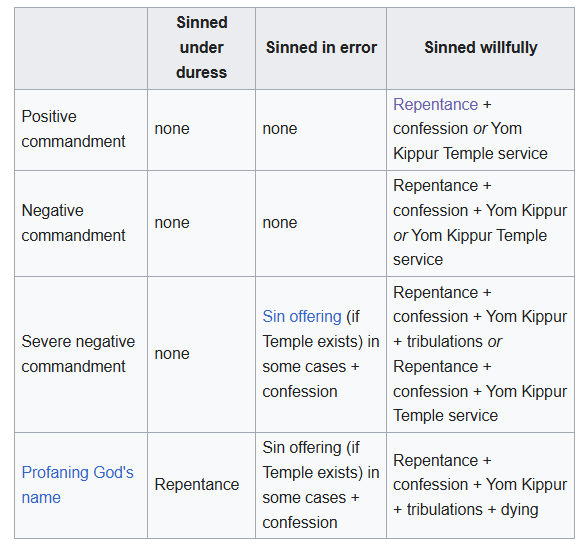
קלות - literally: “light”.
תולה - literally: “hangs”, i.e. leaves hanging.
On this sense of the word, see Jastrow (modernized), entry “תלי”, sense #2:
2) to hold in suspense, leave undecided, leave in doubt; to be suspended.
Mishnah Yoma 8:8 ועל החמורות הוא תולה עד וכ׳ as to heavy sins, he (who repents) is in suspense (will neither be punished nor acquitted), until the Day of Atonement comes and brings forgiveness.
Midrash Tanḥuma Shemot - 20 וכשאני תולה על חטאיו וכ׳ when I suspend judgment for a man’s sins, I am called El Shadday.
Mishnah Sotah 3:4 אם … היתה תוֹלָה לה if she (the Soṭah) has any merit, it will create suspension of punishment for her;
יש זכות תולה שנה אחת וכ׳ some merits create a suspension of one year, some of two etc.
Ibid. 5 אין זכות תולה במים וכ׳ in the case of testing waters merit causes no suspension.
Mishnah Pesachim 1:4 אוכלין … ותוֹלִין כל חמש וכ׳ you may eat (leavened bread on the eve of Passover) to four hours of the day, and hold it in suspense during the fifth hour, and burn it etc.
Mishnah Pesachim 1:5 תולין לא אוכלין וכ׳ they held it in suspense: they did not eat it, nor did they burn it;
and frequently.
passive participle as ab.
Mishnah Pesachim 1:7 they differ על הת׳ ועל הטמאה concerning T’rumah in suspense (under suspicion of uncleanness) and such as is surely unclean.
Niddah 60a:40 טהור ות׳ a clean person and one under doubt of uncleanness;
and frequently.
Compare the modern English expression “leave someone hanging“: “To leave someone waiting in anticipation of one’s response.”
אשריכם - “fortunate, happy, blessed”.
On this word, see Jastrow (modernized), entry “אֶשֶׁר”:
(Biblical Hebrew), only in plural constr. אַשְׁרֵי
the happiness of!, happy is he, are they etc.
Pesachim 117a; and frequently.
Midrash Tehillim 84:4 אַשְׁרַאי happy am I.
Mishnah Yoma 8:9 אַשְׁרֵיכֶם happy are you.
Yoma 87a:4 אַשְׁרֵיהֶם לצדיקים happy are the righteous;
and frequently.
Playing on the Hebrew word mikveh, which in this verse has the sense of “hope” (see Hebrew Wiktionary, מקוה, sense “מִקְוֶה ב“), but in Talmudic Hebrew is only used in the sense of “pool of water” (see Wikipedia, “Mikveh“).