

This is the first part of a two-part series. The outline of the series is below.
Part 1
This sugya develops the history and legal significance of the major Israelite sanctuaries before the construction of Solomon’s Temple:1 at Shiloh,2 Nov,3 and Gibeon,4 followed by Jerusalem. Its central concerns are the physical form and territorial status of these sanctuaries, the rules governing sacrificial slaughter and consumption at each stage, the chronology of the Tabernacle’s movements, and the interpretation of Deuteronomy 12:9:
כי לא באתם עד עתה אל המנוחה ואל הנחלה
אשר יהוה אלהיך נתן לך
For you are not as yet come to the rest and to the inheritance,
which YHWH your God gives you.
The Talmud homiletically interprets this; reading “rest” (מנוחה) and “inheritance” (נחלה) as referring to two historical sanctuaries which preceded the one in Jerusalem.
The discussion begins with Shiloh. The Mishnah had described its sanctuary as having stone walls below but the curtains of the Tabernacle above, rather than a permanent roof. R’ Ḥiyya bar Abba, citing R’ Yoḥanan, derives this hybrid structure from the apparently conflicting biblical descriptions of Shiloh as both a “house” (בית) and a “tent” (אהל). I Samuel calls it the “house of YHWH in Shiloh,” while Psalms refers to the “Tabernacle of Shiloh” and the “tent of Joseph.” Both descriptions are therefore taken literally: Shiloh had the masonry characteristic of a permanent building together with the curtains characteristic of the movable Tabernacle. This period is identified with the Torah’s “rest” in Deuteronomy 12:9.
Shiloh also had an unusual geographical rule governing the consumption of sacrifices: Offerings of the most sacred order remained restricted to the sanctuary precincts, but offerings of lesser sanctity could be eaten anywhere from which Shiloh was visible. R’ Oshaya derives this from the warning in Deuteronomy 12:13 not to offer burnt offerings “in every place that you see.” The verse is read contrastively: offerings may not be offered wherever one can see, but they may be eaten wherever one can see Shiloh. The Talmud tests the scope of this inference by asking whether even slaughter might have been permitted outside the sanctuary. R’ Yannai rejects this possibility from the next verse, which requires both offering and sacrificial service to be performed “there,” at the divinely chosen place. Visibility thus expands the area of consumption, not the location of sacrificial service.
Several homiletical traditions then explain the special relationship between visibility and Shiloh. R’ Avdimi bar Ḥasa interprets the place-name Taanath Shiloh (תאנת שילה) as referring to those who later mourned the loss of the privilege of eating sacred food wherever Shiloh could be seen. R’ Abbahu connects the rule to Joseph: Because Joseph’s “eye” refused to derive illicit benefit from Potiphar’s wife, his descendants were rewarded with a sanctuary in their territory whose offerings could be consumed as far as the eye could see. R’ Yosei b. Ḥanina develops a related interpretation: Joseph’s restraint resulted in the privilege of eating Shiloh offerings even in the territories of the tribes described as hostile to him.
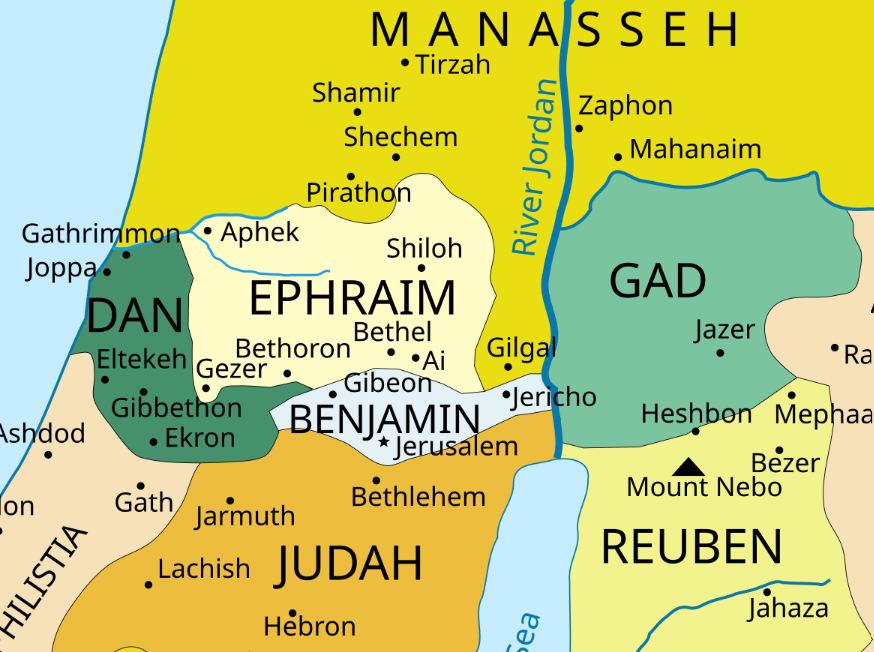
This association of Shiloh with Joseph and Ephraim creates a problem for another tradition. Rav Dimi reports in the name of R’ Yehuda HaNasi that the Shekhina rested at three successive sacred centers: Shiloh, Nov and Gibeon, and the permanent Temple in Jerusalem, and that in every case its resting place was within Benjamin’s tribal territory.5 The proof is Moses’ blessing of Benjamin in Deuteronomy 33:12: “He covers him all the day, and He dwells between his shoulders.” Rav Yosef objects that Psalms explicitly identifies Shiloh with the “tent of Joseph” and the tribe of Ephraim. The sugya therefore places competing traditions about sacred geography alongside one another: one associates Shiloh with Joseph, while another extends Benjamin’s special connection with the divine presence across all the major sanctuaries.
The same question of tribal geography appears with regard to Jerusalem. R’ Ḥama b. Ḥanina states that a narrow strip belonging to Judah extended into Benjamin’s territory and that the altar was built upon it. Benjamin is described as longing to absorb this strip because of the altar’s sanctity. Deuteronomy 33:12 is then interpreted in several broader ways. One baraita reads its three clauses as references to the First Temple, Second Temple (c. 526 BCE to 70 CE), and the future messianic era. R’ Yehuda HaNasi instead understands them as this world, the future messianic era, and the World-to-Come. The blessing of Benjamin thus serves as a scriptural framework for describing the continuing location of divine presence across successive historical and eschatological periods.
Part 2
The sugya next turns from sacred geography to chronology. A baraita divides the pre-Temple period into four principal stages. The Tent of Meeting stood in the wilderness for 39 years; at Gilgal for 14 years, comprising 7 years of conquest (see Joshua chapters 2–12) and 7 years of division of the land (see Joshua chapters 13–22); at Shiloh for 369 years; and at Nov and Gibeon together for 57 years. These periods are fitted into the 480 years between the Exodus and the beginning of Solomon’s Temple recorded in I Kings 6:1.
The Talmud derives these figures in detail. The 39 wilderness years follow from the tradition that the Tabernacle was constructed during the first year after the Exodus and erected in the second. The 7 years of conquest are calculated from Caleb’s age: he was 40 when sent as a spy, approximately 78 when Israel entered Canaan, and 85 when he requested Hebron at the conclusion of the conquest. The additional 7 years of land division are either inferred by analogy with the 7 years of conquest or derived indirectly from the chronology of the Jubilee cycle reflected in Ezekiel 40:1.
The transition from Shiloh to Nov and then Gibeon is tied to the deaths of major leaders. A baraita states that Shiloh was destroyed when Eli (c. 11th century BCE) died, after which the sanctuary moved to Nov; when Samuel died, Nov was destroyed and the sanctuary moved to Gibeon. The Talmud reconstructs the 57-year Nov/Gibeon period from the biblical chronology surrounding Samuel, Saul, David, and Solomon. The 20 years associated with the Ark at Kiriath Jearim are divided into 10 years of Samuel’s sole leadership, 1 year in which Samuel and Saul overlapped, 2 years of Saul alone, and 7 years of David’s reign in Hebron. Adding David’s 33 years in Jerusalem and the opening years of Solomon’s reign produces the 57 years assigned to Nov and Gibeon. Subtracting these periods, together with the wilderness and Gilgal years, from the 480-year total leaves 369 years for Shiloh.
The final part of the sugya returns to Deuteronomy 12:9 and uses the terms “rest” and “inheritance” to classify the successive sanctuaries legally. According to the principal baraita and R’ Yehuda, “rest” refers to Shiloh and “inheritance” to Jerusalem. The fact that the verse names them separately is legally significant: it creates an intervening period between Shiloh and Jerusalem during which private altars were again permitted. Thus Shiloh represents an initial period of centralized sacrifice; Nov and Gibeon form an intermediate phase in which private altars were allowed; and Jerusalem establishes the final, permanent prohibition.
The terminology itself remains disputed. R’ Yehuda identifies “rest” with Shiloh and “inheritance” with Jerusalem, supported by Jeremiah’s description of Jerusalem as God’s inheritance. R’ Shimon reverses the terms, identifying “rest” with Jerusalem on the basis of Psalms 132, where Zion is explicitly called God’s eternal resting place, and “inheritance” with Shiloh. The school of R’ Yishmael understands both terms as referring to Shiloh, while R’ Shimon ben Yoḥai understands both as referring to Jerusalem.
The sugya thus organizes the history of Israelite worship around a sequence of sacred centers, each with its own architectural form, territorial boundaries, sacrificial rules, and chronological position. Shiloh occupies the central place in the discussion: a semi-permanent sanctuary described simultaneously as house and tent, located within the tribal geography of Joseph yet also connected in some traditions to Benjamin, and distinguished by the exceptional rule that lesser sacrifices could be eaten wherever the sanctuary was visible. Nov and Gibeon function as an intermediate period between Shiloh and Jerusalem, while Jerusalem becomes the final and permanent sacred center. The biblical terms “rest” and “inheritance” provide the conceptual framework through which the Talmud distinguishes these stages and their differing legal regimes.
Outline
Intro
The Passage
R’ Ḥiyya bar Abba citing R’ Yoḥanan - Shiloh combined features of a “house” (בית) and a “tent” (אהל): stone walls below, curtains above; this period was the Torah’s “rest” - I Samuel 1:24; Psalms 78:60, 67; Deuteronomy 12:9
R’ Oshaya - At Shiloh, offerings of lesser sanctity could be eaten anywhere from which Shiloh was visible - Deuteronomy 12:13
Challenge to R’ Oshaya: perhaps the verse instead permits slaughtering wherever Shiloh is visible - Deuteronomy 12:13
R’ Yannai - Sacrificial service, including slaughter, had to be performed at Shiloh itself; only eating could occur within sight of it - Deuteronomy 12:14
R’ Avdimi bar Ḥasa - “Taanath Shiloh” alludes to people mourning the loss of the privilege of eating offerings wherever Shiloh could be seen - Joshua 16:6
R’ Abbahu - Joseph’s refusal to benefit improperly through his eyes was rewarded by allowing sacred food in his territory to be eaten as far as the eye could see - Genesis 49:22
R’ Yosei b. Ḥanina - Joseph’s restraint was rewarded by allowing offerings from Shiloh to be eaten even among the territories of tribes that hated him - Deuteronomy 33:16
Rav Dimi citing R’ Yehuda HaNasi - The Shekhina rested at Shiloh, Nov/Gibeon, and Jerusalem, always within Benjamin’s territory - Deuteronomy 33:12
Rav Yosef - Rejects the claim that Shiloh was in Benjamin, since Scripture associates Shiloh with Joseph/Ephraim - Psalms 78:60, 67
R’ Ḥama b. Ḥanina - Judah had a strip entering Benjamin’s territory at the Jerusalem altar
Baraita - Deuteronomy 33:12 refers successively to the First Temple, Second Temple, and messianic era
R’ Yehuda HaNasi - Deuteronomy 33:12 refers to this world, the messianic era, and the World-to-Come
Part 2
Baraita - The Tabernacle stood 39 years in the wilderness, 14 at Gilgal, 57 at Nov/Gibeon, leaving 369 years for Shiloh - I Kings 6:1
Prooftext that the Tabernacle stood 39 years in the wilderness: it was constructed in the 1st year after the Exodus, and erected in the 2nd
Prooftext that the conquest of Canaan lasted 7 years: Caleb was 78 years old when Israel crossed the Jordan, and 85 when the conquest ended - Joshua 14:7, 10
Prooftext for the 7 years of division
Possible prooftext #1 - The division of the land is assumed to have lasted 7 years, matching the 7 years of conquest
Possible prooftext #2 - inferred from the chronological requirements of Ezekiel’s reference to the 14th year after Jerusalem’s destruction and the Jubilee cycle - Ezekiel 40:1
Baraita - Shiloh was destroyed when Eli died and the Tabernacle moved to Nov; Nov was destroyed when Samuel died and it moved to Gibeon - I Samuel 4:18
The 20 years associated with the Ark at Kiriath Jearim comprise 10 years of Samuel alone, 1 of Samuel and Saul, 2 of Saul alone, and 7 of David at Hebron - I Samuel 7:2; I Kings 2:11
Adding David’s Jerusalem reign and Solomon’s first years yields 57 years for Nov/Gibeon; subtracting all other periods from 480 years leaves 369 for Shiloh - II Chronicles 3:2; I Kings 6:1
Baraita - “Rest” means Shiloh and “inheritance” means Jerusalem; their separation in the verse permits private altars during the intervening Nov/Gibeon period - Deuteronomy 12:9
R’ Yehuda - “Rest” is Shiloh and “inheritance” is Jerusalem - Deuteronomy 12:9
Prooftexts - Jeremiah’s description of Jerusalem as God’s “inheritance” - Jeremiah 12:7–9
R’ Shimon - “Rest” is Jerusalem and “inheritance” is Shiloh
Prooftexts - Psalms explicitly describes Zion/Jerusalem as God’s resting place - Psalms 132:13–14
R’ Yishmael’s School - Both “rest” and “inheritance” refer to Shiloh; R’ Shimon ben Yoḥai - Both “rest” and “inheritance” refer to Jerusalem
Appendix 1 - Chronology of the Sanctuaries at Shiloh, Nov, Gibeon, and Jerusalem according to the sugya
Appendix 2 - Schematic geographical map of the movements of the Sanctuary, according to the sugya
The Passage
Zevachim/118a#13 thru 119a#13
R’ Ḥiyya bar Abba citing R’ Yoḥanan - Shiloh combined features of a “house” (בית) and a “tent” (אהל): stone walls below, curtains above; this period was the Torah’s “rest” - I Samuel 1:24; Psalms 78:60, 67; Deuteronomy 12:9
באו לשילה וכו׳.
מנא הני מילי?
אמר רבי חייא בר אבא, אמר רבי יוחנן:
כתוב אחד אומר:
״ותבאהו בית ה׳ שילה״,
וכתוב אחד אומר:
״ויטש (את) משכן שילה, אהל שכן באדם״,
וכתיב ״וימאס באהל יוסף, ובשבט אפרים לא בחר״.
§ The Mishnah teaches that when they arrived at Shiloh, private altars were prohibited. There was no roof of wood or stone in the Tabernacle in Shiloh; there was only a building of stone below, and the curtains of the roof of the Tabernacle were spread above it.
The Talmud asks: From where are these matters derived?
R’ Ḥiyya bar Abba says that R’ Yoḥanan says:
One verse states, with regard to Hannah bringing Samuel to the Tabernacle:
“And she brought him to the house (בית) of YHWH in Shiloh” (I Samuel 1:24),
and one verse states:
“And He forsook the Tabernacle of Shiloh, the tent (אהל) that He had made to dwell among men” (Psalms 78:60).
And in addition, it is written: “Moreover he abhorred the tent of Joseph, and chose not the tribe of Ephraim” (Psalms 78:67).
הא כיצד?
לא היתה שם תקרה,
אלא
אבנים
מלמטן
ויריעות
מלמעלן,
והיא היתה ״מנוחה״.
One verse describes the Tabernacle in Shiloh as a house, while the other describes it as a tent.
How can these texts be reconciled?
As the Mishnah states: There was no roof of wood or stone there;
Rather,
there was stone
below, and it was therefore described as a house,
and the curtains (יריעות) of the Tabernacle
were spread above it, and it was therefore described as a tent.
And the period that the Tabernacle was in Shiloh was characterized in the Torah as “rest” (מנוחה)
in the verse: “For you have not as yet come to the rest and to the inheritance, which YHWH your God has given you” (Deuteronomy 12:9).
R’ Oshaya - At Shiloh, offerings of lesser sanctity could be eaten anywhere from which Shiloh was visible - Deuteronomy 12:13
קדשי קדשים.
מנא הני מילי?
אמר רבי אושעיא,
דאמר קרא:
״השמר לך
פן תעלה עלתיך
בכל מקום אשר (אתה) תראה״
§ The Mishnah teaches that during the period of Shiloh, offerings of the most sacred order were eaten within the curtains, and offerings of lesser sanctity and second tithe were eaten in any place that overlooks Shiloh.
The Talmud asks: From where are these matters derived?
R’ Oshaya said:
As in the context of the prohibition against sacrificing outside the Tabernacle, the verse states:
“Take heed to yourself
that you do not offer6 your burnt offerings
in every place that you see” (Deuteronomy 12:13),
בכל מקום אשר תראה
אי אתה מעלה,
אבל אתה אוכל
בכל מקום שאתה רואה.
from which it may be inferred:
“in every place that you see,”
You may not offer up (מעלה)
but you may eat the offerings
“in every place that you see.”7
Challenge to R’ Oshaya: perhaps the verse instead permits slaughtering wherever Shiloh is visible - Deuteronomy 12:13
אימא:
בכל מקום שאתה רואה
אי אתה מעלה,
אבל אתה זובח
בכל מקום שתראה!
The Talmud challenges:
Say instead the following inference:
“In every place that you see,”
you may not offer up offerings upon an altar
but you may slaughter offerings
“in every place that you see.”
It would therefore be permitted to slaughter offerings in any place that overlooks Shiloh.
R’ Yannai - Sacrificial service, including slaughter, had to be performed at Shiloh itself; only eating could occur within sight of it - Deuteronomy 12:14
אמר רבי ינאי,
אמר קרא:
״שם תעלה...
ושם תעשה״.
R’ Yannai said that the subsequent verse states:
“But in the place that YHWH shall choose in one of your tribes,
there you shall offer your burnt offerings,
and there you shall do all that I command you” (Deuteronomy 12:14).
This verse teaches that all of the sacrificial service is performed in the place that the offering is burned, and only the consumption of offerings of lesser sanctity is permitted in any place that overlooks Shiloh.
R’ Avdimi bar Ḥasa - “Taanath Shiloh” alludes to people mourning the loss of the privilege of eating offerings wherever Shiloh could be seen - Joshua 16:6
רבי אבדימי בר חסא אמר,
אמר קרא:
״ולו תאנת שילה״
R’ Avdimi bar Ḥasa said that
when describing the boundaries of the portions of Eretz Yisrael of the children of Joseph, wherein Shiloh was located, the verse states:
“And the border turned about eastward to Taanath Shiloh” (Joshua 16:6),
a place adjacent to Shiloh.
מקום שכל הרואה אותו --
מתאנח עליו על אכילת קדשים שלו.
Why did it bear the name of “Taanath Shiloh”?
It is because it was the place from which whoever saw the Tabernacle in Shiloh after its destruction --
would moan8 for it with regard to the consumption of sacrificial animals
from offerings of lesser sanctity that had been previously permitted there, but was now no longer permitted.
R’ Abbahu - Joseph’s refusal to benefit improperly through his eyes was rewarded by allowing sacred food in his territory to be eaten as far as the eye could see - Genesis 49:22
רבי אבהו אמר,
אמר קרא:
״בן פרת יוסף
בן פרת עלי עין״
R’ Abbahu says that
a different biblical allusion may be found in what the verse states in the context of Jacob’s blessing to Joseph:
“Joseph is a fruitful vine,
a fruitful vine by a fountain [ayin]” (Genesis 49:22).
עין שלא רצתה לזון וליהנות מדבר שאינו שלו --
תזכה ותאכל כמלא עיניה.
The Talmud interprets the word “fountain” homiletically:
An eye [ayin] that did not wish to partake or derive benefit from something that was not his, i.e., the wife of Potiphar --
shall merit to have offerings of lesser sanctity consumed in Shiloh, in Joseph’s portion of Eretz Yisrael, to the fullest extent of its eyes,
i.e., from wherever Shiloh can be seen.
R’ Yosei b. Ḥanina - Joseph’s restraint was rewarded by allowing offerings from Shiloh to be eaten even among the territories of tribes that hated him - Deuteronomy 33:16
רבי יוסי ברבי חנינא אמר:
״ורצון שכני סנה״
R’ Yosei, son of R’ Ḥanina, says that another allusion may be found in the context of Moses’ blessing to Joseph:
“And the good will of Him Who dwelt in the bush [seneh]” (Deuteronomy 33:16).
עין שלא רצתה ליהנות מדבר שאינו שלו --
תזכה ותאכל בין השנואין.
[...]
The Talmud interprets the word “seneh” homiletically:
An eye that did not wish to derive benefit from something that was not his --
shall merit to have offerings of lesser sanctity consumed among the haters [senu’in].
In other words, offerings of lesser sanctity may be consumed in any place that overlooks Shiloh, even in the portions of the other tribes, who are described by the Torah as hating Joseph (see Genesis, chapter 37).
[...]
Rav Dimi citing R’ Yehuda HaNasi - The Shekhina rested at Shiloh, Nov/Gibeon, and Jerusalem
כי אתא רב דימי, אמר רבי:
בשלשה מקומות שרתה שכינה על ישראל –
בשילה,
ונוב וגבעון,
ובית עולמים;
§ When Rav Dimi came from Eretz Yisrael to Babylonia, he said that R’ Yehuda HaNasi said:
The Shekhina rested upon the Jewish people in 3 places:
In Shiloh,
and Nov and Gibeon,
and the eternal House (בית עולמים - i.e. the Temple in Jerusalem),
… always within Benjamin’s territory - Deuteronomy 33:12
ובכולן לא שרתה אלא בחלק בנימין.
שנאמר:
״חפף עליו כל היום״
כל חפיפות —
לא יהו אלא בחלקו של בנימין.
and in all of those the Shekhina rested only in the portion of the tribe of Benjamin,
as it is stated in Moses’ blessing to Benjamin:
“The beloved of YHWH shall dwell in safety by Him;
He covers (חפף) him all the day and He dwells between his shoulders” (Deuteronomy 33:12),
meaning: All coverings (חפיפות), i.e., times of resting of the Shekhina upon the Jewish people —
shall be only in the portion of Benjamin.
Rav Yosef - Rejects the claim that Shiloh was in Benjamin, since Scripture associates Shiloh with Joseph/Ephraim - Psalms 78:60, 67
כי אזיל אביי,
אמרה קמיה דרב יוסף.
אמר:
חד ברא הוה ליה לכייליל,
ולא מיתקן.
The Talmud relates that when Abaye went to study Torah with Rav Yosef,
he said the statement of Rav Dimi before Rav Yosef.
Rav Yosef said in response:
Kaylil,9 Abaye’s father, had one son,
and he is not proper.10
והכתיב:
״ויטש את משכן שילו״,
וכתיב:
״וימאס באהל יוסף, ובשבט אפרים לא בחר״!
[...]
But isn’t it written with regard to the Tabernacle in Shiloh:
“And He forsook the Tabernacle of Shiloh” (Psalms 78:60);
and it is written:
“Moreover He abhorred the tent of Joseph, and chose not the tribe of Ephraim” (Psalms 78:67)?
These verses indicate that the Tabernacle in Shiloh was in the portion of Joseph, not of Benjamin.
[...]
R’ Ḥama b. Ḥanina - Judah had a strip entering Benjamin’s territory at the Jerusalem altar
אמר רבי חמא ברבי חנינא:
רצועה היתה יוצאת מחלקו של יהודה
ונכנסת לחלקו של בנימין,
ובה היה מזבח בנוי,
והיה בנימין הצדיק מצטער עליה לבלעה.
[...}
R’ Ḥama, son of R’ Ḥanina, says:
A strip (רצועה) of land protruded from the portion of Judah
and entered into the portion of Benjamin,
and the altar in the Temple was built on that strip.
And the tribe of Benjamin the righteous would agonize over it, desiring to take it into its portion, due to its unique sanctity.
[...}
Baraita - Deuteronomy 33:12 refers successively to the First Temple, Second Temple, and the future messianic era
כתנאי:
״חפף עליו״ –
זה מקדש ראשון,
״כל היום״ –
זה מקדש שני,
״ובין כתפיו שכן״ –
אלו ימות המשיח.
The Talmud notes that the dispute between the amora’im with regard to the tribe in which the Tabernacle in Shiloh was located is like a dispute between tanna’im, as it is taught
with regard to Moses’ blessing to Benjamin: “He covers him”;
this is a reference to the First Temple.
“All the day”;
this is a reference to the Second Temple.
“And He dwells between his shoulders”;
this is a reference to the future messianic era.
R’ Yehuda HaNasi - Deuteronomy 33:12 refers to this world, the messianic era, and the World-to-Come
רבי אומר:
״חופף עליו״ –
זה העולם הזה,
״כל היום״ –
אלו ימות המשיח,
״ובין כתפיו שכן״ –
זה העולם הבא.
R’ Yehuda HaNasi says:
“He covers him”;
this is a reference to this world.
“All the day”;
this is a reference to the messianic era.
“And He dwells between his shoulders”;
this is a reference to the World-to-Come.
I.e. the First Temple, built c. 10th century BCE.
See Hebrew Wikipedia, “משכן גבעון”.
For a map of the Tribe of Benjamin’s tribal territory, see Wikipedia, “12 Tribes of Israel Map“, screenshot of the relevant part:

תעלה - literally: “bring up, raise”, i.e. onto an altar.
Note that the literary structure of the Talmud’s inference is chiastic, see my piece on Academic for other examples of this.
מתאנח - mitane’aḥ - “sigh, groan”. Playing on the obscure word “Taanath” in the place name “Taanath Shiloh”.
כייליל.
See תולדות תנאים ואמוראים, entry “אביי (בר כייליל הכהן)“.
The root תקן means “to set right, make proper, correct.”
Here, מיתקן means something like “turned out well,” “came out right,” or “was properly formed/developed.” So ולא מיתקן is idiomatic: “and even he didn’t turn out properly.” Compare modern Hebrew תקין from the same root, which similarly has the sense of “proper, normal, well, OK, in order”.