

This is the first part of a two-part series. The outline of the series is below.
This sugya begins with a close reading of Nehemiah 8:8, where Torah (=Pentateuch) reading is broken down into distinct layers: the written text (mikra), its Aramaic translation (targum), the division into verses (pesukim), and either cantillation (pisuk te’amim) or traditional vocalization rules (masorot). The Talmud thus frames recitation, division, and sound of Torah reading as all integral. Rav insists that cantillation is part of Torah itself, not an added embellishment.
R’ Yitzḥak then shifts the focus to scribal conventions, which he calls a “Law given to Moses at Sinai”. These include changes of vocalization depending on context (eretz/aretz, shamayim/shamayim), ornamental readings of ambiguous phrases, and the phenomena of words read but not written (qere ve-lo ketiv) and written but not read (ketiv ve-lo qere). The sugya illustrates each category with lists of biblical verses, signaling that the Torah as read is not always identical to the Torah as written.1
From here, the discussion turns to biblical verse division. Rav Aḥa bar Adda notes that in Eretz Yisrael Exodus 19:9 was split into 3 separate verses, showing that even verse breaks were not universally fixed.
The sugya then pivots to Moses. R’ Ḥama b. R’ Ḥanina asserts that Moses’ wealth came from the leftover shards of the stone Tablets (Exodus 34:1), while R’ Yosei b. Ḥanina goes further: initially the Torah was given only to Moses and his descendants, both its material “waste” and its writing. According to him, Moses’ act of sharing it with Israel was a voluntary gesture of generosity (Proverbs 22:9).
R’ Yoḥanan reframes Moses as a model: The Shekhina rests only on one who is mighty, wealthy, wise, and humble—and all of these qualities are derived from Moses through scriptural prooftexts. He extends the point to prophets more generally: all prophets were wealthy. Prooftexts include Moses (“I have not taken one donkey from them,” Numbers 16:15), Samuel (I Samuel 12:3–4), Amos (Amos 7:14), and Jonah (Jonah 1:3, interpreted to mean he rented the entire ship for 4,000 gold dinars). Rava even claims Samuel’s integrity exceeded Moses’, since Samuel would not benefit from another’s property even with consent.
The sugya closes with another remark of R’ Yoḥanan: Moses at first studied and forgot Torah until it was finally “given as a gift” (Exodus 31:18).
The figure of Moses thus anchors the entire passage—whether as recipient of Torah, possessor of wealth, or exemplar of qualities that justify prophecy. The sugya moves fluidly from technical questions of vocalization and verse division to larger claims about prophecy, Torah’s transmission, and the character of Moses.
Outline
Intro
The Passage - Torah As Text, the Status of Moses, and the Wealth of Biblical Prophets (Nedarim 37b-38a)
Rav Ika bar Avin citing Rav Ḥananel citing Rav - Nehemiah 8:8 describes multiple aspects of Torah reading
R’ Yitzḥak - Scribal vocalization, scribal ornamentation, words read but not written, and words written but not read are halakha le-Moshe mi-Sinai
“The vocalization of the scribes”: A list of 3 items
“The ornamentation of the scribes”: A list of 5 items
“Read but not written”: A list of 7 items
“Written but not read”: A list of 5 items
Rav Aḥa bar Adda - In Eretz Yisrael they divided Exodus 19:9 into 3 separate verses
Part 2
R’ Ḥama b. R’ Ḥanina - Moses became wealthy from the leftover shards of the hewn tablets - Exodus 34:1
R’ Yosei b. Ḥanina - Torah was originally given only to Moses and his descendants- Exodus 34:27, 34:1
... but Moses generously shared it with Israel - Proverbs 22:9
R’ Yoḥanan - Shekhina rests only on one who is mighty, wealthy, wise, and humble
Prooftexts - from Moses - Exodus 40:19, 26:16; Deuteronomy 9:17; Exodus 34:1; Psalms 8:6; Numbers 12:3
R’ Yoḥanan - All prophets were wealthy
... Derived from Moses, Samuel, Amos, and Jonah, who were all wealthy
Prooftext that Moses was wealthy - Numbers 16:15
Prooftext that Samuel was wealthy - I Samuel 12:3
Rava - Samuel’s integrity was greater than Moses’, he didn’t take even with owner’s consent - Numbers 16:15; I Samuel 12:4
Prooftext that Amos was wealthy - Amos 7:14
Prooftext that Jonah was wealthy - Jonah 1:3
R’ Yoḥanan - Moses initially learned Torah and forgot, until it was given as a permanent gift - Exodus 31:18
Appendix - The act of offering food and hospitality has significant social and moral consequences (Sanhedrin 103b-104a)
R’ Yoḥanan citing R’ Yosei ben Kisma - Ammon and Moab were excluded from Israel because they failed to provide bread and water to the Israelites - Deuteronomy 23:4–5
R’ Yoḥanan - hospitality can distance relatives, draw near outsiders, shield wrongdoers from punishment, and even enable prophetic inspiration among otherwise false prophets - A List of 5 items
Hospitality can distance relatives—Ammon and Moab - Deuteronomy 23:4–5
Hospitality can draw near outsiders—Yitro, whose descendants joined Israelite leadership - Exodus 2:20; I Chronicles 2:55; Judges 1:16
Hospitality can shield wrongdoers from punishment—Micah, who fed travelers - Judges 17–18
Hospitality can enable prophetic inspiration among otherwise false prophets (the prophet who hosted Iddo) - I Kings 13:20
An unwitting transgression with regard to hospitality is considered an intentional transgression - 1 Samuel 21–22
The Passage
(In ChavrutAI, begins at: nedarim/37b#section-5)2
Rav Ika bar Avin citing Rav Ḥananel citing Rav - Nehemiah 8:8 describes multiple aspects of Torah reading
[…]
אמר רב איקא בר אבין
אמר רב חננאל
אמר רב:
מאי דכתיב
״ויקראו בספר בתורת האלהים מפרש
ושום שכל ויבינו במקרא״.
[…]
Rav Ika bar Avin said that
Rav Ḥananel said that
Rav said:
What is the meaning of that which is written:
“And they read in the book, in the Torah of God, distinctly;
and they gave the sense, and caused them to understand the reading” (Nehemiah 8:8)?3
“book of the Torah of God” = Bible (מקרא)
“distinctly” = Aramaic translation (תרגום)
“sense” = [division into] verses (פסוקים)
“understanding” = cantillation (פיסוק טעמים); some say: traditions (מסורות) [of vocalization]
״ויקראו בספר בתורת האלהים״ —
זה מקרא,
״מפרש״ —
זה תרגום,
״ושום שכל״ —
אלו הפסוקים,
״ויבינו במקרא״ —
זה פיסוק טעמים.
ואמרי לה: אלו המסורות.
The Talmud explains:
“They read in the book, in the Torah of God”;
that is the Bible.
“Distinctly”;
that is the Aramaic translation.
“And they gave the sense”;
these are the division into verses.
“And caused them to understand the reading”;
this is punctuation of the text with cantillation notes, which facilitate the understanding of the verses.
And some say: These are the traditions that determine the proper vocalization of the Bible.
Rav holds that the cantillation notes are an integral part of Torah study.
R’ Yitzḥak - Scribal vocalization, scribal ornamentation, words read but not written, and words written but not read are halakha le-Moshe mi-Sinai
אמר רבי יצחק:
מקרא סופרים,
ועיטור סופרים,
וקריין ולא כתיבן,
וכתיבן ולא קריין —
הלכה למשה מסיני.
On a related note, R’ Yitzḥak said:
The vocalization of the scribes,
and the ornamentation of the scribes,
and the verses with words that are read but not written,
and those that are written but not read
are all halakha transmitted to Moses from Sinai.
#1 - “The vocalization of the scribes”: A list of 3 items
מקרא סופרים
ארץ,
שמים,
מצרים.
The Talmud elaborates:
“The vocalization of the scribes”
is referring to words that when they appear at the end of phrases, clauses, or verses, their vocalization changes.4
For example:
eretz with a segol under the letter alef to aretz with a kamatz under the letter alef;
shamayim with a pataḥ under the letter mem, to shamayim with a kamatz under the letter mem;
and mitzrayim with a pataḥ under the letter reish, to mitzrayim with a kamatz under the letter reish.
#2 - “The ornamentation of the scribes”: A list of 5 items
עיטור סופרים:
״אחר תעברו״,
״אחר תלך״,
״אחר תאסף״,
״קדמו שרים אחר נגנים״,
״צדקתך כהררי אל״.
“The ornamentation of the scribes”
are expressions that the scribes understood in a manner that differs slightly from its plain understanding.
For example:
“Then [aḥar] go on” (Genesis 18:5);
“then [aḥar] she will go” (Genesis 24:55);
“afterward [aḥar] you will be gathered” (Numbers 31:2);
“the singers go before, the minstrels follow after [aḥar]” (Psalms 68:26);
“Your righteousness is like the mighty mountains” (Psalms 36:7).
#3 - “Read but not written”: A list of 7 items
קריין ולא כתיבן
״פרת״
ד״בלכתו״,
״איש״
ד״כאשר ישאל איש בדבר האלהים״,
״באים״
ד״נבנתה״,
״לה״
ד״פליטה״,
״את״
״דהגד הגד״,
״אלי״
ד״הגרן״,
״אלי״
ד״השערים״,
הלין קריין ולא כתבן.
Words that are “read but not written”
are included in the halakha transmitted to Moses from Sinai.
For example:
the word “Euphrates”
that is in the phrase “as he went to establish his control over the river Euphrates” (II Samuel 8:3) is not written in the text of the Bible.
The same is true for the word “man”
that is in the verse “now the counsel of Ahithophel, which he counseled in those days, was as if a man inquired of the word of God” (II Samuel 16:23);
and for the word “come”
that is in the verse “behold, the days come, says YHWH, that the city shall be built to YHWH from the tower of Hananel unto the gate of the corner” (Jeremiah 31:37);
and for “her”
that is in the phrase “let her not have escape” (Jeremiah 50:29);
unto
that is in the verse “it has been told me, all that you have done unto your mother-in-law” (Ruth 2:11);
and for “to me”
that is found in the passage “and she said unto her: All that you say to me I will do. And she went down to the threshing floor” (Ruth 3:4–5);
and for “to me”
that is in the verse “he gave me these six measures of barley; for he said to me” (Ruth 3:17).
These5 words are read but not written.
#4 - “Written but not read”: A list of 5 items
וכתבן ולא קריין:
״נא”
ד״יסלח״,
״זאת״
״ד״המצוה״,
״ידרך״
ד״הדרך״,
״חמש״
ד״פאת נגב״,
״אם״
ד״כי גאל״ —
הלין כתבן ולא קריין.
And there are words that are “written but not read”
For example,
the word “may”
that is in the verse “may God forgive your servant” (II Kings 5:18) appears in the Bible text but is not vocalized.
The same is true for “this”
that is in the verse “and this is the mitzva” (Deuteronomy 6:1);
and for “bend”
that is in the verse “let the archer bend his bow” (Jeremiah 51:3);
and for “five”
that is in the verse “and the south side four thousand and five hundred” (Ezekiel 48:16);
and for “if”
that is in the verse “that if I am a near kinsman” (Ruth 3:12).
All these are written but not read.
Rav Aḥa bar Adda - In Eretz Yisrael they divided Exodus 19:9 into 3 separate verses
אמר רב אחא בר אדא:
במערבא פסקין להדין פסוקא לתלתא פסוקין:
״ויאמר ה׳ אל משה:
הנה אנכי בא אליך בעב הענן״.
Rav Aḥa bar Adda said:
In the West, Eretz Yisrael, they divide this verse into three verses:
“And YHWH said to Moses:
behold I come to you in a thick cloud,
that the people may hear as I speak with you, and may also believe in you forever; and Moses told the words of the people unto YHWH” (Exodus 19:9).
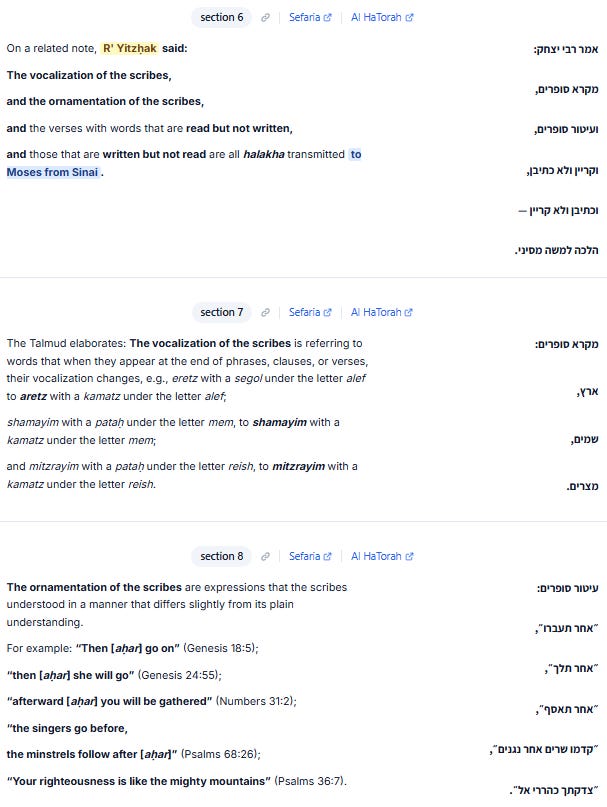
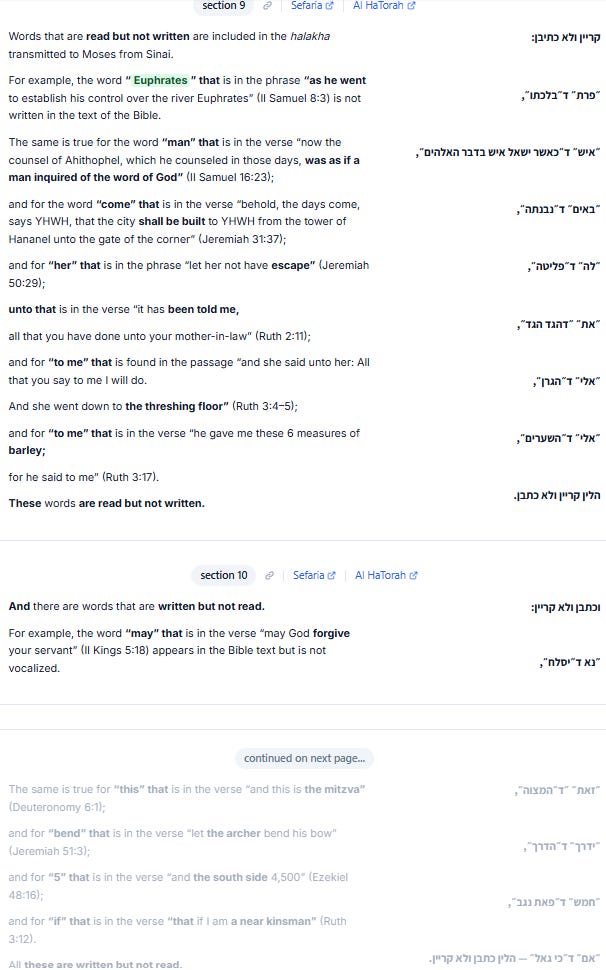
Note how the programmatic splitting of the base Hebrew/Aramaic text in ChavrutAI interface (based on Sefaria punctuation) makes the literary structure in the sugya very clear, especially in sections #6 and on :
Compare my “Public Reading, Ritual Joy, and Liturgical Retelling of Israel’s History: Ezra, Nehemiah, and the People’s Rediscovery of Torah, Sukkot, and Covenant in Nehemiah 8-9“; I cite this verse ibid. in section “Reading With Interpretation“.
This refers to pausal forms in Biblical Hebrew.
In Biblical Hebrew pronunciation, some words change their vowel pattern when they occur at a pause—typically at the end of a verse or major clause (where a strong cantillation mark appears).
The Talmud’s examples (for clarity, I split the syllables with dashes, bolded the relevant syllables, used a lengthier transliteration):
הלין - Aramaic “these”, unusual in the Talmud.
See Jastrow (modernized):
הָלֵין
(contraction of הָאִילֵּין) these, those, these things.
Nedarim 79b:5 - הלין והלין - “both”
and frequently.
Vayikra Rabbah 25:3 הֵילֵין תאיניא (Kohelet Rabbah 2:20:1 הלין) - “these figs here”