

This is the second part of a four-part series. Part 1 is here; the outline of the series can be found at Part 1.1
R’ Yoḥanan - Hadrian’s voice killed 80,000 myriads at Betar
אמר רבי יוחנן:
קול אדריינוס קיסר הורג בביתתר שמונים אלף ריבוא.
R’ Yoḥanan said:
the voice of Emperor Hadrian killing 80,000 myriads2 at Betar.
R’ Yoḥanan - 80,000 pairs of horn-blowers encircled Betar, each commanding many troops
אמר רבי יוחנן:
שמונים [אלף] זוג שלתוקעי קרנות היו מקיפין את ביתתר.
וכל אחד ואחד היה ממונה על כמה חיילות.
R’ Yoḥanan said:
80 [thousand] pairs (זוג) of horn-blowers were encircling Betar,
each of which was commanding several army units.3
Anecdote re Ben Koziba and the rabbis - Ben Koziba had 200,000 soldiers with a cut-off finger; the rabbis objected (to his cutting off fingers), so instead he tested soldiers by requiring them to uproot cedars while riding horses
והיה שם בן כוזבה
והיה לו מאתים אלף מטיפי אצבע.
שלחו חכמים ואמרו לו:
עד אימתי אתה עושה את ישראל בעלי מומין?!
There was Ben Koziba
who had 200,000 with him missing (מטיפי) a finger.
The rabbis sent:
how long will you turn Israel into defective persons (בעלי מומין)?!
אמר להן: וכי היאך איפשר לבודקן?
אמרו לו:
כל מי שאינו רוכב על סוסו ועוקר ארז מן לבנון --
לא יהיה נכתב באיסרטיא שלך.
והיו לו מאתים אלף כך ומאתים אלף כך.
[Ben Koziba] said to [the rabbis]: how [else] should one test them?
[the rabbis] said to [Ben Koziba]:
anyone who riding on his horse cannot uproot a cedar of Lebanon --
should not be enrolled4 in your army.5
[Ben Koziba] had 200,000 of such [people].
Before battle, Ben Koziba asked God neither to assist nor obstruct him - Psalms 60:12
וכד דהוה נפק לקרבא
הוה אמר:
ריבוניה דעלמא!
לא תסעוד ולא ת[כסוף].
הלא אתה אלהים זנחתנו
ולא תצא בצבאותינו.
When [Ben Koziba] went into battle
He would say:
God!
Do not support (תסעוד) and do not hinder,
did not you, God, neglect us,
and do not go out with our armies (Psalms 60:12)6
Anecdote re R’ Elazar of Modiin - During Hadrian’s 3½-year siege, R’ Elazar of Modiin prayed daily that God not judge that day
שלש שנים ומחצה עשה אדריינוס מקיף על ביתתר.
והוה רבי אלעזר המודעי יושב על השק ועל האפר
ומתפלל בכל יום ואומר:
רבון העולמים!
אל תשב בדין היום.
אל תשב בדין היום.
Hadrian laid siege to7 Betar for 3½ years
R’ Elazar from Modiin was sitting in sack[cloth] and ashes,
praying every day and saying:
God!
do not sit in judgment today,
do not sit in judgment today.
Anecdote re Samaritan and Hadrian - A Samaritan persuaded Hadrian not to abandon the siege of Betar, claiming he could make the city surrender
בעא אדריינוס מיזל ליה.
אמר ליה חד כותיי:
לא תיזיל לך.
דאנא חמי מה מיעבד
ומשלים לך מדינתא.
Hadrian wanted to go away8
A Samaritan said to him:
do not go away,
for I am seeing what to do
that the city (מדינתא) will submit to you.
Anecdote re Samaritan, R’ Elazar of Modiin, and Ben Koziba
עאל ליה מן ביבא דמדינתא.
עאל ואשכח רבי אלעזר המודעי קאים מצלי.
עבד נפשיה לחיש ליה בגו אודניה.
חמוניה בני מדינתא, ואייתוניה גבי בן כוזבא.
אמרון ליה: חמינן ההן סבא משתעי לחביבך.
אמר ליה: מה אמרת ליה ומה אמר לך.
[the Samaritan] went to the city gate,
Entered, and found R’ Elazar from Modiin standing in prayer.
[the Samaritan] showed himself as if he would whisper into [R’ Elazar from Modiin’s] ear.
The people of the city saw [the Samaritan], and brought him to Ben Koziba.
They said to [Ben Koziba]: we saw this old man turning to your uncle9
[Ben Koziba] asked [the Samaritan]: what did you say to [R’ Elazar from Modiin] and what did he say to you?
The Samaritan framed R’ Elazar as a traitor
אמר ליה:
[אין] אנא אמר לך
מלכא קטל לי.
ואי לא אנא אמר לך
את קטל יתי.
טב לי מלכא קטל יתי ולא את.
[[the Samaritan said that R’ Elazar from Modiin] answered:
if I shall tell you,
the king [=Hadrian] will kill me;
but if I do not tell you,
you will kill me.
It is better that the king should kill me but not you.
אמר ליה:
אמר לי דאנא משלים מדינתא.
[the Samaritan] told him:
[R’ Elazar from Modiin] said to me:
I will make the town submit to the king.
Ben Koziba interrogated R’ Elazar, then kicked and killed him
אתא גבי רבי אלעזר המודעי.
אמר ליה: מה אמר לך הדין כותייא?
אמר ליה: לא כלום.
מה אמרת ליה?
אמר ליה: לא כלום.
יהב ליה חד בעוט, וקטליה.
[Ben Koziba] came to R’ Elazar from Modiin.
[Ben Koziba] asked [R’ Elazar from Modiin]: what did this Samaritan say to you?
[R’ Elazar from Modiin] answered: nothing.
[Ben Koziba asked:] What did you say to him?
[R’ Elazar from Modiin] answered: nothing.
[Ben Koziba] kicked [R’ Elazar from Modiin], and killed him.
Bat kol - Ben Koziba killed R’ Elazar, “the arm and right eye of Israel,” so his own arm and right eye would be struck - Zechariah 11:17
מיד יצאת בת קול ואמרה:
הוי
רועי האליל
עוזבי הצאן
חרב על זרועו
ועל עין ימינו
זרועו יבש תיבש
ועין ימינו כהה תכהה.
Immediately there came a bat kol that said:
woe,
criminal shepherds,
who abandon the flock,
a sword on his arm
and on his right eye.
His arm shall dry up
and his right eye darken (Zechariah 11:17)
הרגת את רבי אלעזר המודעי
זרוען שלכל ישראל
ועין ימינם.
לפיכך זרועו שלאותו האיש יבוש תיבש
ועין ימינו כהה תכהה.
מיד נלכדה ביתתר
ונהרג בן כוזבה.
You [=Ben Koziba] killed R’ Elazar from Modiin,
the arm of Israel,
and their right eye.
Therefore the arm of this man [=Ben Koziba] shall dry up
and his right eye darken.
Immediately Betar was captured10
and Ben Koziba killed.
Anecdote re Hadrian and the Samaritan - Hadrian found a snake wrapped around Ben Koziba and declared that only God could have killed him - Deuteronomy 32:30
אתון טעינין רישיה גבי אדריינוס.
אמר לון: מאן קטל הדין?
אמר ליה חד כותייא: אנא קטלתיה.
They came carrying [Ben Koziba’s] head to Hadrian.
[Hadrian] asked them: who killed [Ben Koziba]?
A Samaritan said to him: I killed him.
אמר ליה: חמי לי פטומיה.
חמי ליה פטומיה.
אשכח חכינה כריכה עלוי.
אמר:
אלולי אלהא דקטליה
מאן הוה יכיל קטליה?!
וקרא עלוי:
אם לא כי צורם מכרם
ויי הסגרם.
[Hadrian] said to [the Samaritan]: show me [Ben Koziba’s] body.11
[the Samaritan] showed [Hadrian] the body [of Ben Koziba];
[Hadrian] found a poisonous snake wrapped around [Ben Koziba’s body].12
[Hadrian] said:
if God had not killed him,
who could kill him?!
[Hadrian] recited over him:
if not that their Rock had sold them,
and YHWH handed them over (Deuteronomy 32:30)
The massacre at Betar was so vast that blood reached a horse’s nose, moved large stones, and flowed to the sea despite Betar’s distance
(See footnote.)13
והיו הורגין בהם והולכין
עד ששקע הסוס בדם עד חוטמו.
והיה הדם מגלגל סלעים משאוי ארבעים סאה
עד שהלך הדם בים ארבעת מיל.
אם תאמר שהיא קרובה לים,
והלא רחוקה מן הים ארבעים מיל.
[The Romans] killed [the Jews] continuously
until the horse was immersed in blood up to his nose.
The blood was moving rocks of 40 se’ah loads,
until the blood colored the sea for 4 mil.
If you would say that it was close to the sea,
in fact it is 40 mil distant from the sea.
300 children’s brains were found on one stone; 3 boxes of tefillin boxes of 9 se’ah each were found, or alternatively 9 boxes of 3 se’ah each
אמרו:
שלש מאות מוחי תינוקות מצאו על אבן אחת.
ומצאו שלש קופות שלקצוצי תפילין שלתשע תשע סאין.
ויש אומרים:
תשע של שלש שלש סאין.
They said:
300 children’s brains were found on one stone,
and they found 3 boxes of tefillin capsules of 9 se’ah each,
but some say:
9 of 3 se’ah each.
Rabban Shimon b. Gamliel - Betar had 500 schools, the smallest with at least 500 children
תני:
רבן שמעון בן גמליאל אומר:
חמש מאות בתי סופרים היו בביתתר.
והקטן שבהן אין פחות מחמש מאות תינוקות.
It was stated:
Rabban Shimon ben Gamliel says:
500 schools14 were in Betar,
the smallest one for not less than 500 children (תינוקות).
The children expected to fight with their styluses
והיו אומרים:
אם באו השונאים עלינו --
במכתובים הללו אנו יוצאין עליהן
ומנקרים את עיניהם.
[the schoolchildren] were saying:
if the enemies (=Romans) come against us --
we shall go out against them with these styluses (מכתובים)
and blind them.15
... but in fact, ultimately were burned wrapped in their books
וכיון שגרמו עונות
היו כורכים כל אחד ואחד בספרו
ושורפין אותו.
When the sins (divinely) caused,
[the Romans] were wrapping (כורכים) each single [schoolchild] into his book16
and burning him;
Rabban Shimon b. Gamliel - Of all those children, only he himself survived; he applied a verse of lament to himself - Lamentations 3:51
ומכולם לא נשתייר אלא אני.
וקרא על גרמיה:
עיני עוללה לנפשי מכל בנות עירי.
and of [the schoolchildren], only I remained.
[Rabban Shimon b. Gamliel] recited about himself:
my eye hurts my soul more than all daughters of my city (Lamentations 3:51)
Hadrian fenced an 18-by-18-mil vineyard with the corpses of Betar’s dead and left them unburied, until a later emperor allowed burial
כרם גדול היה לאדריינוס הרשע.
שמונה עשר מיל על שמונה עשר מיל
כמין טיבריא לציפורי.
והקיפו גדר מהרוגי ביתתר מלא קומה ופישוט ידיים.
ולא גזר עליהם שייקברו.
עד שעמד מלך אחר
וגזר עליהם שייקברו.
The evil Hadrian had a large vineyard,
18 mil by 18 mil,
as from Tiberias to Sepphoris.
He fenced it in with the slain of Betar standing up (מלא קומה) with outstretched arms,17
and did not decree18 that they should be buried,
until another king19 arose
who decreed that they should be buried.
Rav Ḥuna - When Betar’s dead were allowed burial, the blessing “Who is good and does good” was instituted: “good” because they did not decompose, “does good” because they were buried (#14)
אמר רב חונה:
משניתנו הרוגי ביתתר לקבורה --
נקבעה הטוב והמטיב.
הטוב
שלא נסרחו.
והמטיב
שניתנו לקבורה.
Rav Ḥuna said,
when the slain of Betar were permitted to be buried --
“the good and the benefactor”20 was fixed.
“The good”
that they did not decompose,
“the benefactor”
that they were permitted for burial.
R’ Yose - Betar lasted 52 years after the Temple’s destruction
תני:
רבי יוסי אומר:
חמשים ושתים שנה עשת ביתתר לאחר חרבן בית המקדש.
It was stated:
R’ Yose said:
52 years Betar existed after the destruction of the [Second] Temple21
Divine reason why Betar was destroyed: because its people lit lights after the Second Temple’s destruction, rejoicing over Jerusalem’s fall
ולמה חרבה?
על שהדליקה נירות לאחר חורבן בית המקדש.
And why was it destroyed?
For they lit lights22 after the destruction of the [Second] Temple.
As as aside, unrelated, note a new feature just launched at the ChavrutAI website (I plan to have a dedicate post about this), described in the Changelog page:
New Works: J.N. Epstein’s Introductions to Classical Rabbinic Literature:
Added two major works by Jacob Nahum Epstein, accessible under Study Tools: Introductions to Tanaitic Literature (Mishnah, Tosefta, and Halakhic Midrashim) and Introductions to Amoraic Literature (Babylonian Talmud)
Each work is presented as a paginated reader with full Hebrew text, section navigation, and footnotes displayed inline as margin notes on desktop or a collapsible panel on mobile
These readers have extensive display customization options (using the “Display” menu at the top right), and other UX/UI display amenities. For example, there’s a reading progress bar at the top of the screen, as well as a “return to top” button at the bottom right, both of which are helpful UX/UI features common in more modern webpages where the focus is on reading.
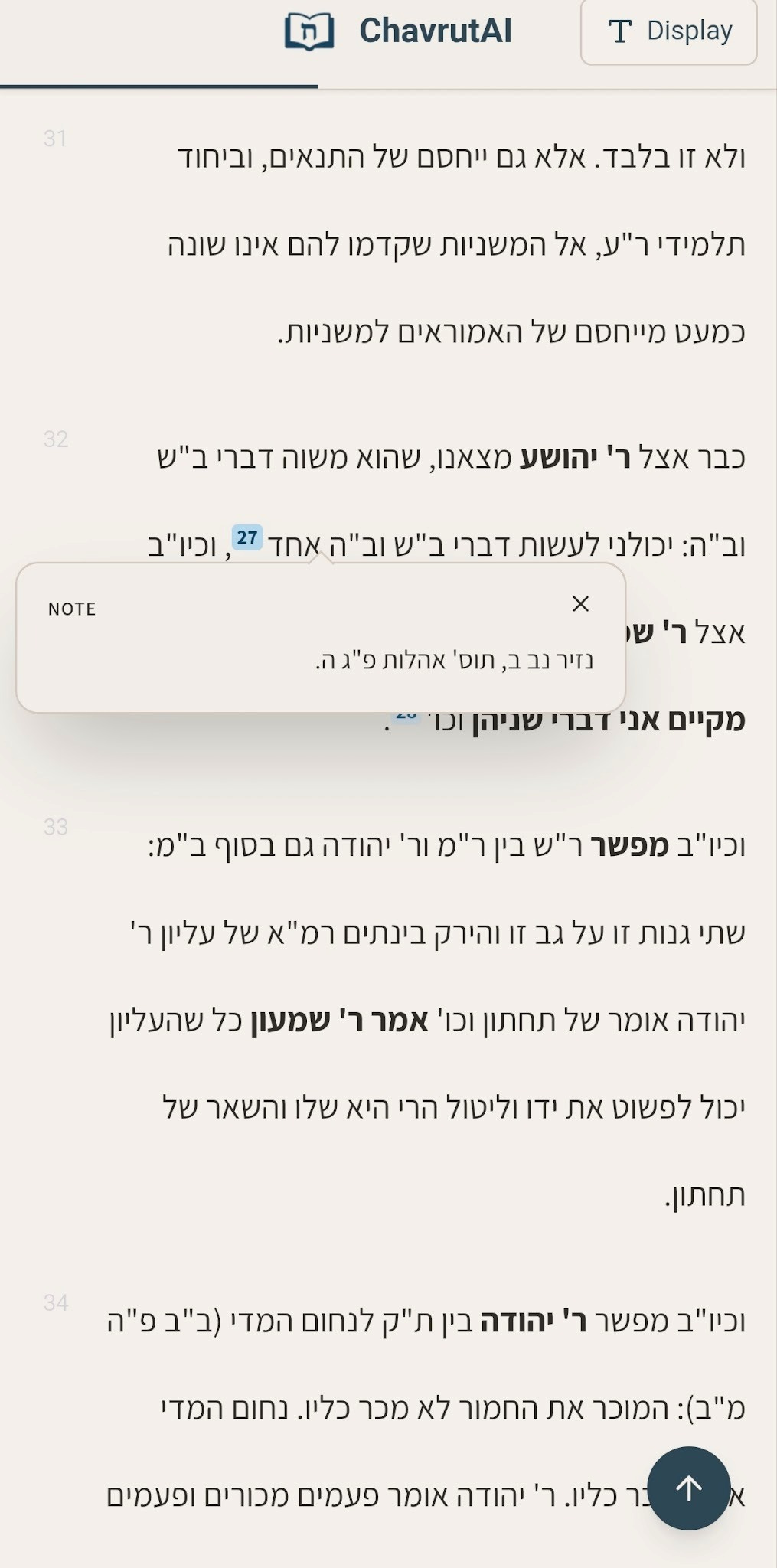
Screenshot in mobile view, for illustration (note that footnote displays in hover, when clicked on. Font is default: “Assistant”; line spacing = 2.2x; text size = Medium):
https://chavrutai.com/scholarship/introductions-tanaitic/how-was-the-mishnah-arranged:
=800,000,000 - eight hundred million. This is clearly hyperbolic. See my discussion of these numbers in the Bavli, in my “Large Numbers (≥100) in the Talmud: A Data Analysis”.
חיילות.
Compare the Bavli, in my “Appendix - The Beitar Massacre (Gittin 57a, sections # 21-23)“, section “R’ Zeira citing R’ Abbahu citing R’ Yoḥanan - the Beitar Massacre (Lamentations 2:3)“:
אלו שמונים [אלף] קרני מלחמה
שנכנסו לכרך ביתר בשעה שלכדוה
These are the 80,000 officers bearing battle trumpets in their hands,
who entered the city of Beitar when the enemy captured it (לכדוה)
נכתב - literally: “written”.
איסרטיא - from Greek.
On this word, see Jastrow (modernized), entry “אִסְטְרַטְיָא II”:
(στρατία [stratia]) prop. army; hence
1) host (of heavens, compare Septuagint Nehemiah 9:6).
Bamidbar Rabbah 12 - אסטרטיא של מעלה
Midrash Tehillim 92:9 - אסרטיא - “divine army” (angels, prophets etc.)
2) royal suite, court-officers.
Mishnah Kiddushin 4:5 - מוכתב באסטרטיא של מלך - “recorded in the king’s list of officers” (during Agrippa’s reign, serving as evidence of legitimate birth; compare אַרְכִי I).
Eichah Rabbah 2:4 - אסטרטיא;
Jerusalem Talmud Taanit 4:5:11 - איסרטיא - the list of Bar-Kokhba’s suite.
[Jerusalem Talmud Nedarim 11:12:2 - אסטרטיות read אִסְטְרַטְיוֹטוֹת;
Ibid.- אסטרטיות חבק׳ - read אִסְטְרַטְיוֹט.
Jerusalem Talmud Gittin 3:4:2 - אסטרטיות, see אַפָּרָטוֹסוֹת.
Midrash Tanḥuma Genesis 2 - אסטרטיאות, Variant אסטראות, see אִסְטַרְיָא.]
Note that modern English strategy ultimately descends from Greek stratos; see Wiktionary, “strategy”:
From Ancient Greek στρατηγία (stratēgía, “office of general, command, generalship”), from στρατηγός (stratēgós, “the leader or commander of an army, a general”), from στρατός (stratós, “army”) + ἄγω (ágō, “to lead, conduct”).
On quoting Psalms 60:12 in this sugya, compare the similar passage in the Bavli, in my “The Destruction of “King’s Mountain” (‘Tur Malka’): A Story of Custom, Rebellion, and Massacre (Gittin 57a)“, section “Bar-Deroma’s downfall came from quoting Psalms 60:12 as a declaration, not a question“.
מקיף - literally: “encircled, surrounded”.
I.e. to give up on the siege. Compare the Bavli ibid., section “The Emperor Withdraws Briefly“.
חביבך - i.e. R’ Elazar from Modiin.
נלכדה ביתתר - the expression used in the Mishnah, see the first section of the first installment of this series.
פטומיה.
On this word, see Jastrow (modernized), entry “פִּיטּוּמָא ²”:
(פטם to break, compare Arabic faṭas [=”dead”]- ‘mortuus fuit’ [Latin - ”he was dead”)
slain body, corpse.
Jerusalem Talmud Taanit 4:5:13 - חמי לי פִּטּוּמֵיה - “show me his (Bar Kokhba’s) body”
Yalkut Shimoni on Torah 946:2 - אייתון לי גופיה פטומיא (read: אייתון לי פטומיה, גופיה being a gloss to פ׳).
Plural: פִּיטּוּמִין, פִּטּ׳.
Eichah Rabbah 2 - זיל אייתי לי פִּיטּוּמַיְהוּ - “go and bring me their bodies”
On death by venomous snake in this sugya, compare the Bavli, in my “The Destruction of “King’s Mountain” (‘Tur Malka’)” (cited in previous footnote), section “Bar-Deroma dies after being attacked by a snake in an outhouse“.
Compare the Bavli, in my “Appendix - The Beitar Massacre” (cited earlier), sections “R’ Eliezer - the Huge Amount of Blood from the Massacre“ and “Baraita - Local vineyards were fertilized in the next 7 years with blood from the massacre“.
בתי סופרים - literally: “houses of scribes”.
On the related term beit [ha-]sefer, compare Jastrow (modernized), entry “סֵפֶר”, section “בֵּית סֵ׳, בֵּית הַסֵּ׳”:
the school in which the Bible is taught, secondary school, contrasted to בית תלמוד Talmud school.
Jerusalem Talmud Maasrot 3:3:8, see סַפָּר 1.
Midrash Tehillim 92:9 - שתולים … אלו התינוקות שבבית הס׳ - “ ‘planted in the house of God’ (Midrash Tehillim 92:14), that means the children at school”
and frequently.
מנקרים את עיניהם - literally: “gouge out their eyes”.
ספרו - likely: Bible scroll.
פישוט ידיים - likely referring to crucifixion.
גזר - i.e. give order to allow.
I.e. a subsequent Roman emperor.
הטוב והמטיב.
Compare the parallel Bavli, in my “Pt1 Tu Be-Av as Turning Point: Inter-Tribal Marriage, the End of Wilderness Death, National Memory, and the Division of the Land (Bava Batra 121a-122a)“, section “Rav Mattana - 15th of Av: the slain of Beitar were finally buried; Yavne instituted “Ha-tov ve-ha-metiv”: “good” = bodies didn’t decompose; “does good” = burial granted“.
Since the destruction of the Second Temple was in year 70 CE, and Betar was destroyed in year 132 CE.
הדליקה נירות - i.e. in celebration, or: continuing business as usual, and not mourning.
Compare the Bavli, “The Destruction of “King’s Mountain” (‘Tur Malka’)”, section “The Emperor Withdraws Briefly“:
איזדקור
ואכלו
ושתו,
ואדליקו שרגי,
עד דאיתחזי בליונא דגושפנקא ברחוק מילא.
They leapt about,
ate,
drank,
and lit candles in celebration
so many that the image [bilyona] imprinted on a seal [gushpanka] was visible from a distance of a mil.