

This is the second part of a four-part series. Part 1 is here; the outline of the series can be found at Part 1.
Baraita - “Orev” means the crow - Leviticus 11:15
תניא:
״עורב״ –
זה עורב,
It is taught in a baraita: The verse states: “Every orev after its kinds” (Leviticus 11:15).
With regard to the orev,
this is the well-known crow;
“after its kinds” includes the zarzir
״למינו״ –
רבי אליעזר אומר:
להביא את הזרזיר.
as for the phrase “after its kinds,”
R’ Eliezer says:
It is written to include the zarzir,1
another type of crow, to teach that it is non-kosher.
Rabbis disputing R’ Eliezer - The people of Kefar Temarta ate the zarzir because it has a crop
אמרו לו לרבי אליעזר:
והלא אנשי כפר תמרתא שביהודה היו אוכלים אותן
מפני שיש להן זפק!
The rabbis said to R’ Eliezer:
But wouldn’t the people of Kefar Temarta in Judea eat the zarzir,
because it has a crop?
R’ Eliezer - The people of Kefar Temarta will be (divinely) judged for eating the zarzir
אמר להם:
אף הן עתידין ליתן את הדין.
R’ Eliezer said to them:
They too will be judged in the future for their transgression.
Alternative version - R’ Eliezer - “After its kinds” also includes the white senunit as non-kosher - Leviticus 11:15
דבר אחר:
״למינהו״ להביא סנונית לבנה,
דברי רבי אליעזר.
Alternatively,
the phrase “after its kinds” is written to include the white senunit2 and teach that it is non-kosher;
this is the statement of R’ Eliezer.
Rabbis disputing R’ Eliezer - The people of the Upper Galilee ate the white senunit because its gizzard can be peeled
אמרו לו:
והלא אנשי גליל העליון אוכלים אותו,
מפני שקרקבנו נקלף!
The Rabbis said to him:
But don’t the people of the upper Galilee eat it,
because its gizzard can be peeled?
R’ Eliezer - The people of the Upper Galilee will be judged for eating the white senunit
אמר להם:
אף הן עתידין ליתן את הדין.
[...]
R’ Eliezer said to them:
They too will be judged in the future for their transgression.
[...]
Ameimar - The halakha is that a bird with one kosher sign is permitted, provided it does not claw prey
אמר אמימר:
הלכתא:
עוף הבא בסימן אחד –
טהור,
והוא דלא דריס.
Ameimar said:
The halakha is:
Any bird that comes before a person with one sign --
is kosher,
provided that it does not claw (דריס) its food.
אמר ליה רב אשי לאמימר:
הא דרב נחמן מאי?
אמר ליה:
לא שמיע לי,
כלומר: לא סבירא לי.
Rav Ashi said to Ameimar:
What about that which Rav Naḥman said, that if one finds a bird with exactly one sign, he may eat it only if he can identify all the non-kosher birds in the Torah, to be sure that it is not one of them?
Ameimar said to him:
I did not hear this statement;
that is to say: I do not hold accordingly.
מאי איכא?
משום פרס ועזניה?
ליתנהו בישוב.
What concern is there?
Is one concerned because of the peres and ozniyya, which have only one sign?
They are not found in settled areas (ישוב),
and one need not be concerned about them.
Rav Yehuda - The “scratching bird” is fit for the purification of a metzora
אמר רב יהודה:
עוף המסרט –
כשר לטהרת מצורע,
§ Rav Yehuda says:
The bird known as the scratching (מסרט) bird --
is fit for use in the purification of a metzora,
i.e., it is kosher. Only kosher birds are fit for this rite, as the verse states: “Then shall the priest command to take for him that is to be purified two living pure birds” (Leviticus 14:4).
it is the white senunit disputed by R’ Eliezer and the Rabbis
וזו היא סנונית לבנה שנחלקו בה רבי אליעזר וחכמים.
[...]
And this is the white senunit about which R’ Eliezer and the Rabbis disagreed in the baraita.
[...]
Raḥava citing R’ Yehuda - The young tasil is unfit as a mature dove offering, but fit as a young pigeon offering
אמר רחבה, אמר רבי יהודה:
תסיל
פסול
משום תורין,
וכשר
משום בני יונה,
§ Raḥava says that R’ Yehuda says:
A young tasil,3 which is similar to a dove --
is unfit
for sacrifice as a dove (תורין), which is fit only when mature,
but it is fit
for sacrifice as a pigeon (בני יונה),
which is fit only when immature. In other words, the tasil is considered a type of pigeon, not a dove.
Datzifi and Reḥava’s doves are fit as mature doves, but unfit as young pigeons
דאציפי
ותורין של רחבה
כשרין משום תורין,
ופסולין משום בני יונה.
[...]
A mature datzifi bird,
and mature doves of Reḥava,
are fit
as doves,
but are unfit
as pigeons,
since they are types of doves.
[...]
Rav Yehuda - Tzutzeyanei doves are fit for the altar; they are Reḥava’s doves
אמר רב יהודה:
הני כופשני צוצייני --
כשרים לגבי מזבח,
והן הן תורין של רחבה.
[...]
Rav Yehuda says:
The tzutzeyanei doves (כופשני צוצייני) --
are fit for sacrifice on the altar,
and they are the doves of Reḥava mentioned earlier.
[...]
Rav Yehuda - Grasshoppers from shrubs are permitted; those from cabbages are forbidden
אמר רב יהודה:
הני כרזי דבי חילפי --
שרו,
ודבי כרבי --
אסירי.
Rav Yehuda says:
These grasshoppers (כרזי) found among the shrubs (בי חילפי)
are kosher and permitted for consumption.
And those found among the cabbages
are forbidden.
Ravina - One who eats the forbidden cabbage grasshoppers is flogged for eating winged swarming creatures - Deuteronomy 14:19
אמר רבינא:
ומלקינן עלייהו משום שרץ העוף.
Ravina said:
And we flog those who eat them on their account, due to the prohibition: “And all winged swarming things are impure unto you” (Deuteronomy 14:19).
Rav Yehuda - Tzarda is permitted, barda is prohibited, and marda is uncertain
ואמר רב יהודה:
צרדא –
שרי,
ברדא –
אסיר,
וסימניך: ״בר מיניה״,
מרדא –
ספקא.
And Rav Yehuda says:
The bird called tzarda
is permitted for consumption,
and the barda
is prohibited.
And your mnemonic to remember which is which is this: Eat any bird except [bar] for it.
As for the marda,
it is uncertain whether it is kosher.
Rav Asi - There are 8 uncertain birds: ḥuva, ḥuga, suga, harnuga, tushelemi, marda, kuḥilna, and bar nappaḥa
אמר רב אסי:
שמונה ספיקות הן:
חובא,
חוגא,
סוגא,
והרנוגא,
תושלמי,
ומרדא,
כוחילנא,
ובר נפחא.
[...]
Rav Asi says:
There are 8 uncertain cases:
The ḥuva,
ḥuga,
suga,
and harnuga,
tushelemi,
and marda,
kuḥilna,
and bar nappaḥa.
[...]
Abaye - The swamp rooster is one of the 8 uncertain birds; it is the mardu
אמר אביי:
תרנגולא דאגמא --
חד משמונה ספיקות הוא,
והיינו מרדו.
Abaye says:
The swamp (אגמא) rooster --
is one of the 8 uncertain cases,
and this is the mardu,
i.e., the marda mentioned earlier.
Rav Pappa - The swamp rooster is forbidden, but the swamphen is permitted - Deuteronomy 23:4
אמר רב פפא:
תרנגולא דאגמא
אסירא,
תרנגולתא דאגמא
שריא,
וסימניך –
״עמוני ולא עמונית״.
Rav Pappa says:
The swamp rooster
is forbidden,
but the swamphen
is permitted.
And your mnemonic to remember this is
the statement of the rabbis with regard to the verse: “An Ammonite or a Moabite shall not enter into the assembly of YHWH” (Deuteronomy 23:4), that an Ammonite man is unfit to enter the assembly, but not an Ammonite woman.
Mareimar - The swamphen is forbidden, because it was seen clawing and eating prey; it is the giruta
דרש מרימר:
תרנגולתא דאגמא --
אסירא,
חזיוה דדרסה ואכלה,
והיינו גירותא.
Mareimar taught:
The swamphen --
is forbidden,
because the rabbis saw that it claws its prey and eats it.
And this is the giruta,4
a non-kosher bird (see 109b).
Rav - Shabor anderafta is permitted; piruz anderafta is forbidden
אמר רב:
שבור אנדרפטא –
שרי,
פירוז אנדרפטא –
אסיר,
וסימניך –
פירוז רשיעא.
Rav says:
The bird called the shavor anderafta
is permitted,
but the piruz anderafta
is forbidden.
And your mnemonic to remember this is
the known personality Piruz the Evil.5
Rav Huna - Bunya is permitted; parva is forbidden
אמר רב הונא:
בוניא –
שרי,
פרוא –
אסיר,
וסימניך –
פרואה אמגושא.
Rav Huna says:
The bird called the bunya
is permitted.
The parva
is forbidden.
And your mnemonic to remember this is
the known personality Parva’a the Sorcerer.6
Rav Pappa - The reclining-and-eating mardu is permitted; the bowing-and-eating mardu is forbidden - Exodus 34:14
אמר רב פפא:
מרדו זגיד ואכיל –
שרי,
סגיד ואכיל –
אסיר,
וסימניך:
״לא תשתחוה לאל אחר״.
Rav Pappa says:
The bird known as the reclining and eating mardu
is permitted,
while the bowing and eating mardu
is forbidden.
And your mnemonic to remember this is
the verse: “You shall bow down to no other god” (Exodus 34:14).
Shmuel - The “wine drinker” bird is forbidden
אמר שמואל:
שתיא חמרא –
אסירא,
וסימניך:
״שתויי יין פסולין לעבודה״.
Shmuel says:
The bird called the wine drinker --
is forbidden.
And your mnemonic to remember this is
the halakha: Those who drank wine are unfit for service in the Temple.7
Shmuel - The “wine pourer” bird is forbidden, but the “little wine pourer” is permitted
ואמר שמואל:
מזגא חמרא –
אסירא,
בת מזגא חמרא –
שריא,
וסימניך
״יפה כח הבן מכח האב״.
And Shmuel says:
The bird called the wine pourer (מזגא חמרא)
is forbidden.
But the bird called the little wine pourer
is permitted.
And your mnemonic to remember this is
the idiom of the rabbis: The power of the son is greater than the power of the father,
i.e., the larger is forbidden while the smaller is permitted.
Rav Yehuda - Among shekitena: long-shanked red ones are permitted; small red ones are forbidden; long-shanked green/yellow ones are forbidden
אמר רב יהודה:
שקיטנא --
אריכי שקי וסומקי –
שריא,
וסימניך: מורזמא.
גוצי וסומקי –
אסירי,
וסימניך ״ננוס פסול״.
אריכי שקי וירוקי –
אסירי,
וסימניך ״ירוקין פסולין״.
Rav Yehuda says:
There are several types of shekitena.8
The long-shanked red ones
are permitted.
And your mnemonic to remember this is the murzema bird, which is similar in appearance and known to be kosher.
The little (גוצי) red ones
are forbidden,
and your mnemonic for this is the halakha that a dwarf (ננוס) priest is unfit for Temple service.9
The long-shanked green, i.e., yellow, ones
are forbidden,
and your mnemonic for this is the Mishnah (56a): Innards that have turned green render an animal a tereifa and unfit for consumption.
Appendix - Permitted Parallels to Things Forbidden by the Torah: A Catalogue of Eight Prohibitions and their Permitted Counterparts (Chullin 109b)
Chullin/109b#12 thru #15
Rav Naḥman’s wife Yalta argues that Torah prohibitions are often matched by some permitted analogue. She therefore says: since meat cooked in milk is prohibited, she wants to taste a permitted analogue of it.
Table summarizing:
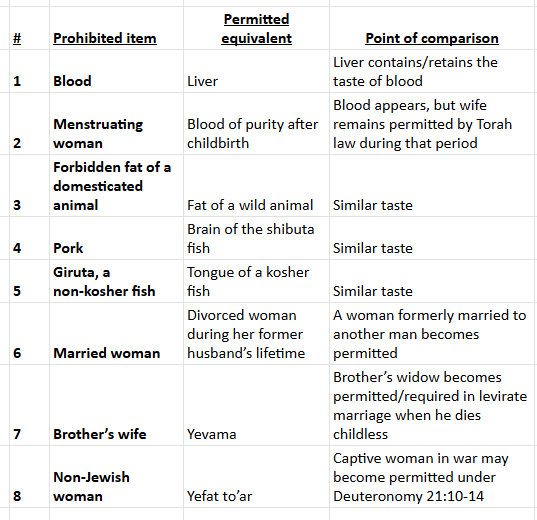
אמרה ליה ילתא לרב נחמן:
מכדי,
כל דאסר לן רחמנא —
שרא לן כוותיה
§ Yalta said to her husband Rav Naḥman:
Now as a rule,
for any item that God prohibited to us —
He permitted to us a similar item.
אסר לן דמא –
שרא לן כבדא,
נדה –
דם טוהר.
חלב בהמה –
חלב חיה,
חזיר –
מוחא דשיבוטא,
גירותא –
לישנא דכוורא.
אשת איש –
גרושה בחיי בעלה,
אשת אח –
יבמה,
גויה –
יפת תאר,
בעינן למיכל בשרא בחלבא
אמר להו רב נחמן לטבחי:
זויקו לה כחלי
He prohibited to us the consumption of blood,
yet He permitted to us the consumption of liver, which is filled with blood and retains the taste of blood.
God prohibited sex with a menstruating woman,
but permitted sex with one’s wife while she discharges the blood of purity. During a particular period after giving birth, even if she experiences a flow of blood she is not rendered ritually impure and remains permitted to her husband by Torah law.
The Torah prohibits the consumption of the forbidden fat of a domesticated animal (בהמה),
but permitted the fat of a wild animal (חיה), which has the same flavor.
It is prohibited to eat pork,
but one may eat the brain of a shibuta fish, which has a similar taste.
One may not eat giruta, a non-kosher fish,
but one may eat the tongue of a fish, which tastes similar.
The Torah prohibits sex with the wife of another man
but permitted one to marry a divorced woman in her previous husband’s lifetime.
The Torah prohibits sex with one’s brother’s wife,
and yet it permits one to marry his yevama, i.e., his brother’s widow when the brother dies childless.
The Torah prohibits sex with a non-Jew woman
but permitted one to marry a beautiful woman (יפת תאר) who is a prisoner of war (see Deuteronomy 21:10–14).
Yalta concluded: The Torah prohibits the consumption of meat cooked in milk; I wish to eat a dish that tastes like meat cooked in milk.
Upon hearing this, Rav Naḥman said to his cooks:
Roast on a spit (זויקו) udders (כחלי) for her.
On this word, see Jastrow (modernized), entry “זַרְזִיר II”:
(Syriac זרזירא Payne Smith, ‘Thesaurus Syriacus’ 1156, Arabic zurzur; probably from זור to circle)
starling, also (collective) flock of starlings.
Chullin 62a:2 להביא את הז׳ (Sifra Sh’mini, Parah 3, chapter 5 הזַרְזִירִים, Arukh רין …) to include the starling (in the genus raven).
Hullin see above;
Bava Kamma 92b:13 (proverb) לא לחנם הלך ז׳ וכ׳ - “not without cause does the starling follow the raven etc.”
Bereishit Rabbah 65:3, beginning
Bereishit Rabbah 65:3 עלה ז׳ אחד וכ׳ a flock of starlings came to Eretz Yisrael.
Plural: זַרְזִירִים, זַרְזִירִין.
Bereishit Rabbah 75:4 אין שני ז׳ וכ׳ two flocks of starlings cannot sleep on one board (two nations cannot rule at the same time).
On this word, see Jastrow (modernized), entry “סְנוּנִית”:
(סָנַן) [the glistening,]
swallow.
Sifra Sh’mini, Parah 3, chapter 5 הס׳;
Chullin 62a:8 ס׳ לבנה the white-bellied swallow.
Tosefta Chullin 3 (Tosefta Chullin 4:23 אוכלין את ס׳ לבנה וכ׳ used to eat the white-bellied swallow, because etc.
Shabbat 77b:7 אימת ס׳ על הנשר the fear which the eagle has of the swallow;
and elsewhere.
For the citation from tractate Shabbat, see my “Appendix 2 - Animal-Based Natural Remedies and Weak Creatures That Intimidate the Mighty (Shabbat 77b)“, section “A List of Five weak animals that strike fear in strong ones“, list item #4.
תסיל.
On this word, see Jastrow (modernized), entry “תָּסִיל”:
(סלל = צלל)
tasil, a species of small doves (compare צוּצְלָא).
Chullin 62a:9 ת׳ פסול משום תורין וכ׳ a tasil is unfit to be offered in place of turtle-doves (a full-grown tasil cannot be offered), but it is fit in place of young pigeons.
Chullin 140b:7 יונה על ביצי ת׳ a dove found brooding over eggs of a tasil;
and elsewhere.
[Rashbam to Bava Batra 75a explains צוצלא = תאציל.]
On this word, see Jastrow (modernized), entry “גִּירוּתָא”:
girutha, name of an unclean bird, supposed to be moor-hen.
Chullin 62b:7; Niddah 50b:24 explaining the hen of the marshes.
Chullin 109b:13 we are forbidden ג׳ to eat girutha. [Arukh גּוּרִיתָא, see Kohut, ‘Aruch Completum’ II, 378a.]
On the citation from 109b, see the appendix at the end of this piece: “Appendix - Permitted Parallels to Things Forbidden by the Torah: A Catalogue of Eight Prohibitions and their Permitted Counterparts (Chullin 109b)”.
Meaning, the permitted anderafta is the sub-species shabor (=Shapur), and the prohibited sub-species is piroz.
פרואה אמגושא - literally: “Parva’ah the Magus”. (A magus is a Zoroastrian priest.)
On this name, see Jastrow (modernized), entry “פַּרְוָה”:
Parva, name of a Persian builder and magian, from whom a compartment in the Temple was supposed to have been named: לִשְׁכַּת הַפּ׳ or בֵּית הַפַּ׳.
Yoma 35a:1, see אַמְגּוּשָׁא;
Chullin 62b, see פַּרְוָא.
[Our word is perhaps identical with פַּרְוָור.]
On this prohibition, see Hebrew Wikipedia, “איסור עבודה במקדש שתויי יין“.
שקיטנא.
On this word, see Jastrow (modernized), entry “שְׁקִיטְנָא”:
(compare שָׁקוּט)
flamingo (from its abruptly bent beak).
Plural: שְׁקִיטְנָאֵי, שִׁיקְטְ׳.
Chullin 63a:2 ש׳ אריכי שקי וכ׳ Manuscript Munich and Arukh (Manuscript Rome: 1 שִׁקְטְנָאֵי; printed editions: singular, see Rabbinowicz, ‘Dikdukei Sofrim’ there, note) flamingos, those with long legs and red are permitted, the short-legged and red are forbidden.
As stated in the Mishnah; see my “Pt3 Body, Blemish, and Temple Duty: Physical Deformities that Disqualify Priests from Serving (Mishnah Bekhorot 7:1-6; Leviticus 21:18-20)“, section “Unusual Physical Features and Problematic Mental Conditions: Cushi (Ethiopian), Giḥor, Pale, Kipe’aḥ, Dwarf, deaf-mute, mentally disabled, alcoholic, and one with a skin condition“, list item #5.