

This is the second and final part of a two-part series. Part 1 is here; the outline of the series can be found at Part 1.
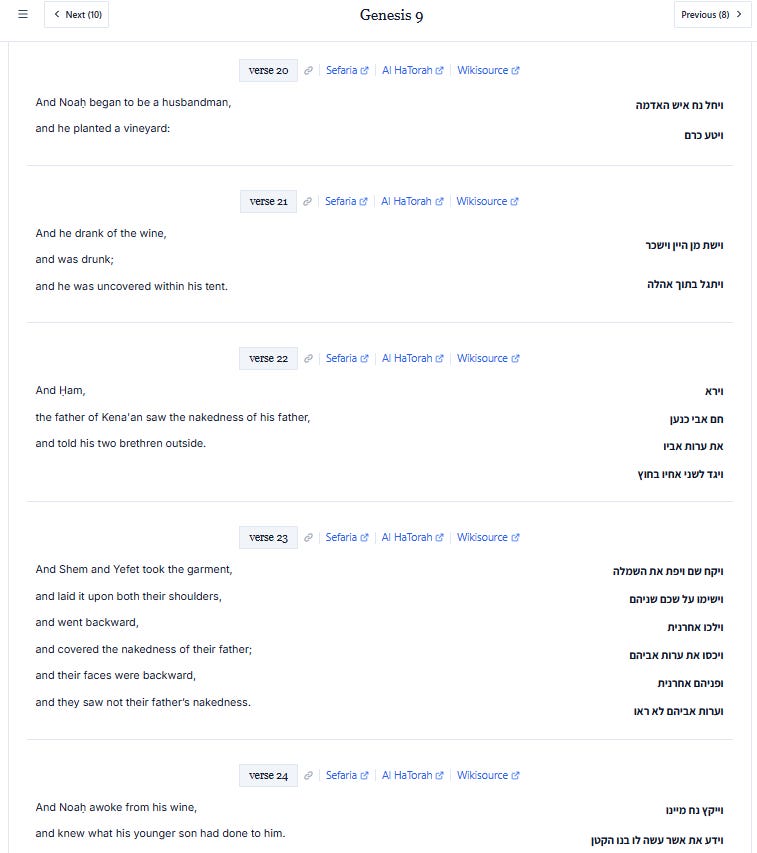
Anonymous Galilean - The Noah narrative contains 13 occurrences of Hebrew letter vav (“and”) followed by yod, spelling vay (“woe” - symbolizing the suffering caused by wine) - Genesis 9:20–24
דריש עובר גלילאה:
שלש עשרה ווין נאמר ביין:
״ויחל נח איש האדמה,
ויטע כרם,
וישת מן היין,
וישכר,
ויתגל בתוך אהלו,
וירא חם אבי כנען את ערות אביו,
ויגד לשני אחיו בחוץ,
ויקח שם ויפת את השמלה,
וישימו על שכם שניהם,
וילכו אחרנית,
ויכסו את ערות אביהם, ופניהם וגו׳״,
״וייקץ נח מיינו,
וידע את אשר עשה לו בנו הקטן״.
A visitor1 from the Galilee expounded:
The initial vav2 is stated 13 times in the passage concerning wine, as it is stated:
“And Noah began [va-yaḥel] to be a farmer,
and he planted [va-yita] a vineyard,
and he drank [va-yesht] of the wine,
and was drunk [va-yishkar];
and he was uncovered [va-yitgal] within his tent.
And Ham, the father of Canaan, saw [va-yar] the nakedness of his father,
and told [va-yaged] his two brothers outside.
And Shem and Japheth took [va-yikaḥ] the garment,
and laid it [va-yasimu] upon both their shoulders,
and went [va-yelekhu] backward,
and covered [va-yekhasu] the nakedness of their father; and their faces were backward, and they did not see their father’s nakedness.
And Noah awoke [va-yiketz] from his wine,
and knew [va-yeda] what his younger son had done to him” (Genesis 9:20–24).
All 13 instances of the initial vav here are followed by the letter yod.3 Vav and yod together form the word vay, meaning “woe,” and allude to the suffering and misfortune caused by uncontrolled drinking.
Rav and Shmuel - One says Ham castrated Noah; the other says he sexually penetrated him - Genesis 9:22–24
רב ושמואל:
חד אמר
סרסו,
וחד אמר
רבעו.
Having cited the passage discussing Noah, the Talmud enters into a discussion about what was actually done to him by his younger son, Ham.
Rav and Shmuel disagreed:
One says that
Ham castrated Noah
and one says that
Ham sexually penetrated him (רבעו)
The castration view explains why Noah cursed Ham through his 4th son, Canaan: Ham prevented Noah from having a 4th son - Genesis 10:6; Genesis 9:25
מאן דאמר סרסו:
מתוך שקלקלו ברביעי --
קללו ברביעי.
The Talmud explains:
The one who says that Ham castrated Noah adduces the following proof:
Since he injured Noah with respect to the possibility of conceiving a 4th son, which Noah wanted but could no longer have --
therefore Noah cursed him by means of Ham’s 4th son.
Ham’s sons were Cush, Mizraim, Put, and Canaan (see Genesis 10:6), and of all of these, it was Canaan whom Noah cursed (see Genesis 9:25–28).
The view that Ham sexually penetrated Noah derives Ham’s act through a verbal analogy between “and he saw” in Noah’s story and “and he saw” in the account of Shechem’s rape of Dinah - Genesis 9:22; Genesis 34:2
ומאן דאמר רבעו:
גמר
״וירא״
״וירא״.
כתיב הכא:
״וירא חם אבי כנען את ערות אביו״,
וכתיב התם:
״וירא אותה שכם בן חמור וגו׳״.
[...]
And the one who says that Ham sexually penetrated Noah
learned this from a verbal analogy between the words
“and he saw”
and “and he saw.”
Here it is written:
“And Ham, the father of Canaan, saw the nakedness of his father”;
and there it is written:
“And Shechem, son of Hamor the Hivite, prince of the country, saw her, and he took her, and lay with her, and afflicted her” (Genesis 34:2).
This indicates that the term “saw” alludes to sex.
[...]
Rav Ḥisda citing Rav Ukva / Mar Ukva citing R’ Zakkai - God rebuked Noah for failing to learn from Adam, whose downfall was likewise caused by wine
״ויחל נח איש האדמה
ויטע כרם״.
אמר רב חסדא, אמר רב עוקבא,
ואמרי לה: מר עוקבא, אמר רבי זכאי:
אמר לו הקדוש ברוך הוא לנח:
נח!
לא היה לך ללמוד מאדם הראשון
שלא גרם לו אלא יין?!
The Talmud continues to analyze the passage relating to Noah. The verse states:
“And Noah began to be a farmer,
and he planted a vineyard.”
In explanation of this matter, Rav Ḥisda says that Rav Ukva says,
and some say that Mar Ukva says that R’ Zakkai says:
God said to Noah:
Noah!
shouldn’t you have learned from Adam the first man,
whose banishment from the Garden of Eden was caused only by wine?!
This is according to the view that the Tree of Knowledge was a grapevine - Genesis 9:20
כמאן דאמר אותו אילן שאכל ממנו אדם הראשון –
גפן היה.
The Talmud notes:
This is in accordance with the opinion of the one who says that the tree from which Adam the first man ate --
was a grapevine.
R’ Meir - The Tree of Knowledge was a grapevine, since wine uniquely brings wailing and trouble upon a person
דתניא:
רבי מאיר אומר,
אותו אילן שאכל אדם הראשון ממנו –
גפן היה,
שאין לך דבר שמביא יללה לאדם אלא יין.
As it is taught in a baraita:
R’ Meir says:
The tree from which Adam the first man ate --
was a grapevine,
As, even today, nothing except wine brings wailing (יללה) and trouble upon a person;
most sins are caused by drunkenness.
R’ Yehuda - The Tree of Knowledge was wheat, as a child does not acquire the knowledge to call “father” and “mother” until tasting grain
רבי יהודה אומר:
חטה היה,
שאין התינוק יודע לקרוא אבא ואימא
עד שיטעום טעם דגן.
R’ Yehuda says:
The Tree of Knowledge was the wheat plant.
This is proven by the fact that, even today, an infant does not know how to call out to his father or mother
until he tastes the taste of grain,4
and for this reason wheat is called “the Tree of Knowledge.”
R’ Neḥemya - The Tree of Knowledge was a fig tree, as Adam and Eve repaired their sin using the same species with which they sinned - Genesis 3:7
רבי נחמיה אומר:
תאנה היה,
שבדבר שקלקלו --
בו נתקנו,
שנאמר:
״ויתפרו עלה תאנה״.
R’ Neḥemya says:
The Tree of Knowledge was a fig tree,
because it was with the matter with which they sinned --
that they were rehabilitated,
as it is stated:
“And they sewed together fig leaves,
and made for themselves loincloths” (Genesis 3:7).
R’ Yoḥanan citing R’ Shimon ben Yoḥai - Bathsheba physically restrained Solomon and rebuked him for excessive drinking - Proverbs 31:1–2
״דברי למואל מלך
משא אשר יסרתו אמו״.
אמר רבי יוחנן, משום רבי שמעון בן יוחי:
מלמד ש
כפאתו אמו על העמוד
§ The Talmud continues its discussion of wine. Referring to the verse that states:
“The words of King Lemuel,
the burden with which his mother corrected him” (Proverbs 31:1),
R’ Yoḥanan says in the name of R’ Shimon ben Yoḥai:
This teaches that
Solomon’s mother Bathsheba bound him to a pillar to have him flogged,
when she saw Solomon engaged in excessive drinking.
ואמרה לו:
״מה ברי
ומה בר בטני
ומה בר נדרי״.
And she said to him:
“What, my son?
And what, son of my womb?
And what, son of my vows?” (Proverbs 31:2).
“What, my son?” - Bathsheba warned Solomon that people would blame his behavior on her rather than his God-fearing father David
״מה ברי״
הכל יודעים שאביך ירא שמים הוה,
עכשיו יאמרו:
אמו גרמה לו.
She meant:
“What, my son?”
Everyone knows that your father, David, was a God-fearing man,
and now, when they see you sin, they will all say that
his mother caused him to drink,
i.e., that you engage in these behaviors because you are my son.
“And what, son of my womb?” - Bathsheba explained to Solomon that she continued to have sex with David while pregnant with him in order to produce a strong and fair-skinned son
״ומה בר בטני״
כל הנשים של בית אביך,
כיון שמתעברות
שוב אינן רואות פני המלך.
ואני דחקתי ונכנסתי,
כדי שיהא לי בן מזורז ומלובן.
“And what, son of my womb?”
That is to say:
With regard to all of the women of your father’s house,
once they conceive --
they no longer see the face of the king,
but I pushed myself in and entered the king’s chamber while I was pregnant,
so that I might have a son who is strong and fair-skinned.5
“And what, son of my vows?” - Unlike David’s other wives, who prayed merely for sons fit for kingship, Bathsheba prayed for a son diligent in Torah and fit for prophecy
״ומה בר נדרי״
כל נשים של בית אביך היו נודרות:
״יהא לי בן הגון למלכות״,
ואני נדרתי ואמרתי:
״יהא לי בן
זריז וממולא בתורה
והגון לנביאות״.
“And what, son of my vows?”
That is to say:
With regard to all of the women of your father’s house,
they would take vows while they were pregnant, saying:
Let me have a son who is fit to be king.
But I, by contrast, took a vow and said:
Let me have a son
who is diligent and filled with knowledge of the Torah
and fit for prophecy.
״אל למלכים למואל,
אל למלכים שתו יין״.
It is further stated there:
“It is not for kings, O Lemoel,
it is not for kings to drink wine;
nor for princes to say: Where is strong drink?”
“It is not for kings” - Bathsheba continues to rebuke Solomon - A king should not imitate drunken kings who become irreligious and ask why they need God
״אל למלכים״
אמרה לו:
מה לך אצל מלכים ששותים יין
ומשתכרים
ואומרים: למה לנו אל?
The Talmud provides an explanation of the meaning of each part of this verse:
“It is not for kings”:
Bathsheba said to her son Solomon:
What have you to do with kings who drink wine
and become intoxicated
and say: “Why [lamma] do we need God [El]?”
“Nor for princes (rozenim) to say: Where is strong drink?” - Solomon, to whom the secrets of the world were revealed, should not become drunk
״ולרוזנים:
אי שכר?״
מי שכל רזי עולם גלויים לו
ישתה יין וישתכר?!
The Talmud continues to explain the verse.
“Nor for princes [rozenim] to say:
Where is strong drink?”
This means that one like Solomon, to whom all the secrets [razei] of the world are revealed,
should he drink wine and become intoxicated?!
Alternate interpretation - Solomon, before whose door the princes of the world assemble, should not become drunk
איכא דאמרי:
מי שכל רוזני עולם משכימין לפתחו
ישתה יין וישתכר?!
Alternatively, there are those who say that this part of the verse should be understood as follows:
One like Solomon, to whom all the princes of the world rise early to come to his door,
should he drink wine and become intoxicated?!
R’ Yitzḥak - Solomon eventually acknowledged his mother’s rebuke, admitting that he had failed to learn from Noah and Adam, both associated with the disastrous effects of wine - Proverbs 30:2; Genesis 9:20
אמר רבי יצחק:
מניין שחזר שלמה והודה לאמו?
דכתיב:
״כי בער אנכי מאיש
ולא בינת אדם לי״.
R’ Yitzḥak says:
From where can it be learned that Solomon repented and admitted to his mother that she was justified in her rebukes?
As it is written:
“For I am more foolish than a man,
and have not the understanding of a man” (Proverbs 30:2).
״כי בער אנכי מאיש״
מנח,
דכתיב: ״ויחל נח איש האדמה״.
״ולא בינת אדם לי״
זה אדם הראשון.
This should be understood as follows:
“For I am more foolish than a man [ish]”;
that is, I am more foolish than Noah, who sinned with wine and is called “a man,” as it is written: “And Noah began to be a farmer [ish ha’adama]” (Genesis 9:20).
“And have not the understanding of a man [adam]”;
this is a reference to Adam the first man, who also sinned with wine, in accordance with the opinion of R’ Meir, who says that the Tree of Knowledge was a grapevine.
עובר - literally: “passer”, i.e. a passerby.
All are a vav-consecutive, see the note on the intro to this series.
The term for this narrative style is “parataxis”: clauses are placed side by side, often linked simply by “and,” rather than subordinated into complex sentences.
In Biblical Hebrew, this is especially associated with the vav-consecutive (or va-yiqtol) narrative style:
“And X did... and Y went... and he said... and they came...”
The repetitive “and... and... and...” is also called polysyndeton, but that refers specifically to the repeated conjunctions, not the broader narrative syntax.
And see next note.
Babies generally begin eating solid foods before they begin using words to call their parents; grain-based food (i.e. bread) is traditionally regarded as the primary solid food.
The chronology is broadly right: solid foods are generally introduced around 6 months, while meaningful "mama"/"dada" typically emerges later, around 8–12 months.
Steinsaltz explains:
There are times during a woman’s pregnancy when sex is beneficial for the development of the fetus. Bathsheba was telling Solomon: I did my utmost to ensure that you have extra strength and beauty, and now you use that strength and appeal to pursue drink.
This time is the second or third trimester, see my “Pt2 From Conception to Birth: Talmudic Perspectives on Fetal Development and Gender (Niddah 31a-b)“, section “Sex during pregnancy“, where I summarize:
The Talmud quotes a baraita regarding the stages of pregnancy and having sex:
First trimester: Sex is difficult and harmful for both the woman and the fetus.
Second trimester: Sex is difficult for the woman but beneficial for the fetus.
Third trimester: Sex is beneficial for both the woman and the offspring, resulting in a fair-skinned (מלובן) and strong (מזורז) baby.