

This sugya examines the relative weight of the commandments of Torah study and honoring one’s parents through a detailed reconstruction of Jacob’s chronology.1 Rabba, citing Rav Yitzhak bar Shmuel bar Marta, states that Torah study is greater than honoring one’s father and mother. The proof is drawn from Jacob’s life: although Jacob remained away from his parents Isaac and Rebecca for many years, the fourteen years that he spent studying in Eber’s academy were excluded from the period for which he was punished.2 The sugya thus treats chronology as evidence for a hierarchy of obligations.3
The calculation begins with the lifespan of Jacob’s uncle Ishmael (Isaac’s brother). The Torah records that Ishmael lived 137 years. Since Ishmael’s father Abraham was 86 when Ishmael was born and 100 when Isaac was born, Ishmael was fourteen years older than Isaac. Isaac was sixty when Jacob and Esau were born, making Ishmael seventy-four at Jacob’s birth. Ishmael thus died when Jacob was sixty-three.
A separate tradition states that Jacob was sixty-three when Isaac blessed him. The sugya connects Ishmael’s death to that moment through the account of Esau’s marriage to Mahalath. The verse identifies her both as Ishmael’s daughter and as Nebaioth’s sister. This redundancy indicates that Ishmael arranged the betrothal but died before the marriage was completed, leaving Nebaioth to conduct it. Ishmael’s death thus fixes Jacob’s age at the time he left his parents’ home.
The next calculation exposes a fourteen-year gap. Jacob was sixty-three when he received the blessing from his father Isaac. Jacob’s son Joseph was born after Jacob had spent fourteen years working for his father-in-law (and uncle) Laban, which would make Jacob seventy-seven at Joseph’s birth. Joseph was thirty when he stood before Pharaoh. Seven years of abundance and two years of famine then passed before Jacob arrived in Egypt. This calculation yields an age of 116. Yet Jacob explicitly tells Pharaoh that he is 130. The missing fourteen years are identified as the period during which Jacob remained concealed from Esau and studied in Eber’s academy before traveling to Aram-naharaim. Jacob was therefore seventy-seven, rather than sixty-three, when he arrived at the well and met his future wife Rachel.
The sugya then uses Joseph’s separation from Jacob to determine which portions of Jacob’s absence carried punishment. Joseph was separated from his father Jacob for twenty-two years. This is presented as a measure-for-measure consequence corresponding to the twenty-two years during which Jacob remained away from Isaac. Jacob’s total absence, however, lasted thirty-six years: fourteen years in Eber’s academy, twenty years with Laban, and two years during the return journey. The fourteen years of study are excluded, leaving twenty-two punishable years.
The final two years are reconstructed from Jacob’s delay after leaving Laban. He remained eighteen months in the city of Sukkot, inferred from the sequence of booths, a house, and further booths, and another six months in Bethel.
The sugya thus integrates biblical verses, chronological arithmetic, and measure-for-measure punishment into a single argument: Jacob was accountable for the years spent in Laban’s household and for delaying his return, but not for the years devoted to Torah study.
Outline
Intro
The Passage
Rabba citing Rav Yitzhak bar Shmuel bar Marta - Torah study is greater than honoring parents
Proof: Jacob was not punished for the 14 years he spent studying in Eber’s academy; Ishmael’s lifespan is recorded so that Jacob’s chronology can be calculated
Ishmael was 14 years older than Isaac; he was 74 when Jacob was born - Genesis 16:16; 21:5; 25:17, 26
Jacob was 63 when Isaac blessed him, and Ishmael died at that time
Ishmael died at that time Ishmael had betrothed Mahalath to Esau, but Nebaioth completed the marriage after Ishmael’s death - Genesis 28:6–9
The biblical chronology leaves 14 unexplained years between Jacob’s departure and his arrival in Egypt, indicating that he spent those years in Eber’s academy - Genesis 41:46; 47:8–9
Baraita - Jacob hid and studied in Eber’s academy for 14 years before traveling to Aram-naharaim
... Jacob was therefore 77 when he arrived at the well
Baraita - Joseph was separated from Jacob for 22 years, corresponding to the 22 years for which Jacob was punished for remaining away from Isaac
Jacob’s 14 years in Eber’s academy were excluded from punishment
Jacob spent only 20 years with Laban (Genesis 31:41), so the remaining two punishable years were those he delayed on his return journey
Baraita - Jacob remained in Sukkot for 18 months and in Bethel for six months, totaling the additional two years of delay - Genesis 33:17
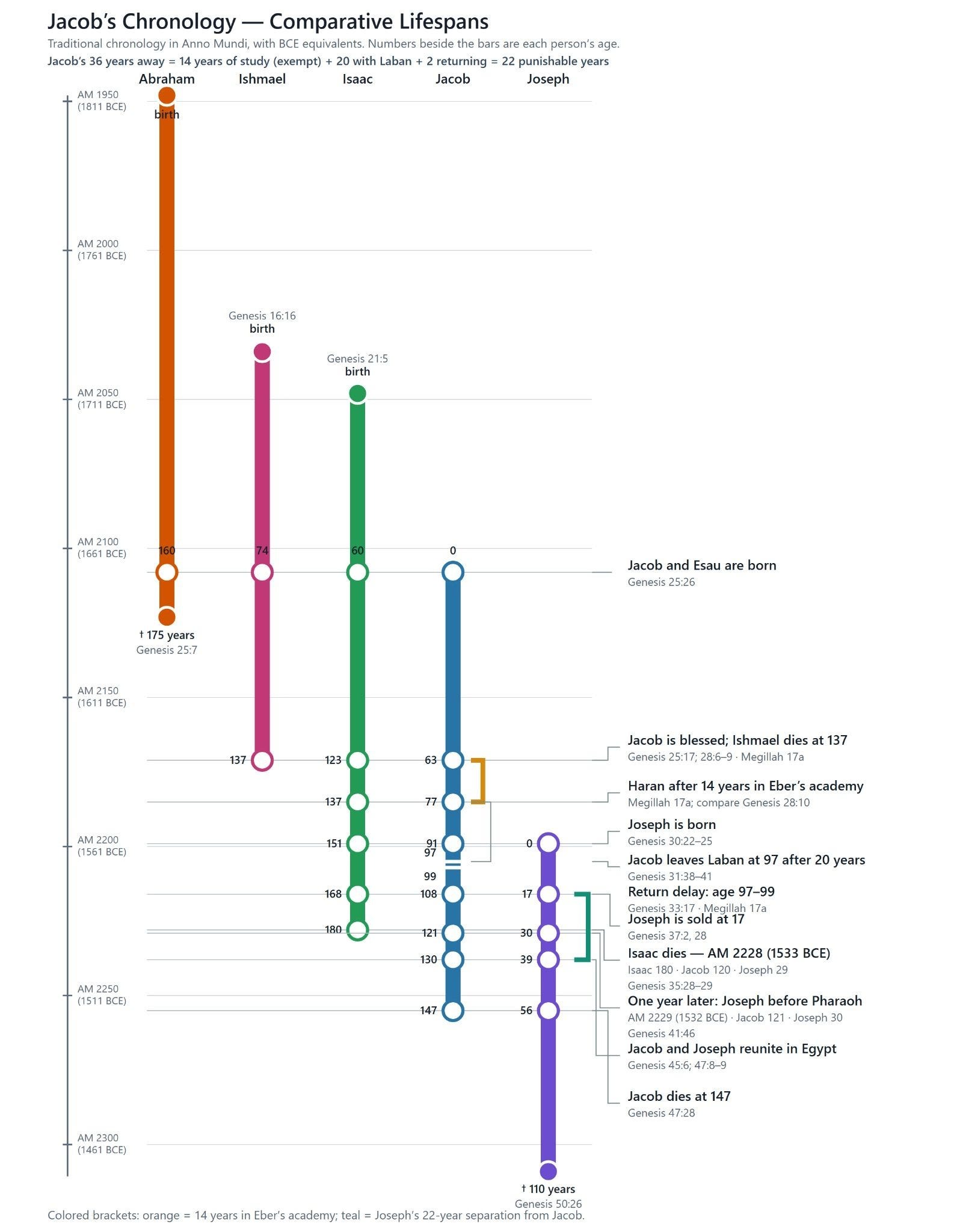
Appendix 1 - Lifespans of Abraham, Ishmael, Isaac, Jacob & Joseph, with key events, according the sugya
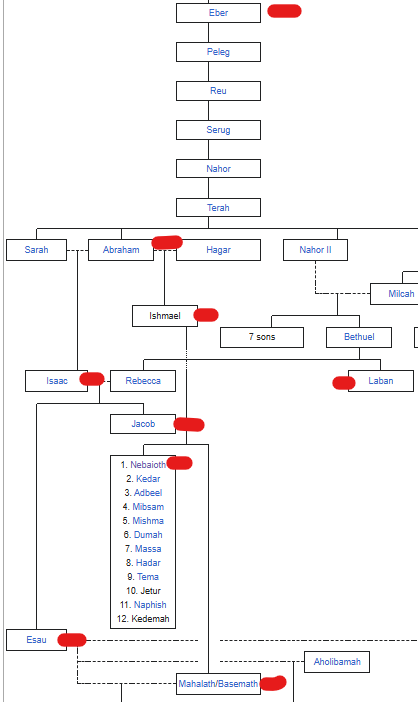
Appendix 2 - Family tree
The Passage
Megillah/16b#20 thru 17a#7
Rabba citing Rav Yitzhak bar Shmuel bar Marta - Torah study is greater than honoring parents
אמר רבה, אמר רב יצחק בר שמואל בר מרתא:
גדול תלמוד תורה יותר מכבוד אב ואם,
Rabba said that Rav Yitzḥak bar Shmuel bar Marta said:
Studying Torah is greater and more important than honoring one’s father and mother,
Proof: Jacob was not punished for the 14 years he spent studying in Eber’s academy; Ishmael’s lifespan is recorded so that Jacob’s chronology can be calculated
שכל אותן שנים שהיה יעקב אבינו בבית עבר --
לא נענש,
דאמר מר:
למה נמנו שנותיו של ישמעאל?
כדי ליחס בהן שנותיו של יעקב.
and a proof of this is that for all those years that our father Jacob spent in the house of Eber and studied Torah there --
he was not punished for having neglected to fulfill the mitzva of honoring one’s parents.
As the Master said:
Why were the years of Ishmael mentioned in the Torah? For what purpose were we told the life span of that wicked man?
In order to reckon4 through them the years of Jacob.
Ishmael was 14 years older than Isaac; he was 74 when Jacob was born - Genesis 16:16; 21:5; 25:17, 26
דכתיב:
״ואלה שני חיי ישמעאל:
מאת שנה ושלשים שנה ושבע שנים״.
As it is written:
“And these are the years of the life of Ishmael:
137 years” (Genesis 25:17).
כמה קשיש ישמעאל מיצחק?
ארביסר שנין,
דכתיב:
״ואברם בן שמונים שנה ושש שנים בלדת הגר את ישמעאל לאברם״,
How much older (קשיש) was Ishmael than Isaac?
14 years.
As it is written:
“And Abram was 86 years old when Hagar bore Ishmael to Abram” (Genesis 16:16).
וכתיב:
״ואברהם בן מאת שנה בהולד לו את יצחק בנו״,
וכתיב:
״ויצחק בן ששים שנה בלדת אותם״,
And it is written:
“And Abraham was 100 years old when his son Isaac was born to him” (Genesis 21:5).
And it is written with regard to Jacob and Esau:
“And Isaac was 60 years old when she [=Rebecca] bore them [=Jacob and Esau]” (Genesis 25:26).
בר כמה הוה ישמעאל כדאתיליד יעקב?
בר שבעים וארבעה,
כמה פיישן משניה?
שתין ותלת.
Based on these verses, how old was Ishmael when Jacob was born?
74.
How many of his years remained then until Ishmael’s death?
63,
as Ishmael died at the age of 137 (as stated in Genesis 25:17, as quoted earlier).
Jacob was 63 when Isaac blessed him, and Ishmael died at that time
ותניא:
היה יעקב אבינו בשעה שנתברך מאביו בן ששים ושלש שנה,
ובו בפרק מת ישמעאל.
And it was taught in a baraita:
Jacob our father was 63 years old at the time he was blessed by his father [=Isaac],
and at that same time Ishmael died.
Ishmael died at that time Ishmael had betrothed Mahalath to Esau, but Nebaioth completed the marriage after Ishmael’s death - Genesis 28:6–9
דכתיב:
״וירא עשו כי ברך וגו׳
וילך עשו אל ישמעאל
ויקח את מחלת בת ישמעאל
אחות נביות״,
ממשמע שנאמר ״בת ישמעאל״,
איני יודע שהיא אחות נביות?!
How is it known that these two events occurred at the same time?
As it is written:
“When Esau saw that Isaac had blessed Jacob…
then Esau went to Ishmael
and took for a wife Mahalath, the daughter of Ishmael, Abraham’s son,
the sister of Nebaioth” (Genesis 28:6–9).
From the fact that it is stated: “the daughter of Ishmael,”
do I not know that she was the sister of Nebaioth?!
For what purpose then does the verse say this explicitly?
מלמד שקידשה ישמעאל
ומת,
והשיאה נביות אחיה.
This teaches that Ishmael betrothed her (קידשה) to Esau
and in the meantime he died,
and Nebaioth her brother married her off.
Therefore, special mention is made of Nebaioth. Consequently, it is understood that Jacob was 63 years old when he received his blessing and left his father’s house.
The biblical chronology leaves 14 unexplained years between Jacob’s departure and his arrival in Egypt, indicating that he spent those years in Eber’s academy - Genesis 41:46; 47:8–9
שתין ותלת
וארביסר עד דמתיליד יוסף,
הא שבעין ושבעה,
If we calculate these 63 years
and the 14 until Joseph was born,
this means that Jacob should have been 77 at the time of Joseph’s birth.
וכתיב:
״ויוסף בן שלשים שנה בעמדו לפני פרעה״,
הא מאה ושבע,
שב דשבעא
ותרתי דכפנא —
הא מאה ושיתסר,
And it is written:
“And Joseph was 30 years old when he stood before Pharaoh” (Genesis 41:46).
This indicates that Jacob should have then been at least 107 years old when Joseph was 30.
Add the 7 years of plenty (see Genesis 41:29-30)
and the 2 years of famine (כפנא),
and this would then indicate that Jacob should have been 116 years old when he arrived in Egypt in the 2nd year of the famine (see Genesis 45:6).
וכתיב:
״ויאמר פרעה אל יעקב:
כמה ימי שני חייך?
ויאמר יעקב אל פרעה:
ימי שני מגורי שלשים ומאת שנה״,
מאה ושיתסר הויין,
But it is written:
“And Pharaoh said to Jacob:
How many are the days of the years of your life?
And Jacob said to Pharaoh:
The days of the years of my sojournings are 130 years” (Genesis 47:8–9).
Jacob indicated that he was 130 when he arrived in Egypt, which is different from the 116 years calculated previously.
Where are the missing 14 years from Jacob’s lifetime?
Baraita - Jacob hid and studied in Eber’s academy for 14 years before traveling to Aram-naharaim
אלא שמע מינה ארבע עשרה שנין דהוה בבית עבר לא חשיב להו.
דתניא:
היה יעקב בבית עבר מוטמן ארבע עשרה שנה.
Rather, learn from here that the 14 years that Jacob spent in the house of Eber are not counted here.
As it is taught in a baraita:
Jacob was studying in the house of Eber for 14 years while in hiding5 from his brother Esau.
... Jacob was therefore 77 when he arrived at the well
עבר מת לאחר שירד יעקב אבינו לארם נהרים שתי שנים,
יצא משם
ובא לו לארם נהרים,
נמצא כשעמד על הבאר —
בן שבעים ושבע שנה.
If we were to calculate the life spans recorded in the Torah, we would find that Eber died when Jacob was 79 years old, 2 years after Jacob our father went down to Aram-naharaim, to the house of Laban.
When Jacob left after completing his studying there,
he then went immediately to Aram-naharaim.
Therefore, when Jacob stood at the well upon his arrival in Aram-naharaim --
he was 77 years old.
Baraita - Joseph was separated from Jacob for 22 years, corresponding to the 22 years for which Jacob was punished for remaining away from Isaac
ומנלן דלא איענש?
דתניא:
נמצא יוסף שפירש מאביו עשרים ושתים שנה,
כשם שפירש יעקב אבינו מאביו
And from where do we derive that Jacob was not punished for the 14 years that he was in the house of Eber, during which time he failed to fulfill the mitzva of honoring one’s parents?
As it is taught in a baraita:
It turns out6 that Joseph was away from his father for 22 years,
just as Jacob our father was away from his own father for that same period of time.
Jacob’s 14 years in Eber’s academy were excluded from punishment
דיעקב תלתין ושיתא הויין!
אלא:
ארביסר דהוה בבית עבר לא חשיב להו.
According to the previous calculation, however, the baraita is difficult, as Jacob was absent for 36 years.
Rather, conclude from here that
the 14 years that he was in the house of Eber are not counted,
as he was not punished for them.
Jacob spent only 20 years with Laban (Genesis 31:41), so the remaining two punishable years were those he delayed on his return journey
סוף סוף דבית לבן עשרין שנין הויין!
The Talmud raises an objection:
But ultimately, Jacob was in Laban’s house for only 20 years (as stated in Genesis 31:41)
Why, then, is he faulted for being away from his father for 22 years?
Baraita - Jacob remained in Sukkot for 18 months and in Bethel for six months, totaling the additional two years of delay - Genesis 33:17
אלא משום דאשתהי באורחא תרתין שנין,
דתניא:
יצא מארם נהרים ובא לו לסכות,
ועשה שם שמונה עשר חודש,
שנאמר:
״ויעקב נסע סכותה
ויבן לו בית
ולמקנהו עשה סכות״,
Rather, he was punished because on his journey back from Aram-naharaim he tarried another two years before returning home to his parents,
as it is taught in a baraita:
Jacob left Aram-naharaim and came to Sukkot,
and spent 18 months there,
as it is stated:
“And Jacob journeyed to Sukkot,
built himself a house,
and made booths [sukkot] for his cattle” (Genesis 33:17).
The baraita understands this verse to mean that first he made booths [Sukkot], to live in during the summer, and then he built a house in the winter, and afterward he again made booths [sukkot] during the next summer, indicating that he must have been there for 18 months.
ובבית אל עשה ששה חדשים,
והקריב זבחים.
He then was in Bethel for 6 months,
and he brought offerings,
totaling two years in all. In this way, all the various calculations of years are reconciled.
Appendix 1 - Lifespans of Abraham, Ishmael, Isaac, Jacob & Joseph, with key events, according the sugya
Appendix 2 - Family tree
Screenshot of part of Wikipedia, “Ishmael”, section “Family tree”.
I added red ticks to indicate some of the major relevant figures mentioned in our sugya.
For the previous part of the sugya, that this riffs off of, see my “Talmudic Interpretations of the Book of Esther: Esther 8:16-10:3 (Megillah 16b)”.
For other examples of Talmudic chronology of Biblical events, compare these pieces of mine (and compare also my timeline visualizations there):
The Origins of Tisha B’Av and the Chronology of Numbers 10-14: the Date of the Destructions of the Both Temples and the Biblical Spies Episode (Taanit 29a)”, final part: Pt2.
It’s worth noting that Eber was Jacob’s distant patrilineal ancestor, six generations above him: Eber → Peleg → Reu → Serug → Nahor → Terah → Abraham → Isaac → Jacob. So Eber was Jacob’s great-great-great-great-great-great-grandfather.
(See Appendix 2 at the end of this piece for a full family tree.)
In rabbinic tradition, Jacob studied in the academy associated with Shem and Eber.
See Appendix 1 at the end of this piece for a full chronology.
ליחס - literally: “to ascribe, connect, trace, relate”.
On this word, see Jastrow (modernized), entry “יָחַס”, section “Pi’el”, sense #1:
to trace the connection (יַחַס) of events or descent.
Megillah 17a:1 - כדי לְיַיחֵס בהן שנותיו וכ׳ (Rashi: להִתְיַיחֵס) - “in order to trace through them the years of Jacob” (in which the principal events of his life occurred);
Ibid.;
Bereishit Rabbah 62:4 (referring to Genesis 25:12 sq.) -מה ראה הכתוב לייחס תולדותיו וכ׳ - “what reason was there for the Bible to insert here the genealogy of that etc.?”
Sanhedrin 82b:5 בא הכתוב ויִחֲסוֹ the Scripture comes and records his genealogy (Numbers 25:11).
Shabbat 55b:7-14 אפשר … והכתוב מְיַחֲסוֹ is it possible that he was a sinner and the Scripture would state his genealogy?;
and frequently.
2) to nobilize, distinguish, invest with prerogatives.
Bamidbar Rabbah 13:7 יִיחֲסוֹ הכתוב על שם שבטו the Scripture distinguished him (giving him the privilege of the first offering) for the sake of his tribe (Numbers 7:12).
Bereishit Rabbah 82 אין מְיַיחֲסִין ליוסף וכ׳ not Joseph is ranked in the records as the first-born;
and elsewhere.
מוטמן - literally: “concealed, hidden”.
On this word, see Jastrow (modernized), entry “טָמַן”:
(Biblical Hebrew; compare the preceding word)
to hide, store away, preserve, especially to keep dishes warm for the Sabbath.
Mishnah Shabbat 2:7 טוֹמְנִין את החמין you may put warm dishes in the chafing stove etc.
and frequently.
Mishnah Makhshirin 1:6 הטומן פירותיו וכ׳ if one hides his fruits in water against thieves.
Kohelet Rabbah 10:8:1 שהוא ט׳ וכ׳ that he buried it there;
and elsewhere.
Part. pass. טָמוּן.
Bava Kamma 5b, and elsewhere. נזקי ט׳ באש damage caused to things hidden in a pile to which fire was set.
Bereishit Rabbah 68 היה ט׳ וכ׳ he (Jacob) was hiding (before Esau) in the house of Eber; Megillah 17a:5 מוּטְמָן (Manuscript Munich: נטמן, see Rabbinowicz, ‘Dikdukei Sofrim’ there, note);
and frequently.
Nif’al: - נִטְמָן to be hidden, to hide one’s self, to be stored up.
Ibid. שנ׳ בבית עבר, see above.
Vayikra Rabbah 3 ויִטָּמְנוּ ד”ת בפיך and the words of the Law shall be stored up in your mouth.
Pesikta Rabbati 4:1 נ׳ במערה sought protection in a cave;
and elsewhere.
Hif’il:
הִטְמִין 1) to hide, keep.
Bava Kamma 61b:13 שדרכם להַטְמִין וכ׳ which it is customary to hide in the stack.
Bava Metzia 61b לא יַטְמִין … במלח he must not keep his weights in salt (by which they gain in weight);
and frequently.
Part. pass. מוּטְמָן, see above.
2) to hide one’s self, lie in wait.
Bava Kamma 79b:2 ראוהו שה׳ וכ׳ if he has been seen hiding himself in the woods (waiting for a chance to steal).
נמצא - literally: “it is found”.
On this word in this sense, see Jastrow (modernized), entry “מצי”, section “Nif’al: - נִמְצָא to be found”:
Especially: to turn out, to follow, to result.
Mishnah Chullin 1:4 נ׳ כשר וכ׳ the result is, what is legal in slaughtering is illegal in pinching.
Pesachim 25b ונ׳ למד, see לָמֵד II.
Sifrei Devarim 210:5 נִמְצִּינוּ למדים from which we can consequently derive.
Yerushalmi Pesahim 5, beginning: 31c,
and frequently.
נִמְצֵאתָ אומר - “you turn out saying,” i.e. the result is, consequently.
אם תִּימָּצֵי (תִּמָּצֵא) לומר (abbreviated את”ל) - “if you will say.”
Gittin 82b:11 אם תמצא לומר איתא וכ׳ if you will adopt the opinion of etc.
Shabbat 136a:10 את”ל פליגי וכ׳ if you assume that they differ etc.; and frequently.
Tosefta Ohalot 4:12 כשתמצא לומר וכ׳ if you assume etc.