

The Hebrew word ben (בֵּן) most basically means “son.” But biblical Hebrew, like many languages, stretches kinship terms far beyond literal genealogy. A “son” can be a biological child, a member of a group, a citizen of a place, a young animal, a descendant, a student, or — in one especially productive idiom — a person characterized by some quality, status, or fate.1
This last use is the one catalogued in BDB under ben as “noun relative followed by word of quality, characteristic, etc.” In this construction, “son of X” means something like “one belonging to the category X,” “one marked by X,” “one characterized by X,” or “one destined for X.”
Thus, biblical Hebrew can say בֶּן־חַיִל, literally “son of strength/valor,” meaning a mighty man. It can speak of בְּנֵי עַוְלָה, “sons of wickedness,” meaning wicked men. It can describe בְּנֵי מָוֶת, “sons of death,” meaning people deserving death or doomed to die. It can refer to בֶּן־הַכּוֹת, “a son of beating,” meaning someone liable to be flogged. The literal phrase “son of” has become an idiom of classification.
This is the normal biblical way of expressing what English would usually express with an adjective, a compound noun, or a relative phrase. Biblical Hebrew often prefers a genitive construction: “son of X,” where modern English says “X-ish,” “X-like,” “X-worthy,” “liable to X,” “marked by X,” or simply uses an adjective.
So בְּנֵי בְלִיַּעַל are not “sons” of a person named Belial; they are worthless or lawless men (“people without yoke”). בְּנֵי מֶרִי are rebels, literally “sons of rebellion.” בְּנֵי תַעֲרֻבוֹת are hostages, literally “sons of pledges/exchange.” בְּנֵי שָׁאוֹן are tumultuous ones, those marked by noise or uproar. בְּנֵי יְצְהָר are “sons of oil,” that is, anointed ones. בֶּן־מֶשֶׁק in Genesis 15:2 is traditionally understood as “son of possession,” that is, heir or possessor. בְּנֵי שַׁחַץ in Job are “sons of pride,” proud beasts.2
This idiom is especially easy to understand if we compare it with another Hebrew expression: ba’al (בַּעַל).3
בַּעַל literally means “owner,” “master,” or “possessor.” But it too becomes a broad idiom of characterization. A בַּעַל חָכְמָה is a person who possesses wisdom; a בַּעַל מוּם is one who has a blemish; a בַּעַל קוֹמָה is someone of stature; a בַּעַל לָשׁוֹן is someone with a sharp or dangerous tongue; a בַּעַל תְּשׁוּבָה is one characterized by repentance. In later Hebrew, especially rabbinic and modern Hebrew, בַּעַל becomes an extremely common way to say “a person with X.”
English has partial parallels. We still say “man of courage,” “person of interest,” “child of fortune,” “son of perdition,” “man of peace,” “creature of habit,” “people of faith,” “heir to trouble,” “born of violence,” and “doomed man.” These are not exact equivalents, but they show the same conceptual pattern: a person is described by being placed in relation to an abstract noun.4
The phrase “son of perdition,” familiar from older English Bible style, is especially close. It means not that “perdition” literally fathered someone, but that the person belongs to destruction, is marked by destruction, or is destined for destruction. That is very close to Hebrew phrases like בְּנֵי מָוֶת, “sons of death.”
Modern English, however, usually avoids this idiom. We tend to translate the Hebrew construction into adjectives or paraphrases. בְּנֵי עַוְלָה becomes “wicked men.” בְּנֵי מֶרִי becomes “rebels.” בְּנֵי מָוֶת becomes “men deserving death.” בֶּן־חַיִל becomes “mighty man.” This makes for smoother English, but it also hides the underlying Hebrew structure.
Appendix 1 - BDB, entry “ben”, sense #8
(See footnote).5
בן as noun relative followed by word of quality, characteristic, etc. especially:
בֶּן־(בני) חַיִל = mighty man I Samuel 14:52;I Samuel 18:17 II Samuel 2:7;II Samuel 13:28;II Samuel 17:10 ((×2)) I Kings 1:52 + 7 times Chronicles;אֲנָשִׁים בני ח׳ Judges 18:2 II Kings 2:16; אֶלָף אִישׁ מִבְּנֵי הֶחָ֑יִל Judges 21:10;
בְּנֵי עַוְלָה wicked men II Samuel 3:34;II Samuel 7:10 I Chronicles 17:9 Hosea 10:9; בֶּן־ע׳ Psalms 89:23 (for בני בליעל see בליעל);
בְּנֵי מֶ֑רִי rebels Numbers 17:25 (compare בַּיִת);
בְּנֵי הַתַּעֲרֻבוֹת sons of pledges = hostages II Kings 14:14 = II Chronicles 25:24;
בְּנֵי מָוֶת i.e. those deserving of death I Samuel 26:16; so בֶּן־מות II Samuel 12:5; בְּנֵי תְמוּתָה appointed or exposed to death Psalms 79:11;Psalms 102:21;
בִּן הַכּוֹת one worthy of smiting Deuteronomy 25:2;
בְּנֵי עֹ֑נִי Proverbs 31:5;
בְּנֵי חֲלוֹף Proverbs 31:8;
בְּנֵי שָׁאוֹן Jeremiah 48:45 = tumultuous ones; so also (= שֵׁאת) בְּנֵי שֵׁת Numbers 24:17 […]
בְּנֵי הַיִּצְהָר Zechariah 4:14 i.e. anointed ones;
בֶּן־מֶשֶׁק Genesis 15:2 son of possession, i.e. heir;
הֵילֵל בֶּן־שָׁ֑חַר Isaiah 14:12 son of dawn;
of animals בְּנֵי שָׁ֑חַץ i.e. proud beasts Job 28:8;Job 41:26;
of Jonah’s gourd בִּן־לַיְלָה Jonah 4:10 ((×2));
of a fertile hill קֶרֶן בֶּן־שֶׁמֶן Isaiah 5:1.
Appendix 2 - BDB, entry “ba’al”, sense #5
(See footnote).6
noun of relation:
a. בַּעַל:
ב׳ החלמות dreamer Genesis 37:19 (Elohist source);
ב׳ דברים whosoever has cases, complaints Exodus 24:14 (Elohist source);ב׳
שׂער an hairy man II Kings 1:8;
ב׳ חמה wrathful Nahum 1:2 Proverbs 29:22;
ב׳ אף one given to anger Proverbs 22:24;
ב׳ החכמה one having wisdom Ecclesiastes 7:12;
ב׳ משׁחית destroyer Proverbs 18:9;
ב׳ כנף winged thing, bird Proverbs 1:17 Ecclesiastes 10:20;
ב׳ נפשׁ one given to appetite Proverbs 23:2;
ב׳ מזמות mischievous person Proverbs 24:8;
ב׳ הלשׁון charmer Ecclesiastes 10:11;
ב׳ רשׁע one given to wickedness Ecclesiastes 8:8;
ב׳ פיפיות double-edged Isaiah 41:15;
ב׳ משׁפט adversary Isaiah 50:8;
ב׳ פקדת captain of the ward Jeremiah 37:13;
ב׳ הקרנים two-horned7 Daniel 8:6, Daniel 8:20.
b. בַּעֲלֵי:
בּ׳ בְּרִית confederates Genesis 14:13;
ב׳ חצים archers Genesis 49:23 (poetic)
ב׳ הפרשׁים horsemen II Samuel 1:6;
ב׳ שׁבועה conspirators Nehemiah 6:18;
ב׳ אספות members of assemblies; or well-grouped sayings; or collectors (of wise sentences) Ecclesiastes 12:11.
Appendix 3 - Jastrow, entry “ba’al”, sense #4
Jastrow (modernized), entry “בַּעַל”, sense #4:
(mostly in compounds) owner of, master of, possessed of, given to etc.;
for example:
בעל אבידה - “owner of a lost object”
בעל אגדה - “master of Agadah, lecturer”
בעל דין - “opponent in court”
[…]
Compounds:
בעלי מחשבות He who knows man’s thoughts.
Sanhedrin 19b:1 - בעלי מחשבות - those entertaining considerations (of fear), hesitating to do justice.
בעלי שיבה gray-haired.
בעלי תשובה repentant sinner.
and frequently.
בעלי תשובות a man of many objections or excuses.
Bereishit Rabbah 20:2 beginning:
[For other compounds, not self-evident, see the respective determinants.]
I mentioned a while ago that this is a topic that I planned to return to.
For primary biblical and Talmudic sources, see BDB and Jastrow entries cited in the appendices at the end of this piece.
Part of my continuing work on BDB dictionary. See the latest updates in the ChavrutAI changelog page, section “May 2026”, recent entries:
BDB: More Abbreviation Expansions & a Fix (May 30)
Sources / editions: V. d. H (van der Hooght), Sora (Sura), Var. Lect. (Variae Lectiones), Jüd. Ztschr. (Jüdische Zeitschrift), ad loc. (at the place).
Fixed Norzi — now expands to Yedidya Nortzi (Minḥat Shai), naming his masoretic work.
Added Delitzsch (W and Dl (W → Delitzsch (Assyrisches Wörterbuch), naming his Assyrian dictionary.
Grammar: Ithp. → Ithpeʿel (Aramaic verb stem); ms. → masculine singular.
Scholars: Prät → Prätorius.
BDB: More Headwords Searchable (May 30)
Three more BDB headwords that were missing from consonant search now appear in results: הַל, לָט, and לֹט (e.g. searching לט now returns both לָט and לֹט).
They also now appear in the browsable Headword Index under their respective letters.
BDB: More Abbreviation Expansions (May 30)
Grammar: demonstr. (demonstrative), disj. (disjunctive), cohort. (cohortative), contin. (continuation), syll. (syllable), gutt. (guttural), predic. (predicate), Prep. (Preposition), daghesh (dagesh).
Vocabulary: combin. (combination), geograph. (geographical), individ. (individual), connexion (connection).
Sources / scholars: Od. (Odyssey), Hdt (Herodotus), Nat. Hist. Bib. (Natural History of the Bible), and Dr (Sm → Driver (Samuel) in the וְ entry.
BDB: Grammatical Particles Now Searchable (May 30)
Seven core grammatical particles that were missing from BDB search now appear in results: לְ (to, for), מִן־ (from), וְ (and), בְּ (in), כְּ (like, as), הֲ (interrogative), and פֶּן־ (lest).
These short prepositions and prefixes exist in BDB but were invisible to the dictionary’s consonant search; they’re now merged in alongside regular results (e.g. searching פן returns both פֶּן־ and פִּנָּה).
They also now appear in the browsable Headword Index under their respective letters.
For that last issue, I opened an issue with Sefaria, there seems to be a bug:
https://github.com/Sefaria/Sefaria-Project/issues/3327 (the issue was quickly closed despite no resolution).
For the full list of ChavrutAI’s current BDB abbreviation mappings, see the “BDB Abbreviations” page.
On the topic of the word “ben”, see also these previous pieces of mine:
And see also my note in “From Eunuch-ville to Bald-town: A Eunuch and R’ Yehoshua the Bald Trade Insults Over Physical Shortcomings (Shabbat 152a)“, on section “Pt1 - “Bald-town” vs. “Eunuch-town” “, on the terms “ben Korha” and “ben hamtzan”.
And compare Aramaic bar; for example in bar mitzvah, “son of the commandment,” i.e. one now liable to it. (For example, see בר מצוה and בר משא ומתן [“one who is involved in business dealings“] in Bava_Kamma/15a#7; and see further instances search results here.)
From a broader comparative perspective, compare especially the similar expanded sense of Arabic abu (“father”); see Wikipedia, “Ab (Semitic)“, section “Arabic“:
’Ab […] from a theoretical, abstract form ([…] ʼabaʼun) (triliteral ʼ-b-w) is Arabic for “father” […]
The combination is extended beyond the literal sense: a man may be described as acting as a father in his relation to animals, e.g., Abu Bakr, “the father of a camel’s foal”; Abu Huraira, “father of kittens”.
In some cases, a man’s enemies will refer to him in such a way to besmirch him, e.g. Abu Jahl, “the father of ignorance”.
A man may be described as being the possessor of some quality, as Abu’l Na’ama “father of grace”, or “the graceful one”; Abu’l Fida, “father of devotion”, or “the devout one”.
An object or a place may be given a nickname, such as Abu’l hawl, “father of terror”, (the Sphinx at Giza).
Abu’l fulus, “father of money”, is frequently used to refer to a place where rumors have been told of a treasure being hidden there.
This is about ba’al as a noun (בַּעַל). On ba’al as a verb (בָּעַל), see my discussion in “Appendix 3 - Hebrew Verbs for “Sex” “, section “The verbs ba’al (בעל) and ba al (בא על) in Mishnaic Hebrew“.
Note also that modern English (similar to German) has a highly productive formation of “[X]-master”. For example: “chessmaster”, “toastmaster”. However, in addition to this being slightly archaic, it usually denotes expertise or mastery rather than a general attribute or character trait. See especially Wiktionary, entry “master”, section “Noun”, sense #6: “An expert at something“ (and see the etymology there, that it stems from Latin word for “great”). For a list of these words, see Wiktionary ibid., sub-section “Derived terms“.
Source: BDB at ChavrutAI, entry “בֵּן” (at Sefaria here), sense #8, with slight changes.
See the full generated outline there:
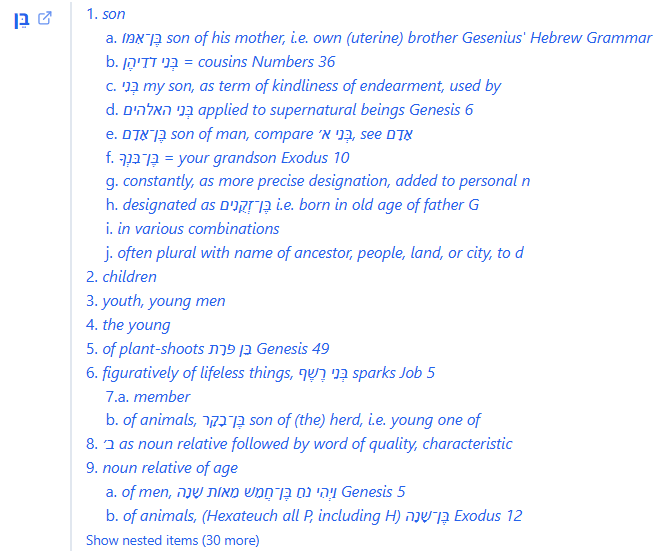
And see also the list of derived terms at Hebrew Wiktionary, entry “בֵּן“, section “צירופים“. For examples of additional relevant terms:
בן חורין
בן בית
בן ברית
And compare also the term ben Torah, used in the Talmud especially regarding people who aren’t b’nei Torah. For example, see my “Why Are Babylonian Birds Fat? Eretz Yisrael Amoraim Probe the Seemingly Superior Babylonia (Shabbat 145b)“, section “R’ Ḥiyya bar Abba and R’ Asi have an exchange about four questions—about Babylonian fowl, festivals, and scholars, and about non-Jews“, list item # 3:
מפני מה תלמידי חכמים שבבבל מצויינין?
לפי שאינן בני תורה
R’ Ḥiyya then asked: For what reason are Torah scholars in Babylonia distinguished (מצויינין) by their special rabbinic garb?
R’ Asi answered: Because they are not well-versed in Torah (בני תורה).
If they would not distinguish themselves by dressing differently, they would not be respected for their Torah knowledge.
And see more instances in the search results here.
Source: BDB at ChavrutAI, entry “בַּעַל” (at Sefaria here), sense #5, with slight changes.
And compare also Hebrew Wiktionary, entry “בַּעַל א“, sense #4.
The Koran’s Dhū al-Qarnayn, “the two-horned” is famously the equivalent of Daniel’s baʿal ha-qeranayim, the two-horned one.
In general, Arabic dhū / dhāt (“possessor of”) is related to Aramaic דִּי (dī / da) and Hebrew זֶה (ze / zo / zot).