

I wanted a simple answer to a simple question: which biblical verses are cited most often in the Babylonian Talmud?1
I checked this using the GitHub repository EzraBrand/bible-rabbinic-index, which builds a concordance between Bible verses and Talmudic passages. The project processes the complete Steinsaltz English translation of the Bavli and extracts biblical quotations when they appear in bold and are followed by a parenthetical citation such as (Genesis 1:5). That produces a large verse-to-passage index that can then be counted.2
Top 20 Most-Cited Verses in the Talmud
Here are the results from the concordance data (17,138 citations across 6,303 unique verses):
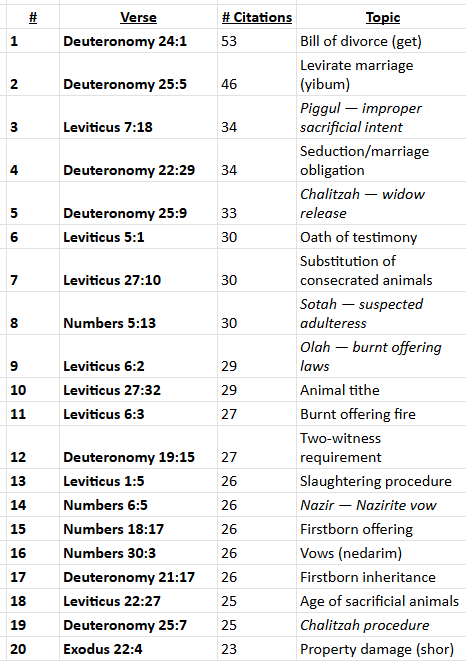
Using the repository’s exported CSV, the most cited verse in the dataset is Deuteronomy 24:1, with 53 citations. That is the verse about a man writing a bill of divorce.3 After that come Deuteronomy 25:5 with 46 citations, Leviticus 7:18 and Deuteronomy 22:29 with 34 each, and Deuteronomy 25:9 with 33. The top ten also include Leviticus 5:1, Leviticus 27:10, Numbers 5:13, Leviticus 6:2, and Leviticus 27:32.
By Book
Leviticus dominates with 4,170 citations (24%), followed by Deuteronomy (2,492) and Exodus (1,911). The Torah accounts for ~66% of all citations; Psalms leads among Ketuvim at 1,026.
The pattern is clear: the Talmud most heavily cites legal verses dealing with marriage/divorce, sacrifices, vows, and evidentiary procedure.
The most heavily cited verses here are mostly legal verses. They cluster around divorce, levirate marriage, sacrificial law, testimony, vows, valuation, suspected adultery, and tithing. That fits the structure of the Talmud, which spends much of its energy on close legal reading. A verse rises to the top when it becomes a hinge for repeated interpretation, dispute, or derivation across many sugyot.4
Appendix - Most Cited Verse - Deuteronomy 24:1 - Bill of divorce (get) - All Talmudic Citations
The verse, Deuteronomy 24:1:
כי יקח איש אשה
ובעלה
והיה אם לא תמצא חן בעיניו
כי מצא בה ערות דבר
וכתב לה ספר כריתת
ונתן בידה
ושלחה מביתו
When a man has taken a wife,
and married her (בעלה),
and it come to pass that she find no favor in his eyes,
because he has found some unseemliness in her:
then let him write her a bill of divorce,
and give it in her hand,
and send her out of his house.
Summary of all 53 Talmudic citations of Deuteronomy 24:1 from the concordance:5
Patterns
The Talmud mines this single verse for an extraordinary range of halakhot across four major legal domains:
Gittin (divorce law) — 19 citations: the mechanics of writing, delivering, and validating a get. Almost every word is parsed: “writes,” “for her,” “scroll,” “gives,” “in her hand,” “sends her out.”
Kiddushin (betrothal) — 14 citations: “when a man takes a woman” is the primary source for all three modes of betrothal (money, document, and sex).
Sotah (suspected adultery) — 8 citations: “unseemly matter [davar]” creates a verbal analogy with witness law (Deut 19:15) to establish evidentiary standards.
Scattered tractates — acquisition law (Bava Metzia), slave emancipation (Gittin 41b), Nazirite vow (Nazir 2a), material validity (Sukkah 24b).
The famous Beit Shammai / Beit Hillel / R. Akiva dispute at Gittin 90a is the headline: what constitutes grounds for divorce — sexual misconduct only (ervat davar), any fault (davar), or even finding someone better (”no favor in his eyes”)?
Based on: https://chavrutai.com/biblical-index/, which is itself based on: https://github.com/EzraBrand/bible-rabbinic-index
As an aside, note a new related ChavrutAI feature - hyperlinked verse citations, and verses in full at bottom of page. See a summary at the Changelog page (with slight revisions):
Bible Citation Linking in Talmud Pages
Bible references in the English (Steinsaltz) translation are now automatically detected and hyperlinked to the corresponding ChavrutAI Bible page
Supports all 24 books of the Tanach, including multi-word names (e.g. Song of Songs, I Samuel)
Clicking a citation like Deuteronomy 6:7 navigates directly to /bible/Deuteronomy/6#7
Also, note the new ChavrutAI Yerushalmi reader (and the related new piece I uploaded to Academia), and the new ChavrutAI Mishneh Torah reader, and the new Home Page display. See a summary at the Changelog page (see there for more details):
Home Page: Updated Subtitle & Card Layout
Updated subtitle to reflect all five available works: Babylonian Talmud, Jerusalem Talmud, Mishnah, Mishneh Torah, and Tanakh — replacing the previous text that only mentioned Talmud and Hebrew Bible
Redesigned the text selection section with a featured layout: Babylonian Talmud displayed as a prominent full-height card on the left, with the remaining four works in a 2×2 grid on the right
Card order in the grid: Tanakh and Mishnah (top row), Jerusalem Talmud and Mishneh Torah (bottom row)
Mishneh Torah description updated from “83 Hilchot” to “83 Books” for clarity
Mishneh Torah (Rambam) Reader
Added a full Mishneh Torah (Rambam) reader at /rambam — all 14 books and 83 Books (’Hilchot’) with bilingual Hebrew-English text (Touger translation via Sefaria)
Three-level navigation: contents page (all 83 Books (’Hilchot’) organized by book), chapter list, and chapter reader with halacha-by-halacha bilingual display
Footnotes from the Touger translation are extracted, displayed as numbered blue superscripts, and expandable inline — identical to the Yerushalmi reader’s footnote UX
Jerusalem Talmud (Yerushalmi) Reader
New Jerusalem Talmud reader covering all 39 tractates across the four sedarim: Zeraim, Moed, Nashim, and Nezikin
Three-level navigation: contents page by seder → tractate page with chapter list → parallel Hebrew-English chapter reader
Hebrew text sourced from Sefaria; English translation: Heinrich W. Guggenheimer scholarly edition
Side-by-side 50/50 layout matching the Mishnah reader, with halakhah-level section numbering
Collapsible footnotes panel — Guggenheimer’s scholarly notes appear as a full-width row below both columns, collapsed by default with a “Notes (N)” toggle; footnote markers remain as superscripts in the text
A difficulty is that “most cited” depends on what counts as one citation. In this repository, the exported concordance is already deduplicated. The exporter keeps one row per combination of biblical verse and Talmud location, with location defined as tractate, page, and section.
See the appendix for a broader discussion of this.
Note: The repository is based on the Steinsaltz English translation, so the extraction depends on editorial formatting and citation practice in that edition. It is also designed to capture explicit citations, not every allusion or unstated reuse of a verse. And because the export is deduplicated by verse plus tractate/page/section, repeated appearances inside the same local unit are compressed.
If I extend this, the next step might be to group the top verses by legal topic, tractate, or biblical book.
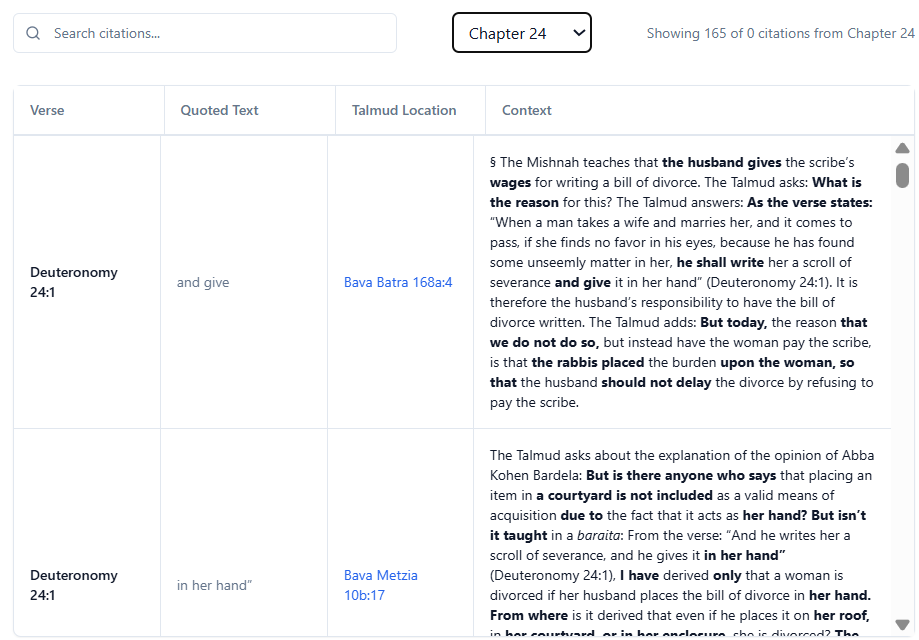
For full links and passages, see https://chavrutai.com/biblical-index/book/deuteronomy_part2 > Chapter 24.
Screenshot:
Nice! I can't access your concordance link though, maybe it's private?