

Intro
This sugya presents a rabbinic geography of the Jordan River, its legal designation, and several associated teachings on river sources, names, and vow-law.1
The sugya begins with a baraita describing the Jordan’s five-stage route from its origin to its endpoint: it “issues from the Cave of Pamias”,2 moves through the “Sea of Sivkhi” (Lake Hula), then the “Sea of Tiberias” (Sea of Galilee), then the “Sea of Sodom” (Dead Sea), and finally “falls into the Great Sea.” The sugya asserts that the river is called “Jordan” only from Beit Jericho and downward (i.e., only the southern section bears this name). According to R’ Meir, the Jordan functions as a partition only south of Beit Jericho.
Multiple amoraic statements then address the etymology and biblical anchoring of the river’s name and origin. R’ Ḥiyya bar Abba, citing R’ Yoḥanan, states that the river is called “Jordan” because it descends (יורד) from the biblical city of Dan. R’ Abba says to Rav Ashi that the origin in Dan can also be learned from Joshua 19:47, where the tribe of Dan conquers Leshem and renames it Dan. R’ Yitzḥak identifies biblical Leshem with contemporary Pamias, and a baraita likewise teaches that the Jordan “emerges from the Cave of Pamias.”
A halakhic implication appears in Rav Kahana’s ruling: the “source”3 of the Jordan is the Cave of Pamias; therefore, if one vows “not to drink water from the Cave of Pamias,” all Jordan water becomes forbidden, since the entire river descends from that source. The passage then records parallel statements from Rav Kahana: the “source of blood” is the liver, and the “source of all water” is the Euphrates.
This introduces a series of teachings about the Euphrates. Rav Yehuda citing Rav: one who vows from Euphrates-water is prohibited from all waters of the world, because all rivers derive from it. Rav Yehuda further states in Rav’s name that all rivers are below three rivers—Pishon, Gihon, and Tigris (from the Rivers of the Garden of Eden in Genesis 2:11–14)—and those three are below the Euphrates, i.e., receive from it. An objection arises from mountain springs higher than the Euphrates; Rav Mesharshiyya answers that such springs are “ladders of the Euphrates,” water that filters through the ground and emerges at higher elevations.
Another objection cites Genesis 2:10–14, which lists the Euphrates fourth, apparently subordinate rather than primary. Rav Naḥman bar Yitzḥak, or Rav Aḥa bar Ya‘akov, replies that the verse speaks of the same primordial Euphrates that originally flowed out of Eden, which continued after the branching of the other rivers.
A baraita records R’ Meir’s teaching that the primordial name of the Euphrates is “Yuval,” citing Jeremiah 17:8. Its later name “Perat” derives from its waters being fruitful and multiplying (parim ve-rabim) without rainfall. This supports Shmuel’s principle that “a river is blessed from its riverbed”—its increase comes from subterranean sources.
The passage concludes with a contradiction to Shmuel: Rav Ami citing Rav teaches that rainfall in the West (Eretz Yisrael) is attested by the rise of the Euphrates, showing dependence on precipitation. A related anecdote notes that Shmuel’s father prepared a mikveh for his daughters in Nisan (=spring season; when collected rainwater is available) and used mats in Tishrei (=autumn season; to provide privacy when they immersed directly in the Euphrates).
Outline
Intro
The Passage - Biblical Rivers: The Origins, Course, and Names of the Jordan and Euphrates (Bekhorot 55a-b)
Baraita - the Jordan’s route from the Cave of Pamias through the lakes - 5 stages - Pamias Cave → Sivkhi Sea (=Lake Hula) → Tiberias Sea (=Sea of Galilee) → Sodom Sea (=Dead Sea) → Great Sea (=Mediterranean? Gulf of Aqaba? Red Sea?) ; only from Beit Jericho downward is it called “Jordan”
R’ Ḥiyya bar Abba citing R’ Yoḥanan - The river is named “Jordan” because it descends (yored) from Dan
R’ Abba to Rav Ashi; R’ Yitzḥak - Leshem = Pamias, from which the Jordan emerges - Joshua 19:47
Rav Kahana - If one vows not to drink water from the Cave of Pamias, all Jordan water is included; Pamias is its source
The “source” of blood is the liver
The “source” of all water is the Euphrates
Rav Yehuda citing Rav - vows about Euphrates-water extend globally
Rav Yehuda citing Rav - All rivers derive from 3 rivers (of Eden), which themselves derive from the Euphrates
Rav Mesharshiya - “ladders of the Euphrates”
Rav Naḥman bar Yitzḥak / Rav Aḥa bar Ya’akov - The “Euphrates” mentioned last in Genesis is the same as the primordial river; it later continues after the branching - Genesis 2:10–14
R’ Meir - The name of the Euphrates is “Yuval”; it is called “Perat” because its waters “multiply” (P-R-H) - Jeremiah 17:8
Shmuel - Euphrates is “a river is blessed from its riverbed” (i.e., its increase is subterranean, not from rainfall)
Rav Ami citing Rav - Rainfall in the West is evidenced by rising Euphrates levels
Anecdote - Shmuel’s father built a mikveh in Nisan (=spring season; due to rainwater majority) and used mats in Tishrei (=autumn season; for privacy when immersing directly in the Euphrates)
The Passage
Baraita - the Jordan’s route from the Cave of Pamias through the lakes - 5 stages - Pamias Cave → Sivkhi Sea (=Lake Hula) → Tiberias Sea (=Sea of Galilee) → Sodom Sea (=Dead Sea) → Great Sea (=Mediterranean? Gulf of Aqaba? Red Sea?) ; only from Beit Jericho downward is it called “Jordan”
תניא נמי הכי:
ירדן יוצא ממערת פמייס,
ומהלך בימה של סיבכי,
ובימה של טבריא,
ובימה של סדום,
והולך ונופל לים הגדול,
ואין ״ירדן״ אלא מבית יריחו ולמטה.
According to the opinion of R’ Meir the Jordan River acts as a partition only south of Beit Jericho, but north of that point it is not a partition.
The Talmud notes: That is also taught in a baraita:
The Jordan River issues forth from the Cave of Pamias4
and flows via the Sea of Sivkhi, i.e., Lake Hula,5
and via the Sea of Tiberias, i.e., the Sea of Galilee,
and via the Sea of Sodom, i.e., the Dead Sea,
and continues and falls down to the Great Sea.6
But it is called “Jordan” only from Beit Jericho and below, i.e., to the south.
R’ Ḥiyya bar Abba citing R’ Yoḥanan - The river is named “Jordan” because it descends (yored) from Dan
אמר רבי חייא בר אבא אמר רבי יוחנן:
למה נקרא שמו ״ירדן״?
שיורד מדן.
R’ Ḥiyya bar Abba says that R’ Yoḥanan says:
Why is the river called Jordan?
Because it descends [yored] from the city of Dan.7
R’ Abba to Rav Ashi; R’ Yitzḥak - Leshem = Pamias, from which the Jordan emerges - Joshua 19:47
אמר ליה רבי אבא לרב אשי:
אתון מהתם מתניתו לה,
אנן מהכא מתנינן לה:
״ויקראו (לו) ללשם --
דן
בשם דן אביהם״.
R’ Abba said to Rav Ashi:
You learned that the Jordan River emerges from the territory of Dan from there, i.e., from its name.
We learn it from here:
“And the border of the children of Dan went out from them; and the children of Dan went up and fought against Leshem, and took it, and smote it with the edge of the sword, and possessed it, and dwelt there, and called Leshem --
Dan,
after the name of Dan their father” (Joshua 19:47).
ואמר רבי יצחק:
לשם זו פמייס,
ותניא:
יוצא ירדן ממערת פמייס.
And R’ Yitzḥak says that
this Leshem is a city that was known in the Talmudic period as Pamias.
And it is taught in a baraita that
the Jordan River emerges from the Cave of Pamias.
Rav Kahana - If one vows not to drink water from the Cave of Pamias, all Jordan water is included; Pamias is its source
אמר רב כהנא:
זכרותיה דירדנא ממערת פמייס,
היכא דאמר:
״לא שתינא מים ממערת פמייס״ —
איתסר ליה בכוליה ירדנא.
Rav Kahana says:
The source8 of the Jordan River is from the Cave of Pamias.
Therefore, in a case where one says:
“I will not drink water from the Cave of Pamias” --
it is prohibited for him to drink water from the entire Jordan River.
The “source” of blood is the liver
זכרותא דדמא —
כבדא,
[...]
Rav Kahana also states:
The source of blood --
is the liver.9
[...]
The “source” of all water is the Euphrates
זכרותא דמיא —
פרת,
[...]
Rav Kahana also states: The source of all the water in the world --
is the Euphrates River.
[...]
Rav Yehuda citing Rav - vows about Euphrates-water extend globally
אמר רב יהודה, אמר רב:
הנודר ממימי פרת —
אסור בכל מימות שבעולם.
[...]
Rav Yehuda says that Rav says:
With regard to one who takes a vow rendering the waters of the Euphrates River forbidden to him --
it is prohibited for him to drink from any water in the world.10
[...]
Rav Yehuda citing Rav - All rivers derive from 3 rivers (of Eden), which themselves derive from the Euphrates
אמר רב יהודה, אמר רב:
כל הנהרות --
למטה משלשה נהרות,
ושלשה נהרות --
למטה מפרת.
Rav Yehuda says that Rav says:
All the rivers --
are below, i.e., they receive their waters from, 3 rivers, i.e. The Pishon, the Gihon, and the Tigris (see Genesis 2:11–14).
And these 3 rivers --
are below and receive their waters from the Euphrates River.
Rav Mesharshiya - “ladders of the Euphrates”
והאיכא עינתא דמידליין!
אמר רב משרשיא:
הנהו סולמי דפרת נינהו.
The Talmud asks: But there are springs that are higher in the mountains than the Euphrates; how can their water come from the Euphrates?
Rav Mesharshiyya said:
These are “ladders of the Euphrates”11
Rav Naḥman bar Yitzḥak / Rav Aḥa bar Ya’akov - The “Euphrates” mentioned last in Genesis is the same as the primordial river; it later continues after the branching - Genesis 2:10–14
והא כתיב:
״והנהר הרביעי הוא פרת״!
The Talmud asks: But isn’t it written:
“And a river went out of Eden to water the garden; and from there it was separated, and became four heads…And the name of the 3rd river is Tigris; that is the one that goes toward the east of Ashur. And the 4th river is the Euphrates” (Genesis 2:10, 14)?
This indicates that the Euphrates, which is mentioned last, is the least of the four rivers, not the source of the other three.
אמר רב נחמן בר יצחק,
ואיתימא רב אחא בר יעקב:
הוא פרת דמעיקרא.
Rav Naḥman bar Yitzḥak said,
and some say it was Rav Aḥa bar Ya’akov who said:
It is the Euphrates that the verse mentions initially as the river that went out of Eden, which divided into all the other rivers.
After the other three branched out from it, the Euphrates continued to flow.
R’ Meir - The name of the Euphrates is “Yuval”; it is called “Perat” because its waters “multiply” (P-R-H) - Jeremiah 17:8
תניא,
רבי מאיר אומר:
״יובל״ שמו,
שנאמר:
״והיה כעץ שתול על מים
ועל יובל ישלח שרשיו״,
ולמה נקרא שמו ״פרת״?
שמימיו פרים ורבים.
It is taught in a baraita that R’ Meir says:
“Yuval” is the name of the Euphrates River where it emerges from Eden,
as it is stated:
“For he shall be as a tree planted by the waters,
and that spreads out its roots by the river [yuval],
and shall not see when heat comes, but its foliage shall be luxuriant; and shall not be anxious in the year of drought, neither shall cease from yielding fruit” (Jeremiah 17:8).
And why is it named Euphrates [perat]?
Because its waters are fruitful [parim] and multiply without the need for rainfall.12
Shmuel - Euphrates is “a river is blessed from its riverbed” (i.e., its increase is subterranean, not from rainfall)
מסייע ליה לשמואל,
דאמר שמואל:
נהרא מכיפיה מיבריך.
The Talmud adds that this supports the opinion of Shmuel,
as Shmuel says:
The river is blessed from its riverbed;
the additional water in the river is not from rainfall but rather from subterranean sources.
Rav Ami citing Rav - Rainfall in the West is evidenced by rising Euphrates levels
ופליגא דרב,
דאמר רב אמי, אמר רב:
מיטרא במערבא --
סהדא רבה פרת.
And this statement disagrees with the opinion of Rav,
as Rav Ami says that Rav says:
When rain falls in the West (=Eretz Yisrael) —
the great witness attesting to that fact is the Euphrates,
as the water flow in the Euphrates increases after the winter.
Anecdote - Shmuel’s father built a mikveh in Nisan (=spring season; due to rainwater majority) and used mats in Tishrei (=autumn season; for privacy when immersing directly in the Euphrates)
(See footnote).13
אבוה דשמואל עביד להו לבנאתיה
מקוה ביומי ניסן,
ומפצי ביומי תשרי.
The Talmud relates that Shmuel’s father fashioned for his daughters
a mikveh during the days of Nisan,
and placed mats in the Euphrates River during the days of Tishrei when his daughters immersed in the river.
On this sugya, compare “The Seven Seas and Four Rivers that Surround Eretz Yisrael (Bava Batra 74b), and Its Comparative Context”.
Throughout this sugya, I fact-check some of the factual claims, in footnotes.
There are a number of etymologies here, on these in general, see my “ “Why Was He Called Thus?”: An Anthology of Talmudic Passages Relating to Explanations of Biblical Names, Unification of Ostensibly Separate Biblical Personalities, and Etymologies of Biblical Words“. I cite the passages here in our sugya regarding the etymology of “Jordan”, and the name “Yuval” for the Euphrates.
Unrelated, see my recent general discussion of Talmud on the popular tech forum Hacker News (27-Nov-2025).
Paneas; modern-day Banias.
On this place, see the note on the intro of my recent “Pt1 Mapping Roman-Era Eretz Yisrael: From Biblical Place-Names to the Powers of Edom (Megillah 6a-b)“ .
zikhruta - “its maleness,” i.e. “its origin”.
Claim: Jordan River originates at the “Cave of Pamyas (Paneas/Banias)”:
Modern status: Partly correct; see Wikipedia, “Jordan River”, section “Geography”, sub-section “Sources”.
One of the Jordan’s main headwaters is indeed at Banias Spring, emerging from the foot of Mt. Hermon near the cave traditionally associated with Pan (Paneas).
But the Jordan has multiple sources (Banias, Dan, Hasbani). Not a single cave.
There was historically a Lake Hula (drained in the 20th c.), and the Jordan indeed passed through it.
Claim: Jordan flows through five bodies: Hula → Galilee → Dead Sea → “Great Sea”:
Modern status: Partially incorrect.
Jordan flows: Sources → Hula Valley → Sea of Galilee → Dead Sea → terminates.
It does not continue beyond the Dead Sea and does not reach the Mediterranean (“Great Sea”). (Note: South of the Dead Sea is Gulf of Aqaba, and Red Sea.)
See Wikipedia, “Jordan River”, section “Geography”, sub-section “Lower course”:
South of the Sea of Galilee, the river is situated about 210 metres below sea level.
The last 120-kilometre-long (75 mi) section follows what is commonly termed the “Jordan Valley”, which has less gradient (the total drop is another 210 metres) so that the river meanders before entering the Dead Sea, a terminal lake about 422 metres below sea level with no outlet.
And see a map at Wikimedia Commons:

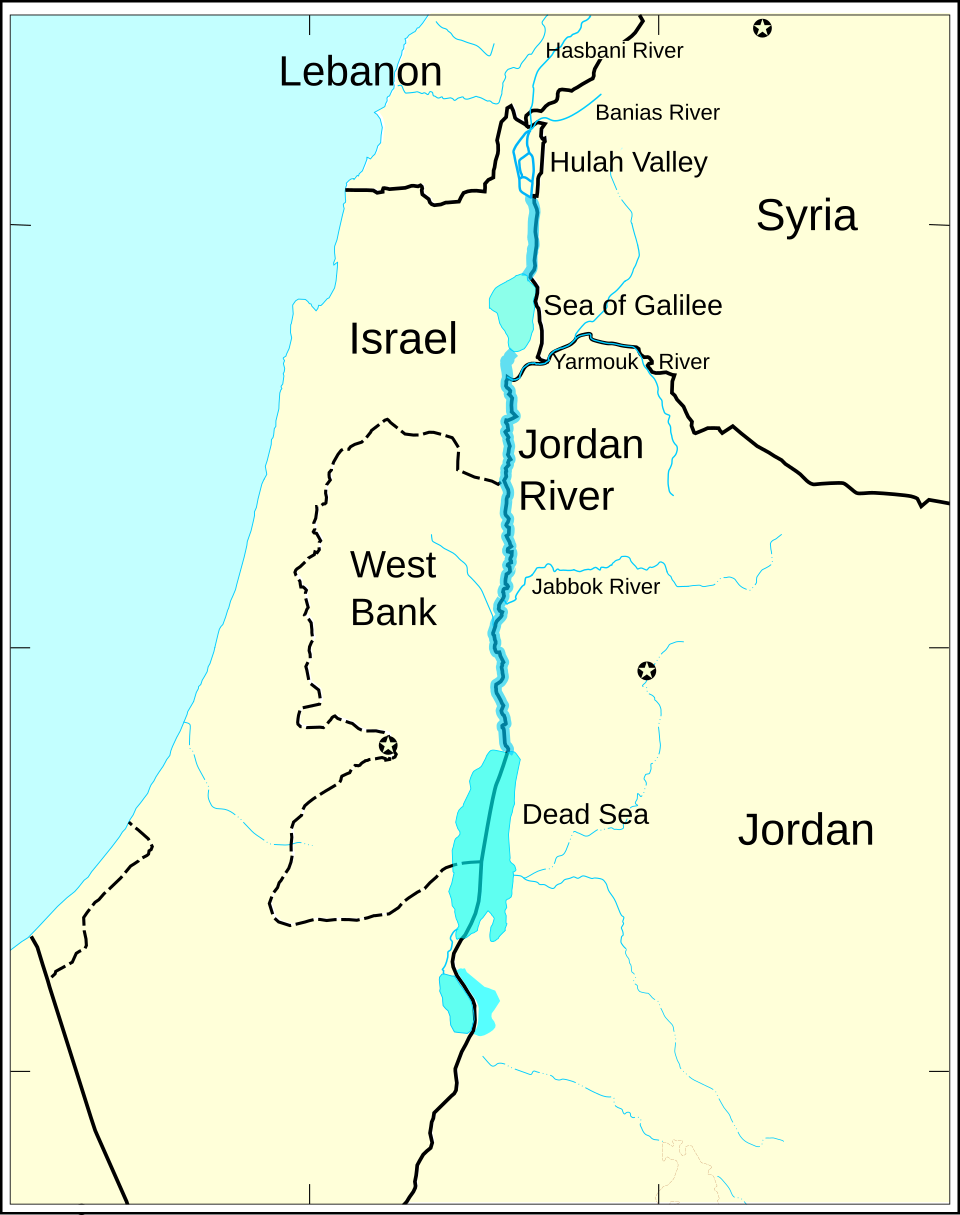
Claim: “Jordan” = “descends from Dan” (etymology):
Folk etymology.
Linguistic etymology of “Yarden” is uncertain; see Wikipedia, “Jordan River”, section “Etymology”.
Possible roots: YRD (descend) and Dan, but modern linguistics does not confirm a derivation from “Dan.”
זכרותיה - literally: “its maleness”, by metaphor with a phallus.
Note: The liver is not in fact the source of blood.
In adults, blood cells are produced in the bone marrow, a process called hematopoiesis.
The liver does produce blood before birth (in the fetus) and performs many blood-related functions, but it is not the main source of blood in children or adults.
Claim: “Source of all water in the world is the Euphrates” (as the Talmud explains in the elided part); All rivers derive from three rivers, and those from the Euphrates (Pishon, Gihon, Tigris)
Geographically incorrect. This reflects a mythic / cosmological Near Eastern model (see the subsequent discussion; the four rivers of Eden in Genesis), not physical hydrology.
סולמי דפרת.
Ed. Steinsaltz explains:
i.e., the waters of the Euphrates seep through the ground and are drawn upward to emerge from these springs.
This same line appears elsewhere in the Talmud, see my “Pt2 King David, the Altar Drainpipes, and the Tehom: The Dramatic Tale of How He Nearly Unleashed a Global Flood but Successfully Averted It (Sukkah 49a; 53a-b)”, section ‘Ulla’s Inference on Earth’s Thickness and Euphrates River’s Underground Water Flow“.
Claim: Euphrates is “Yuval”; called ‘Perat’ because waters “multiply” without rainfall
Partly correct / partly incorrect.
“Yuval” literarily means “stream”; used in the Bible.
Euphrates flow does depend significantly on snowmelt and rainfall, not only subterranean sources.
Re the etymology of the name ‘Perat’, see Wikipedia, “Euphrates”, section “Etymology”.
This same anecdote appears elsewhere in the Talmud, see the appendix at the end of my “Captivity and Purity: The Story of Shmuel’s Daughters (Ketubot 23a)”, “Appendix - Shmuel’s father’s strict practices for his daughters (Shabbat 65a)”.