


Ein Yaakov is the collection of the aggada of the Babylonian Talmud: the stories, sayings, and biblical interpretation, without the legal discussion. Jacob ibn Ḥabib compiled it in the early sixteenth century, and for centuries it was how many Jews who did not study the Talmud’s legal discussions met the Talmud. It is on Sefaria in full. But the digital text has no page references. You can read a passage of Ein Yaakov, but you cannot see where in the Talmud it comes from, or what the compiler left out around it.1
I have made a table that supplies this: Every passage of Ein Yaakov on Sefaria is linked to the exact place in the Bavli, page and section, in the numbering that Sefaria uses for the Koren Steinsaltz edition (the same numbering Bekiut uses). The table is here, with a filter by tractate and a search: https://ezrabrand.github.io/ein-yaakov-bavli-map/
What is there
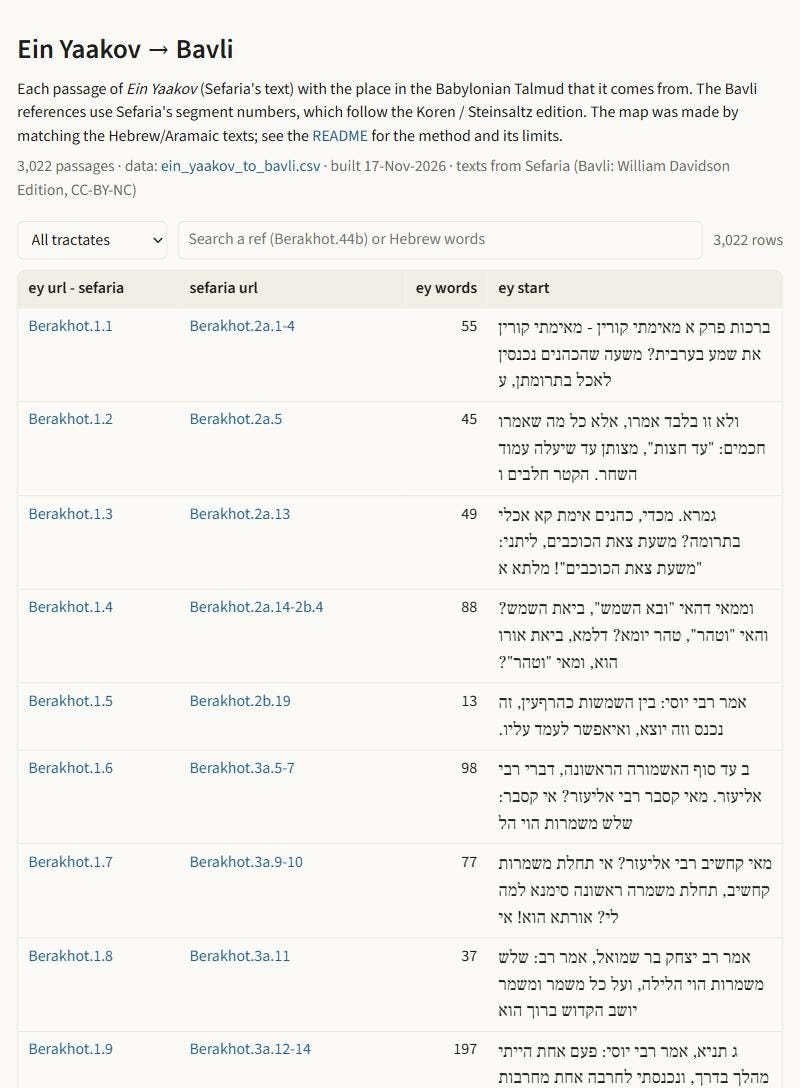
The table has ~3k rows, one for each passage of Ein Yaakov (in Sefaria’s edition) that has a match in the Bavli. Each row links the passage of Ein Yaakov on Sefaria (for example Berakhot 6:25) to the matching section of the Talmud (Berakhot 44b:10), and gives the passage’s length and first words.2 A last column lists parallels: when the same text also occurs elsewhere in the tractate, as a repeated Mishnah does, that place is listed separately (185 passages).
Screenshot of the start of the table, at the opening of Berakhot (on left, the passage of Ein Yaakov; next, its place in the Talmud; then its length and first words):
How it was made
Since there are no references to follow, the map compares the two texts. Both are reduced to a common form: vowels removed, abbreviations written out (א”ל becomes אמר ליה), and each word cut down to its consonants, so that full and defective spellings match. Each section of the Talmud is then compared with Ein Yaakov by runs of four words, and assigned to the passage it shares the most runs with.
Almost every section of the Talmud is either nearly all in Ein Yaakov or not at all. The match is not exact, because Ein Yaakov has its own readings, some changed by the censor.
How much of the Talmud is aggada
Ein Yaakov has about 412k words, 22% of the 1.85 million words of the Bavli in Sefaria’s text, and the sections it takes hold 20% of the Bavli’s words. By the measure of this one compiler, about a fifth of the Talmud is aggada. The share is very uneven: in Berakhot, Ein Yaakov is half the length of the tractate (51%); in Bava Kamma it is 9%, in Zevachim 6%.
Appendix - Technical
Sources. Sefaria’s public export bucket (gs://sefaria-export), read without login. Bavli: William Davidson Edition, English and Aramaic (<Tractate>_en.json, <Tractate>_he.json), 37 tractates. Ein Yaakov: Midrash/Aggadah/Ein Yaakov/Hebrew/merged.json (version source: Daat), structured as tractate → chapter → passage, 3,192 passages, no daf references.
Normalisation. Maqaf to space, then nikud and cantillation removed. Text in parentheses is dropped: in Ein Yaakov these are verse references, in the Vilna text deleted readings. About 30 abbreviations are expanded (א”ל, א”ר, הקב”ה, ת”ר, רשב”י …). Each word is reduced to a consonant skeleton: inner and final ו/י/א removed (a leading one is kept), final letters normalised.
Matching. Per tractate, word 4-grams. A Bavli segment is in Ein Yaakov if ≥ 40% of its 4-grams occur in the Ein Yaakov text of that tractate (the coverage is bimodal: 61,530 segments ≤ 0.05, 10,112 ≥ 0.6). Each such segment is assigned to the Ein Yaakov passage it shares the most 4-grams with. A passage’s segments form a range; a new range starts after a gap of more than 3 segments. A range more than 40 segments from the passage’s main range is a parallel. Passages with no assigned segment get a span from 4-grams that occur only once in the tractate (10% trimmed at each end).
Counts. 2,915 passages assigned, 107 by anchors, 95 with no match (section numbers, chapter endings, “אין אגדות בפרק זה”), 75 in tractates without Bavli. 163 passages have 2–4 ranges; 185 have parallels. Ein Yaakov segments: 16% of the Bavli’s segments (11,360 of 70,510 Gemara segments) and 20% of its Aramaic words.
I noted this in a comment in a previous piece of mine.
Note that Ein Yaakov’s “Berakhot 6:25” means Tractate Berakhot, Chapter 6, Ein Yaakov section # 25; the chapters are the traditional general Talmud chapters, while the sections are particular to Ein Yaakov.
Also note that Ein Yaakov includes Mishnayot that have no Talmud, especially Tractate Yadayim and Eduyot; these aren’t included in this table, they total ~20 sections.
Some previous pieces of mine on (or utilizing) Ein Yaakov: