

Over the past few years, I’ve written more than 400 blog posts analyzing aggadic passages from the Talmud. In that process, I’ve developed a consistent methodology for breaking down these texts and presenting them clearly.
Here I’d like to step back to explain how I approach each sugya or why I format my posts the way I do.
So here’s an overview of my method, with a general discussion of various fundamental aspects of aggadah, especially as relates to literary structure.1
In addition, I map my posts to Ein Yaakov. Separately and unrelatedly, I examine Grokipedia in comparison with Wikipedia, as well as the broader prospect of a high-quality AI-generated encyclopedia.
Outline
Intro
How I Analyze Aggadic Sugyot: A Methodological Overview
Guiding Principles
Structure of an Analysis
Main Body, per section
Section Headers with Key Information
The Aggadic Formula
Tradent
Statement
Prooftext
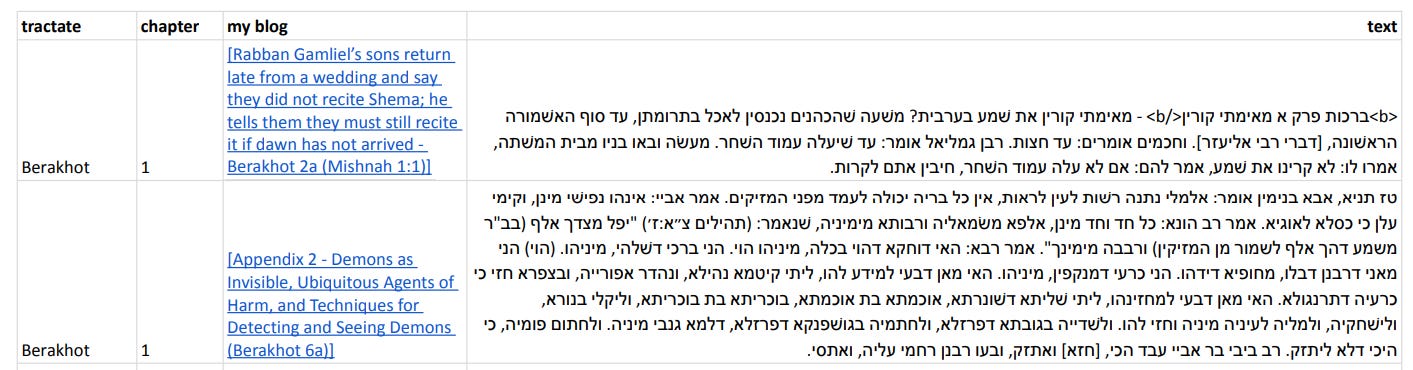
Mapping my posts to Ein Yaakov - ~110 pages, 700+ items/rows
On Wikipedia, Grokipedia, and the Possibility of a good AI-generated Encyclopedia
How I Analyze Aggadic Sugyot: A Methodological Overview
Over the past several years, I’ve developed a consistent approach to analyzing aggadic passages in the Babylonian Talmud. This post describes my methodology.
Guiding Principles
My approach centers on pshat—reading the text as it presents itself, without apologetics or anachronism. When a passage contains material that later generations found uncomfortable, I don’t sanitize it. The goal is to understand what the text says and how it works, not to defend or attack it.2
I treat each sugya as a complete literary unit.
Structure of an Analysis
Title: Descriptive, with the Talmudic citation in parentheses. For multi-part analyses: “Pt[X] [Topic]...” with a note pointing to the series outline.
Introduction: Two to four paragraphs of prose summarizing the sugya’s central themes, the key interpretive questions at stake, and the major rabbinic voices involved.
Outline: A hierarchical numbered outline showing the passage’s structure. This serves as both a table of contents and a map of the sugya’s logic. Section headers in the outline match those in the body.
The Passage: A link to the passage on Sefaria
Main Body: see next section
Appendices: Supplementary material that enriches understanding without interrupting the main analysis. When a passage cites many verses—especially when they cluster in a single biblical book—I sometimes provide an index of those verses in an appendix, with a short summary of each statement.
Footnotes: Contain cross-references to other posts, observations relating to linguistic and literary structure, and basic background info from Wikipedia (English or Hebrew).
Main Body, per section
I provide:
Section headers that break the sugya into digestible units
Sometimes: Italicized contextual narrative summarizing the section
Hebrew/Aramaic text in bold within blockquotes, split into new lines by clause
Ed. Steinsaltz English translation and interpretation immediately following, split by corresponding clauses
Glosses for technical terms, either inline or in footnotes; Hyperlinks to Wikipedia for historical figures, places, and concepts
Tables or diagrams when the text contains lists, parallel structures, or comparative material
Section Headers with Key Information
For each distinct teaching within the sugya, I provide:
The tradent’s name (the rabbi attributed with the statement)
A summary of the content in plain language
The prooftext cited (the biblical verse cited to support the teaching)
The Aggadic Formula
Aggadic material typically follows a highly regular, tripartite structure. This formula repeats itself hundreds—if not thousands—of times across the Bavli and related literature. It goes like this:
1. Tradent
The tradent is the rabbi to whom the teaching is attributed. Often this is straightforward: “Rabbi X said...” But frequently, it’s a citation chain: “Rabbi X said in the name of Rabbi Y...”3
The typical formula looks like this:
Rabbi X said [that] Rabbi Y said...
This structure tells us who is responsible for transmitting the teaching and gives us insight into the intellectual lineage and authority behind the statement.
2. Statement
The actual content of the teaching. Aggadic statements often follow a two-part formula.
Especially common is a casuistic format such as the following:
One who does X—Y happens.
Or:
X only happened because of Y.
I’ve discussed this conditional, cause-and-effect structure in previous posts.4 It’s a way of encoding moral, theological, or historical claims. The statement can be about divine reward and punishment, the nature of biblical events, ethical principles, or theological speculation. But whatever the content, the form is remarkably consistent.
3. Prooftext
The teaching is supported by citing at least one biblical verse. It’s typically based on a creative midrashic reading that exploits wordplay, unusual syntax, or semantic associations. The prooftext generates the teaching through interpretive ingenuity.
I therefore frequently split individual sections into two parts: the main teaching itself, and then a sub-section dedicated to the prooftext. The prooftext is often an elaborate midrashic or homiletic reading built on wordplay, linguistic associations, or creative exegesis. Treating it separately keeps the core statement clear while still giving the interpretive gymnastics their due attention.
I’ve written briefly before about the mechanics of drash—how these midrashic readings work. The key point is that the biblical verse isn’t functioning as a straightforward proof in the way we might think of “evidence.” Instead, it’s a hermeneutical anchor, a textual hook that the rabbis use to ground their statement in scripture. The verse is read in a way that reveals or supports the rabbi’s claim, often through linguistic creativity that would never fly in a pshat reading.
Mapping my posts to Ein Yaakov - ~110 pages, 700+ items/rows
In PDF format, hosted at my Google Drive:5
Screenshot:
On Wikipedia, Grokipedia, and the Possibility of a good AI-generated Encyclopedia
When Grokipedia launched two months ago as Elon Musk’s alternative to Wikipedia, I dismissed it as yet another doomed fork—the latest in a long line of conservative/reactionary Wikipedia alternatives that inevitably fail due to fundamental network effects, as well as other fundamental flaws. I was half-right.
Grokipedia isn’t only a fork. A significant percentage of it is AI-generated content, essentially what other AI providers call “deep research”, creating wiki-style entries by synthesizing sources from across the web. This makes it more interesting than I initially thought, though not necessarily better.
I’ve had an unexpected opportunity to evaluate Grokipedia firsthand: it now cites my blog over 60 times. Screenshot, from the ezrabrand.com Google Search Console > “External Links”, exported into a spreadsheet, and filtered for ‘grokipedia’, initial rows:6
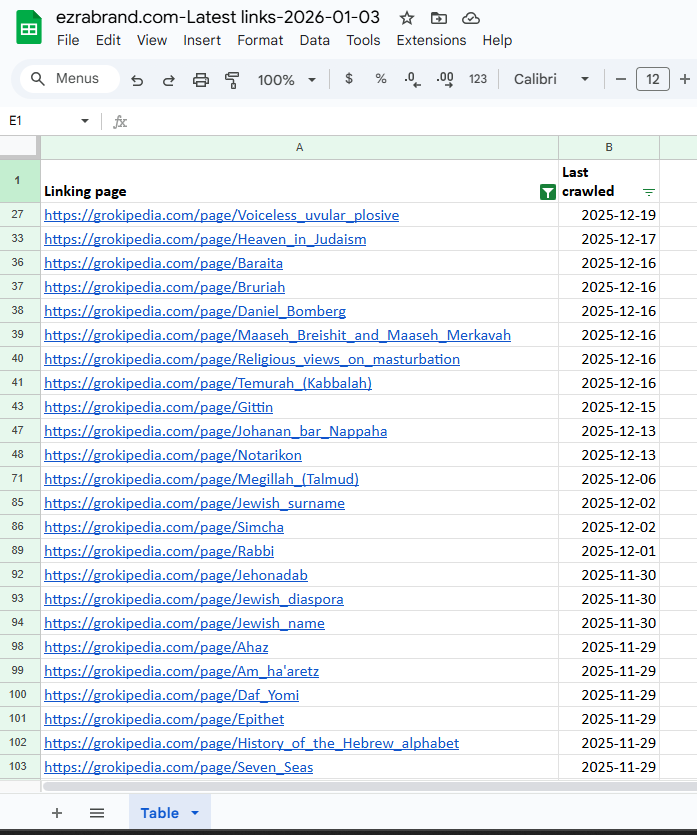
This sounds flattering until you examine how it uses sources. Like a college student cramming an essay, Grokipedia pads citations while barely engaging with the actual content: vague, hazy, imprecise, saying little in many words. The entries typically cite work for things that have relatively little to do with what I actually say.
For example, taking one essentially at random (the second one on the list), https://grokipedia.com/page/Heaven_in_Judaism, control + F finds that I’m cited in footnote 27 (https://www.ezrabrand.com/p/pt1-talmudic-cosmology-earths-foundations):

Here’s the full paragraph containing the citation to footnote 27 (as of 3-Jan-2026):
Interpretations of the seven heavens often favor symbolic over literal understandings, representing stages of metaphysical ascent toward divine unity rather than tangible astronomical spheres, in line with rabbinic warnings against overly speculative cosmology.[27]
Screenshot:

If you look at my post, I don’t discuss at all how “Interpretations of the seven heavens often favor symbolic over literal understandings, representing stages of metaphysical ascent toward divine unity rather than tangible astronomical spheres [...]”. Rather, it’s using my post as a source for “rabbinic warnings against overly speculative cosmology”. Which is not technically wrong, but a) it should be giving a source for the first assertion in the sentence, re "Interpretations of the seven heavens often favor symbolic over literal understandings”; and b) it should be giving the primary source for “rabbinic warnings against overly speculative cosmology”.
Yet I’ve found exceptions. An entry on Rashi script appeared as Google’s second search result and was genuinely better than the corresponding Wikipedia entry, with a far more comprehensive discussion. This hints at potential value, even if most content remains mediocre.
This tracks with my broader experiments in AI research tools. I recently tested ChatGPT-5 ‘thinking,’ Claude 4.5 thinking, and Gemini 3 Pro for finding scholarly sources on aggadic passages. ChatGPT-5 won on precision and recall, but none were reliable enough for serious scholarship without manually checking every link. Good for initial source discovery; terrible for anything more.
Here’s my current assessment: AI-generated encyclopedic content isn’t there yet, or at least isn’t cost-effective. But extrapolating current trends, within a few years AI-generated wiki-style entries will match or exceed human-written ones. At that stage, Wikipedia itself could, in principle, move toward predominantly AI-generated content (after extensive testing, of course), once such material matches or exceeds the quality of human writing while being produced far more efficiently.
Another fundamental question is whether AI can and should adjudicate truth in controversial areas.7 One person (mostly-jokingly) mused to me whether AI’s “god-like processing power” could sort out truth so we’d all be “blissfully well informed.” Maybe not ultimate Truth, but a synthesis of current knowledge? That’s coming within years.8
Until then, Wikipedia’s advantages (including network effects) remain insurmountable, and Grokipedia remains what it is: occasionally useful, frequently unreliable, and primarily valuable (to me) for the SEO backlinks it’s giving me.
See my previous related discussion here: “Two Years of Talmud & Tech: A Retrospective on My Approach and Methods, and an ‘Interview’ with an AI Academic Talmud Scholar” (May 18, 2025).
My focus there is considerably broader; here, it is narrowly directed at my current, concrete methodology, within the context of briefly analyzing the typical literary structure of aggadic sugyot and their component sections.
For more on this, see the intro to my “Pt1 Trending Talmud: Top Queries, Popular Posts, and Plain Readings of Controversial Talmudic Passages” (Oct 19, 2025)
This two-step attribution is standard. Occasionally, you’ll find a chain of three (or more) tradents, though that’s rare.
See especially the intro to my “Pt1 ‘Due to Sin [X], Occurs [Y]’: Divine Justice and Human Responsibility for Suffering and Death (Shabbat 32b-33a)“.
Note that brackets means that it’s not a dedicated blogpost, rather an appendix, or a section within a broader work.
All these links can also be found in my full “Index of Talmud Posts, by Tractate”.
The Ein Yaakov edition is from Sefaria, as an Excel export.
The full Ein Yaakov excel file is around 3k rows. I only included rows that have a published piece of mine, and also then, only the initial row.
Note that an Ein Yaakov cell can include Talmud text which isn’t discussed in my piece.
Compare my previous discussions of Ein Yaakov, which includes a discussion of this specific Excel export, with analysis:
Actual URL, for the record (not publicly accessible):
https://search.google.com/search-console/links?resource_id=sc-domain%3Aezrabrand.com
Note that this is Grokipedia’s stated purpose for existing.
In my opinion.
Compare this long list of relevant related recent predictions: Jessica Taylor, “2025 in AI predictions“ (2nd Jan 2026).