This sugya contains a long allegorical interpretation of Isaiah 3:1–7. Rav Dimi states that Isaiah pronounced eighteen curses upon Israel and was not satisfied until he declared the most bitter one: “The child shall behave insolently against the aged, and the base against the honorable.” The Talmud then lists those eighteen losses foretold in Isaiah 3:1–4, where God removes from Jerusalem (in the leadup to its destruction in 586 BCE) every form of “support” — bread, water, strength, wisdom, and leadership. Each element is read as a symbol for a class of Torah scholar or leader:1
“Support” refers to masters of Bible; “staff” to masters of Mishnah such as R. Yehuda ben Teima ( יהודה בן תימא) and his peers; “support of bread” to masters of Talmud, as in “Come, eat of my bread” (Prov 9:5); “support of water” to masters of aggadah, whose words move the heart like flowing water. “The mighty man” is one skilled in transmitted traditions; “man of war,” one who battles in argument for the truth of Torah; “judge,” one who rules truly; “prophet,” literal; “diviner,” a king whose word carries divine weight; “elder,” one fit to preside over an academy.
“Captain of fifty” is re-read as “captain of the five books of Torah (=Pentateuch)”, or, according to R. Abbahu, one not appointed as public translator before age 50. “Man of favor” is one whose merit brings favor to his generation — in heaven like R. Ḥanina ben Dosa, or on earth like R. Abbahu at the (Roman) emperor’s court. “Counselor” knows the calendar and intercalation; “cunning” is the student who sharpens his teachers; “charmer” is so profound that his listeners fall silent; “skillful” can infer one teaching from another; “enchanter” is worthy to receive the whispered secrets of Torah.
R. Elazar explains “I will make children their princes” to mean leaders empty of mitzvot; Rav Pappa bar Ya‘akov interprets “babes shall rule” as foxes ruling over lions — inferior men replacing the noble. Isaiah’s mind, the Talmud says, was not calmed until he foresaw a generation where those devoid of commandments would mock the righteous filled with them, and the base would scorn the honorable, those who treat grave sins as light challenging those who treat light sins as grave.
Rav Ketina adds that even at Jerusalem’s collapse there remained “men of trust.” Isaiah 3:6–7 is read as a dialogue: people beseech the learned to lead — “You have a cloak; be our ruler” — meaning, you possess hidden teachings (“things covered like a cloak”). The “stumbling block” signifies deep matters of Torah understood only through trial and error. Yet the learned reply under oath, “I will not be a healer,” admitting they never sat in the study hall, owning that their houses contain neither bread, cloak, nor Torah knowledge of Scripture, Mishnah, or Talmud.
Finally, Rava concludes: Jerusalem was destroyed (in 586 BCE) only when even these trustworthy men disappeared, as Jeremiah 5:1 laments — none remained who acted justly or sought truth, and therefore the city was not pardoned.
Isaiah 3:1-7
כי הנה
האדון יהוה צבאות
מסיר מירושל͏ם ומיהודה
משען ומשענה
כל משען לחם
וכל משען מים
For lo!
The Sovereign YHWH of Hosts
Will remove from Jerusalem and from Judah
Prop and stay,
Every prop of food
And every prop of water
גבור ואיש מלחמה
שופט ונביא
וקסם וזקן
Soldier and warrior,
Magistrate and prophet,
Augur and elder;
שר חמשים
ונשוא פנים ויועץ
וחכם חרשים ונבון לחש
Captain of fifty,
Magnate and counselor,
Skilled artisan and expert enchanter;
ונתתי נערים שריהם
ותעלולים ימשלו בם
And I will make boys their rulers,
And babes shall govern them.
ונגש העם איש באיש
ואיש ברעהו ירהבו
הנער בזקן
והנקלה בנכבד
So the people shall oppress one another—
Each man oppressing his fellow:
The youth [shall bully] the elder;
And the despised [shall bully] the honored.
כי יתפש איש באחיו
בית אביו שמלה
לכה
קצין תהיה לנו
והמכשלה הזאת תחת ידך
For should a man seize his brother,
In whose father’s house there is clothing:
“Come,
be a chief over us,
And let this ruin be under your care,”
ישא ביום ההוא לאמר
לא אהיה חבש
ובביתי אין לחם ואין שמלה
לא תשימני קצין עם
The other will thereupon protest,
“I will not be a dresser of wounds,
With no food or clothing in my own house.
You shall not make me chief of a people!”
Outline
Intro
The Passage - Isaiah’s Eighteen Curses and Categories of Torah and Torah Scholars: An Allegorical Reading of Isaiah 3:1-7 (Chagigah 14a)
Rav Dimi states that Isaiah cursed Israel with 18 curses, culminating in the verse, “The child shall behave insolently against the aged, and the base against the honorable” (Isaiah 3:5)
List of the 18 curses - Isaiah 3:1–5
The list in Isaiah 3:1–4 is read allegorically: each “support” removed from Jerusalem (in 6th century BCE) represents a lost category of Torah mastery
R’ Elazar - “I will make children their princes” = leaders devoid of mitzvot - Isaiah 3:4
Rav Pappa bar Ya’akov - “Ta’alulim” = foxes (i.e., inferior leaders) - Isaiah 3:4
(Isaiah 3:5)
Rav Ketina - Even at Jerusalem’s fall (in 586 BCE), “men of trust” remained—those urged to lead in Torah
Prooftext - Isaiah 3:6–7
“Cloak” = hidden Torah knowledge (The learned are urged to lead)
“And this stumbling block” = Deep teachings understood only through error
Isaiah 3:7 - “Healer” = one who sat in the study hall
Rava - Jerusalem was destroyed (in 586 BCE) when trust ended
Prooftext - Jeremiah 5:1
Appendix 1 - Table Summarizing the Allegorical Reading of Isaiah 3:1-7
Appendix 2 - Seven Wicked Israelite Dynasties (Northern Kingdom) and the Assyrian Conquest (Gittin 88a)
The Passage
Rav Dimi states that Isaiah cursed Israel with 18 curses, culminating in the verse, “The child shall behave insolently against the aged, and the base against the honorable” (Isaiah 3:5)
כי אתא רב דימי, אמר:
שמונה עשרה קללות קילל ישעיה את ישראל,
ולא נתקררה דעתו
עד שאמר להם המקרא הזה:
״ירהבו הנער בזקן
והנקלה בנכבד״
§ The Talmud stated earlier that one who studies the secrets of Torah must be “a captain of 50 and a man of favor” (Isaiah 3:3), but it did not explain the meaning of these requirements. It now returns to analyze that verse in detail.
When Rav Dimi came from Israel to Babylonia, he said:
Isaiah cursed Israel with 18 curses,
and his mind was not calmed,3 i.e., he was not satisfied,
until he said to them the great curse of the following verse:
“The child shall behave insolently against the aged,
and the base against the honorable” (Isaiah 3:5).
List of the 18 curses - Isaiah 3:1–5
שמונה עשרה קללות, מאי נינהו?
דכתיב:
״כי הנה
האדון —
ה׳ צבאות —
מסיר מירושלם ומיהודה
משען
ומשענה
כל משען לחם
וכל משען מים
גבור
ואיש מלחמה
שופט
ונביא
וקוסם
וזקן.
שר חמשים
ונשוא פנים
ויועץ
וחכם חרשים
ונבון לחש.
ונתתי נערים שריהם
ותעלולים ימשלו בם וגו׳״.
The Talmud asks: What are these 18 curses?
The Talmud answers: As it is written:
“For behold,
the Master —
YHWH of hosts —
shall take away from Jerusalem and from Judah
support
and staff,
every support of bread,
and every support of water;
the mighty man,
and the man of war;
the judge,
and the prophet,
and the diviner,
and the elder;
the captain of fifty,
and the man of favor,
and the counselor,
and the cunning charmer,
and the skillful enchanter.
And I will make children their princes,
and babes shall rule over them” (Isaiah 3:1–4).
The 18 items listed in these verses shall be removed from Israel.
The list in Isaiah 3:1–4 is read allegorically: each “support” removed from Jerusalem (in 6th century BCE) represents a lost category of Torah mastery
״משען״ —
אלו בעלי מקרא.
״משענה״ —
אלו בעלי משנה,
כגון רבי יהודה בן תימא וחביריו [...]
״כל משען לחם״ —
אלו בעלי תלמוד,
שנאמר: ״לכו לחמו בלחמי, ושתו ביין מסכתי״.
״וכל משען מים״ —
אלו בעלי אגדה,
שמושכין לבו של אדם כמים באגדה.
״גבור״ —
זה בעל שמועות.
״ואיש מלחמה״ —
זה שיודע לישא וליתן במלחמתה של תורה.
״שופט״ —
זה דיין שדן דין אמת לאמיתו.
״נביא״ —
כמשמעו.
״קוסם״ —
זה מלך,
שנאמר: ״קסם על שפתי מלך״.
״זקן״ —
זה שראוי לישיבה.
״שר חמשים״ —
אל תקרי ״שר חמשים״, אלא ״שר חומשין״.
זה שיודע לישא וליתן בחמשה חומשי תורה.
דבר אחר:
״שר חמשים״ — כדרבי אבהו.
דאמר רבי אבהו: מכאן שאין מעמידין מתורגמן על הצבור פחות מחמשים שנה.
״ונשוא פנים״ —
זה שנושאין פנים לדורו בעבורו.
למעלה,
כגון רבי חנינא בן דוסא.
למטה,
כגון רבי אבהו
בי קיסר.
״יועץ״ —
שיודע לעבר שנים ולקבוע חדשים.
״וחכם״ —
זה תלמיד המחכים את רבותיו.
״חרשים״ —
בשעה שפותח בדברי תורה, הכל נעשין כחרשין.
״ונבון״ —
זה המבין דבר מתוך דבר.
״לחש״ —
זה שראוי למסור לו דברי תורה שניתנה בלחש.
The Talmud proceeds to clarify the homiletical meaning of these terms:
“Support” --
these are masters of the Bible.
“Staff” --
these are masters of Mishnah,
such as R’ Yehuda ben Teima and his colleagues [...]
“Every support of bread” --
these are masters of Talmud,
as it is stated: “Come, eat of my bread, and drink of the wine that I have mingled” (Proverbs 9:5).
“And every support of water” --
these are the masters of aggada,
who draw people’s hearts like water by means of aggada.
“The mighty man” --
this is the master of halakhic tradition, one who masters the halakhot transmitted to him from his rabbis.
“And the man of war” --
this is one who knows how to engage in the discourse of Torah, generating novel teachings in the war of Torah.
“A judge” --
this is a judge who judges a true judgment truthfully.
“A prophet” --
as it literally indicates.
“A diviner” --
this is a king.
Why is he called a diviner? For it is stated: “A divine sentence is on the lips of the king” (Proverbs 16:10).
“An elder” --
this is one fit for the position of head of an academy..
“A captain of 50” --
do not read it as “sar ḥamishim,” rather read it as “sar ḥumashin”;
this is one who knows how to engage in discourse with regard to the 5 books of [ḥamisha ḥumshei] the Torah.
Alternatively,
“a captain of 50” should be understood in accordance with R’ Abbahu, for R’ Abbahu said: From here we learn that one may not appoint a disseminator over the public to transmit words of Torah or teachings of the rabbis if he is less than 50 years of age.
“And the man of favor” --
this is one for whose sake favor is shown to his generation.
The Talmud provides different examples of this:
Some garner favor above (i.e. in Heaven),
such as R’ Ḥanina ben Dosa,
whose prayers for his generation would invariably be answered.
Others gain favor below (i.e. in this world),
for example: R’ Abbahu,
who would plead Israel’s case in the house of the emperor.
“The counselor” --
this is referring to one who knows how to intercalate years and determine months, due to his expertise in the phases of the moon and the calculation of the yearly cycle.
“The cunning” --
this is a student who makes his rabbis wise through his questions.
“Charmer [ḥarashim]” --
this is referring to one so wise that when he begins speaking matters of Torah, all those listening are as though deaf [ḥershin], as they are unable to comprehend the profundity of his comments.
“The skillful” --
this is one who understands something new from something else he has learned.
“Enchanter [laḥash]” --
this is referring to one who is worthy of having words of the Torah that were given in whispers [laḥash], i.e., the secrets of the Torah, transmitted to him.
R’ Elazar - “I will make children their princes” = leaders devoid of mitzvot - Isaiah 3:4
״ונתתי נערים שריהם״.
מאי ״ונתתי נערים שריהם״?
אמר רבי אלעזר:
אלו בני אדם שמנוערין מן המצות.
The Talmud continues to interpret this verse: “And I will make children their princes” (Isaiah 3:4).
The Talmud asks: What is the meaning of “And I will make children [ne’arim] their princes”?
R’ Elazar said:
These are people who are devoid [meno’arin] of mitzvot; such people will become the leaders of the nation.
Rav Pappa bar Ya’akov - “Ta’alulim” = foxes (i.e., inferior leaders) - Isaiah 3:4
״ותעלולים ימשלו בם״ —
אמר רב פפא בר יעקב:
תעלי בני תעלי.
“And babes [ta’alulim] shall rule over them”;
Rav Pappa bar Ya’akov said:
Ta’alulim means foxes [ta’alei], sons of foxes.
In other words, inferior people both in terms of deeds and in terms of lineage.
(Isaiah 3:5)
ולא נתקררה דעתו, עד שאמר להם:
״ירהבו הנער בזקן
והנקלה בנכבד״ —
אלו בני אדם שמנוערין מן המצות,
“ירהבו” —
במי שממולא במצות כרמון
And the prophet Isaiah’s mind was not calmed until he said to them:
“The child shall behave insolently against the aged,
and the base against the honorable” (Isaiah 3:5) —
“The child” [na’ar]; these are people who are devoid of mitzvot,
who “will behave insolently” —
toward one who is as filled with mitzvot as a pomegranate.
״והנקלה בנכבד״ —
יבא מי שחמורות דומות עליו כקלות,
וירהבו —
במי שקלות דומות עליו כחמורות
“And the base [nikleh] against the honorable [nikhbad]” —
this means that one for whom major [kaved] transgressions are like minor ones [kalot] in his mind will come
“and behave insolently” —
with one for whom even minor transgressions are like major ones in his mind.
Rav Ketina - Even at Jerusalem’s fall (in 586 BCE), “men of trust” remained—those urged to lead in Torah
אמר רב קטינא:
אפילו בשעת כשלונה של ירושלים —
לא פסקו מהם בעלי אמנה,
§ The Talmud continues its explanation of the chapter in Isaiah.
Rav Ketina said:
Even at the time of Jerusalem’s downfall --
trustworthy men did not cease to exist among its people,
Prooftext - Isaiah 3:6–7
“Cloak” = hidden Torah knowledge (The learned are urged to lead)
שנאמר:
״כי יתפש איש באחיו בית אביו
שמלה לך
קצין תהיה לנו״.
דברים שבני אדם מתכסין כשמלה --
ישנן תחת ידך.
as it is stated:
“For a man shall take hold of his brother of the house of his father, and say:
You have a cloak,
be our ruler” (Isaiah 3:6).
The Talmud explains that they would approach someone and say to him: Things that people are careful to keep covered as with a cloak, i.e., words of Torah that are covered and concealed --
are under your hand, as you are an expert with regard to them.
“And this stumbling block” = Deep teachings understood only through error
״והמכשלה הזאת״.
מאי ״והמכשלה הזאת״?
דברים שאין בני אדם עומדין עליהן אלא אם כן נכשל בהן —
״ישנן תחת ידך״.
What is the meaning of the end of that verse: “And this stumbling block” (Isaiah 3:6)?
Things that people cannot grasp unless they have stumbled over them, as they can be understood only with much effort --
are under your hand.
Isaiah 3:7 - “Healer” = one who sat in the study hall
״ישא ביום ההוא לאמר:
לא אהיה חובש
ובביתי אין לחם ואין שמלה
לא תשימוני קצין עם״.
Although they will approach an individual with these statements, he “shall swear that day, saying:
I will not be a healer,
for in my house there is neither bread nor a cloak;
you shall not make me ruler of a people” (Isaiah 3:7).
״ישא״ —
אין ישא אלא לשון שבועה,
שנאמר: ״לא תשא את שם ה׳ אלהיך״.
״לא אהיה חובש״ —
לא הייתי מחובשי בית המדרש.
״ובביתי אין לחם ואין שמלה״ —
שאין בידי
לא מקרא
ולא משנה
ולא גמרא.
[...]
When the verse states: “Shall swear [yissa]” --
yissa is none other than an expression of an oath,
as it is stated: “You shall not take [tissa] the name of YHWH your God in vain” (Exodus 20:6).
Therefore, the inhabitant of Jerusalem swears: “I will not be a healer [ḥovesh]” () --
which means: I was never one of those who sit [meḥovshei] in the study hall;
“for in my house there is neither bread nor a cloak” --
as I possess knowledge of
neither the Bible,
nor Mishnah,
nor Talmud.
This shows that even at Jerusalem’s lowest spiritual ebb, its inhabitants would admit the truth and own up to their complete ignorance.
[...]
Rava - Jerusalem was destroyed (in 586 BCE) when trust ended
אמר רבא:
לא חרבה ירושלים עד שפסקו ממנה בעלי אמנה,
Rava said:
Jerusalem was not destroyed until trustworthy men ceased to exist in it,
Prooftext - Jeremiah 5:1
שנאמר:
״שוטטו בחוצות ירושלם
וראו נא ודעו
ובקשו ברחובותיה
אם תמצאו איש
אם יש עושה משפט
מבקש אמונה
ואסלח לה״
as it is stated:
“Run to and fro through the streets of Jerusalem,
and see now and know,
and seek in its broad places,
if you can find a man,
if there is any that acts justly,
that seeks truth,
and I will pardon her” (Jeremiah 5:1),
implying there were no trustworthy people at that time
Appendix 1 - Table Summarizing the Allegorical Reading of Isaiah 3:1-7
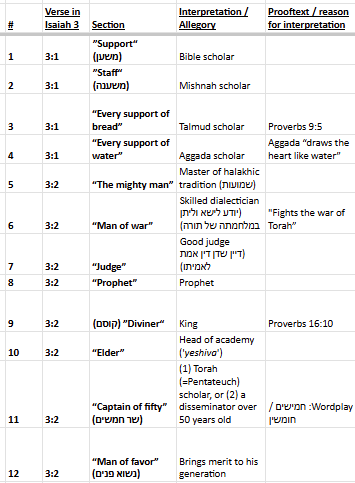
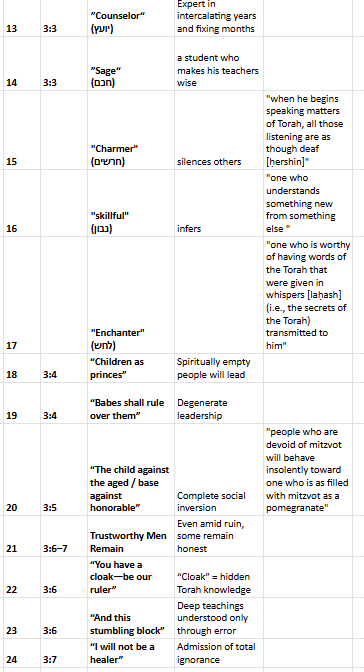
Appendix 2 - Seven Wicked Israelite Dynasties (Northern Kingdom) and the Assyrian Conquest (Gittin 88a)
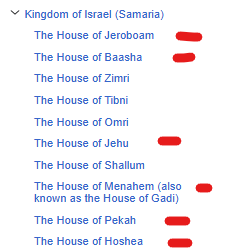
R’ Yehoshua ben Levi asserts that “Eretz Yisrael was not destroyed”4 until 7 (royal) “courts” (בתי דינים) practiced idolatry.
He lists 7 kings of Israel (Northern Kingdom):5
Jeroboam — c. 930–910 BCE — 1st king of Israel
Baasa — c. 900 BCE — 3rd king of Israel
Ahab — c. 850 BCE — 7th king of Israel
Jehu — c. 820 BCE — 10th king of Israel
Pekah — c. 740 BCE — 18th king of Israel
Menahem — c. 750 BCE — 17th king of Israel
Hoshea — c. 730 BCE — 19th and last king of Israel
אמר רבי יהושע בן לוי:
לא חרבה ארץ ישראל עד שעבדו בה שבעה בתי דינים עבודה זרה,
ואלו הן:
ירבעם בן נבט,
ובעשא בן אחיה,
ואחאב בן עמרי,
ויהוא בן נמשי,
ופקח בן רמליהו,
ומנחם בן גדי,
והושע בן אלה
§ The Talmud cites another derivation from this verse.
R’ Yehoshua ben Levi says:
The first destruction of Eretz Yisrael did not occur until seven dynasties and their courts committed idol worship in it,
and they are these:
Jeroboam, son of Nevat;
and Baasa, son of Ahijah;
and Ahab, son of Omri;
and Jehu, son of Nimshi;
and Pekah, son of Remaliah;
and Menahem, son of Gadi;
and Hoshea, son of Elah,
Prooftext - Jeremiah 15:9
The claim is anchored in Jeremiah 15:9: “she who bore 7 languishes” (which is read as a compressed metaphor for cumulative institutional failure rather than a single transgression).
שנאמר:
״אומללה יולדת השבעה,
נפחה נפשה,
באה שמשה בעוד יומם,
בושה וחפרה״.
as it is stated:
“She who has given birth to seven languishes;
her spirit droops;
her sun is gone down while it was yet day,
she is ashamed and confounded” (Jeremiah 15:9).
Re these categories of Torah knowledge, compare my “Appendix - Hillel’s 80 students, and Rabban Yoḥanan ben Zakkai’s Encyclopedic Knowledge: A List of 11 Domains of Knowledge (Sukkah 28a)”, section “Yoḥanan ben Zakkai’s Encyclopedic Knowledge: A List of 11 Domains of Knowledge“, and my notes there.
See Wikipedia, “Isaiah 3“:
This chapter describes how the corrupt leadership brought about the collapse of the social condition of Jerusalem […]
3:1-15: shows the collapse of human leadership […]
Verses 1-15 speaks of the imminent collapse of the society […]
Compare also the Mishnah’s description re the societal collapse before and after the destruction of the Second Temple, in these pieces of mine:
“The End of an Era: The Mishnah on Societal Decline and the Discontinuation of Rituals (Mishnah Sotah 9:9-15)”, final part: Pt2
“ ”On Whom Can We Rely?” Literary Laments of a Fallen Society in the Mishnah (Mishnah Sotah 9:15)”
נתקררה - literally: “cooled”.
Referring to the Assyrian conquest.
Treating each king as standing for a dynastic court.
I give approximate date of flourishing, and ordinal position among the kings of Israel (Northern Kingdom).
See the list at Wikipedia, “Kings of Israel and Judah“, section “Kingdom of Israel (Samaria)“.
Screenshot, with my red ticks highlighting names listed here: