

This short sugya presents homiletic interpretations of the imagery of scarlet sin becoming white, depictions of a (messianic) future dialogue between God, Israel, and the Patriarchs concerning sin and mercy, a portrayal of Isaac as Israel’s defender, and a concluding statement about Jacob’s descent to Egypt.1
Outline
Intro
The Passage
R’ Yitzḥak - Explains the unusual plural כשנים in Isaiah 1:18: even if Israel’s sins are as numerous as all the years from Creation until now, they can still become white as snow - Isaiah 1:18
Rava - Interprets the odd phrasing “לכו נא… יאמר ה׳” as a (messianic) future scene - Isaiah 1:18
God tells Israel to go to the Patriarchs for rebuke
None of the three Patriarchs asked for mercy on their Jewish descendants’ behalf - Gen. 15:13, 27:40, 46:4
Since Israel relied only on God, He grants forgiveness
R’ Shmuel bar Naḥmani citing R’ Yonatan - Expounds Isaiah 63:16
In the (messianic) future Abraham and Jacob fail to defend Israel
But Isaac argues on their behalf, arguing that they’re also God’s children - Isaiah 63:16; Exodus 4:22
Isaac’s Progressive Reduction of Human Sin-Time
Isaac redirects their praise to God alone
R’ Ḥiyya bar Abba citing R’ Yoḥanan - Jacob really deserved to go down to Egypt in chains, but his merit caused the decree to be fulfilled gently and lovingly instead - Hosea 11:4
The Passage
(In ChavrutAI, the sugya starts at Shabbat/89b#2)
R’ Yitzḥak - Explains the unusual plural כשנים in Isaiah 1:18: even if Israel’s sins are as numerous as all the years from Creation until now, they can still become white as snow - Isaiah 1:18
מנין שקושרין לשון של זהורית וכו׳.
We learned in the Mishnah:
From where is it derived that one ties a scarlet strip of wool to the scapegoat? As it says: “If your sins be like scarlet [ka-shanim], they will become white like snow” (Isaiah 1:18).
״כשנים״?
״כשני״ מיבעי ליה!
The Talmud wonders at this:
Why does the verse use the plural form: Ka-shanim?
It should have used the singular form: Ka-shani.2
אמר רבי יצחק:
אמר להם הקדוש ברוך הוא לישראל:
אם יהיו חטאיכם
כשנים הללו שסדורות ובאות מששת ימי בראשית ועד עכשיו —
כשלג ילבינו.
R’ Yitzḥak said that
God said to the Jewish people:
Even if your sins
are as numerous as those years [ka-shanim] that have proceeded continuously from the 6 days of Creation until now3 --
they will become white like snow.
Rava - Interprets the odd phrasing “לכו נא… יאמר ה׳” as a (messianic) future scene - - Isaiah 1:18
דרש רבא:
מאי דכתיב:
״לכו נא ונוכחה
יאמר ה׳״
Rava taught:
What is the meaning of that which is written:
“Go please and let us reason (נוכחה) together,
YHWH will say” (Isaiah 1:18)?
״לכו נא״?
״בואו נא״ מיבעי ליה!
״יאמר ה׳״?
״אמר ה׳״ מיבעי ליה!
Why does the verse say: “Go (לכו) please”?
It should have said: “Come (בואו) please”
And why does the verse say: YHWH will say (יאמר ; future tense)?
The prophet’s message is based on something that God already said. Therefore, the verse should have said: YHWH said (אמר ; past tense)
God tells Israel to go to the Patriarchs for rebuke
לעתיד לבא
יאמר להם הקדוש ברוך הוא לישראל:
לכו נא אצל אבותיכם
ויוכיחו אתכם.
Rather, the explanation of this verse is that
in the (messianic) future that will come,
God will say to the Jewish people:
Go please to your Patriarchs,
and they will rebuke4 you.
ויאמרו לפניו:
רבונו של עולם!
אצל מי נלך?
And the Jewish people will say before Him (=God):
God!
to whom shall we go?!
… None of the three Patriarchs asked for mercy on their Jewish descendants’ behalf - Gen. 15:13, 27:40, 46:4
אצל אברהם
שאמרת לו ״ידע תדע״
ולא בקש רחמים עלינו?!
אצל יצחק
שבירך את עשו ״והיה כאשר תריד״
ולא בקש רחמים עלינו?!
אצל יעקב
שאמרת לו ״אנכי ארד עמך מצרימה״
ולא בקש רחמים עלינו?!
אצל מי נלך?
Shall we go to Abraham,
to whom You said: “Know certainly that your seed shall be a stranger in a land that is not theirs, and shall serve them; and they shall afflict them 400 years” (Genesis 15:13),
and he did not ask for mercy on our behalf!
Or perhaps we should go to Isaac,
who blessed Esau and said: “And it shall come to pass when you shall break loose, that you shall shake his yoke from off your neck” (Genesis 27:40),
and he did not ask for mercy on our behalf!
Or perhaps we should go to Jacob,
to whom You said: “I will go down to Egypt with you” (Genesis 46:4),
and he did not ask for mercy on our behalf!
And if so, to whom shall we go?!
Shall we go to our Patriarchs, who do not have mercy on us?!
Since Israel relied only on God, He grants forgiveness
עכשיו ״יאמר ה׳״.
אמר להן הקדוש ברוך הוא:
הואיל ותליתם עצמכם בי —
״אם יהיו חטאיכם כשנים --
כשלג ילבינו״.
Rather, now God Himself says what punishment we deserve.
God said to them:
Since you made yourselves dependent on Me,
“If your sins be like scarlet --
they will become white like snow.”
R’ Shmuel bar Naḥmani citing R’ Yonatan - Expounds Isaiah 63:16
אמר רבי שמואל בר נחמני, אמר רבי יונתן:
מאי דכתיב:
״כי אתה אבינו
כי אברהם לא ידענו
וישראל לא יכירנו
אתה ה׳ אבינו גואלנו
מעולם שמך״
Apropos the Jewish people assessing their forefathers, the Talmud cites a related teaching.
R’ Shmuel bar Naḥmani said that R’ Yonatan said:
What is the meaning of that which is written:
“For You are our Father;
for Abraham knows us not,
and Israel does not acknowledge us;
You, YHWH, are our Father, our Redeemer,
everlasting is Your name” (Isaiah 63:16)?
In the (messianic) future Abraham and Jacob fail to defend Israel
לעתיד לבא
יאמר לו הקדוש ברוך הוא לאברהם:
בניך חטאו לי.
אמר לפניו:
רבונו של עולם!
ימחו על קדושת שמך.
In the (messianic) future that will come,
God will say to Abraham:
Your children have sinned against Me!
Abraham will say before Him:
God!
if so, let them be eradicated5 to sanctify Your name (קדושת שמך)
אמר:
אימר ליה ליעקב
דהוה ליה צער גידול בנים,
אפשר דבעי רחמי עלייהו.
God said:
I will say it to Jacob.
Since he experienced the pain of raising children,6
perhaps he will ask for mercy on their behalf.
אמר ליה: בניך חטאו.
אמר לפניו:
רבונו של עולם!
ימחו על קדושת שמך.
God said to Jacob: Your children have sinned!
Jacob said before Him:
God!
if so, let them be eradicated to sanctify Your name.
אמר:
לא בסבי טעמא
ולא בדרדקי עצה
God said:
There is no reason in elders
and no wisdom in youth.7
Neither Abraham nor Jacob knew how to respond properly.
But Isaac argues on their behalf, arguing that they’re also God’s children - Isaiah 63:16; Exodus 4:22
אמר לו ליצחק: בניך חטאו לי.
אמר לפניו:
רבונו של עולם!
בני, ולא בניך?!
God said to Isaac: Your children have sinned against Me!
Isaac said before Him:
God!
are they my children, and not Your children?!
בשעה שהקדימו לפניך ״נעשה״ ל״נשמע״ --
קראת להם ״בני בכורי״,
עכשיו בני, ולא בניך?!
At Sinai, when they accorded precedence to “We will do” over “We will listen” before You8 --
didn’t You call them, “My son, My firstborn son Israel” (Exodus 4:22)?
Now that they have sinned, are they my children, and not Your children?!
Isaac’s Progressive Reduction of Human Sin-Time
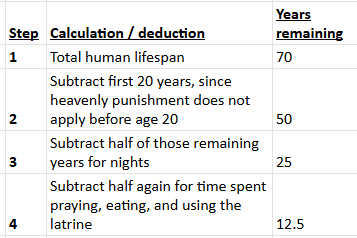
Table summarizing the sugya’s calculations:
ועוד,
כמה חטאו?
And furthermore,
how much did they actually sin?!
כמה שנותיו של אדם?
שבעים שנה.
How long is a person’s life?
70 years.9
דל עשרין דלא ענשת עלייהו —
פשו להו חמשין.
Subtract the first 20 years of his life. One is not punished for sins committed then, as in heavenly matters, a person is only punished from age 20.
50 years remain for them.
דל עשרין וחמשה דלילותא —
פשו להו עשרין וחמשה.
Subtract 25 years of nights,10
and 25 years remain for them.
דל תרתי סרי ופלגא
ד
צלויי
ומיכל
ודבית הכסא —
פשו להו תרתי סרי ופלגא,
Subtract 12½ years11
during which one
prays
and eats
and uses the latrine,
and 12½ years remain for them.
אם אתה סובל את כולם —
מוטב,
ואם לאו —
פלגא עלי
ופלגא עליך.
If You can endure them all and forgive the sins committed during those years,
excellent.
And if not,
half of the sins are upon me to bear
and half upon You.
ואם תמצא לומר כולם עלי —
הא קריבית נפשי קמך.
And if You say that all of them, the sins of all 12½ years that remain, are upon me,
I sacrificed my soul before You12
and You should forgive them due to my merit.
פותחין ואומרין:
״כי אתה אבינו״.
The Jewish people began to say to Isaac:
You are our father.13
Only Isaac defended the Jewish people as a father would and displayed compassion toward his children.
Isaac redirects their praise to God alone
אמר להם יצחק:
עד שאתם מקלסין לי,
קלסו להקדוש ברוך הוא,
ומחוי להו יצחק לקודשא בריך הוא בעיניה.
Isaac said to them:
Before you praise14 me,
praise God.
And Isaac points (מחוי) to God before their eyes.15
מיד נושאים עיניהם למרום ואומרים:
״אתה ה׳
אבינו גואלנו
מעולם שמך״.
Immediately they lifted their eyes to the heavens and say:
“You, YHWH,
are our Father, our Redeemer,
everlasting is Your name.”
R’ Ḥiyya bar Abba citing R’ Yoḥanan - Jacob really deserved to go down to Egypt in chains, but his merit caused the decree to be fulfilled gently and lovingly instead - Hosea 11:4
אמר רבי חייא בר אבא, אמר רבי יוחנן:
ראוי היה יעקב אבינו לירד למצרים בשלשלאות של ברזל,
אלא שזכותו גרמה לו,
And since the Talmud mentioned Jacob’s descent to Egypt, the Talmud cites that which R’ Ḥiyya bar Abba said that R’ Yoḥanan said:
Our father Jacob should have gone down to Egypt in iron chains (שלשלאות), as would an exile against his will, as decreed by God and related to Abraham.
However, his merit caused him to descend without suffering,
דכתיב:
״בחבלי אדם אמשכם
בעבתות אהבה
ואהיה להם כמרימי על על לחיהם
ואט אליו אוכיל״.
as it is written:
“I drew them with cords (חבלי) of man,
with bands (עבתות) of love,
and I was to them as they that take off the yoke on their jaws,
and I fed them gently” (Hosea 11:4).
Unrelated, as an aside, I recently added Mishnah tractates not in Talmud, to ChavrutAI.
Screenshots, in tablet view:
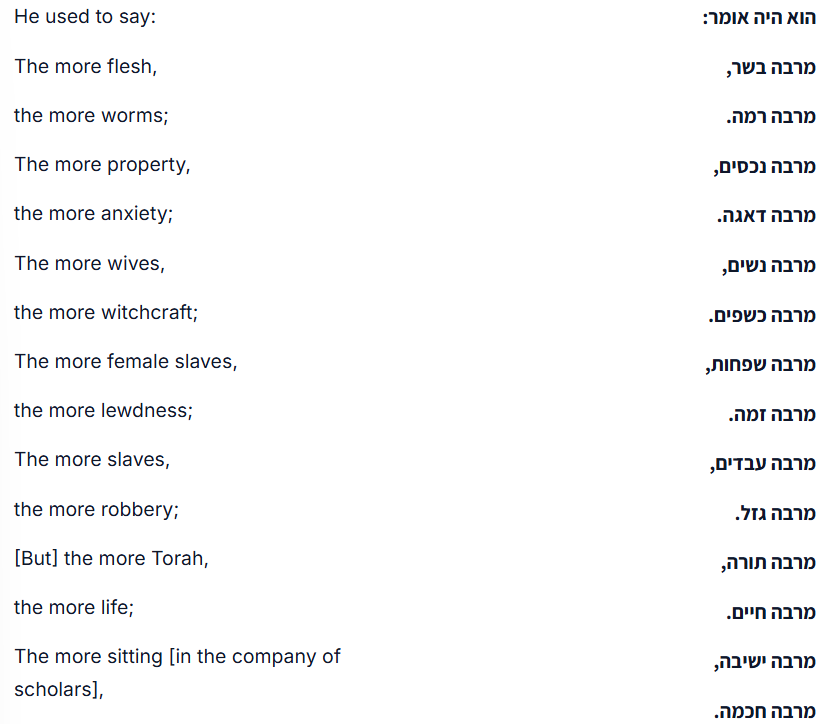
Sample Mishnah section, which shows the literary structure clearly, Avot 2:7 (see my piece on this Mishnah section in my “Appendix - More Of Hillel’s Aphorisms (Avot 2:4-7)”, section ““The more [X], the more [Y]” - A List of 9 items (2:7)”):
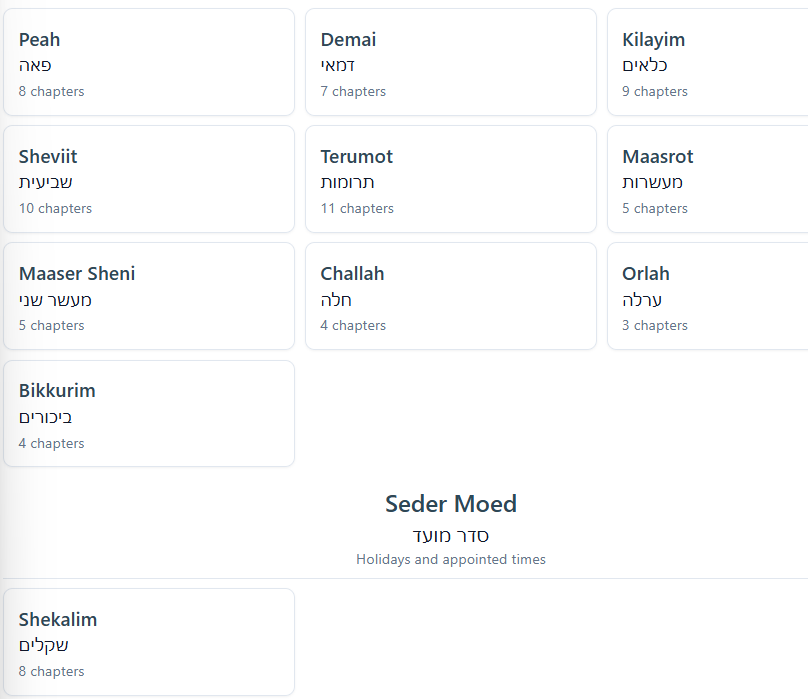
And see summary in the the Changelog page, section “March 2026”, sub-section “Mishnah Reader”:
New Mishnah reader covering 26 tractates not included in the Babylonian Talmud, organized by Seder
Bilingual Hebrew-English chapter reader with 50/50 side-by-side layout, matching the Bible reader style
Hebrew text: Torat Emet (public domain). English translation: Dr. Joshua Kulp, “Mishnah Yomit” (CC-BY, via Sefaria)
Tractate Shekalim uses the Steinsaltz (William Davidson Edition) translation with Talmud-style commentary layout
Custom Hebrew text processing: comma-to-colon conversion for speech markers (e.g. אומר: instead of אומר,)
Custom English text processing: name transliteration (R’ instead of R., Yehoshua instead of Joshua, etc.) and sentence-level line splitting
Tractate table of contents with chapter and mishnah-count navigation
Note that I used these translations in my various presentations of Mishnah tractates (with focus on literary structure):
שני - which is the typical form for the biblical word for “scarlet”, especially in the recurring biblical term תולעת שני.
See at length at Hebrew Wikipedia, “שני (צבע)“, especially section “אטימולוגיה“.
And see also Jastrow (modernized):
שָׁנִי
(Biblical Hebrew) scarlet;
תולעת שני, see תֹּולֵעָה.
Plural: שָׁנִים.
Shabbat 89b:2 (referring to Isaiah 1:18) - כשנים כשני מיבעי ליה וכ׳ - “ka-shanim? it ought to read ka-shani (as scarlet) etc.”
and elsewhere.
And see Wikipedia, “Kermes (dye)“, section “The biblical scarlet (tolaʻat šanī)“:
In the Bible, scarlet was one of three principal pigments used in the Temple curtain appurtenances, and sacred vestments […]
The English word for the biblical “scarlet” (Exodus 25:4, etc.) is a literal translation from the Septuagint (Koine Greek: κόκκινον = kókkinon, meaning “scarlet”).
The original Hebrew text (tola’at shani) translates to “scarlet worm”, indicating that the scarlet color is derived from an insect, a requirement which was formalized in the Jerusalem Talmud (Kila’im 9:1 [32a]).
This insect, generally mistaken for a plant, was known in the Roman world as grani coccum = “the grain of scarlet.”
I.e. Anno Mundi ( ‘to the creation of the world’).
On the Anno Mundi count in the Talmud, see the initial note in my “Pt2 The Messianic Era in the Talmud: Calculations of World Duration and Messianic Timing (Sanhedrin 96b-99a)“, on the “Year 6000“.
יוכיחו - based on נוכחה of the verse in Isaiah.
ימחו - literally: “erased”; a similar phrasing is used with regards to the bitter waters used for the Sotah ordeal; the phrasing here is likely influenced by that.
Since he raised a large number of children (=twelve sons); with much drama, as depicted in the Book of Genesis.
A folk saying.
See Hebrew Wikipedia, “נעשה ונשמע“, my translation:
“Na‘aseh ve-nishma” is an expression that appears in the Book of Exodus, spoken by the Israelites at the revelation at Mount Sinai.
Following the words of the Talmudic rabbis, this phrase became a major symbol of complete faith and unconditional acceptance of the Torah.
See Psalm 90:10: “The days of our years are seventy years…” In Talmudic literature, that is the standard source for the statement that a person’s lifespan is 70 years.
I.e., the previous 50 years, divided by two, as nights are half the day.
I.e., the previous 25 years, divided by two.
Referring to the biblical story of the sacrifice of Isaac.
Meaning, the Talmud homiletically interprets the verse’s “You are our father” not as referring to God, but to Isaac.
מקלסין - from Greek kalos.
On this word, see my “Appendix - On the Greek word ‘kalos’, especially in the Talmudic context”.
On “pointing at God” in the future messianic era, compare the Talmud elsewhere, Taanit 31a#9:
אמר עולא ביראה, אמר רבי אלעזר:
עתיד הקדוש ברוך הוא לעשות מחול לצדיקים,
והוא יושב ביניהם בגן עדן,
וכל אחד ואחד מראה באצבעו
The tractate concludes with a statement related to the topic of dancing.
Ulla of the city of Bira’a said that R’ Elazar said:
In the (messianic) future, in the end of days, God will arrange a dance (מחול) of the righteous,
and He will be sitting among them in the Garden of Eden,
and each and every one of the righteous will point (מראה - literally: “show”) to God with his finger
שנאמר:
״ואמר ביום ההוא
הנה אלהינו
זה קוינו לו
ויושיענו
זה ה׳
קוינו לו
נגילה ונשמחה בישועתו״.
as it is stated:
“And it shall be said on that day:
Behold, this is our God,
for whom we waited,
that He might save us.
This is YHWH;
for whom we waited.
We will be glad and rejoice in His salvation” (Isaiah 25:9).
God will be revealed, so that every righteous individual will be able to say: “This is our God”, as though they were pointing at Him with a finger.