


Jacob Emden (1697–1776) was one of the great rabbis of eighteenth-century Germany, and one of its fiercest polemicists. He is best known for his long war against R. Jonathan Eybeschütz, whom he accused of secret Sabbatianism.1 He also wrote an autobiography, Megillat Sefer, “the scroll of the book”. It is an unusual text: a rabbi writing at length about his family, his illnesses, his money, his marriages and his enemies, with very little restraint. I have written before about another of his books, Mitpaḥat Sefarim, his critique of the Zohar. This post is about a new project: a Hebrew text and English translation of Megillat Sefer, page by page, online here:2 https://ezrabrand.github.io/emden-megillat-sefer/
Screenshot of the reader, p. 3, English left and Hebrew right:
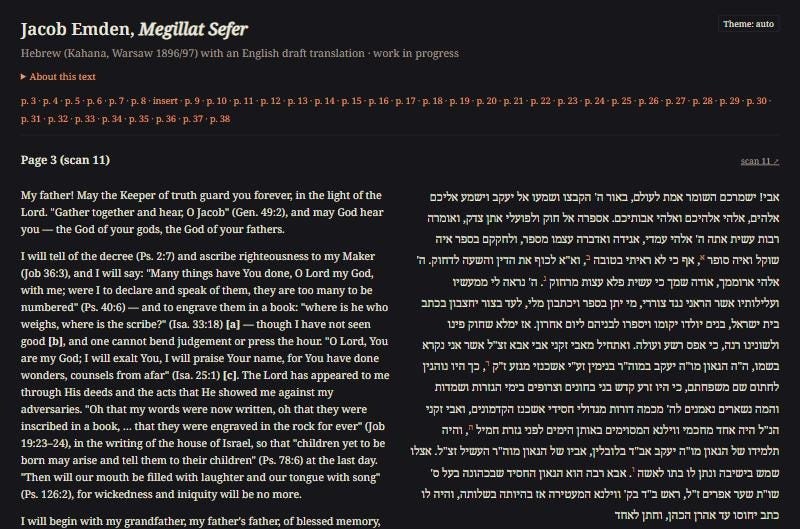
Which Hebrew text
The book was not printed in Emden’s lifetime. It survives in one manuscript, in the Bodleian Library in Oxford, and that manuscript is a copy, not Emden’s own hand.3 There are two printed editions. David Kahana published it in Warsaw in 1896. Avraham Bick (Shauli) published a second edition in Jerusalem in 1979, which claims to restore what Kahana left out. The scholars who know the manuscript best are hard on Bick: Jacob J. Schacter calls his edition worthless, and Shnayer Leiman says Kahana’s is “infinitely superior, though not without error”. (Pini Dunner’s review on the Seforim Blog collects these judgments.) The only full English translation, from 2011, follows Bick. Schacter has announced a critical edition, which has not yet appeared.
So I used Kahana as the base. A typed text of Bick’s edition exists online, from the Pninim project, and I used it only as a second reader, to find places where the two editions differ.
Scholem’s copy
The scan of Kahana’s edition on HebrewBooks turned out to be more than a scan; on one page there is a round library stamp: Gershom Scholem.
Screenshot of Scholem’s library stamp on the scan:
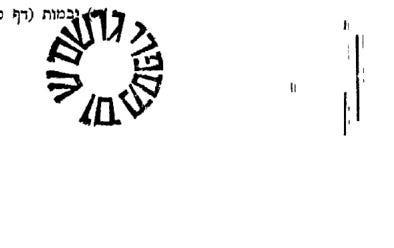
Scholem’s copy compares his copy with the manuscript, at least in part. In the margins is written, in a small cursive hand, words that are in the manuscript and not in Kahana’s print, with a caret in the line to show where they go.4
A typed sheet is bound in after p. 8. It copies a half-page slip from the Oxford manuscript about the last years of Emden’s grandfather in Jerusalem: how the sages there made him remarry at over seventy, and how rain fell when he was buried. That passage is not in Kahana at all. (Bick has it.)
Screenshot of the typed insert in Scholem’s copy:
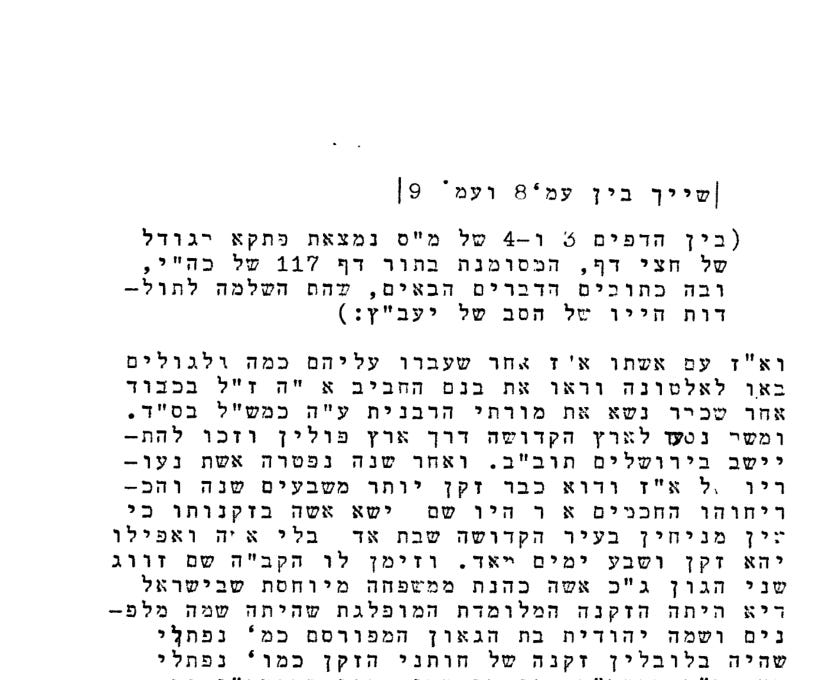
What Scholem restored is one of the more interesting results so far. Kahana was known to have softened at least one passage: the manuscript says that the Ḥakham Tzvi read secular books “in the privy”, and Kahana printed “in his free hours”. The margins show that this was not an isolated case.
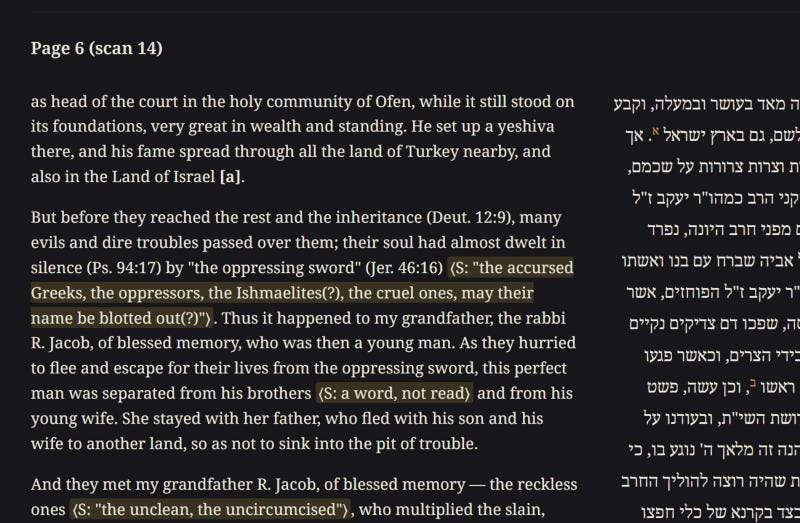
On p. 6, where the grandfather barely escapes the Cossacks in 1648, Kahana prints a biblical phrase, “the oppressing sword”. Scholem adds what the manuscript says: “the accursed Greeks [that is, the Greek Orthodox Cossacks] … the cruel ones”. A few lines down, after “the reckless ones”, he adds “the unclean, the uncircumcised”.
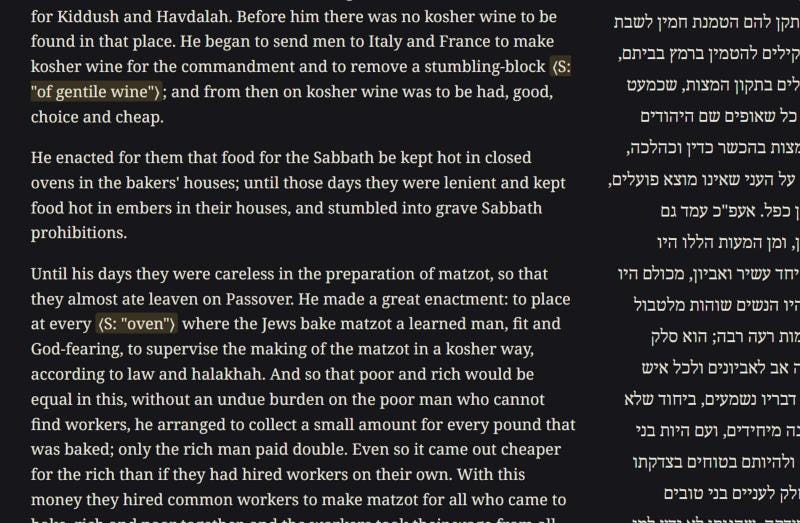
On p. 14, where the Ḥakham Tzvi arranges kosher wine for Altona “to remove a stumbling-block”, Scholem adds “of gentile wine”.
In the pages on the Ḥayon and Eybeschütz affairs, he restores curses after the names of Ḥayon and Shabbetai Zevi (”may the name of the wicked rot”) and words like “the wicked” and “the scoundrel”.
Screenshot of the scan of p. 6, with Scholem’s notes in the margin:
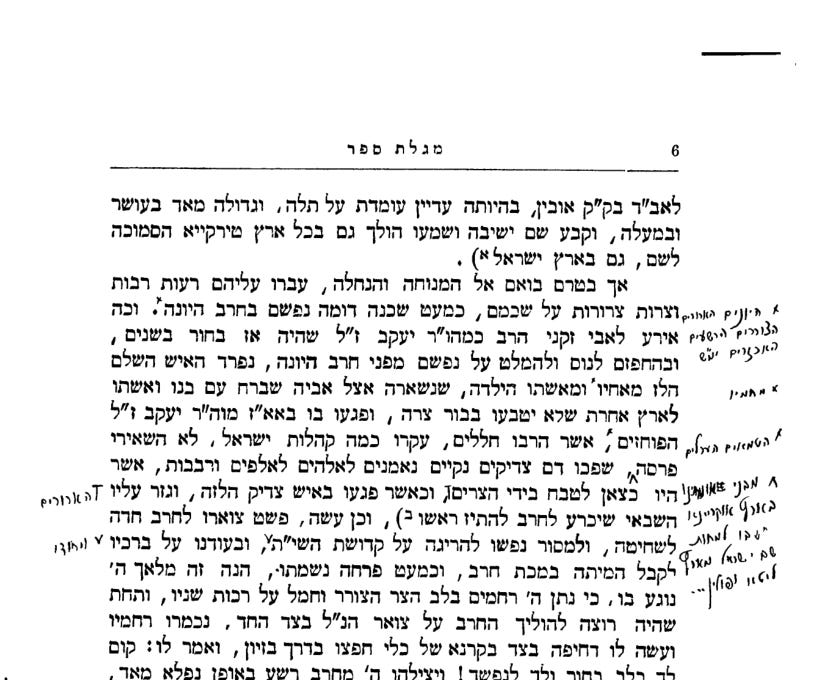
So Kahana’s edition has a layer of censorship, mostly of harsh language about non-Jews and about Emden’s enemies. I have not seen this described in the literature I read on the editions. In the reader, Scholem’s words appear in their place, in a coloured box, and are not merged into Kahana’s text.
Screenshot of the reader, p. 6, with Scholem’s restorations highlighted:
How it is made
The Hebrew was read from the scan by an open-source OCR program for historical documents, using a recent model that reads printed Hebrew well: one to three real errors on a page of about 400 words. I then checked every page against the scan, corrected the errors, and separated Kahana’s footnotes from the text. Scholem’s notes needed reading by eye, page by page. The English translation was written by Claude, in the same session, from the checked Hebrew.
Screenshot of the reader, p. 14, “of gentile wine” and “oven”:
Appendix - Technical
Source. Kahana, Megilat Sefer (Warsaw, Aḥiasaf, 1896/97), HebrewBooks no. 37017, 254 pages, 2721×4276 bilevel images. Scan page = book page + 8 to + 24 (blank and inserted pages shift the offset). The HebrewBooks text layer was not usable (ס/ם confusions, broken word order).
OCR. Kraken 7.1.1 with the PP-OCRv6 (medium) multilingual model (B. Kiessling, Inria; Zenodo 21788410; Apache-2.0), pages rendered at 600 dpi. Two medieval Hebrew manuscript models (BiblIA, Italian) were tested and were worse: they dropped punctuation and gershayim. 17 pages took 19 minutes on a laptop CPU with three workers. Output is in visual order and is reversed per line. Running heads, page numbers and Scholem’s pen marks are removed by hand; 200 corrections over 102 pages are recorded in data/fixes.json.
Second reader. The Pninim project’s GitLab text of Bick’s edition (GFDL license), aligned word by word with difflib, ignoring ו/י spelling and abbreviation expansions. Agreement is 73–91% of words per batch; most differences are Pninim modernising spelling or writing out abbreviations, so it flags places to check but does not decide them.
Scholem’s marks. Logged per page in data/scholem/notes_*.tsv: printed anchor, kind of mark, reading, certainty. Margin crops are made from 500 dpi renders.
Translation. By Claude (Opus 5.5) in the Claude Code session, from the checked Hebrew, with Kahana’s notes translated under each page. No API cost; it ran on my Claude plan.
Reader. A static page built by scripts/build_site.py into docs/, served by GitHub Pages: Hebrew and English side by side, Kahana’s footnotes, Scholem’s marks per page, a link to the scan for each page, light and dark themes.
Editions research. Dunner, “Megillat Sefer Translation: A Review”, Seforim Blog (2012); Schacter, “ ‘Megillat Sefer‘ by R. Jacob Emden: A Forgery?”, Ḥakirah 34 (2023).
Compare my “Notes on controversies, polemics and bans in Modern Jewish history“. For Emden’s proto-scientific bent, see these pieces of mine:
“Between Tradition and Critique: R’ Yaakov Emden’s Examination of the Zohar in ‘Mitpachat Sefarim’ “, final part: Pt2
“Some Proto-Scientific Jewish scholars, from Pre-Late Modern Period”
Unrelated, note additional recent projects of mine, that I plan to write about and continue developing:
All nine sections are now online, through p. 218, from Emden’s ancestors to Kahana’s continuation to his death. The English is still an unreviewed draft.
The code and data are on GitHub: https://github.com/EzraBrand/emden-megillat-sefer
For more on this manuscript, see at my Github:
The Oxford manuscript: shelfmark and access (21-Nov-2026)
Shelfmark given in the literature: Bodleian MS. Mich. 587 (Michael collection, bought 1848), e.g. “fols. 163b-165a” for the introduction (Fordham Early Modern Workshop source, https://research.library.fordham.edu/emw/emw2011/emw2011/8/). Neubauer’s catalogue number 1723:2 is presumably the same manuscript (not checked against Neubauer). A copy, not Emden’s autograph; the autograph is lost.
Not online as far as I can find: Digital Bodleian has only 13 Michael manuscripts digitized, and 587 is not one of them; the Bodleian Hebrew catalogue online (hebrew.bodleian.ox.ac.uk) has no record for it.
Ktiv (checked 21-Nov-2026): Ms. Mich. 587 = Neubauer 1723, IMHM film F 17754, “not scanned”. The same volume also holds Vital’s Mevo She’arim (c. 1675) and a collection (17th-18th c.). So the manuscript is not online anywhere.
I subsequently discovered a scan of the same copy at NLI, see at my Github:
NLI scan of the same copy, and the key sheet (21-Nov-2026):
NLI Rosetta IE12757688 (https://rosetta.nli.org.il/delivery/DeliveryManagerServlet?dps_pid=IE12757688): 258 images, colour, full margins. Same copy as HebrewBooks 37017: the owner’s screenshots show the same margin notes on p. 6 and the typed insert after p. 8. HebrewBooks has 254 pages and crops the right margin.
Key sheet (in the NLI scan, not in HebrewBooks), my reading:
…ר הספר (…) תקי”ז–תקי”ט
(first word cut off; perhaps a date of composition 1757–59)
הגירסאות שבשוליים לפי כ”י אוקספורד
הסימן V פירושו השמטה
X פירושו החלפה
הושוה עם כ”י ע”י חיים וירשובסקי
So: margin readings = Oxford MS; V = omission (addition to the print); X = substitution; collated by Ḥayyim Wirszubski. The site now says this, with a note that the reading of the sheet is not certain in every word.
The handwritten sheet at scan 72 looks like the same hand as the key sheet (not checked further); NOTES above call it “Scholem’s hand”, which is probably wrong.
yasher koach! one note: you (or a silicon collaborator) write that “Kahana was known to have softened at least one passage: the manuscript says that the Ḥakham Tzvi read secular books “in the privy”, and Kahana printed “in his free hours”.” — this is obv. inaccurate; nobody has a problem with the chacham zvi reading in the bathroom. this is rather kahana adjusting the text so the CZ looks like he was more enthusiastic about secular reading than the original indicates.