

Abaye repeatedly cites medical guidance he received from his mother.1 The sugya presents concrete neonatal interventions: how to place or improvise a circumcision bandage to avoid tearing the urethra, how to identify and open a concealed anus, how to stimulate nursing, urination, bowel movements, and breathing, and how to assess infant size and vitality using the placenta.
The sugya draws a clear link between circumcision and the infant’s blood condition. A red infant indicates unabsorbed blood; a pale or green infant indicates insufficient blood. In both cases, the circumcision procedure must be delayed until the body stabilizes. Circumcision is treated as dangerous if performed prematurely.
A baraita recounts two parallel cases reported by R’ Natan. In each, a woman lost two sons after circumcision and feared for the third. R’ Natan inspects the child’s color (red in one case, pale in the other), infers blood instability, and instructs delay. In both cases, the child survives once circumcision is postponed, and is named after him.
Medical fact-check of the practical claims in the Talmud, based current medical knowledge
The sugya presupposes that infant mortality from circumcision is a known risk and that visual inspection of the body reliably indicates internal physiological states. Medical knowledge is presented as experiential, domestic, and cumulative, rather than theoretical or textual. The narrative material functions to ratify the practical rules attributed to Abaye’s mother.
Medical fact-check of the practical claims in the Talmud, based current medical knowledge:
Circumcision wound-care principle: The sugya’s concern about materials sticking to the circumcision site and causing damage broadly matches modern aftercare concerns (modern solutions: petroleum jelly + gauze; avoid constrictive dressings)
Several “hands-on interventions” (opening an anus, shaking to urinate, placenta for apnea) are not helpful, and much of it is actively dangerous.
The recurring-deaths-after-circumcision motif fits modern bleeding-disorder risk (notably hemophilia; modern practice is evaluation/prophylaxis planning rather than judging readiness by color.)
Outline
Intro
Medical fact-check of the practical claims in the Talmud, based current medical knowledge
The Passage - Neonatal Care and Conditional Circumcision: Medical Observation, Harm Prevention, and Maternal Expertise (Shabbat 134a)
Abaye citing his mother - Bandage (pouch) for a circumcised infant; Practical Guidance: place it with threads facing downward to avoid adhesion to the wound
Abaye - Case: Infant without a pouch; Practical Guidance: Use a worn garment with a hem; wrap hem downward and fold garment upward
Abaye’s mother - Case: Infant with obscured anus; Practical Guidance: Rub with oil and hold before daylight
... Where the area appears translucent, Tear gently with a barley-grain widthwise and lengthwise; avoid metal tools so as to avoid infection and swelling
Abaye’s mother - Case: Infant refusing to nurse
Practical Guidance: Warm the mouth by holding a cup of coals nearby
Abaye’s mother - Case: Infant not urinating; Practical Guidance: Place the baby in a sieve and gently shake
Abaye’s mother - Case: Infant not breathing; Practical Guidance: Place the mother’s placenta on the infant
Abaye’s mother - Case: Infant too small or too large; Practical Guidance: Rub with placenta: from narrow to wide end if too small; reverse if too large
Abaye’s mother - Case: Infant red in color; Practical Guidance: Delay circumcision until blood is absorbed
Case: Infant red in color; Practical Guidance: Delay circumcision until blood is absorbed
Case: Infant pale in color; Practical Guidance: Delay circumcision until blood enters
R’ Natan - Anecdote: Woman whose first two sons died after circumcision
Third son red; Practical Guidance: Instructed to wait until blood was absorbed before circumcision; Child lived; named after R. Natan
R’ Natan - Anecdote: Similar case in Cappadocia
Third son pale; Practical Guidance: Diagnosed blood deficiency; instructed to wait until blood entered; Child lived; named after R. Natan
The Passage
1 - Abaye citing his mother - Bandage (pouch) for a circumcised infant; Practical Guidance: place it with threads facing downward to avoid adhesion to the wound
אין עושין לה חלוק כו׳.
אמר אביי:
אמרה לי אם:
האי חלוק דינוקא,
לפכיה לסיטריה לעילאי,
דילמא מידביק גרדא מיניה,
ואתי לידי כרות שפכה.
אימיה דאביי עבדא כיסתא לפלגא.
We learned in the Mishnah: And on Shabbat one may not make a pouch (חלוק) to place over the circumcision as a bandage ab initio.
Abaye said:
My mother, actually his foster mother who was the nursemaid who raised him, told me:
With regard to that pouch, placed as a bandage over the circumcision of a baby,
let one place it on the upper side with the threads below,
lest a thread (גרדא) from it stick to the place of circumcision
and cause the baby to become one with a severed penis2
The Talmud relates that Abaye’s mother would make a pouch (כיסתא) that covered half the place of circumcision so that it would not be damaged through contact with the threads emerging from the edge of the pouch.
2 - Abaye - Case: Infant without a pouch; Practical Guidance: Use a worn garment with a hem; wrap hem downward and fold garment upward
אמר אביי:
האי ינוקא דלית ליה חלוק —
לייתי בליתא דאית ליה שיפתא,
וליכרכיה לשיפתא לתתאי,
ועייף ליה לעילאי.
Abaye said:
If this baby does not have a pouch to put on the place of the circumcision --
let one bring a worn-out (בליתא) garment with a hem (שיפתא),
and wrap the hem under,
and fold the garment over,
so that the threads from the worn-out garment will not adhere to the wound.
3 - Abaye’s mother - Case: Infant with obscured anus; Practical Guidance: Rub with oil and hold before daylight
ואמר אביי,
אמרה לי אם:
האי ינוקא דלא ידיע מפקתיה,
לשייפיה מישחא
ולוקמיה להדי יומא,
And Abaye also said:
My mother told me:
In the case of a baby the location of whose exit (מפקתיה), i.e., anus, is unknown, as it is obscured by skin,
let one rub it with oil
and stand it before the light of the day.
... Where the area appears translucent, Tear gently with a barley-grain widthwise and lengthwise; avoid metal tools so as to avoid infection and swelling
והיכא דזיג —
ליקרעיה בשערתא שתי וערב.
אבל בכלי מתכות — לא,
משום דזריף.
And where it appears transparent (זיג),
let one tear it with a barley grain widthwise and lengthwise.3
However, one should not tear it with a metal implement
because it causes infection and swelling4
4 - Abaye’s mother - Case: Infant refusing to nurse
ואמר אביי,
אמרה לי אם:
האי ינוקא דלא מייץ,
מיקר [הוא] דקר פומיה.
And Abaye said that
my mother told me:
If a baby refuses to nurse,5
that is because its mouth is cold and it is unable to nurse.
Practical Guidance: Warm the mouth by holding a cup of coals nearby
מאי תקנתיה?
ליתו כסא גומרי,
ולינקטיה ליה להדי פומיה,
דחיים פומיה
ומייץ.
What is his remedy?
They should bring a cup of coals
and place it near his mouth,
so that his mouth will warm
and he will nurse
5 - Abaye’s mother - Case: Infant not urinating; Practical Guidance: Place the baby in a sieve and gently shake
ואמר אביי,
אמרה לי אם:
האי ינוקא דלא מנשתים —
לינפפיה בנפוותא
ומנשתים.
And Abaye said that
my mother told me:
A baby that does not urinate (מנשתים) --
let one place him in a sieve (נפוותא) and shake him,
and he will urinate.
6 - Abaye’s mother - Case: Infant not breathing; Practical Guidance: Place the mother’s placenta on the infant
ואמר אביי,
אמרה לי אם:
האי ינוקא דלא מעוי —
ליתו סילתא דאימיה
ולישרקיה עילויה,
ומעוי.
And Abaye said:
My mother told me:
If a baby is not breathing6 --
let them bring his mother’s placenta (סילתא)
and smear (לישרקיה) the placenta on him,
and the baby will breathe.
7 - Abaye’s mother - Case: Infant too small or too large; Practical Guidance: Rub with placenta: from narrow to wide end if too small; reverse if too large
ואמר אביי,
אמרה לי אם:
האי ינוקא דקטין --
לייתו לסילתא דאימיה,
ולישרקיה עילויה מקוטנא לאולמא.
ואי אלים —
מאולמא לקוטנא.
And Abaye said that
my mother told me:
If a baby is too small --
let them bring his mother’s placenta
and rub the baby with it from the narrow end to the wide (אולמא) end of the placenta.
And if the baby is strong,7 i.e., too large --
let them rub the baby from the wide end of the placenta to the narrow end.
8 - Abaye’s mother - Case: Infant red or pale in color
Case: Infant red in color; Practical Guidance: Delay circumcision until blood is absorbed
ואמר אביי,
אמרה לי אם:
האי ינוקא דסומק —
דאכתי לא איבלע ביה דמיה
ליתרחו ליה עד דמיבלע ביה דמיה,
ולימהלוה.
And Abaye said that
my mother told me:
If a baby is red --
that is because the blood has not yet been absorbed in him.
In that case, let them wait until his blood is absorbed
and then circumcise him.
Case: Infant pale in color; Practical Guidance: Delay circumcision until blood enters
דירוק,
דאכתי לא נפל ביה דמיה —
ליתרחו עד דנפל ביה דמיה,
ולימהלוה.
Likewise, if a baby is pale8
that is because his blood has not yet entered him,
let them wait until his blood enters him
and then circumcise him.
R’ Natan - Anecdote: Woman whose first two sons died after circumcision
(See footnote.)9
דתניא,
אמר רבי נתן:
פעם אחת
הלכתי לכרכי הים,
ובאת אשה אחת לפני ש
מלה בנה ראשון
ומת,
שני
ומת,
שלישי,
הביאתו לפני,
As it was taught in a baraita,
R’ Natan said:
On one occasion,
I went to the coastal cities,10
and one woman came before me who
circumcised her 1st son
and he died,
and she circumcised her 2nd son
and he died,
and since she feared circumcising the 3rd due to concern that he might die as well,
she brought him before me.
Third son red; Practical Guidance: Instructed to wait until blood was absorbed before circumcision; Child lived; named after R. Natan
ראיתיו שהוא אדום.
אמרתי לה: המתיני לו עד שיבלע בו דמו,
המתינה לו עד שנבלע בו דמו,
ומלה אותו
וחיה,
והיו קורין אותו ״נתן הבבלי״
על שמי.
I saw that he (=the baby) was red.
I said to her: Wait until his blood is absorbed into him.
She waited until his blood was absorbed into him
and then circumcised him,
and he lived.
And they would call him “Natan the Babylonian”, after my name.
R’ Natan - Anecdote: Similar case in Cappadocia
שוב פעם אחת הלכתי למדינת קפוטקיא,
ובאת אשה אחת לפני ש
מלה בנה ראשון
ומת,
שני
ומת,
שלישי
הביאתו לפני,
R’ Natan further related: On another occasion I went to the state of Cappadocia,
and a woman came before me who
circumcised her 1st son
and he died,
and she circumcised her 2nd son
and he died.
Since she feared circumcising the 3rd due to concern that he might die as well,
she brought him before me.
Third son pale; Practical Guidance: Diagnosed blood deficiency; instructed to wait until blood entered; Child lived; named after R. Natan
ראיתיו שהוא ירוק.
הצצתי בו
ולא ראיתי בו דם ברית.
אמרתי לה: המתיני לו עד שיפול בו דמו,
והמתינה לו ומלה אותו
וחיה,
והיו קורין שמו ״נתן הבבלי״ על שמי.
I saw that he was pale.
I looked (הצצתי) at him
and I could not see in him the blood of the covenant (ברית), i.e., he had a blood deficiency.
I said to her: Wait until blood enters him.
And she waited and then circumcised him,
and he lived.
And they would call his name “Natan the Babylonian”, after my name.
Traditionally understood to in fact refer to his nursemaid, who he referred to as “my mother”.
Note Abaye’s recurring introductory phrase:
Abaye said:
[my] mother said to me (אמרה לי אם):
this baby (האי ינוקא) […]
This introductory phrase appears seven times in this sugya; see screenshot of “ctrl + F” of that phrase in this sugya in Sefaria:
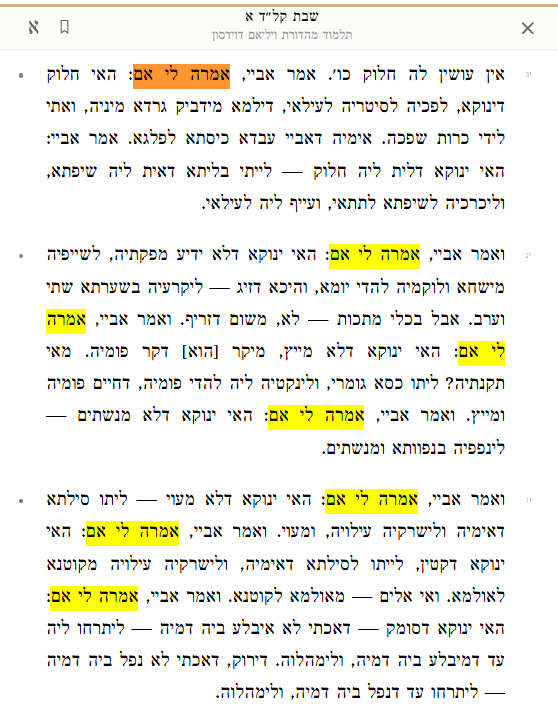
This citation chain (Abaye citing his mother) also appears elsewhere in the Talmud another ~15 times, generally in the context of medical advice, see search results here.
Compare this same expression used elsewhere in the Talmud, Sanhedrin.21a.22:
״וישנאה אמנון שנאה גדולה מאד״.
מאי טעמא?
אמר רבי יצחק:
נימא נקשרה לו
ועשאתו כרות שפכה.
At the end of the story, the verse states: “Then Amnon hated her with exceeding, great hatred, for greater was the hatred with which he hated her than the love with which he had loved her” (II Samuel 13:15).
The Talmud asks: What is the reason for Amnon’s intense hatred?
R’ Yitzḥak says:
While he (=Amnon) raped her (=Tamar), a hair [nima] of hers became tied around his penis
and caused him to be one whose penis has been severed (כרות שפכה)
The expression originates in a biblical verse, see Deuteronomy 23:2:
לא יבא
פצוע דכא
וכרות שפכה
בקהל יהוה
No man shall be admitted
whose testes are crushed (פצוע דכא)
or whose member is cut off (כרות שפכה)
into the congregation of YHWH.
זריף.
On this word, see Jastrow (modernized):
זְרַף
, Pa. זָרֵיף (compare זרב)
to form a rim or elevation around a wound (compare כָּתִית, סַפַּחַת), to cause a swelling and inflammation.
Avodah Zarah 28b:8 מִיזְרַף זָרֵיף - “the operation with the hand creates soreness”
Yevamot 76a:7 פרזלא מז׳ ז׳ - “cutting with an iron tool causes inflammation”
מייץ - literally: “squeeze”, i.e. suckle.
On this word, see Jastrow (modernized):
מוּץ
(compare מצץ) to suck.
Part. מָיֵיץ.
Shabbat 134a:13 האי ינוקא דלא מ׳ - “an infant that does not suck”
Shabbat 133b:14 אומנא דלא מ׳ - “a surgeon (circumciser) that fails to suck the blood out of the wound”
Avodah Zarah 32a:2 ומָיְיצֵי להו וכ׳ - “and they (the earthen vessels) resorb the wine” (Manuscript Munich: עד דמצי וכ׳, see מְצֵי).
מעוי - literally: “cry”.
On this word, see Jastrow (modernized):
עֲוֵי II
, Pa. עַוֵּי (compare צָוַח) to cry;
Yoma 77a:8 ע׳ ע׳ וליכא דאשגח ביה (missing in later eds.; see Rabbinowicz, ‘Dikdukei Sofrim’ there,) - “he cried and cried, and none minded him”
Yevamot 71b:9 היכא דלא מְעַוֵּי - “if the infant (on putting its head forth the first time) did not cry.”
Shabbat 134a:14 האי ינוקא דלא מעוי - “if an infant does not cry (breathe)”
Sotah 12a:19 כי היכי … ומעוי בהדייהו - “in order that it should hear them and cry with them”
and elsewhere.
Chullin 53a:16 איהו קא מְעַוַּאי - “when he (the lion) roars”
On the example from Sotah 12a, see my “Pharaoh’s Decrees and Amram’s Response: Talmudic Interpretations of Exodus 1:16-2:3 (Sotah 12a)“, section “The Three-Month Hiding Period; Egyptian Methods of Detection (Exodus 2:3, Song of Songs 2:15)“, where I summarize:
The verse states that [Yocheved] could no longer hide [Moses]. The Talmud questions why not.
It explains that the Egyptians used the following method to uncover hidden infants: they would bring another baby near the suspected location, causing it to cry, which in turn would make the hidden baby cry as well.
And see my note there.
אלים.
Note that this word typically means “violent”.
ירוק - literally: “green/yellow”.
On this word, see Jastrow (modernized):
יָרוֹק
light-colored, yellow or greenish.
Mishnah Eduyot 5:6 דם הירוק
Mishnah Niddah 2:6 הירוק - “the greenish secretion (menstruation)”
Niddah 19b:15 כתם ירוק וכ׳ - “a greenish stain on the garment”
and frequently.
Mishnah Sukkah 3:6 הירוק ככרתי - “an Ethrog green like leek”
Plural: יְרוֹקִים green colors.
and elsewhere
see יְרַקְרַק.
Fem. יְרוֹקָה.
Bamidbar Rabbah 9 מאדמת עושין אותה י׳ - “if she was of a ruddy complexion, the test waters make her pale”
יָרוֹק ²
same.
and frequently.
Onkelos Leviticus 13:49 (h. text ירקרק).
Chullin 62a:6 בדירוק׳ כרסה - “as regards the bird whose belly is green”
Pesachim 30b:9 בין חיורא בין אוכמא ובין י׳ Manuscript Munich: (ed. יורקי) - “whether white, dark or green (glazed)”
Literary and structural analysis of the following two anecdotes of R’ Natan, in the baraita:
Paired anecdotal structure: Two near-identical narratives presented back-to-back (“a story [ma’aseh]… and another story”).
Triptych pattern in each story:
(1) Failed precedent — two earlier sons circumcised and died, third one brought to R’ Natan for advice.
(2) Diagnosis — R’ Natan observes the infant’s physical state.
(3) Prescriptive delay → success — postponement of circumcision leads to survival and naming.Controlled variation: The stories differ only in the diagnostic sign and rationale (“red” vs. “green”; excess blood vs. absence of blood).
Authority through observation: Rabbi Natan’s legitimacy rests not on citation or prooftext but on close visual inspection and practical judgment. The verb choices emphasize seeing and discerning.
Naming as closure: Both conclude with the child named after Rabbi Natan. This provides symmetry, marks communal validation, and converts successful intervention into lasting memorial.
Geographic doubling: Different (foreign) locales (“cities of the sea” and “Cappadocia”; see also next footnote) underscore portability of rabbinic expertise while maintaining narrative sameness.
כרכי הים.
On this term, see my note in “A Sequence of Eleven Stories of Talmudic Rabbis as Empirical Linguists (Rosh Hashanah 26a-b)“, on section “Kira = “sale” (observed in the speech of ‘Sea Towns’) - R’ Yehuda Hanasi (Genesis 50:5)“.