

This is the first part of a three-part series. The outline of the series is below.
The sugya begins with the Mishnah’s concise map of the cities of refuge and then opens into an extended discussion: geography and roads, judicial procedure and crowd control, scriptural exegesis and moral causality, and finally a set of programmatic claims about Torah as a sustaining practice.
See Wikipedia, “Cities of Refuge”:
The cities of refuge (Hebrew: ערי המקלט ‘ārê ha-miqlāṭ) were six Levitical towns in the Kingdom of Israel and the Kingdom of Judah in which the perpetrators of accidental manslaughter could claim the right of asylum.
[…T]almudic literature expands the city of refuge count to all 48 Levitical cities
Outside of these cities, blood vengeance against such perpetrators was allowed by law.
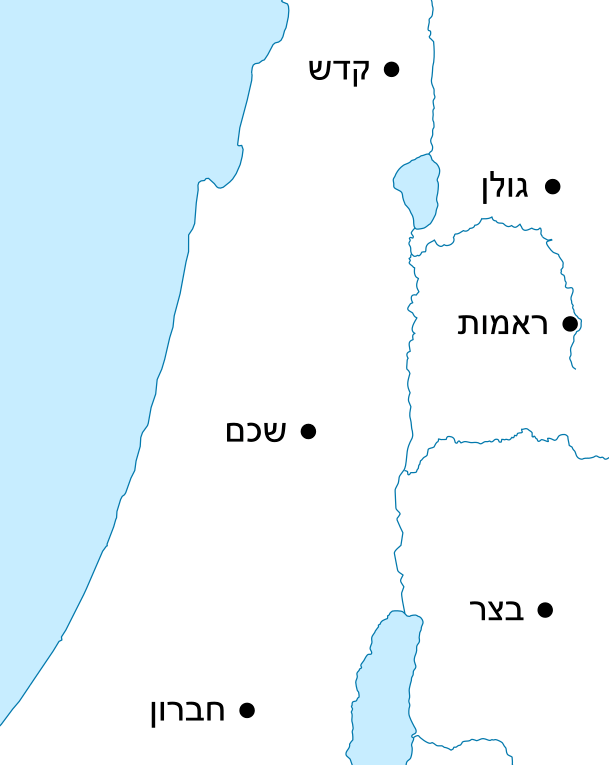
The Bible names the six cities of refuge as follows: Golan, Ramoth, and Bezer (בצר) to the east (left bank) of the Jordan River [=Transjordan region]; and Kedesh, Shechem, and Hebron on the western (right) side.
In the Book of Numbers, the laws concerning the cities of refuge state that, once he had claimed asylum, a perpetrator had to be taken from the city and put on trial; if the trial found that the perpetrator was innocent of murder, then the perpetrator had to be returned under guard (for their own protection) to the city in which they had claimed asylum.
This law code treats blood money as an unacceptable device that would compound the crime, insisting that atonement can only be made by the murderer’s blood.
Numbers states that no harm was allowed to come to the perpetrator once the Jewish high priest had died, at which point the perpetrator was free to leave the city without fear.
In the setting of the Book of Deuteronomy, the Israelites have conquered several kingdoms on the east side of the Jordan river, and are about to enter the land of Canaan. At this point, Moses separated three cities of refuge on the east side.
Later on, it is prescribed that three cities of refuge be set aside in Canaan once it is conquered, with three additional cities to be set aside “if YHWH your God enlarges your territory”.
See map of the biblical 6 cities of refuge (from Wikimedia Commons):

Numbers 35 verses 6, 13-14, 24-25:
Numbers 35 verses 6-7, 13-14, 24-25:
verses 6-7:
ואת הערים אשר תתנו ללוים
את שש ערי המקלט אשר תתנו לנס שמה הרצח
ועליהם תתנו ארבעים ושתים עיר
כל הערים אשר תתנו ללוים ארבעים ושמנה עיר
אתהן ואת מגרשיהן
The towns that you assign to the Levites
shall comprise the 6 cities of refuge that you are to designate for a murderer1 to flee to,
to which you shall add 42 towns.
[Thus,] the total of the towns that you assign to the Levites shall be 48 towns,
with their pasture.
13-14:
והערים אשר תתנו שש ערי מקלט תהיינה לכם
את שלש הערים תתנו מעבר לירדן
ואת שלש הערים תתנו בארץ כנען
ערי מקלט תהיינה
The towns that you [thus] assign shall be 6 cities of refuge in all.
3 cities shall be designated beyond the Jordan,
and the other 3 shall be designated in the land of Canaan
they shall serve as cities of refuge.
24-25:
ושפטו העדה בין המכה ובין גאל הדם על המשפטים האלה
והצילו העדה את הרצח מיד גאל הדם
והשיבו אתו העדה אל עיר מקלטו אשר נס שמה
וישב בה עד מות הכהן הגדל אשר משח אתו בשמן הקדש
in such cases, the assembly shall decide between the slayer and the blood-avenger.2
The assembly shall protect the murderer from the blood-avenger,
and the assembly shall restore him [=the murderer] to the same city of refuge,
and there he shall remain until the death of the high priest who was anointed with the sacred oil.
Deuteronomy 4:41-43
Deuteronomy 4:41-43:
אז יבדיל משה שלש ערים בעבר הירדן מזרחה שמש
לנס שמה רוצח
אשר ירצח את רעהו בבלי דעת
והוא לא שנא לו מתמל שלשם
ונס אל אחת מן הערים האל וחי
Then Moses set aside 3 cities on the east side of the Jordan
to which a murderer could escape,
one who unwittingly murdered another person
without having been an enemy in the past;
that person could flee to one of these cities and live:
את בצר
במדבר בארץ המישר
לראובני
ואת ראמת,
בגלעד
לגדי
ואת גולן,
בבשן
למנשי
Bezer,
in the wilderness in the Flatland,
belonging to the Reubenites;
Ramoth,
in Gilead,
belonging to the Gadites;
and Golan,
in Bashan,
belonging to the Manassites.
Mishnah
The Mishnah states that there are 6 cities of refuge, 3 east of the Jordan [=Transjordan region] and 3 in Canaan (Num 35:14). They function only as a system: until all 6 are designated, none “admit” the fugitive (Num 35:13). Accessibility is engineered—roads are prepared and straightened (Deut 19:3)—and two Torah scholars escort the manslayer to deter a “blood redeemer”. R’ Meir pushes the agency further: the fugitive himself may speak to persuade the pursuer (Deut 19:4). R’ Yosei b. Yehuda sketches procedure: both intentional and unintentional killers initially flee; the court retrieves, tries, executes or frees, or returns the exiled to his city (Num 35:24–25).
Talmud
A baraita attributes the 3+3 split to Moses (east of Jordan) and Joshua (Canaan), then geographically aligns the pairs “like two vineyard rows”: Hebron ↔ Bezer (בצר), Shechem ↔ Ramoth, Kadesh ↔ Golan (see the map earlier). Deut 19:3’s “ve-shilashta” yields a spacing rule: the land is quartered by equal intervals—south border–Hebron = Hebron–Shechem = Shechem–Kadesh = Kadesh–north border. The design is meant to minimize travel time.
Part 2
Abaye then faces the allocation problem (why 3 east for fewer tribes?): Gilead (=northern Transjordan) “has many murderers” (Hos 6:8, “akuba mi-dam”). He extends the murder hotspot logic to Shechem via Hos 6:9 (“ḥever kohanim”), reading local homicide profiles off prophetic invective.
The sugya acknowledges 42 additional Levite towns (Num 35:6). Abaye resolves: the 6 “admit” whether entry is intentional or not; the 42 protect only if one knowingly enters. Two textual knots follow. Hebron: if Caleb “received” it, how can it be a refuge city? Answer: Caleb received the fields/suburbs; the urban core remained a priestly/Levite city (Josh 21:11–12; Judg 1:20). Kadesh: listed among fortified cities—yet refuge towns must be mid-sized. Solution 1: there were two Kadeshes. Solution 2 (Rav Ashi): a paired town-and-fortress configuration.
A foundational baraita sets refuge-city standards: medium size (neither small (“tirin”) nor large (“kerakhin”)), water on-site or piped in, active markets, and robust population. If population dips, the state boosts it—importing residents, even seeding with priests, Levites, and Israelites. R’ Neḥemya forbids selling weapons and hunting gear inside; the Rabbis permit sales but agree to remove lures for redeemers (no nets or rope-braiding inside). R’ Yitzḥak’s prooftext (Deut 4:42) reframes the project: do what it takes so the manslayer can actually live there. Refuge is not a sign; it’s urban policy.
The piece then turns to Torah as life-sustaining. If a student is exiled, his teacher goes; if a teacher is exiled, his academy relocates. R’ Yoḥanan adds a striking claim: Torah “provides refuge”—construed narrowly as protection while actively studying (even from the Angel of Death, in the Rav Ḥisda anecdote).
Part 3
Two short homiletical arcs frame Moses and study-at-scale. R’ Simlai reads Deut 4:41 as God telling Moses to “shine the sun” for killers—designate now, even if not yet operative. Linked to Eccl 5:9, Moses “loves mitzvot” and enacts partial progress. The same verse supports pro-public learning: who “loves the many” gets “increase”—rendered as scholarly children, accelerated learning, or both. The sugya polemicizes against solitary study (Jer 50:36; Num 12:11; Isa 19:13) and praises collective work. R’ Yehuda HaNasi’s ladder of learning—from teachers, more from peers, most from students—functions as the intellectual complement to the physical ladder in Reish Lakish’s providence parable.
That scenario is as follows (Exod 21:13 with 1 Sam 24:13): an unwitnessed murderer and an unwitnessed manslayer are maneuvered into a single accident; one dies (just deserts), one is exiled (also just). A companion maxim says: “Along the path a person wants to go, he is led” (Num 22; Isa 48:17; Prov 3:34). Together they articulate constrained providence: human choice sets direction; circumstances supply consequence.
Finally, R’ Yehoshua b. Levi reads national security as an outcome of study “in your gates” (Ps 122:2) and contrasts David’s day of Torah with Solomon’s 1,000 offerings (Ps 84:11; 1 Kgs 3:4).
Thus, major themes in this sugya are that justice requires engineered access; survival requires cultural investment; Torah study—public, continuous, and institutionally supported—keeps both running.
Outline
Intro
Numbers 35 verses 6, 13-14, 24-25
Deuteronomy 4:41-43
The Passage - Cities of Refuge: Geography, Access, Legal Procedure, and Theological Reflections (Makkot 9b-10b)
Mishnah
Six cities of refuge: 3 east of the Jordan, 3 in Canaan
Prooftext - Num 35:14
The cities function as cities of refuge only once all 6 are active
Prooftext - Num 35:13
Roads were prepared and aligned for access to the cities - Deut 19:3
Court assigns two Torah scholars to escort the fugitive to prevent the blood redeemer
R’ Meir - The fugitive himself may speak to dissuade the blood redeemer - Deut 19:4
R’ Yosei b. Yehuda - Both intentional and unintentional killers initially flee
… court brings him back and tries him
… and executes or frees
… or returns him to exile, as appropriate - Num 35:24–25
Talmud
Baraita - Moses set 3 cities east of the Jordan; Joshua set 3 in Canaan
The city pairs were geographically aligned
Tripartite geographic spacing of cities of refuge—equal intervals from south border to Hebron, Hebron–Shechem, Shechem–Kedesh, Kedesh to north border - Deut 19:3
Part 2
Abaye - 3 cities east of Jordan despite fewer tribes: Gilead had many murderers
Prooftext - Hos 6:8; R’ Elazar - “Akuba mi-dam” = they lay ambush to kill
Abaye - Shechem also had many murderers
Prooftext - Hos 6:9; R’ Elazar - “Ḥever kohanim” = people banded together to kill, like priests banding to divide teruma
Abaye - The 6 cities admit fugitives whether they entered knowingly or unknowingly; the 42 Levite cities protect only if entered knowingly - Num 35:6
Abaye - Caleb received Hebron’s fields/suburbs, but the city itself was a Levite/priestly city of refuge - Josh 21:11–12; Judg 1:20
Kadesh listed among fortified cities- Joshua 19:35–37
Baraita - refuge towns must be mid-sized
Rav Yosef - Two cities named Kedesh; the fortified one is distinct from the city of refuge
Rav Ashi - Like “Selikum” and its fortress, so Kedesh had a fortress alongside the refuge town
Baraita - Cities of refuge must be mid-sized, with water, markets, and population; bolster population if needed
R’ Yitzḥak - prooftext - do what it takes so the manslayer can actually live there - Deut 4:42
Baraita - If a student is exiled, his teacher is exiled with him (to sustain Torah study) - Deut 4:42
R’ Zeira - Do not teach an unfit student (so as not to be forced into exile)
R’ Yoḥanan - If a teacher is exiled, his academy relocates with him
R’ Yoḥanan - Torah “provides refuge” - Deut 4:43–44
Interpretation of R’ Yohanan’s statement: protection only while actively studying
Alternative interpretation of R’ Yohanan’s statement: Torah study protects from the Angel of Death
Anecdote of Rav Ḥisda and the Angel of Death
R’ Tanḥum bar Ḥanilai - Reuben is listed first in “rescue” because he began rescuing Joseph - Gen 37:21; Deut 4:43
Part 3
R’ Simlai - God told Moses to “shine the sun” for murderers—designate cities now - Deut 4:41
R’ Simai - Eccl 5:9
“He who loves silver” = Moses loved mitzvot and designated cities even before they functioned
“Nor he who loves abundance with increase,” = For whom is it fitting to teach an abundance of people? One for whom all its increase belongs to him
R’ Elazar - only one who can proclaim all of God’s praise should speak publicly - Ps 106:2
Rabbis / Rabba bar Mari - whoever loves those who teach the many merits “increase” (scholarly sons) - Eccl 5:9
Example of this: Rava, son of Rabba
Rav Ashi - “Loves to study among many” yields increase
R’ Yosei b. Ḥanina - Studying alone is condemned - Jer 50:36; Num 12:11; Isa 19:13
Ravina - “Loves to teach among many” yields increase; learning grows most from students - Eccl 5:9
R’ Yehuda HaNasi - “Much Torah have I studied from my teachers, and I have learned more from my colleagues than from them, and I have learned more from my students than from all of them”
R’ Yehoshua b. Levi - Military success came from Torah at Jerusalem’s gates - Ps 122:2
R’ Yehoshua b. Levi - David rejoiced though he wouldn’t build the Temple - Ps 122:1; Ps 84:11; 1 Kgs 3:4
God prefers a day of David’s Torah to Solomon’s 1,000 animal sacrifices
R’ Eliezer ben Ya’akov - “Miklat” signposted at crossroads to guide fugitives - Deut 19:3
Rav Kahana - prooftext for signage: “Prepare the road” - Deut 19:3
Rav Ḥama bar Ḥanina - God guides even sinners (hence helping manslayers to refuge), certainly guides the righteous - Ps 25:8
R’ Shimon ben Lakish - “God caused it to come to his hand”: providential pairing of an unwitnessed murderer with unwitnessed manslayer so each receives due (death/exile) - Exod 21:13; 1 Sam 24:13
Rabba bar Rav Huna citing Rav Huna, or Rav Huna citing R’ Elazar - One is led along the path one chooses—proved from Torah, Prophets, and Writings
Prooftexts - Num 22:12, 20; Isa 48:17; Prov 3:34
Appendix - The sugya’s interpretation of biblical verses, by order of verses
The Passage
Mishnah (Makkot 2:4-6)
Mishnah_Makkot.2.4-6 (=Makkot.9b.14-17)
Six cities of refuge: 3 east of the Jordan, 3 in Canaan
להיכן גולין?
לערי מקלט,
לשלש שבעבר הירדן
ולשלש שבארץ כנען
To where are the unintentional murderers exiled?
They are exiled to cities of refuge,
to 3 cities that were in the east bank of the Jordan
and to 3 cities that were in the land of Canaan, i.e., Eretz Yisrael
Prooftext - Num 35:14
שנאמר:
״את שלש הערים תתנו מעבר לירדן
ואת שלש הערים תתנו בארץ כנען וגו׳״
as it is stated:
“3 cities shall you give beyond the Jordan
and 3 cities shall you give in the land of Canaan; they shall be cities of refuge” (Numbers 35:14).
The cities function as cities of refuge only once all 6 are active
עד שלא נבחרו שלש שבארץ ישראל --
לא היו שלש שבעבר הירדן קולטות
The Mishnah comments:
Until the 3 cities of refuge that were in Eretz Yisrael were selected --
an unintentional murderer would not be admitted to the 3 that were in the east bank of the Jordan,
even though the latter 3 were already selected by Moses (see Deuteronomy 4:41),
Prooftext - Num 35:13
שנאמר: ״שש ערי מקלט תהיינה״
עד שיהיו ששתן קולטות כאחת.
as it is stated: “6 cities of refuge shall they be” (Numbers 35:13),
from which it is derived that they do not become cities of refuge until all 6 of them admit unintentional murderers as one.
Roads were prepared and aligned for access to the cities - Deut 19:3
ומכוונות להן דרכים מזו לזו,
שנאמר: ״תכין לך הדרך ושלשת וגו׳״.
The Mishnah continues:
And roads were aligned for them from this city, i.e., all cities, to that city, i.e., they would pave and straighten the access roads to the cities of refuge,
as it is stated: “Prepare for you the road, and divide the borders of your land, which YHWH your God causes you to inherit, into three parts, that every murderer may flee there” (Deuteronomy 19:3).
Court assigns two Torah scholars to escort the fugitive to prevent the blood redeemer
ומוסרין להן שני תלמידי חכמים,
שמא יהרגנו בדרך,
וידברו אליו
And the court would provide the unintentional murderers fleeing to a city of refuge with two Torah scholars,
due to the concern that perhaps the blood redeemer, i.e., a relative of the murder victim seeking to avenge his death, will seek to kill him in transit,
and in that case they, the scholars, will talk to the blood redeemer
and dissuade him from killing the unintentional murderer.
R’ Meir - The fugitive himself may speak to dissuade the blood redeemer - Deut 19:4
רבי מאיר אומר:
אף הוא מדבר על ידי עצמו,
שנאמר: ״וזה דבר הרצח״.
R’ Meir says:
The unintentional murderer also speaks [medabber] on his own behalf to dissuade the blood redeemer,
as it is stated: “And this is the matter [devar] of the murderer, who shall flee there and live” (Deuteronomy 19:4),
indicating that the murderer himself speaks.
R’ Yosei b. Yehuda - Both intentional and unintentional killers initially flee
רבי יוסי בר יהודה אומר:
בתחלה —
אחד שוגג
ואחד מזיד
מקדימין לערי מקלט
R’ Yosei bar Yehuda says:
Initially —
both one who killed another unintentionally
or one who killed another intentionally
hurry and flee to the cities of refuge
… court brings him back and tries him
ובית דין שולחין
ומביאין אותו משם
and the court in his city send for him
and bring him from there to stand trial.
… and executes or frees
מי שנתחייב מיתה בבית דין –
הרגוהו,
ושלא נתחייב מיתה –
פטרוהו
For one who was found liable to receive the death penalty in court for intentional murder,
the court executes him,
and for one who was not found liable to receive the death penalty, e.g., if they deemed that the death occurred due to circumstances beyond his control,
they free him.
… or returns him to exile, as appropriate - Num 35:24–25
מי שנתחייב גלות –
מחזירין אותו למקומו,
שנאמר: ״והשיבו אתו העדה אל עיר מקלטו וגו׳״
For one who is found liable to be exiled --
the court restores him to his place in the city of refuge,
as it is stated: “And the congregation shall judge between the murderer and the blood redeemer…and the congregation shall restore him to his city of refuge, that he fled there” (Numbers 35:24–25),
indicating that he had been in a city of refuge before his trial.
Talmud
Baraita - Moses set 3 cities east of the Jordan; Joshua set 3 in Canaan
תנו רבנן:
שלש ערים הבדיל משה בעבר הירדן
וכנגדן הבדיל יהושע בארץ כנען
A baraita states:
Moses designated 3 cities of refuge in the east bank of the Jordan,
and corresponding to them, Joshua designated 3 cities of refuge in the land of Canaan.
The city pairs were geographically aligned
ומכוונות היו כמין שתי שורות שבכרם:
חברון בהר יהודה
כנגד בצר במדבר,
שכם בהר אפרים
כנגד רמות בגלעד,
קדש בהר נפתלי
כנגד גולן בבשן.
And the cities were aligned like two rows of vines in a vineyard:
In Eretz Yisrael there was Hebron in Mount Judea,
corresponding to Bezer in the wilderness;
Shechem in Mount Ephraim,
corresponding to Ramoth in the Gilead;
and Kadesh in Mount Naphtali,
corresponding to Golan in the Bashan.
Tripartite geographic spacing of cities of refuge—equal intervals from south border to Hebron, Hebron–Shechem, Shechem–Kedesh, Kedesh to north border - Deut 19:3
״ושלשת״ –
שיהו משולשין,
שיהא
מדרום לחברון
כמחברון לשכם,
ומחברון לשכם
כמשכם לקדש,
ומשכם לקדש
כמקדש לצפון.
From the term “And you shall divide [ve-shilashta]” (Deuteronomy 19:3),
it is derived that the 3 cities in Eretz Yisrael will serve as 3 [meshulashin] lines of demarcation dividing the length of the land into four equal parts,
in a manner that
the distance from the southern border of Eretz Yisrael to Hebron, the southernmost city of refuge,
will be like the distance from Hebron to Shechem,
and the distance from Hebron to Shechem
will be like the distance from Shechem to Kadesh,
and the distance from Shechem to Kadesh
will be like the distance from Kadesh to the northern border.
רצח.
The Hebrew term rotze’ah is translated by JPS as “manslayer” throughout this passage, but I think “murderer” is more accurate. The Hebrew itself makes no distinction between intentional and unintentional killing; that nuance is conveyed by context. “Manslayer” imposes a differentiation that isn’t present in the original, whereas “murderer” preserves the term’s broad, unqualified sense.
Steinsaltz consistently translates this term as “blood redeemer” (compare JPS, which translates is as “blood avenger”; Steinsaltz’s translation is the more exact one-to-one translation.)
See Wikipedia, “Goel (Judaism)“:
Goel (Hebrew: גואל, romanized: goʾel, lit. ‘redeemer’), in the Hebrew Bible and rabbinic Judaism, is a person who, as the nearest relative of someone, is charged with the duty of restoring that person’s rights and avenging wrongs done to him or her.
One duty of the goel was to redeem (purchase back) a relative who had been sold into slavery.
Another was to avenge the death of a relative who had been wrongly killed; one carrying out this vengeance was known as the goel ha-dam, commonly translated to English as “avenger of blood.”
And see also Wikipedia, “Feud”, section “Hebrew Law“:
In ancient Hebrew law, it was considered the duty of the individual and family to avenge unlawful bloodshed, on behalf of God and on behalf of the deceased.
The executor of the law of blood-revenge who personally put the initial killer to death was given a special designation: go’el ha-dam, the blood-avenger or blood-redeemer (Book of Numbers 35: 19, etc.).
Six Cities of Refuge were established to provide protection and due process for any unintentional manslayers.
The avenger was forbidden from harming an unintentional killer if the killer took refuge in one of these cities.
On the permissibility for the go’el ha-dam to kill the manslayer, compare the archaic concept of “outlaw”:
An outlaw, in its original and legal meaning, is a person declared as outside the protection of the law.
In pre-modern societies, all legal protection was withdrawn from the criminal, so anyone was legally empowered to persecute or kill them.
Outlawry was thus one of the harshest penalties in the legal system.
In early Germanic law, the death penalty is conspicuously absent, and outlawing is the most extreme punishment, presumably amounting to a death sentence in practice.
The concept is known from Roman law, as the status of homo sacer, and persisted throughout the Middle Ages.
On vigilante justice, see my piece here, section “When Lethal Vigilante Force Is Justified: Halakhic Distinctions in Preventing Sexual and Violent Crimes (Sanhedrin 73a)“.