

This is the first part of a two-part series. The outline of the series is below.
The sugya opens with a halakhic inquiry grounded in the biblical commandment of “covering of the blood” (kisui ha-dam), the obligation to cover the blood of certain animals after slaughter. The verse in question, Leviticus 17:13, frames the obligation in terms of hunting: “who traps a trapping of an undomesticated animal or bird that may be eaten.” The baraita initially reads this language narrowly, deriving the obligation only in cases where the animal or bird was actively hunted. From there, it raises a question: how do we know that the obligation also applies to animals that are effectively already “trapped,” such as domesticated birds like geese and chickens, which do not roam freely?
The answer rests on a rereading of the verse’s language. The term tzayid (“trapping”) is taken not as a descriptive limitation but as a general category, extending the obligation of covering the blood to all relevant cases of slaughter, regardless of whether the animal was captured through active pursuit. At this point, the baraita turns back to the verse and asks why the Torah nonetheless chose the phrasing “who traps.” The response introduces a recurring interpretive move in this sugya: the claim that the Torah is not merely legislating technical requirements but also teaching derekh eretz, normative modes of conduct embedded in legal or narrative formulations.1
A second baraita reinforces this theme through Deuteronomy 12:20, which permits meat consumption upon Israel’s territorial expansion. The verse’s allowance is read not as a blanket endorsement of meat eating, but as conditional and appetite-driven: one should eat meat le-te’avon, when genuinely desired, not as a routine practice. The discussion then tightens further. Even when meat is consumed, the baraita limits its source to one’s own herd rather than the marketplace (grounding consumption in household production rather than commercial availability). It proceeds to exclude the possibility of slaughtering all of one’s livestock at once, interpreting the biblical phrasing “of your cattle” and “of your flock” as implying partial, measured use rather than total depletion.
At this point, the sugya shifts from biblical exegesis to explicit socio-economic guidance. R’ Elazar ben Azaria presents a graduated dietary scale keyed to wealth, ranging from vegetables for those of minimal means, to fish for the moderately affluent, to meat for the wealthy, and daily meat only for those of extreme means. The Talmud then asks how often those not included in the highest tier should eat meat, answering: from one Friday to the next (i.e. once a week, on Friday night, for Shabbat).
Subsequent amoraic statements qualify and contextualize this model. Rav urges adherence to R’ Elazar ben Azaria’s restraint, while R’ Yoḥanan limits this advice to unusually robust individuals, arguing that ordinary people should not delay spending even minimal funds on food. Rav Naḥman extends this further, asserting that later generations are physically weaker and may even borrow money to ensure adequate nourishment.2
The sugya then broadens into a set of interrelated teachings on household economy and livelihood strategy, anchored in Proverbs 27:26–27. These verses are read as practical instruction: invest in assets such as sheep and goats rather than land; rely on wool and milk for clothing and sustenance; ensure one’s own food before that of one’s household. Mar Zutra b. Naḥman draws an educational principle from the same passage, arguing that while one must support one’s children, one should not accustom them to meat and wine. (Dietary restraint is framed as part of proper upbringing, as habituation to modest living.)
Additional statements reinforce the economic value of small livestock, interpret biblical language about flocks as indicating enrichment, and introduce practical health advice attributed to R’ Yoḥanan. These include warnings against drinking lukewarm water under certain conditions, alongside qualifications that neutralize the danger through vessel type, boiling, or additives.
The sugya concludes with a cluster of aphoristic teachings, again attributed to R’ Yoḥanan, on how wealth is lost—through fragile clothing, expensive utensils, and unsupervised labor—and a homiletic interpretation by Rav Avira (in the name of R’ Ami or R’ Asi) outlining a balanced domestic ethic: eat and drink below one’s means, dress within one’s means, but honor one’s wife and children beyond one’s means, trusting in divine provision.
Leviticus 17:13
Leviticus 17:13:
ואיש איש מבני ישראל
ומן הגר הגר בתוכם
אשר יצוד ציד חיה או עוף אשר יאכל
ושפך את דמו
וכסהו בעפר
And if any Israelite
or any stranger who resides among them
hunts down an animal or a bird that may be eaten,
that person shall pour out its blood
and cover it with earth.
Deuteronomy 12:20-21
Deuteronomy 12:20-21:
כי ירחיב יהוה אלהיך את גבלך כאשר דבר לך
ואמרת: אכלה בשר
כי תאוה נפשך לאכל בשר
בכל אות נפשך תאכל בשר
When YHWH enlarges your territory, as promised,
and you say: “I shall eat some meat,”
for you have the urge to eat meat,
you may eat meat whenever you wish.
כי ירחק ממך המקום אשר יבחר יהוה אלהיך לשום שמו שם
וזבחת מבקרך ומצאנך אשר נתן יהוה לך
כאשר צויתך
ואכלת בשעריך
בכל אות נפשך
If the place where YHWH has chosen to establish the divine name is too far from you,
you may slaughter any of the cattle or sheep that YHWH gives you,
as I have instructed you;
and you may eat in your settlements
to your heart’s content
Outline
Intro
Leviticus 17:13
Deuteronomy 12:20-21
The Passage - Meat, Moderation, and Means: ‘Derekh Eretz’, Dietary Restraint, Household Provisioning, and Economic Prudence (Chullin 84a-b)
Baraita - Obligation of covering blood applies not only to animals or birds actively trapped, but also to those effectively “pre-trapped,” such as geese and chickens The wording “trapping” is re-read to include all cases - Leviticus 17:13
... The phrase “who traps” is not literal but prescriptive: the Torah presupposes restraint and indicates that meat should not be eaten casually or habitually - Leviticus 17:13
Baraita - Meat consumption should be motivated by appetite, not routine abundance; expansion of borders permits meat, but only when genuinely desired - Deuteronomy 12:20
Meat should come from one’s own herd, not the market
... and even then, only part of one’s livestock may be slaughtered, not all - Deuteronomy 12:21
R’ Elazar ben Azaria - Dietary scale based on wealth: vegetables for the poor, fish for the moderately wealthy, meat only for the very wealthy, and daily meat only for the extremely rich
Others eat meat weekly
Rav - Advises frugality and adherence to R’ Elazar ben Azaria’s dietary restraint
R’ Yoḥanan - Limits Rav’s advice to unusually robust individuals; for ordinary people, even minimal funds should be spent promptly on food
Rav Naḥman - Extends leniency further: later generations are weaker and may even borrow money to eat adequately
Livelihood strategy: invest in livestock rather than land; subsist on renewable household resources such as wool and milk; one must first ensure that he has food for himself before providing for his family - Proverbs 27:26–27
Mar Zutra b. Naḥman - One must support one’s children but not accustom them to meat and wine; dietary restraint is part of upbringing - Proverbs 27:27
Part 2
R’ Yoḥanan - Wealth comes from raising sheep and goats
Rav Ḥisda - ‘ashterot’ = enrichment of the owner - Deuteronomy 7:13
R’ Yoḥanan - Practical health advice: lukewarm water is harmful, (hyperbolically) better to drink from a “witch’s cup”
Boiling or additives neutralize the danger of lukewarm water
R’ Yoḥanan - (hyperbolically) How to squander an inheritance: linen clothing, glassware, and unsupervised labor
Linen = Roman linen; glass = white glass; unsupervised labor = oxen
Rav Avira citing R’ Ami / R’ Asi - Proper household economy: eat and drink less than one’s means, dress within one’s means, but honor wife and children beyond one’s means, trusting in God - Psalms 112:5
Appendix 1 - “From here, the Torah taught etiquette (‘derekh eretz’) “: Everyday Norms Derived from Biblical Narrative and Ritual Procedure
R’ Yirmeya ben Elazar - God as Best Man at Adam’s Marriage: Social Deference and Initiative - Genesis 2:22 (Berakhot 61a)
Meat at Night and Scheduled Eating (Yoma 75a-b)
R’ Yehoshua ben Korḥa - contrasts meat (=quail) and bread (=manna) in the Wilderness: meat was requested improperly and given improperly, while bread was requested properly and given properly - Exodus 16:8
From the verse’s temporal framing is derived etiquette: meat is associated with evening consumption, while staple food aligns with daytime order and preparation
R’ Aḥa bar Ya’akov - this as a civilizing move: Moses instituted fixed mealtimes, shifting Israel from impulsive eating to structured consumption
Rami bar Abba - Meat preparation Before Consumption (Beitza 25a)
Appendix 2 - “From here (‘mi-kan’) that...”: Norms Derived from Biblical Verses
R’ Yehoshua ben Levi - Prayer Space and Physical Presence: one may not sit within 4 cubits of someone praying - I Samuel 1:26 (Berakhot 31b)
R’ Akiva - Blessings Before Consumption - Leviticus 19:24 (Berakhot 35a)
R’ Pineḥas ben Yair - Sexual Thoughts and Nocturnal Emissions - Deuteronomy 23:10–11 (Ketubot 46a)
R’ Pineḥas ben Ya’ir - The Ethical-Ascent sequence - 12 steps: Torah → vigilance → diligence → cleanliness → abstention → purity → piety → humility → fear of sin → holiness → Holy Spirit → resurrection of the dead - Deuteronomy 23:10 (Avodah Zarah 20b)
... piety (‘hasidut’) exceeds all stages - Psalms 89:20
The Passage
Baraita - Obligation of covering blood applies not only to animals or birds actively trapped, but also to those effectively “pre-trapped,” such as geese and chickens The wording “trapping” is re-read to include all cases - Leviticus 17:13
ת”ר
(ויקרא יז,יג) אשר יצוד
אין לי אלא אשר יצוד
נצודין ועומדין מאליהן מנין?
כגון אווזין ותרנגולים
§ A baraita states:
The verse states with regard to covering the blood: “And any man of the children of Israel, or of the strangers that sojourn among them, who traps a trapping of an undomesticated animal or bird that may be eaten, he shall pour out its blood and cover it with earth” (Leviticus 17:13).
I have derived only that one is obligated to cover the blood of an undomesticated animal or bird that one traps.
From where is it derived that undomesticated animals or birds that are already considered trapped on their own,
such as geese and chickens that do not roam freely, are also included in the mitzva of covering the blood?
... The phrase “who traps” is not literal but prescriptive: the Torah presupposes restraint and indicates that meat should not be eaten casually or habitually - Leviticus 17:13
ת”ל: “ציד”,
מ”מ
א”כ מה ת”ל אשר יצוד?
למדה תורה דרך ארץ --
שלא יאכל אדם בשר אלא בהזמנה הזאת
The verse states “a trapping”
to indicate that in any case (i.e. in all cases), one is obligated to cover the blood of an undomesticated animal.
If so, what is the meaning when the verse states: “Who traps,” if it is not to be understood literally?
The baraita explains: The Torah taught derekh eretz:
that a person should consume meat only with this mode of preparation (הזמנה).
That is, just as the meat that one traps is not readily available, so too, one should not become accustomed to consuming meat.
Baraita - Meat consumption should be motivated by appetite, not routine abundance; expansion of borders permits meat, but only when genuinely desired - Deuteronomy 12:20
ת”ר
(דברים יב,כ) כי ירחיב ה’ אלהיך את גבולך
למדה תורה דרך ארץ:
שלא יאכל אדם בשר אלא לתאבון
In a similar vein, A baraita states that
the verse states: “When YHWH, your God, expands your boundary…according to every craving of your soul you may eat meat” (Deuteronomy 12:20).
The Torah taught derekh eretz:
a person should consume meat due only to appetite (תאבון).
That is, one should consume meat only when he feels a need to eat it.
Meat should come from one’s own herd, not the market
יכול יקח אדם מן השוק ויאכל?
ת”ל:
(דברים יב,כא) וזבחת מבקרך ומצאנך
The baraita continues: One might have thought that a person may purchase meat from the marketplace and consume it.
Therefore, the next verse states:
“And you may slaughter of your cattle and of your flock,”
indicating that one should consume the meat of animals of his own flock, not those purchased in the marketplace.
... and even then, only part of one’s livestock may be slaughtered, not all - Deuteronomy 12:21
The passage reads Deuteronomy 12:21 restrictively: the verse’s phrasing “of your cattle” and “of your flock” is taken to mean some, not all.3
יכול יזבח
כל בקרו ויאכל
כל צאנו ויאכל?
ת”ל:
מבקרך
ולא כל בקרך
מצאנך
ולא כל צאנך
One might have thought that a person may slaughter
all of his cattle, i.e., his only cow, and consume the meat,
or slaughter all of his flock, i.e., his only sheep, and consume the meat.
Therefore, the verse states:
“Of your cattle,”
indicating some, but not all of, your cattle;
“of your flock,”
but not all of your flock.
R’ Elazar ben Azaria - Dietary scale based on wealth: vegetables for the poor, fish for the moderately wealthy, meat only for the very wealthy, and daily meat only for the extremely rich

מכאן אמר רבי אלעזר בן עזריה:
מי שיש לו מנה --
יקח לפסו ליטרא ירק
עשרה מנה --
יקח לפסו ליטרא דגים
חמשים מנה --
יקח לפסו ליטרא בשר
מאה מנה --
ישפתו לו קדרה בכל יום
From here, R’ Elazar ben Azaria said:
One who has a maneh (=100 dinars)
one who has 10 maneh (=1,000 dinars)
should purchase a litra of fish for his stewpot;
one who has 50 maneh (=5,000 dinars)
should purchase a litra of meat for his stewpot;
and if one has 100 maneh (=10,000 dinars)
his servants should place a pot of meat on the stove for him every day.
Others eat meat weekly
ואינך אימת?
מערב שבת לערב שבת
The Talmud asks: And with regard to these other individuals mentioned by R’ Elazar ben Azaria, when, i.e., how often, should they consume meat?
The Talmud responds: Every Friday.
Rav - Advises frugality and adherence to R’ Elazar ben Azaria’s dietary restraint
אמר רב:
צריכין אנו לחוש לדברי זקן
Rav says:
We must be concerned for the statement of the elder,
i.e., R’ Elazar ben Azaria, and be thrifty with our expenditure on food items.
R’ Yoḥanan - Limits Rav’s advice to unusually robust individuals; for ordinary people, even minimal funds should be spent promptly on food
א”ר יוחנן:
אבא ממשפחת בריאים הוה
אבל כגון אנו --
מי שיש לו פרוטה בתוך כיסו --
יריצנה לחנווני
R’ Yoḥanan says:
Abba, i.e., Rav, was from a family of particularly healthy (בריאים) individuals, and was able to subsist on the modest diet suggested by R’ Elazar ben Azaria.
But with regard to people such as us, who are not as healthy --
one who has even one peruta in his pocket --
should hasten with it to the storekeeper and purchase food.
Rav Naḥman - Extends leniency further: later generations are weaker and may even borrow money to eat adequately
א”ר נחמן:
כגון אנו --
לווין ואוכלין
Two generations later, Rav Naḥman said:
With regard to people such as us, who are physically weaker than those in previous generations --
not only do we not delay the purchase of food items, we even borrow money to purchase food and eat.
Livelihood strategy: invest in livestock rather than land; subsist on renewable household resources such as wool and milk; one must first ensure that he has food for himself before providing for his family - Proverbs 27:26–27
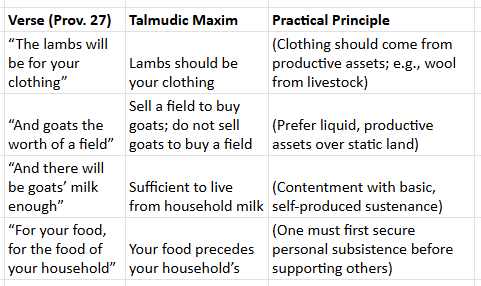
(משלי כז,כו) כבשים ללבושך מגז
כבשים יהא מלבושך
(משלי כז,כו) ומחיר שדה עתודים
לעולם ימכור אדם שדה ויקח עתודים
ואל ימכור אדם עתודים ויקח שדה
(משלי כז,כז) ודי חלב עזים
דיו לאדם שיתפרנס מחלב גדיים וטלאים שבתוך ביתו
(משלי כז,כז) ללחמך ללחם ביתך
לחמך קודם ללחם ביתך
The Talmud continues its discussion with regard to one’s livelihood: The verse states: “The lambs will be for your clothing, and goats the worth of a field. And there will be goats’ milk enough for your food, for the food of your household; and sustenance for your maidens” (Proverbs 27:26–27).
“The lambs (כבשים) will be for your clothing”
indicates that your clothing should be produced from the shearings of lambs, i.e., purchase lambs from whose wool you can produce clothing.
“And goats (עתודים) the worth of a field”
indicates that a person should always seek to sell a field and purchase goats (עתודים) in order to benefit from their milk, wool, and offspring,
and a person should not sell goats and purchase a field instead.
“And there will be goats’ milk enough”
indicates that it is sufficient for a person that he be sustained from the milk of kids and lambs (טלאים) that are in his house.
“For your food (לחמך), for the food of your household”
indicates that your food comes before the food of your household,
i.e., one must first ensure that he has food for himself before providing for others.
Mar Zutra b. Naḥman - One must support one’s children but not accustom them to meat and wine; dietary restraint is part of upbringing - Proverbs 27:27
(משלי כז,כז) וחיים לנערותיך
אמר מר זוטרא בריה דרב נחמן:
תן חיים לנערותיך
מיכן למדה תורה דרך ארץ:
שלא ילמד אדם את בנו בשר ויין
With regard to the phrase: “And sustenance for your maidens (נערותיך),”
Mar Zutra, son of Rav Naḥman, said:
The verse indicates that you must give sustenance to your youth, i.e., to your children.
From here, the Torah taught derekh eretz:
it is a desired mode of behavior that a person should not accustom his son to eat meat and drink wine;
rather, he should teach his children to eat less expensive foods.
Note that the term derekh eretz is used in particular to denote norms of etiquette in matters relating to eating and sexual conduct.
See the appendix for more examples of “The Torah taught derekh eretz” in the Talmud. (Forthcoming, in Part 2 of this series.)
And see also my discussion of this term in a footnote in “Pt2 Tripartite Aphorisms: From The Men of the Great Assembly to Rabban Gamaliel’s Dynasty (Mishnah Avot 1:1-2:4)”, on section “Torah + work prevents sin; Torah without work leads to sin; work with the public for Heaven’s sake; their merit helps; God credits you as if you did it all”.
And compare also the usage of that term in my “Aggadah, Folly, and Conduct: R’ Yehoshua ben Ḥanania’s Responses to the Alexandrians’ Questions (Niddah 70b-71a)”, section “Three Matters of Behavior”.
These exchanges do not negate the earlier ideal of restraint but recalibrate it in light of perceived generational decline and physical vulnerability. In general, compare Wikipedia, “Declinism”.
The midrashic inference is that even when private slaughter is permitted, a person may not slaughter their entire livestock—i.e., not their only cow or only sheep—since that would eliminate their means of sustenance.
The law thus functions as a built-in restraint against total depletion. Compare anthropological explanations of meat taboos as mechanisms for preserving animal resources. The anthropologist most strongly associated with explaining meat taboos as ecological and resource-preservation mechanisms is Marvin Harris, founder and chief proponent of cultural materialism. He argued that food taboos are best explained by material conditions—ecology, economy, and cost–benefit pressures—rather than symbolism alone. He famously analyzed the cow taboo in India as preserving draft animals, milk supply, and fertilizer.
ליטרא - from Latin/Greek.
פסו - paso - from Greek ‘ilpas’.
Thank you for this.