

This is the first part of a two-part series. The outline of the series is below.1
This sugya offers a wide-ranging meditation on the methods, obligations, and ethical posture required for the serious study of Torah. Framed around biblical verses—from Judges and Proverbs to Deuteronomy and Exodus—the passage layers rabbinic interpretations that link mastery of Torah not only to intellectual effort, but also to pedagogical clarity, patience, humility, and structured repetition.
The sugya opens with a homiletical reading of Judges 5:10, interpreting its poetic imagery as a taxonomy of Torah scholars, ranging from traveling students to judges, and from masters of Bible and Mishnah to the elite practitioners of Talmud.
From there, the passage moves into a series of lessons: the danger of studying superficially; the value of incremental learning and mnemonic devices (סימנין - from Greek); the obligation of a teacher to ensure full understanding; and the profound patience exemplified by R’ Perida, who taught a single lesson 800 (!) times to help a struggling student.
The centerpiece is a detailed reconstruction of how Torah was first transmitted: from God to Moses, and then in cascading repetitions to Moses’s brother Aaron, then to Aaron’s sons, the Elders, and the people, ensuring that each individual heard the lesson four times. This becomes the halakhic model for the minimum number of repetitions a teacher owes a student.
Throughout, the rabbis emphasize not only the transmission of content but the formation of character, insisting that Torah is inaccessible to the arrogant, to those who refuse guidance, or to those too distracted for consistency. In their place, the Talmud champions the humble, the diligent, and the devoted, who are willing to “ascend to the heavens”—or “cross the sea”—for the sake of learning.
Outline
Intro
The Passage
Interpreting the Praise in Judges 5:10 as referring to different types of Torah scholars
Dangers of Superficial Study (Proverbs 12:27)
Gradual Learning Increases Retention (Proverbs 13:11)
Transmission of Torah from God
Phase 1: Initial Transmission from God to Moses
Phase 2: Moses Teaching Others
Phase 3: Continued Transmission After Moses
Final Count of Repetitions
R’ Eliezer’s Conclusion
Part 2
Teaching Torah: Obligations of Clarity, Repetition, and Reasoning
R’ Akiva - Obligation to Teach Until Understood (Deuteronomy 31:19)
Requirement for Verbal Mastery (Deuteronomy 31:19)
Need for Explanation and Logic (Exodus 21:1)
R’ Perida’s Patience and the Reward of a Generation
Part 1: Devotion to a Student’s Needs; A Moment of Distraction; Doubling the Effort
Part 2: Heavenly Reward
Mnemonic Signs Aid Torah Study (Jeremiah 31:20)
R’ Abbahu’s Proof to Rav Taḥalifa of Eretz Yisrael
Lexical Justification of ‘tziyyun’ (Ezekiel 39:15)
R’ Eliezer - Scheduled Learning Times (Proverbs 7:4)
The Effort and Humility Required for Torah Study (Deuteronomy 30:12–13)
Avdimi bar Ḥama bar Dosa - even if Torah were as distant as heaven or across the sea, one would be obligated to pursue it
Rava - excludes those who elevate their intellect above the Torah and think they don’t need teachers, and hose who arrogantly believe they’ve fully mastered the topic
R’ Yoḥanan - Torah is not for the arrogant who think of themselves as exalted like heaven, nor for itinerant merchants who lack the time to study consistently
The Passage
Rav Anan’s School - Interpreting the Praise in Judges 5:10 as referring to different types of Torah scholars
A baraita from the school of Rav Anan interprets each phrase in Judges 5:10 as referring to different types of Torah scholars:
“Riders on white donkeys” are those who travel to study;
“white” suggests clarity of understanding (as [clear as in the brightness of] “noon” - צהרים);
“sit on midin” refers to judges rendering true judgment;
“walkers” are masters of Bible;
“on the way” are masters of Mishnah;
“speak of it” are masters of Talmud, whose every word is Torah.
תנא דבי רב ענן:
מאי דכתיב
״רוכבי אתונות צחורות
יושבי על מדין
[והולכי על דרך
שיחו]״?
In further praise of the Torah and those who study it, a Sage of the school of Rav Anan taught:
What is the meaning of that which is written:
“You that ride on white donkeys,
you that sit on rich cloths,
and you that walk by the way,
tell of it” (Judges 5:10)?
״רוכבי אתונות״ —
אלו תלמידי חכמים,
שמהלכין מעיר לעיר וממדינה למדינה ללמוד (בו) תורה.
״צחורות״ —
שעושין אותה כצהרים.
״ישבי על מדין״ —
שדנין דין אמת לאמיתו.
״והולכי״ —
אלו בעלי מקרא.
״על דרך״ —
אלו בעלי משנה.
״שיחו״ —
אלו בעלי תלמוד,
שכל שיחתן דברי תורה.
“You that ride on white donkeys” --
these are Torah scholars,
who travel from city to city and from province to province to study Torah.
“White [tzeḥorot]” --
are those who make it clear as noon [tzahorayim], i.e., who make the Torah comprehensible.
“You that sit on couches [midin]” --
refers to those who judge [danin] an absolutely true judgment.
“And you that walk” --
these are the masters of Bible, who are the least important of the scholars.
“By the way” --
these are the more important masters of Mishna.
“Tell of it” --
these are the masters of Talmud, the most important of all,
as all their conversation is about matters of Torah.
Dangers of Superficial Study (Proverbs 12:27)
Rav Sheizvi citing R’ Elazar ben Azarya
Rav Sheizvi interprets the verse about the deceitful hunter as a warning: one who collects knowledge without review will lose it.
אמר רב שיזבי, משום רבי אלעזר בן עזריה:
מאי דכתיב
״לא יחרוך רמיה צידו״?
לא יחיה ולא יאריך ימים צייד הרמאי.
The Talmud continues with this topic:
Rav Sheizvi said in the name of R’ Elazar ben Azarya:
What is the meaning of that which is written:
“The slothful man [remiyya] will not roast [yaḥarokh] his catch” (Proverbs 12:27)?
The deceitful [rammai] hunter will not live [yiḥyeh] a long life [ya’arikh].
A deceitful hunter continues to hunt more and more animals without holding on to the animals he has already caught. Similarly, someone who continues to study new material without reviewing what he has already learned will not be successful.
Rav Sheshet
Rav Sheshet challenges the term “deceitful,” suggesting such a student is merely foolish.
רב ששת אמר:
צייד הרמאי יחרוך?!
Rav Sheshet said:
Will a deceitful hunter have something to roast?!
One who acts in this way is a fool, but it is hard to describe him as deceitful.
Rav Dimi
Rav Dimi offers a bird-hunter metaphor: unless wings are broken (i.e., unless material is reviewed), the catch will be lost.
כי אתא רב דימי, אמר:
משל
לצייד שצד צפרים,
אם ראשון ראשון משבר כנפיו —
משתמר,
ואם לאו —
אין משתמר.
When Rav Dimi came from Eretz Yisrael to Babylonia, he said:
This is comparable to
a hunter who is hunting birds;
if he breaks the wings of the birds one by one as he captures them so that they will be unable to fly off again --
his prey will be secured,
and if not --
they will not be secured.
According to this explanation, the word rammai is interpreted as cunning rather than deceitful. A cunning hunter secures his prey; similarly, a cunning student reviews each lesson and thereby retains that which he learns.
Rabba citing Rav Seḥora citing Rav Huna - Gradual Learning Increases Retention (Proverbs 13:11)
Rav Huna explains that learning Torah in large bundles (ḥavilot) leads to forgetting, while gathering little by little ensures growth.
אמר (רבה) אמר רב סחורה, אמר רב הונא:
מאי דכתיב
״הון מהבל ימעט
וקובץ על יד ירבה״?
Similarly, Rabba said that Rav Seḥora said that Rav Huna said:
What is the meaning of that which is written:
“Wealth gotten through vanity [hevel] shall be diminished;
but he that gathers little by little shall increase” (Proverbs 13:11)?
אם עושה אדם תורתו חבילות חבילות —
מתמעט,
ואם לאו —
קובץ על יד ירבה.
If a person turns his Torah into “bundles” [ḥavilot, derived from the word hevel by replacing the heh with a ḥet], studying large amounts at the same time --
his Torah will diminish (מתמעט).
And if not, i.e., if he learns little by little and reviews what he has learned --
“he that gathers little by little shall increase.”
Rabba laments that Sages know this truth but ignore it
אמר רבה:
ידעי רבנן להא מלתא,
ועברי עלה.
Rabba said:
The rabbis know this,
but nevertheless transgress it,
i.e., they fail to heed this advice.
Rav Naḥman bar Yitzḥak testifies that learning incrementally worked for him
אמר רב נחמן בר יצחק:
אנא עבדתה,
ואיקיים בידאי.
Rav Naḥman bar Yitzḥak said:
I did this, learning little by little and regularly reviewing what I had learned,
and my learning has indeed endured.
Transmission of Torah from God
Phase 1: Initial Transmission from God to Moses
A baraita outlines the transmission of Torah from God:
Moses learned from God (גבורה).
תנו רבנן,
כיצד סדר משנה?
משה למד מפי הגבורה.
The Talmud continues to discuss methods of Torah study.
A baraita states:
What was the order of teaching (משנה) the Oral Law? How was the Oral Law first taught?
Moses learned directly from God’s mouth (פי הגבורה)
Phase 2: Moses Teaching Others
Table visualizing:
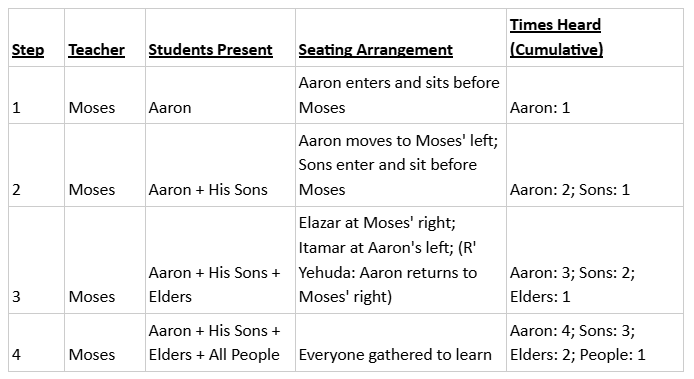
Then, Moses taught (שנה פירקו):
Aaron,
then Aaron’s sons,
then the elders,
then the people
Each layer stayed as the next layer was taught. Thus, each layer heard the teaching one fewer time.
נכנס אהרן,
ושנה לו משה פירקו,
נסתלק אהרן,
וישב לשמאל משה.
נכנסו בניו,
ושנה להן משה פירקן,
נסתלקו בניו,
אלעזר ישב לימין משה, ואיתמר לשמאל אהרן. רבי יהודה אומר: לעולם אהרן לימין משה חוזר.
נכנסו זקנים,
ושנה להן משה פירקן,
נסתלקו זקנים,
נכנסו כל העם,
ושנה להן משה פירקן.
Aaron entered and sat before him,
and Moses taught (שנה) him his lesson (פירקו) as he had learned it from God.
Aaron moved aside
and sat to the left of Moses.
Aaron’s sons entered,
and Moses taught them their lesson while Aaron listened.
Aaron’s sons moved aside;
Elazar sat to the right of Moses and Itamar sat to the left of Aaron. R’ Yehuda disagreed with the first tanna with regard to the seating arrangements and said: Actually, Aaron would return to sit to the right of Moses.
The Elders entered
and Moses taught them their lesson.
The Elders moved aside,
and the entire nation entered
and Moses taught them their lesson.
נמצאו:
ביד אהרן --
ארבעה,
ביד בניו --
שלשה,
וביד הזקנים --
שנים,
וביד כל העם --
אחד.
Therefore (נמצאו):
Aaron
had heard the lesson 4 times,
his sons
heard it 3 times,
the Elders
heard it 2 times,
and the entire nation
heard it 1 time.
Phase 3: Continued Transmission After Moses
Table visualizing:
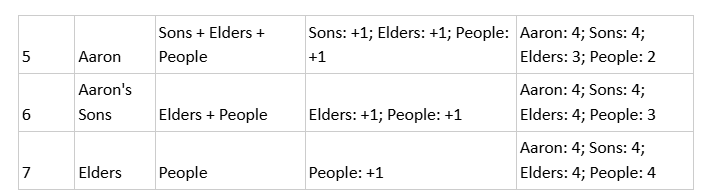
Then the process reversed—Aaron taught the sons and elders, then they in turn taught the people—so that ultimately all heard the lesson 4 times.
נסתלק משה,
ושנה להן אהרן פירקו.
נסתלק אהרן,
שנו להן בניו פירקן.
נסתלקו בניו,
שנו להן זקנים פירקן.
Moses then departed to his tent,
and Aaron taught the others his lesson as he had learned it from Moses.
Aaron then departed
and his sons taught the others their lesson.
His sons then departed
and the elders taught the rest of the people their lesson.
Final Count of Repetitions
Ultimately, everyone heard it four times through this cascading method.
נמצא:
ביד הכל --
ארבעה.
Hence:
everyone, Aaron, his sons, the elders and all the people —
heard the lesson taught by God 4 times.
R’ Eliezer’s Conclusion - a teacher must teach each lesson 4 times
R’ Eliezer infers from this that a teacher must teach each lesson 4 times: If Aaron required 4 repetitions when learning from Moses, who learned from God, then certainly “ordinary (הדיוט - from Greek) [student learning] from the mouth of an ordinary [teacher]” needs at least as much review.
מכאן אמר רבי אליעזר:
חייב אדם לשנות לתלמידו ארבעה פעמים.
וקל וחומר:
ומה אהרן
שלמד מפי משה,
ומשה מפי הגבורה —
כך,
הדיוט
מפי הדיוט —
על אחת כמה וכמה.
From here R’ Eliezer said:
A person is obligated to teach his student his lesson 4 times.
And it follows by way of an a fortiori inference:
If Aaron,
who learned from Moses himself,
and Moses had received the Torah directly from God,
needed this regimen;
an ordinary (הדיוט) student
learning from the mouth of an ordinary teacher,
how much more so must he review his studies four times.
For the previous part of this extended macro-sugya, see my two-part series “ “If a person makes himself like [X], his study will endure”: Metaphors for the Character Traits Essential to Remembering Torah (Eruvin 54a-b)”, final part: Pt2.
And see my intro there for a general discussion of literary themes in the sugya.