

This is the second and final part of a two-part series. Part 1 is here; the outline of the series is below.
Humility and the Stages of Torah Acquisition
Rav Mattana: “Wilderness” (Numbers 21:18) - Wilderness is tread upon by everyone
Rav Mattana states that just as the wilderness is open and trampled (דשין) by all, one who humbles himself like the wilderness will merit enduring Torah study, given to him as a gift (‘mattana’).
אמר רב מתנה:
מאי דכתיב ״וממדבר מתנה״?
אם משים אדם עצמו
כמדבר זה
שהכל דשין בו —
תלמודו מתקיים בידו.
ואם לאו —
אין תלמודו מתקיים בידו.
Similarly, Rav Mattana said:
What is the meaning of that which is written: “The well that the princes dug out, that the nobles of the people delved, with the scepter, with their staves. And from the wilderness they went to Mattanah” (Numbers 21:18)?
If a person makes himself
humble like this wilderness,
which is open to all and upon which everyone treads,
his Torah study will endure and be given to him as a gift [mattana].
And if not --
his Torah study will not endure.
Rava Seeks Reconciliation with Rav Yosef on Yom Kippur Eve
Due to a longstanding grievance, Rav Yosef and Rava had not seen each other.
On the eve of Yom Kippur, Rava decides to make peace and visits Rav Yosef, mixing his wine in a familiar style that allows the blind Rav Yosef to recognize him.
רבא בריה דרב יוסף בר חמא הוה ליה מלתא לרב יוסף בהדיה,
כי מטא מעלי יומא דכיפורי
אמר: איזיל ואפייסיה.
אזל, אשכחיה לשמעיה דקא מזיג ליה כסא.
אמר: הב לי, ואימזגיה אנא.
יהב ליה, מזגיה.
כדטעמיה,
אמר:
דמי האי מזיגא
למזיגא דרבא בריה דרב יוסף בר חמא.
אמר ליה: אנא הוא.
אמר ליה:
לא תתיב אכרעיך
עד דמפרשת לי הני קראי.
The Talmud relates that Rav Yosef had a grievance against Rava, son of Rav Yosef bar Ḥama, who is usually referred to in the Gemara simply as Rava, and as a result of the grievance the two would never meet.
When the eve of Yom Kippur arrived,
Rava said: I will go and appease him.
He went and found Rav Yosef’s attendant mixing him a cup of wine.
He said to the attendant: Give it to me, and I will mix it.
He gave it to Rava, and Rava mixed it.
Rav Yosef was blind and could not see his visitor, but when he tasted the wine
he said:
This mixture is similar to
the mixture of Rava, son of Rav Yosef bar Ḥama, who would add extra water to the wine.
Rava said to him: It is I.
Rav Yosef said to him:
Do not sit on your knees
until you have explained these verses to me:
Rava: “And from the wilderness to Mattanah; and from Mattanah to Nahaliel; and from Nahaliel to Bamoth; and from Bamoth to the valley” (Numbers 21:18-20) - Metaphor: A progression: wilderness → gift → inheritance of God → heights → valley → exaltation - Meaning: If one is humble like wilderness, Torah is given as a gift; then one inherits God and rises to heights; but if one becomes haughty, God lowers him; if he repents, God raises him again
The Talmud homiletically interprets the five Stations of the Exodus listed in Numbers 21:18-20:
“wilderness / desert (מדבר)”
Mattanah
Nahliel
“valley” (גיא).
מאי דכתיב:
״וממדבר
מתנה
וממתנה
נחליאל
ומנחליאל
במות
ומבמות
הגיא״?
What is the meaning of that which is written:
“And from the wilderness
[to] Mattanah;
and from Mattanah
[to] Nahaliel;
and from Nahaliel
[to] Bamoth;
and from Bamoth
[to] the valley in the field of Moab,
to the top of Pisgah, which looks out toward the desert” (Numbers 21:19–20)?
The itinerary listed in the verses as a symbolic spiritual progression rather than a geographical itinerary.
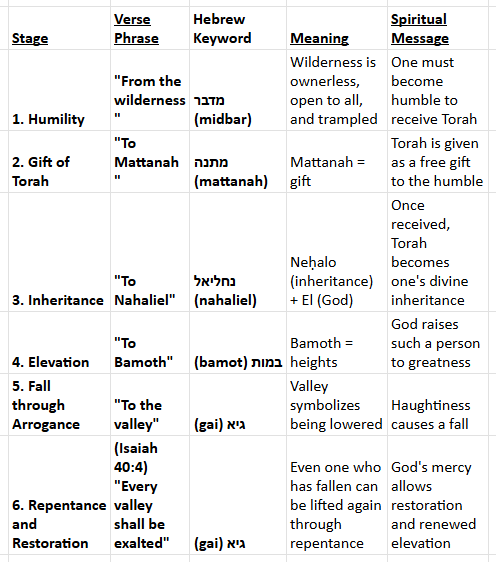
Rava interprets the itinerary listed in the verses as a symbolic spiritual progression rather than a geographical itinerary. Each place name corresponds to a stage in personal and religious development:
The “wilderness” (מדבר) represents radical humility—like the desert, which is open and trampled by all.
Only through such humility can a person receive the Torah as a “gift”.1
Once the Torah is received as a gift, it becomes an “inheritance” (נחלו - “neḥalo”, suggesting full integration). This stage is alluded to in the phrase “from Mattanah to Nahaliel”—with El (God) symbolizing divine sanction of the inheritance.
From this inheritance, the individual is “elevated”.2
However, if one becomes haughty (מגיס לבו), God brings them low (משפילו): “from Bamoth to the valley”.
Yet, if they repent, they are raised again, as promised in Isaiah: “Every valley shall be exalted (ינשא)”.
אמר ליה:
אם אדם משים עצמו כמדבר זה
שהכל דשין בו —
תורה ניתנה לו במתנה.
וכיון שניתנה לו במתנה —
נחלו אל,
שנאמר: ״וממתנה נחליאל״.
וכיון שנחלו אל —
עולה לגדולה,
שנאמר: ״ומנחליאל במות״.
ואם מגיס לבו —
הקדוש ברוך הוא משפילו,
שנאמר: ״ומבמות הגיא״.
ואם חוזר בו —
הקדוש ברוך הוא מגביהו,
שנאמר: ״כל גיא ינשא״.
Rava said to him:
If a person makes himself humble like this wilderness,
which is open to all and upon which everyone treads,
the Torah will be given to him as a gift [mattana].
And once it is given to him as a gift,
he inherits it [neḥalo] and God [El] makes it His inheritance,
as it is stated: “And from Mattanah to Nahaliel.”
And once God has made it His inheritance,
he rises to greatness,
as it is stated: “And from Nahaliel to Bamoth,” which means heights.
And if he becomes haughty,
God lowers him,
as it is stated: “And from Bamoth to the valley.”
And if he repents,
God raises him back up,
as it is stated: “Every valley shall be exalted” (Isaiah 40:4).
Rav Huna: “Your flock found a dwelling there” (Psalms 68:11) - A wild animal preys (without concern for cleanliness or refinement)
Rav Huna interprets Psalms 68:11--which refers to “Your flock” (חיתך)--to mean that one must be like a wild animal (חיה) that preys.3
God Himself will personally (בעצמו) prepare a feast (סעודה) for such humble scholars.
אמר רב הונא:
מאי דכתיב:
״חיתך ישבו בה
תכין בטובתך לעני, אלהים״?
Rav Huna said:
What is the meaning of that which is written:
“Your flock found a dwelling in it;
You, O God, prepare of Your goodness for the poor” (Psalms 68:11)?
אם אדם משים עצמו
כחיה זו
שדורסת ואוכלת,
ואיכא דאמרי: שמסרחת ואוכלת —
תלמודו מתקיים בידו.
ואם לאו —
אין תלמודו מתקיים בידו
If a person makes himself
like an animal
that tramples its prey and eats it immediately, without being particular about its food, i.e., if a scholar immediately reviews what he has heard from his teacher;
and some say, like an animal that soils and eats, i.e., if a scholar is not particular about maintaining his honor during his Torah study, just as an animal is not particular about the quality of its food,
his Torah study will endure.
And if not,
his Torah study will not endure.
ואם עושה כן —
הקדוש ברוך הוא עושה לו סעודה בעצמו,
שנאמר:
״תכין בטובתך לעני
אלהים״.
And if he does so,
God will Himself prepare him a feast,
as it is stated:
“You prepare of Your goodness for the poor,
O God,”
indicating that God in His goodness will Himself prepare a feast for that pauper.
R’ Ḥiyya bar Abba (in name of R’ Yoḥanan): “He who guards the fig tree shall eat its fruit” (Proverbs 27:18) - A fig tree yields fruit at different times; constant revisiting bears results
R’ Ḥiyya bar Abba, quoting R’ Yoḥanan, compares Torah to a fig tree (תאנה):
Just as “whenever a person searches (ממשמש) it, he finds figs in it” (i.e. figs ripen continuously and one always finds new fruit), so too Torah “Whenever a person meditates (הוגה) upon them, he finds in them (new) meaning.4
אמר רבי חייא בר אבא, אמר רבי יוחנן:
:מאי דכתיב
״נוצר תאנה
יאכל פריה״?
R’ Ḥiyya bar Abba said that R’ Yoḥanan said:
What is the meaning of that which is written:
“He who guards the fig tree —
shall eat its fruit” (Proverbs 27:18)?
למה נמשלו דברי תורה כתאנה?
מה תאנה זו
כל זמן שאדם ממשמש בה —
מוצא בה תאנים
אף דברי תורה,
כל זמן שאדם הוגה בהן —
מוצא בהן טעם.
Why were matters of Torah compared to a fig tree?
Just as this fig tree,
whenever a person searches it for figs to eat,
he finds figs in it, as the figs on a tree do not ripen all at once, so that one can always find a recently ripened fig,
so too, with matters of Torah
Whenever a person meditates upon them,
he finds in them new meaning.
R’ Shmuel bar Naḥmani on the Erotic and Perpetual Allure of Torah (Proverbs 5:19)
אמר רבי שמואל בר נחמני:
מאי דכתיב
״אילת אהבים
ויעלת חן וגו׳״?
R’ Shmuel bar Naḥmani said:
What is the meaning of that which is written:
“A loving hind
and a graceful roe,
let her breasts satisfy you at all times, and be you ravished always with her love” (Proverbs 5:19)?
R’ Shmuel bar Naḥmani: “A loving hind and a graceful roe” (Proverbs 5:19) - A hind is cherished anew each time due to its narrow womb, like the first time
R’ Shmuel bar Naḥmani explains that just as a hind’s womb5 is narrow and arouses constant desire from her mate, so too Torah remains ever-cherished and fresh for those who study it.
למה נמשלו דברי תורה לאילת?
לומר לך:
מה אילה
רחמה צר,
וחביבה על בועלה כל שעה ושעה, כשעה ראשונה —
אף דברי תורה
חביבין על לומדיהן כל שעה ושעה, כשעה ראשונה.
Why were matters of Torah compared to a hind?
To tell you that
just as with a hind,
its womb is narrow
and it is cherished by its mate each and every hour like the first hour,
so too, matters of Torah
are cherished by those who study them each and every hour like the first hour.
“A loving hind and a graceful roe” - Metaphor: A graceful roe - Meaning: Torah bestows grace upon those who study it
The term “graceful (חן) roe (יעלת)” is interpreted to mean that Torah endows (מעלת) beauty and charm (חן) to its students.
״ויעלת חן״ —
שמעלת חן על לומדיה.
“And a graceful roe”
is expounded as follows: That the Torah bestows grace upon those who study it.
R’ Shmuel bar Naḥmani: “Let her breasts satisfy you at all times” (Proverbs 5:19) - A breast always produces milk when stimulated
Just as a baby always finds milk in a mother’s breast, one who meditates upon Torah always finds new insights and nourishment in it.
״דדיה ירוך בכל עת״ —
למה נמשלו דברי תורה כדד?
מה דד זה
כל זמן שהתינוק ממשמש בו —
מוצא בו חלב,
אף דברי תורה,
כל זמן שאדם הוגה בהן —
מוצא בהן טעם.
“Let her breasts satisfy you at all times”;
why were matters of Torah compared to a breast?
Just as with a breast,
whenever a baby searches it for milk to suckle,
he finds milk in it,
so too, with matters of Torah
Whenever a person meditates upon them,
he finds new meaning in them.
Appendix 1 - Table Summary: Tradent; Biblical Citation; Metaphor; Meaning / Interpretation
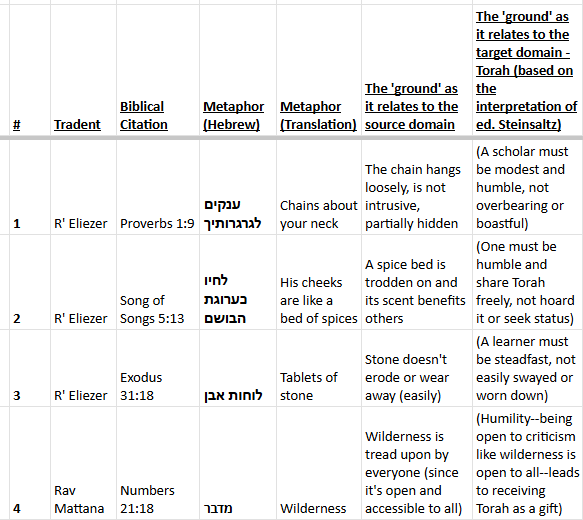
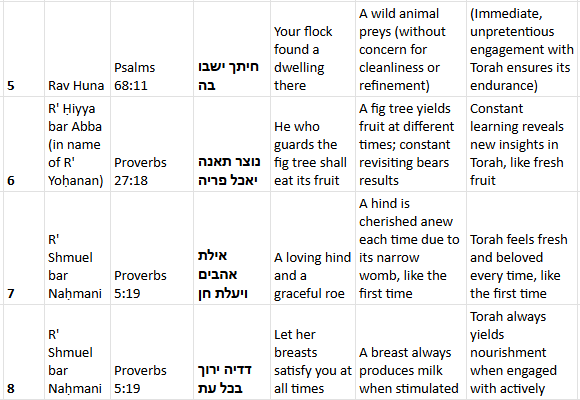
Appendix 2 - Eternal Language: Netzaḥ, Selah, Va’ed (Eruvin 54a)
A baraita taught in the name of the school of R’ Eliezer ben Yaakov states that the terms “netzaḥ,” “selah,” and “va’ed” always imply eternity.6
Each is supported by a verse showing it describes something unending: God’s anger not lasting “forever” (Isaiah 57:16), Jerusalem being established “forever, selah” (Psalms 48:9), and God reigning “forever and ever” (Exodus 15:18).
תנא דבי רבי אליעזר בן יעקב:
כל מקום שנאמר
״נצח״
״סלה״
״ועד״ —
אין לו הפסק עולמית.
נצח,
דכתיב: ״כי לא לעולם אריב, ולא לנצח אקצוף״.
סלה,
דכתיב: ״כאשר שמענו, כן ראינו בעיר ה׳ צבאות, בעיר אלהינו, אלהים יכוננה עד עולם. סלה״.
ועד,
דכתיב: ״ה׳ ימלוך לעולם ועד״.
With regard to the end of this verse, a Sage of the school of R’ Eliezer ben Ya’akov taught the following baraita:
Wherever it states
netzaḥ,
Selah,
or va’ed,
the matter will never cease.
Netzaḥ,
as it is written: “For I will not contend forever; neither will I be eternally [lanetzaḥ] angry” (Isaiah 57:16), which demonstrates that netzaḥ bears a similar meaning to forever.
Selah,
as it is written: “As we have heard, so have we seen in the city of YHWH of Hosts, in the city of our God; may God establish it forever, Selah” (Psalms 48:9), which demonstrates that Selah means forever.
Va’ed, as it is written: “The Lord shall reign forever and ever [va’ed]” (Exodus 15:18).
מתנה - “mattana”; as stated in the earlier section.
במות - “Bamoth” meaning “heights”, suggesting spiritual greatness bestowed by God.
דורסת / מסרחת ואוכלת - “tramples / soils and eats” ; i.e. wild animals what it finds: undiscerning and unselfconscious. So too, Torah students who don’t seek prestige.
טעם; alternative translation: “flavor”; i.e. Torah yields ongoing insights to those who revisit and meditate on it regularly.
A euphemism for vagina; see my previous notes on this passage.
אין לו הפסק עולמית - literally: “it has no interruption (הפסק) forever (עולמית)”.