

This is the first part of a two-part series. The outline of the series is below.
This sugya is an anthology of rabbinic reflections on how character traits influence the successful acquisition and retention of Torah knowledge.1 Anchored in a series of verse-based homilies, primarily from Proverbs, Song of Songs, Exodus, Numbers, Psalms, and Isaiah, the rabbis develop a sustained metaphorical discourse on humility, diligence, and spiritual posture.
Each rabbi offers a metaphor drawn from nature, the body, or domestic objects—chains, gardens, tablets, animals, wilderness, figs, breasts—to illustrate a moral or spiritual quality essential for meaningful Torah study. Often introduced with the phrase “What is the meaning of that which is written...” (מאי דכתיב), these teachings rely on close readings, wordplay, and reinterpretation of biblical verses.
The overarching message is clear: Torah does not endure with arrogance, pride, or superficiality. Rather, it thrives in those who are modest, open, persistent, and reverent—those who approach learning not as conquest but as cultivation.
The Rhetorical Formula
The passage follows a consistent formula for most of its teachings:
Introduction of the tradent: “Rabbi/Rav X said”
Framing question: “What [is the meaning of] that which is written...?” (מאי דכתיב)
Citation of prooftext: A biblical verse is quoted
Metaphorical interpretation: “If a person makes himself like...” (אם משים אדם עצמו כ)
Conditional consequence: “...his [Torah] study will endure. But if not, his [Torah] study will not endure.” (תלמודו מתקיים בידו. ואם לאו — אין תלמודו מתקיים בידו)
Technical Terms Used to Analyze Metaphor: source domain, target domain, and “Ground”
Central to the analysis of metaphor is the distinction between the following three things:2
Source domain: the concrete image or situation evoked
Target domain: the abstract or complex idea being clarified or illuminated
The “ground” of a metaphor: the shared quality or conceptual overlap that enables this transfer of meaning—the basis for the analogy.
The table in my Appendix organizes the analysis into two complementary “grounds”:
The ‘ground’ as it relates to the source domain identifies the key physical or behavioral qualities of the metaphor’s image (e.g., the looseness of a chain, the durability of stone, the constant yield of a fig tree).
The ‘ground’ as it relates to the target domain – Torah interprets how those qualities translate into the realm of Torah learning and the student’s character, following the commentary of ed. Steinsaltz.
In many cases in our sugya, the second element—the “ground” as it applies to the target domain (i.e., Torah)—is not stated explicitly. So in step #4 of the Rhetorical Formula I listed above (“Metaphorical interpretation: ‘If a person makes himself like...’”), only the metaphor itself is presented. It includes the “ground” as it applies to the source domain, but doesn’t spell out the intended message or “payoff” in terms of the target domain.
Here’s the formula:
What [is the meaning of] the verse (מאי דכתיב) [V - verse]?
If a person makes himself (משים אדם עצמו)
like this [A - source domain] (כפלוני זה) —
that [J - attribute]
his [Torah] learning will endure in his hand (תלמודו מתקיים בידו)
But if not (ואם לאו) --
his [Torah] learning will not endure in his hand (אין תלמודו מתקיים בידו)
For example, here’s the first section in our sugya, with variables bolded:
What [is the meaning of] the verse “and ornaments (‘anaqim) for your throat” (Proverbs 1:9)?
If a person makes himself (משים אדם עצמו)
like this ornament—
that hangs loosely on the neck,
visible and not visible3 —
his [Torah] learning will endure (מתקיים) in his hand.
But if not --
his [Torah] learning will not endure in his hand.
This passage interprets “וענקים לגרגרותיך” (”and ornaments for your throat”) metaphorically. It follows the rhetorical formula:
Metaphor stated: A person should make himself like a “chain” (anak) on the throat.
Ground in source domain: The ornament is subtle (“visible and hidden”).
Ground in target domain (implied): Torah should be displayed modestly (barely perceptible).
Impact: Only when one treats Torah this way does learning endure.
The “ground” related to Torah is not spelled out; it’s implied through the metaphor’s qualities.
Traits as Functional conditions for retaining and internalizing the Torah
The Talmud emphasizes that these metaphors convey not merely ideals of piety or scholarship but functional conditions for Torah study to “be sustained” (mitkayem). The metaphors describe how humility, discretion, consistency, and an eagerness to learn are not only virtuous—they are structurally necessary for retaining and internalizing the Torah.
Wordplay and Etymology
The passage frequently employs wordplay as an exegetical technique:
Reading “חרות” (engraved) as “חירות” (freedom)
Connecting “מתנה” (Mattanah) with “gift” (מתנה)
Linking “לחייו” (cheeks) with “לוחות” (tablets)
Embodied Metaphors
The metaphors consistently use physical, tangible objects to represent abstract qualities: Chains, garden beds, stones, wilderness, animals, fig trees, breasts.
Outline
Intro
The Rhetorical Formula
Technical Terms Used to Analyze Metaphor: source domain, target domain, and “Ground”
Traits as Functional conditions for retaining and internalizing the Torah
Wordplay and Etymology
Embodied Metaphors
The Passage - “If a person makes himself like [X], his study will endure”: Metaphors for the Character Traits Essential to Remembering Torah (Eruvin 54a-b)
Humility, Endurance, and the Conditions for Lasting Torah Study
R’ Eliezer: “Chains about your neck” (Proverbs 1:9) - The chain hangs loosely, is not intrusive, partially hidden
R’ Eliezer: “His cheeks are like a bed of spices” (Song of Songs 5:13) - A spice bed is trodden on and its scent benefits others
R’ Eliezer: “Tablets of stone” (Exodus 31:18) - Stone doesn’t erode or wear away (easily)
The Power of the First Tablets (Exodus 32:16): the Lost Potential of Eternal Torah and Freedom;
R’ Eliezer: “Engraved upon the tablets” - Had the first tablets not been broken, Torah would never have been forgotten from Israel
Rav Aḥa bar Ya’akov: “Engraved upon the tablets” - Had the tablets not been broken, no nation would have ruled over Israel
Part 2
Humility and the Stages of Torah Acquisition
Rav Mattana: “Wilderness” (Numbers 21:18) - Wilderness is tread upon by everyone
Rava Seeks Reconciliation with Rav Yosef on Yom Kippur Eve
Rava: “And from the wilderness to Mattanah; and from Mattanah to Nahaliel; and from Nahaliel to Bamoth; and from Bamoth to the valley” (Numbers 21:18-20) - Metaphor: A progression: wilderness → gift → inheritance of God → heights → valley → exaltation - Meaning: If one is humble like wilderness, Torah is given as a gift; then one inherits God and rises to heights; but if one becomes haughty, God lowers him; if he repents, God raises him again
The itinerary listed in the verses as a symbolic spiritual progression rather than a geographical itinerary.
Rav Huna: “Your flock found a dwelling there” (Psalms 68:11) - A wild animal preys (without concern for cleanliness or refinement)
R’ Ḥiyya bar Abba (in name of R’ Yoḥanan): “He who guards the fig tree shall eat its fruit” (Proverbs 27:18) - A fig tree yields fruit at different times; constant revisiting bears results
R’ Shmuel bar Naḥmani on the Erotic and Perpetual Allure of Torah (Proverbs 5:19)
R’ Shmuel bar Naḥmani: “A loving hind and a graceful roe” (Proverbs 5:19) - A hind is cherished anew each time due to its narrow womb, like the first time
“A loving hind and a graceful roe” - Metaphor: A graceful roe - Meaning: Torah bestows grace upon those who study it
R’ Shmuel bar Naḥmani: “Let her breasts satisfy you at all times” (Proverbs 5:19) - A breast always produces milk when stimulated
Appendix 1 - Table Summary: Tradent; Biblical Citation; Metaphor; Meaning / Interpretation
Appendix 2 - Eternal Language: Netzaḥ, Selah, Va’ed
The Passage
Humility, Endurance, and the Conditions for Lasting Torah Study
R’ Eliezer: “Chains about your neck” (Proverbs 1:9) - The chain hangs loosely, is not intrusive, partially hidden
R’ Eliezer interprets the phrase “chains about your neck” to mean that Torah must be like an ornament (ענק) that “hangs loosely (רף) on the neck” and that’s present but not flaunted (i.e. The scholar should be modest, neither intrusive nor attention-seeking)
If he maintains this balance (seen yet unseen) his Torah study will endure. Otherwise, it will not.
אמר רבי (אליעזר):
מאי דכתיב ״וענקים לגרגרותיך״?
אם משים אדם עצמו
כענק זה
שרף על הצואר
ונראה ואינו נראה —
תלמודו מתקיים בידו.
ואם לאו —
אין תלמודו מתקיים בידו.
In light of the previous discussion, the Talmud cites several expositions of verses proposed by R’ Eliezer.
[...]
R’ Eliezer said:
What is the meaning of that which is written: “And chains about your neck” (Proverbs 1:9)?
If a person makes himself
like a chain
that hangs loosely on the neck, i.e., if a scholar is not pushy and disruptive to others,
and he is also seen but not seen, i.e., just as a chain is covered by clothes and hair, so too, the scholar does not let himself be seen --
his Torah study will endure.
But if not, if he acts in a rude and arrogant manner --
his Torah study will not endure.
R’ Eliezer: “His cheeks are like a bed of spices” (Song of Songs 5:13) - A spice bed is trodden on and its scent benefits others
Expounding on “His cheeks are like a bed of spices,” R’ Eliezer draws a metaphor from a spice garden (ערוגה) trampled (דשין) by all, yet still benefiting everyone through its scent (בושם).
Similarly, a scholar who humbles himself for others and allows them to benefit from his Torah ensures his learning will endure.
Without this, his learning will not last.
ואמר רבי אליעזר:
מאי דכתיב ״לחיו כערוגת הבושם״?
אם משים אדם עצמו
כערוגה זו
שהכל דשין בה,
וכבושם זה
שהכל מתבשמין בה —
תלמודו מתקיים,
ואם לאו —
אין תלמודו מתקיים.
And R’ Eliezer also said:
What is the meaning of that which is written: “His cheeks are like a bed of spices” (Song of Songs 5:13)?
If a person makes himself
humble like this garden bed
upon which everyone treads,
and like this spice
with which everyone perfumes himself, i.e., which benefits not only the one who wears it --
his Torah study will endure.
But if not --
his Torah study will not endure.
R’ Eliezer: “Tablets of stone” (Exodus 31:18) - Stone doesn’t erode or wear away (easily)
R’ Eliezer links “tablets of stone” (לוחות אבן) to a pun on “leḥayav” (לחייו - “cheeks”), saying that a scholar must make his “cheeks” like unyielding “stone” which doesn’t (easily) erode (נמחית - i.e. resilient and unwavering).
Only through such tenacity will his Torah study endure.
ואמר רבי (אליעזר):
מאי דכתיב ״לוחות אבן״?
אם אדם משים עצמו את לחייו
כאבן זו
שאינה נמחית —
תלמודו מתקיים בידו,
ואם לאו —
אין תלמודו מתקיים בידו.
And R’ Eliezer further said:
What is the meaning of that which is written: “Tablets [luḥot] of stone” (Exodus 31:18)?
If a person makes his cheeks [leḥayav]
like this stone
that does not wear away --
his Torah study will endure.
But if not, i.e., if he is not diligent in his studies --
his Torah study will not endure.
The Power of the First Tablets (Exodus 32:16): the Lost Potential of Eternal Torah and Freedom;
R’ Eliezer: “Engraved upon the tablets” - Had the first tablets not been broken, Torah would never have been forgotten from Israel
R’ Eliezer interprets the verse “engraved upon the tablets” to mean that if the first tablets had not been shattered, the Torah would have never have been forgotten (as it would have been permanently “inscribed on the hearts” of the Jewish people).
ואמר רבי (אליעזר):
מאי דכתיב ״חרות על הלוחות״?
— אלמלי לא נשתברו לוחות הראשונות
לא נשתכחה תורה מישראל.
And, lastly, R’ Eliezer said:
What is the meaning of that which is written: “And the tablets were the work of God, and the writing was the writing of God, engraved upon the tablets” (Exodus 32:16)?
This teaches that had the first tablets, the subject of this verse, not been broken —
the Torah would never have been forgotten from the Jewish people, as the Torah would have been engraved upon their hearts.
Rav Aḥa bar Ya’akov: “Engraved upon the tablets” - Had the tablets not been broken, no nation would have ruled over Israel
Rav Aḥa bar Ya’akov adds that had the tablets remained whole, no foreign nation (אומה) or language (לשון) would have ever dominated the Jewish people.
He reads the word “ḥarut” (חרות - “engraved”) via wordplay as “ḥeirut”.4
רב אחא בר יעקב אמר:
אין כל אומה ולשון שולטת בהן,
שנאמר: ״חרות״
אל תיקרי ״חרות״,
אלא חירות.
Rav Aḥa bar Ya’akov said:
Had the tablets not been broken, no nation or tongue would ever have ruled over them,
as it is stated: “Engraved”;
do not read it “engraved” [ḥarut]
but rather “freedom” [ḥeirut].
On Torah study in general in the Talmud, see the initial note in my recent “Pt1 Torah Study, Marriage, and Parental Obligation: Priorities, Ages, and the Torah as Antidote to the Yetzer Hara (Kiddushin 29b-30b)“.
Note that in this context, “Torah” is used in its broader sense, encompassing both the Written Torah and the Oral Torah, rather than the narrower meaning that refers only to the Pentateuch. Compare my discussion in “Scripture and Structure: The Definition of “Torah” and Taxonomies of Traditional Jewish Literature“.
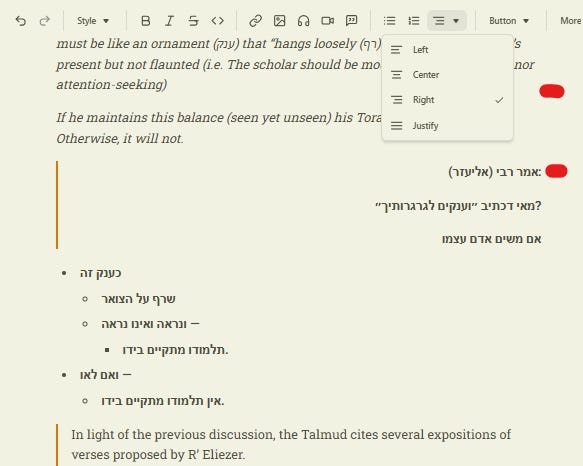
Technical note, related to formatting: Substack recently (finally!) added a right-alignment option, and by default Hebrew text is now aligned that way, which is mostly helpful. Unfortunately, this still doesn’t apply to bullet points, which I use heavily, especially in this piece. So I reverted those to the usual left alignment. In other words, Substack still doesn’t fully support proper Hebrew right-to-left formatting. (Therefore, periods (`.`) and question marks (`?`) are also not properly aligned in the Hebrew, and appear at the beginning of the line, instead of at the end.)
See, for example, in the first paragraph:
Compare Wikipedia, “Metaphor”, section “Parts of a metaphor”.
נראה ואינו נראה - literally: “seen and not seen”, i.e. partially visible.
“X and not X” is the common Talmudic idiomatic way of saying “partially X”.
חירות - “freedom” - implying that the original tablets contained within them the key to eternal national and spiritual autonomy.