

This is the first part of a two part series. The outline of the series is below.1
Intro
This sugya addresses one of the sharpest ritual-calendrical disputes between the Pharisaic rabbis and the Boethusian/Sadducean sects: when does the count toward the holiday of Shavuot begin? The answer hinges on a single phrase in Leviticus 23:15 — “mi-maḥarat ha-shabbat” (”from the morrow after the shabbat”). The Boethusians read the word shabbat literally as the weekly Sabbath, placing the omer harvest always on a Sunday and consequently fixing Shavuot perpetually on a Sunday. The Pharisaic tradition reads shabbat as the first Festival day of Passover (15 Nisan), so the omer is always harvested on the night of 16 Nisan regardless of which day of the week it falls on.
The Mishnah opens with a vivid description of the omer harvest ceremony. Court emissaries would go out on the eve of the festival and bind the standing barley into sheaves while still attached to the ground, to ease the reaping. Residents of neighboring towns would gather to ensure the harvest was performed be-esek gadol — with great public fanfare. Once darkness fell, a formal litany began: the emissary called out three pairs of questions — “Did the sun set?” “This sickle?” “This basket?” — each repeated twice, each answered “Yes!”2 by the crowd. On Shabbat, two additional questions were added: “This Shabbat?” and “Shall I cut?” The Mishnah states that every question was asked three times. The reason for this elaborate public theater: to refute the Boethusians, who denied the legitimacy of harvesting the omer on any night other than Saturday night.
The Talmud broadens the frame by citing a baraita (from Megillat Ta’anit) listing festive days on which fasting and eulogizing are forbidden. Two periods in Nisan mark Pharisaic victories over sectarian positions: (1) From Rosh Chodesh Nisan through the 8th, celebrating the establishment that the daily tamid offering must come from communal Temple funds, against the Sadducees who argued (from the singular ta’aseh in Numbers 28:4) that an individual could donate it; the rabbis countered with the plural tishmeru of Numbers 28:2. (2) From the 8th of Nisan through the end of Passover, celebrating the restoration of the correct date of Shavuot against the Boethusians.
The sugya then records a confrontation between Rabban Yoḥanan ben Zakkai and the Boethusians. He challenged them — “Fools! From where do you derive this?” — and only one old man responded, arguing that Moses fixed Shavuot after Shabbat so Israel could enjoy two consecutive days off. Rabban Yoḥanan retorted with Deuteronomy 1:2: if Moses loved Israel so much, why did he keep them in the wilderness for forty years? When the old man protested the dismissal, Rabban Yoḥanan replied: “Fool! Will our perfect Torah not be as worthy as your frivolous speech?”
Part 2
The sugya then marshals six distinct Tannaitic proofs that shabbat means the Festival day, not the weekly Sabbath:
Rabban Yoḥanan ben Zakkai reconciles “50 days” (Lev. 23:16) with “7 complete weeks” (Lev. 23:15) — complete weeks occur only when Passover falls on Shabbat; otherwise it is simply 50 days.
R. Eliezer: “for you” (Deut. 16:9) means the count depends on the court’s calendar, excluding weekly Shabbat which anyone can track.
R. Yehoshua: just as counting toward a new month starts from a known, fixed date, so must the omer count.
R. Yishmael: the omer on Passover parallels the two loaves on Shavuot — both must come at the start of their respective festival.
R. Yehuda ben Beteira: The word shabbat earlier and later in the biblical passage both mean “festival”.
R. Yosei: the verse doesn’t say “the shabbat during Passover” — since every week has a Shabbat, the unspecified term must mean the Festival; he adds the above/below shabbat argument as well.
R. Yosei b. Yehuda further notes that a Sunday-based count would yield 51–56 days from the 16th of Nisan rather than a fixed 50. R. Shimon ben Elazar resolves the contradiction between “six days” (Deut. 16:8) and “seven days” (Exod. 12:15) of matza by explaining that new-crop matza is permitted only after the omer — possible only if the omer falls on 16 Nisan.
The sugya concludes with a precise choreography of timing: harvesting and counting occur at night (to achieve “seven complete weeks”), while the actual bringing of the omer offering is during the day — derived from the interplay of Leviticus 23:15–16 and Deuteronomy 16:9.
Pentateuch passages
Leviticus 23:15–16
Leviticus 23:15–16 (translation Koren Jerusalem Bible):3
וספרתם לכם ממחרת השבת
מיום הביאכם את עמר התנופה
שבע שבתות תמימת תהיינה
עד ממחרת השבת השביעת
תספרו חמשים יום
והקרבתם מנחה חדשה ליהוה
And you shall count for yourselves from the morrow after the sabbath,
from the day that you brought the omer of the wave offering;
7 complete sabbaths shall there be:
to the morrow after the 7th sabbath
shall you number 50 days
and you shall offer a new meal offering to YHWH
Deuteronomy 16:9
Deuteronomy 16:9-10:
שבעה שבעת תספר לך
מהחל חרמש בקמה
תחל לספר שבעה שבעות
ועשית חג שבעות ליהוה אלהיך
מסת נדבת ידך אשר תתן
כאשר יברכך יהוה אלהיך
You shall count off 7 weeks;
when the sickle is first put to the standing grain
start to count the 7 weeks.
Then you shall observe the Feast of Weeks (שבעות - Shavuot) for YHWH your God,
offering your freewill contribution
as YHWH your God has blessed you.
Outline
Intro
Pentateuch passages
Leviticus 23:15–16
Deuteronomy 16:9
The Passage
Mishnah (Menachot 10:3)
Omer harvest was staged publicly
Back-and-forth litany - A list of 3 doubled calls-and-responses: Did the sun set? this sickle? this basket?
Back-and-forth litany on Shabbat - A list of 2 doubled calls-and-responses: this Shabbat? Shall I cut?
“Three times each”
Rationale: “because of the Boethusians,” who said the omer is not reaped on motza’ei Yom Tov unless it is motza’ei Shabbat
Talmud
Baraita (Megillat Ta’anit) - days on which fasting is prohibited -- From the 1st to 8th of Nisan, and then to until of Passover
Sadducees - The daily offering may be donated by an individual
Sadducees’ prooftext - Numbers 28:4
Pharisees prooftext - The daily offering must come from communal funds, from the Temple treasury - Numbers 28:2
Boethusians - Shavuot must always fall on Sunday; “morrow after the shabbat” is literal Shabbat - Leviticus 23:15
Rabban Yoḥanan ben Zakkai critiques the Boethusians
An elderly man responds to Rabban Yoḥanan ben Zakkai
Rabban Yoḥanan ben Zakkai responds - Deuteronomy 1:2
Part 2
Reconciliation of “50 days” with “7 complete weeks”: if Yom Tov falls on Shabbat, there are 7 complete weeks; otherwise the count is simply 50 days - Deuteronomy 1:2; Leviticus 23:15–16
R’ Eliezer - “Mi-maḥarat ha-shabbat” means after Yom Tov, not after weekly Shabbat, because the counting depends on court-fixed calendrical sanctification - Deuteronomy 16:9; Leviticus 23:15
R’ Yehoshua - Shavuot counting must begin from a fixed, knowable date, analogous to counting toward the new month; therefore it cannot depend on Sunday - Numbers 11:20; Leviticus 23:16
R’ Yishmael - The omer on Passover parallels the two loaves on Shavuot: just as the Shavuot offering is at the start of the festival, so the omer must be at the start of Passover
R’ Yehuda ben Beteira - “Shabbat” earlier and later both mean festival, not weekly Shabbat; thus the omer follows immediately after the start of Passover - Leviticus 23:15–16
Baraita - “U-sefartem lakhem” teaches that counting the omer is incumbent on each individual - Leviticus 23:15
R’ Yosei b. Yehuda - “Mi-maḥarat ha-shabbat” cannot mean Sunday, because then Shavuot would sometimes fall 51–56 days after the start point rather than always 50 - Leviticus 23:16
R’ Yehuda ben Beteira - (Same court-based argument as above:) the count depends on beit din, excluding weekly Shabbat as the starting point - Deuteronomy 16:9
R’ Yosei - “Mi-maḥarat ha-shabbat” means after Yom Tov, since the verse does not specify which Shabbat; also “shabbat” above and below both refer to festival - Leviticus 23:15–16
R’ Shimon ben Elazar - The new grain becomes permitted on the 2nd day of Passover, explaining the contrast between eating matza 6 vs 7 days; this proves the omer is brought on 16 Nisan - Deuteronomy 16:8; Exodus 12:15
Counting begins when the grain is reaped; bringing and counting are linked to the day of the omer - Deuteronomy 16:9; Leviticus 23:15–16
To achieve “7 complete weeks,” counting must begin in the evening - Leviticus 23:15
Harvesting the omer and counting are at night; bringing is by day - Leviticus 23:15–16
The Passage
(In ChavrutAI, begins at: Menachot/65a#4)
Mishnah (Menachot 10:3)
Omer harvest was staged publicly
כיצד הן עושין?
שלוחי בית דין יוצאין מערב יום טוב,
ועושין אותן כריכות במחובר לקרקע,
כדי שיהא נוח לקצור.
How would they perform the rite of the harvest of the omer?
Emissaries of the court would emerge on the eve of the festival of Passover
and fashion the stalks of barley into sheaves while the stalks were still attached to the ground,
so that it would be convenient to reap them.
כל העיירות הסמוכות לשם מתכנסות לשם,
כדי שיהא נקצר בעסק גדול.
The residents of all the towns adjacent to the site of the harvest would assemble there,
so that it would be harvested with great fanfare4
Back-and-forth litany - A list of 3 doubled calls-and-responses: Did the sun set? this sickle? this basket?
כיון שהחשיכה,
אומר להן: ״בא השמש?״
אומר: ״הין״.
״בא השמש?״
אומר: ״הין״.
״מגל זו?״
אומר: ״הין״.
״מגל זו?״
אומר: ״הין״.
״קופה זו?״
אומר: ״הין״.
״קופה זו?״
אומר: ״הין״.
Once it grew dark,
the court emissary says to those assembled: Did the sun set? (בא השמש)
The assembly says in response: Yes (הין)
The emissary repeats: Did the sun set?
They again say: Yes.
The court emissary next says to those assembled: Shall I reap the sheaves with this sickle (מגל)?
The assembly says in response: Yes.
The emissary repeats: With this sickle?
The assembly says: Yes.
The court emissary then says to those assembled: Shall I place the gathered sheaves in this basket (קופה)?
The assembly says in response: Yes.
The emissary repeats: In this basket?
The assembly says: Yes.
Back-and-forth litany on Shabbat - A list of 2 doubled calls-and-responses: this Shabbat? Shall I cut?
בשבת,
אומר להן: ״שבת זו?״
אמר: ״הין״.
״שבת זו?״
אמר: ״הין״.
״אקצור?״
והם אומרים לו: ״קצור״.
״אקצור?״
והם אומרים לו: ״קצור״.
If the 16th of Nisan occurs on Shabbat,
the court emissary says to the assembled: Shall I cut the sheaves on this Shabbat?
The assembly says in response: Yes.
The emissary repeats: On this Shabbat?
The assembly says: Yes.
The court emissary says to those assembled: Shall I cut the sheaves?
And they say to him in response: Cut.
The emissary repeats: Shall I cut the sheaves?
And they say to him: Cut.
“Three times each”
שלש פעמים על כל דבר ודבר,
והן אומרים לו:
הין,
הין,
הין.
The emissary asks 3 times with regard to each and every matter,
and the assembly says to him:
Yes,
yes,
yes.
Rationale: “because of the Boethusians,” who said the omer is not reaped on motza’ei Yom Tov unless it is motza’ei Shabbat
כל כך למה לי?
מפני הבייתוסים,
שהיו אומרים:
אין קצירת העומר במוצאי יום טוב.
The Mishnah asks: Why do I need those involved to publicize each stage of the rite to that extent?
The Mishnah answers: It is due to the Boethusians,
as they deny the validity of the Oral Law and would say:
There is no harvest of the omer at the conclusion of the first Festival day of Passover unless it occurs at the conclusion of Shabbat.
The publicity was to underscore that the 16th of Nisan was the proper time for the omer harvest.
Talmud
Baraita (Megillat Ta’anit) - days on which fasting is prohibited -- From the 1st to 8th of Nisan, and then to until of Passover
תנו רבנן:
אלין יומיא דלא להתענאה בהון,
ומקצתהון דלא למספד בהון:
A baraita states:
These are the days on which fasting is prohibited,
and on some of them eulogizing is prohibited as well:
מריש ירחא דניסן עד תמניא ביה –
איתוקם תמידא
דלא למספד,
ומתמניא ביה ועד סוף מועדא –
איתותב חגא דשבועיא
דלא למספד.
From the New Moon (=1st) of Nisan until the 8th of the month --
the proper sacrifice of the daily offering was established,
and therefore it was decreed not to eulogize on these dates.
And furthermore, from the 8th of Nisan until the end of the festival of Passover --
the correct date for the festival of Shavuot was restored,
and it was similarly decreed not to eulogize during this period.
Sadducees - The daily offering may be donated by an individual
מריש ירחא דניסן ועד תמניא ביה איתוקם תמידא,
דלא למספד –
שהיו צדוקים אומרים:
יחיד מתנדב ומביא תמיד.
The Talmud discusses the baraita:
From the New Moon (=1st) of Nisan until the 8th of Nisan the proper sacrifice of the daily offering was established,
and therefore it was decreed not to eulogize on these dates.
The Talmud explains that the Sadducees would say:
An individual may donate and bring the daily offering,
in opposition to the accepted tradition that the daily offering must be brought from communal funds.
Sadducees’ prooftext - Numbers 28:4
מאי דרוש?
״את הכבש האחד תעשה בבקר
ואת הכבש השני תעשה בין הערבים״.
What verse did the Sadducees expound?
“The one lamb shall you offer [ta’aseh] in the morning,
and the other lamb shall you offer in the afternoon” (Numbers 28:4).
Since the verse is in the singular form, the Sadducees maintained that even an individual may donate the daily offering.
Pharisees prooftext - The daily offering must come from communal funds, from the Temple treasury - Numbers 28:2
מאי אהדרו?
״את קרבני לחמי לאשי
תשמרו״,
שיהיו כולן באין מתרומת הלשכה.
The Talmud asks: What did the rabbis (=Pharisees) reply to refute the argument of the Sadducees?
They cited the verse: “Command the children of Israel, and say to them: My food that is presented to Me for offerings made by fire, of a pleasing aroma unto Me,
you shall observe [tishmeru] to offer to Me in its due season” (Numbers 28:2).
The term: “You shall observe” is in the plural form, which indicates that all of the daily offerings should come from collection of the Temple treasury chamber.
Since during that period, between the New Moon of Nisan and the 8th of Nisan, the rabbis overruled the Sadducees, it was established as a period of rejoicing, and it was prohibited to eulogize on those dates.
Boethusians - Shavuot must always fall on Sunday; “morrow after the shabbat” is literal Shabbat - Leviticus 23:15
מתמניא ביה, ועד סוף מועדא --
איתותב חגא דשבועיא,
דלא למספד,
שהיו בייתוסין אומרים:
עצרת אחר השבת.
The Talmud discusses the next period listed in the baraita: From the 8th of Nisan until the end of the festival of Passover --
the correct date for the festival of Shavuot was restored,
and it was similarly decreed not to eulogize during this period.
As the Boethusians would say that the festival of Shavuot always occurs after Shabbat, on a Sunday.
Their reasoning was that the verse states, with regard to the omer offering and the festival of Shavuot that follows 7 weeks later: “And you shall count for you from the morrow after the day of rest [ha-shabbat], from the day that you brought the sheaf [omer] of the waving; 7 weeks shall there be complete” (Leviticus 23:15). Disregarding the oral tradition, the Boethusians interpreted the phrase “from the morrow after the day of rest [ha-shabbat]” literally, as referring to Shabbat, not the Festival day.
Rabban Yoḥanan ben Zakkai critiques the Boethusians
ניטפל להם רבן יוחנן בן זכאי,
ואמר להם:
שוטים,
מנין לכם?!
At the time, Rabban Yoḥanan ben Zakkai joined the discussion with the Boethusians
and said to them:
Fools!
From where have you derived this?!
An elderly man responds to Rabban Yoḥanan ben Zakkai
ולא היה אדם אחד שהיה משיבו,
חוץ מזקן אחד שהיה מפטפט כנגדו,
ואמר:
משה רבינו אוהב ישראל היה,
ויודע שעצרת יום אחד הוא,
עמד ותקנה אחר שבת
כדי שיהו ישראל מתענגין שני ימים.
And there was no man who answered him,
except for one elderly man who was prattling [mefatpet] at him,
and he said:
Moses, our teacher, was a lover of the Jewish people
and he knew that Shavuot is only one day.
Therefore, he arose and established it after Shabbat,
in order that the Jewish people would enjoy themselves (מתענגין) for two days.
Rabban Yoḥanan ben Zakkai responds - Deuteronomy 1:2
קרא עליו מקרא זה:
״אחד עשר יום מחורב דרך הר שעיר״.
ואם משה רבינו אוהב ישראל היה,
למה איחרן במדבר ארבעים שנה?!
Rabban Yoḥanan ben Zakkai recited this verse in response to that old man:
“It is 11 days’ journey from Horeb to Kadesh Barnea by the way of Mount Seir” (Deuteronomy 1:2).
And if Moses, our teacher, was a lover of the Jewish people,
why did he delay them in the wilderness 40 years?! (See Deuteronomy 8:2,4)
אמר לו:
רבי!
בכך אתה פוטרני?!
אמר לו:
שוטה!
ולא תהא תורה שלמה שלנו כשיחה בטילה שלכם!
The elderly man said to him:
My teacher!
you dismiss me with this retort?!
R’ Yoḥanan ben Zakkai said to him:
Fool!
And will our perfect Torah (תורה שלמה) not be as worthy as your frivolous speech (שיחה בטילה)?
Your claim can easily be refuted.
This passage is in tomorrow’s Daf Yomi.
Unrelated, I recently uploaded a new piece to my Academia account:
“Formulaic Patterns Relating to ‘Kal Va-Homer’ (A Fortiori) Reasoning in Tannaitic Midrash: A Selected Anthology, Highlighting Structure“ (63 pp.).
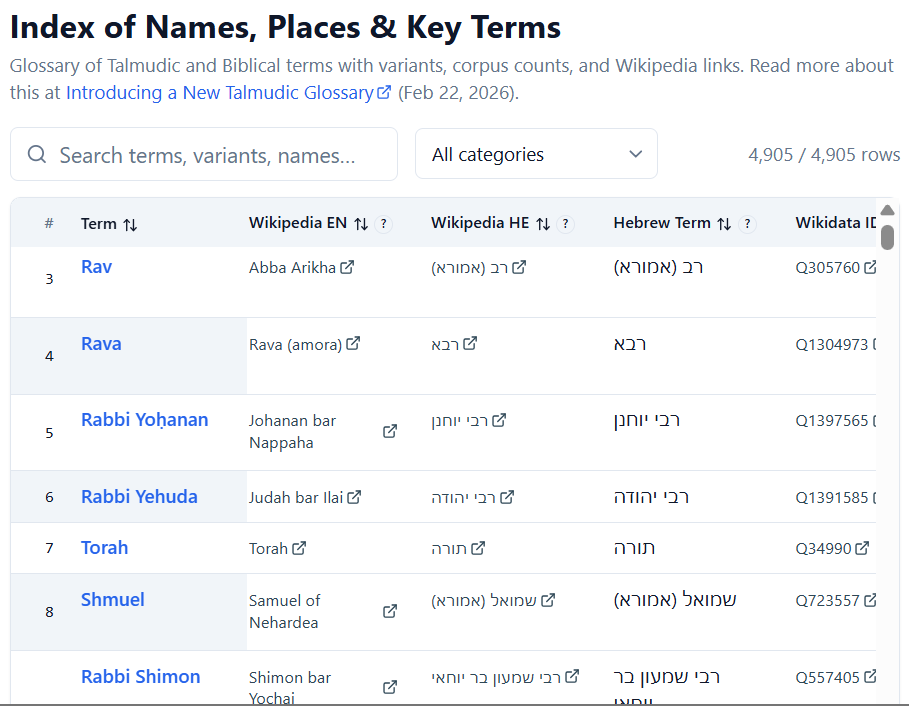
And created a new page on ChavrutAI containing a general Talmudic term index table (based on table that I previously discussed, with a number of further enhancements, such as additional data points for personalities, based on Wikidata).
Screenshot (sorted by Count, from highest; tablet view):
הין.
On this word, see Jastrow (modernized), entry “הֵן 2”, sense #4:
Bava Metzia 49a:6, see הִין II
Mekhilta Yithro section 4 - “answer על לאו לאו ועל הן הן no to a prohibition and yes to a positive command”
Ibid. section 5 - הן והן - “yes, indeed”; and frequently
Nedarim 11a:2, and frequently - מכלל לאו אתה שומע הן - “from the negative we derive the affirmative by implication”
Yerushalmi ibid. 1, end, 37a, and elsewhere - ממשמע לאו וכ׳.
And see also my “Pt3 Divine Names, Oaths, and Curses: Erasure, Sanctity, and Speech (Shevuot 35b-36a)“, section “Rava - Such oaths require doubling—“no, no” / “yes, yes”“:
אמר רבא:
והוא דאמר ״לאו״ ״לאו״
תרי זימני,
והוא דאמר ״הן״ ״הן״
תרי זימני;
Rava said:
And a negative expression is an oath only in a case where one said “no, no”,
stating the term two times,
or it is in a case where one said “yes (הן), yes”,
stating the term two times
Note that I recently changed ChavrutAI’s Bible translation to this translation—Koren Jerusalem, from JPS 1985—as it’s far more literal/closer to the Hebrew original, and thus more conducive to the kind of parallel Hebrew-English alignment that I’m going for.
עסק גדול - literally: “large/great/much doing”.
See Jastrow (modernized), entry עֵסֶק II:
(עָסַק) business, worldly occupation; affair, concern.
[…]
Transferred sense: affair, display.
Mishnah Menachot 10:3 (Menachot 65a:4) - כדי שיהא נקצר בעסק גדול - “that the cutting of the omer may take place with great display” (in the presence of many people)