

This is the third and final part of a three-part series. Part 1 is here, Part 2 is here; the outline of the series can be found at Part 1.
The functions and meanings of ‘ala’, ‘arur’, ‘amen’, and “yes/no”
R’ Abbahu - ‘Ala’ = oath - Ezekiel 17:13; 2 Chronicles 36:13
אמר רבי אבהו:
מנין ל״אלה״ שהיא שבועה?
שנאמר:
״ויבא אתו באלה וגו׳״;
וכתיב:
״וגם במלך נבוכדנצר מרד, אשר השביעו באלהים״.
R’ Abbahu says:
From where is it derived with regard to ala that it is an oath?
It is derived
as it is stated:
“And he took from the seed of the monarchy…and brought it into an ala” (Ezekiel 17:13);
and it is stated with regard to Zedekiah, who was from the seed of the monarchy:
“And he also rebelled against Nebuchadnezzar, who had administered an oath to him by God” (II Chronicles 36:13).
This indicates that the ala is an oath.
Baraita - The word ‘Arur’ carries the triple senses of ostracism, curse, and oath
תנא:
״ארור״ –
בו נידוי,
בו קללה,
בו שבועה.
§ The Talmud proceeds to define a related term.
It is taught with regard to the term arur:
There is an element of ostracism (נידוי) within it,
there is an element of curse within it,
and there is an element of oath (שבועה) within it.
Prooftexts - Judges 5:23; Deuteronomy 27:13,15; Joshua 6:26; 1 Samuel 14:24,27
בו נידוי –
דכתיב: ״אורו מרוז, אמר מלאך ה׳, ארו ארור ישביה״,
ואמר עולא: בארבע מאה שיפורי שמתיה ברק למרוז.
בו קללה –
דכתיב: ״ואלה יעמדו על הקללה״,
וכתיב: ״ארור האיש אשר יעשה פסל וגו׳״.
בו שבועה –
דכתיב: ״וישבע יהושע בעת ההיא לאמר, ארור האיש לפני ה׳ וגו׳״.
[...]
The Talmud elaborates:
There is an element of ostracism within it --
as it is written in the song of Deborah: “Curse [oru] Meroz, said the angel of God; cursed with a curse [oru aror] are its inhabitants” (Judges 5:23).
And Ulla says: With blasts from 400 shofarot, Barak ostracized the city of Meroz, indicating that the term arur has the connotation of ostracism.1
There is an element of curse within it --
as it is written with regard to the ceremony at Mount Gerizim and Mount Ebal: “And these shall stand for the curse” (Deuteronomy 27:13),
and it is written: “Cursed [arur] be the man who fashions a graven image, an abomination to YHWH, the work of the hands of the craftsman, and sets it up in secret. And all the people shall answer and say: Amen” (Deuteronomy 27:15).2
There is an element of oath within it --
as it is written: “And Joshua administered an oath at that time saying: Arur be the man before God who shall arise and rebuild this city, Jericho” (Joshua 6:26).
[...]
R’ Yosei b. Ḥanina - The word ‘Amen’ includes the triple senses of oath, acceptance, and affirmation
אמר רבי יוסי ברבי חנינא:
״אמן״ –
בו שבועה,
בו קבלת דברים,
בו האמנת דברים.
§ R’ Yosei, son of R’ Ḥanina, says
with regard to the term amen:
There is an element of oath within it,
there is an element of acceptance of the statement and agreement within it,
and there is an element of confirmation of the statement (האמנת דברים), i.e., that he believes and prays that the statement will be fulfilled, within it.
Prooftexts - Numbers 5:21–22; Deuteronomy 27:26; Jeremiah 28:6
בו שבועה –
דכתיב: ״ואמרה האשה אמן אמן״.
בו קבלת דברים –
דכתיב: ״ארור אשר לא יקים את דברי התורה הזאת לעשות אותם, ואמר כל העם אמן״.
בו האמנת דברים –
דכתיב: ״ויאמר ירמיה [הנביא] (אל חנניהו), אמן כן יעשה ה׳, יקם ה׳ את דבריך״.
The Talmud elaborates:
There is an element of oath within it --
as it is written: “And the priest shall administer an oath to the woman…and the woman shall say: Amen, amen” (Numbers 5:21–22). “Amen” is the oath that the woman takes.
There is an element of acceptance of the statement within it --
as it is written: “Cursed is he who shall not confirm the matters of this Torah to perform them; and all the people shall say: Amen” (Deuteronomy 27:26), expressing their agreement to fulfill all the matters of the Torah.
There is an element of confirmation of the statement within it --
as it is written: “And Jeremiah the prophet said: Amen, may YHWH do so; may YHWH uphold your statement” (Jeremiah 28:6).
R’ Elazar - The words “No” and “Yes” can function as oaths
אמר רבי אלעזר:
״לאו״ –
שבועה,
״הן״ –
שבועה.
[...]
§ R’ Elazar says:
“No”, or any negative expression --
can be an oath,
and “yes”, or any positive expression --
can be an oath.
[...]
Rava - Such oaths require doubling—“no, no” / “yes, yes”
אמר רבא:
והוא דאמר ״לאו״ ״לאו״
תרי זימני,
והוא דאמר ״הן״ ״הן״
תרי זימני;
Rava said:
And a negative expression is an oath only in a case where one said “no, no”,
stating the term two times,
or it is in a case where one said “yes, yes”,
stating the term two times,
Prooftexts - Genesis 9:11,15
דכתיב:
״ולא יכרת כל בשר עוד ממי המבול״,
״ולא יהיה עוד המים למבול״;
ומד״לאו״ תרי זימני —
״הן״ נמי תרי זימני.
[...]
as it is written:
“All flesh shall not be excised any more by floodwaters” (Genesis 9:11),
and it is again written: “And the waters shall no more become a flood” (Genesis 9:15).
And from the fact that “no” is an oath only when stated two times —
“yes”, too, is an oath only when stated two times.
[...]
Anecdote of Rav Yehuda and Rav Kahana - When citing biblical curse formulas before a teacher, euphemize to 3rd person
״יכך ה׳ אלהים״,
וכן ״יככה אלהים״ –
זו היא אלה הכתובה בתורה
§ The Mishnah teaches that
if one says: YHWH God (אלהים - ‘Elohim’) shall strike you (see Deuteronomy 28:22),
and likewise if one says: God shall strike you if you do not come to testify —
that is a curse that is written in the Torah.
יתיב רב כהנא קמיה דרב יהודה,
ויתיב וקאמר הא מתניתין כדתנן.
אמר ליה: כנה
The Talmud relates:
Rav Kahana sat before Rav Yehuda,
and he sat and stated the Mishnah verbatim as we learned it.
Rav Yehuda said to him: Employ a euphemism3
and formulate it in the third-person rather than the second-person: “God shall strike him” instead of “you”, so that it will not sound as though you are cursing your teacher.
Anecdote of Rav Kahana - Use euphemism when quoting verses of curse - Psalms 52:7
יתיב ההוא מרבנן קמיה דרב כהנא,
ויתיב וקאמר:
״גם אל יתצך לנצח,
יחתך ויסחך מאהל,
ושרשך מארץ חיים
סלה״.
אמר ליה: כנה.
[...]
Likewise, the Talmud relates:
A certain one of the rabbis sat before Rav Kahana,
and he sat and said the verse:
“God will likewise break you forever;
He will take you up and pluck you from the tent,
and uproot you from the land of the living,
Selah” (Psalms 52:7).
Rav Kahana said to him: Employ a euphemism
and formulate it in the third-person rather than the second-person, so that it will not sound as though you are cursing your teacher.
[...]
Appendix 1 - Literary structure of the baraita of the halachic status of potentially divine names (especially ‘Adonai’ and ’Elohim’) in the Bible in Seven contexts: Abraham, Lot, Naboth, Micah, Gibeah of Benjamin, “Shlomo” in Song of Songs, and “king” in Daniel
The Talmudic text, highlighting the literary structure through a numbered list, eliding added glosses.
The passage establishes interpretive rules for determining whether specific ambiguous terms (e.g., “Adonai,” “Solomon,” “King”) refer to God (kodesh) or to a human (ḥol).
In several cases the default assumption is reversed for a single verse, identified by contextual indicators. In one case (Gibeah of Benjamin) there is a tannaitic dispute.
Table summarizing:
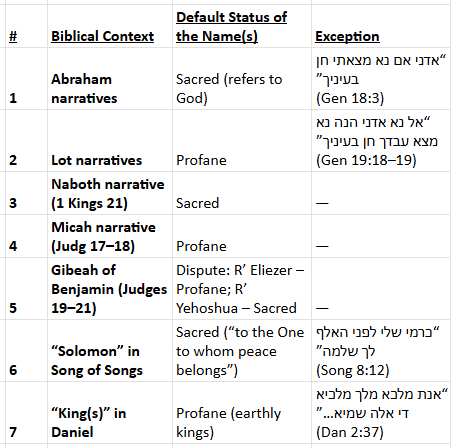
כל שמות האמורים בתורה באברהם –
קדש;
חוץ מזה --
שהוא חול
שנאמר: ״ויאמר, אדני אם נא מצאתי חן בעיניך״ [...]
כל שמות האמורים בלוט –
חול;
חוץ מזה --
שהוא קדש
שנאמר:
״ויאמר לוט אלהם: אל נא אדני, הנה נא מצא עבדך חן בעיניך וגו׳״ [...]
כל שמות האמורים בנבות –
קדש,
במיכה –
חול [...]
כל שמות האמורים בגבעת בנימין –
רבי אליעזר אומר: חול,
רבי יהושע אומר: קדש [...]
כל ״שלמה״ האמורין בשיר השירים –
קדש,
שיר למי שהשלום שלו;
חוץ מזה:
״כרמי שלי לפני האלף לך שלמה״ [...]
כל מלכיא האמורים בדניאל –
חול;
חוץ מזה --
שהוא קדש:
״אנת מלכא [מלך] מלכיא די אלה שמיא, מלכותא חסנא ותקפא ויקרא יהב לך״.
Appendix 2 - Divine Names, Oaths, and Blasphemy: A Modern Scholarly Framing
From a modern scholarly Bible-studies angle, this sugya preserves late antique rabbinic norms layered over much older Israelite language and practice. It treats the written lexeme as a unit of sanctity and the spoken formula as a unit of legal force. Modern questions are different: What did these words mean in their biblical settings? How did their usage change across literary strata? And how did scribal and liturgical habits reshape both meaning and law?
Divine Names As Epithet Systems, Not a Flat List
“YHWH,” “Elohim,” “Shaddai,” “Adonai,” and “Tzevaot” are not interchangeable labels. In biblical Hebrew, each has its own history and distribution:
“YHWH” functions as the personal name of Israel’s God, prominent in sources typically labeled J/D (and widely in later redaction).
“Elohim” is grammatically plural but governs singular verbs when referring to Israel’s God—best understood as a conventional singular of majesty or an abstract noun reanalyzed as a proper name.
“Shaddai” clusters in older poetic strata and Job
“Tzevaot” (“of armies/hosts”) is an epithet attached to YHWH in monarchic-era texts, likely invoking celestial armies.
“Adonai,” in biblical voice, means “my Lord,” but by Second Temple times it also serves as the spoken substitute (qere) for the written Tetragrammaton.
The sugya’s debate over which fragments/affixes “count” treats the name as a bounded string; modern philology treats these as distinct lexical items with context-driven reference. Thus R’ Yosei’s claim that “Tzevaot” names Israel’s hosts runs against the dominant modern reading that “hosts” are divine/celestial retinues; the sugya’s halakhic outcome still turns on late meanings rather than monarchic-era semantics.
Scribal Practice and the Tetragrammaton
The non-erasure of the Tetragrammaton coheres with Second Temple and rabbinic avoidance of pronouncing or defacing the name. The prefix/suffix discussions match real Hebrew morphology: preposed clitics (ל־, ב־, ו־, etc.) and pronominal suffixes on “Elohei–” are not part of the root lexeme. The dispute whether the name “sanctifies” a following suffix shows a halakhic theory of graphic contagion: once the divine lexeme appears, adjacency may acquire status.
Modern textual criticism would separate morphology (what belongs to the lexeme) from paratextual sanctity (what scribal culture protects). The ruling aligns with the growth of genizah practice and with care for written sancta rather than with biblical-era orthographic habits.
Narrative Casework vs. Source Criticism
The sugya classifies occurrences in Abraham/Lot, Micah/Naboth, Gibeah, Song of Songs, and Daniel by asking: is this a divine reference or not? Modern literary history asks a different question: which layer authored or reframed these scenes, and how did theology shift?
Judges 17–18 (Micah) and Judges 20 (Gibeah) belong to Deuteronomistic storytelling that polemicizes against non-central cults. Consulting “God” in Gibeah likely denotes YHWH oracular practice embedded in a narrative that condemns Benjamin’s crime and Israel’s fractured polity; labeling those references “idolatrous” (per R’ Eliezer) is a rabbinic move to align the story with a later theology of centralized legitimacy.
Likewise, the Song-of-Songs re-reading of “Shlomo” as a theonymic hint (“to the One whose peace is His”) is midrashic; modern criticism reads superscriptions and royal imagery as literary framing devices within a love anthology, not as covert theonyms.
Daniel’s “King” and Aramaic Polysemy
The sugya’s hesitation over ‘Mari’ (מרי - “my lord”) in Daniel highlights Aramaic honorific ambiguity. Court Aramaic often addresses human kings as “lord,” while prayer scenes address God with overlapping honorifics. Modern philology resolves individual cases by syntax, scene, and versional evidence. The takeaway is not a fixed rule but the need for contextual disambiguation; the sugya’s rulings model exactly that, albeit in service of halakha rather than philological neutrality.
Oath and Curse As Performative Speech
Alah (אלה), arur, and amen are performatives in the biblical world. Comparative texts (Levantine and Mesopotamian treaties, Israelite covenant ceremonies) use maledictions and self-imprecations to bind parties. Modern linguistics would say: these are conventionalized illocutionary acts that create obligations. The sugya’s triads—arur as ostracism/curse/oath and amen as oath/acceptance/affirmation—map these functions closely to biblical usage. The insistence that arur is part of the oath (not an added curse) matches treaty formulae where the curse line is the oath itself. R’ Elazar’s “yes/no” as oaths, and Rava’s requirement of doubling, reflect known biblical emphatic patterns; critically, such rules canonize pragmatic cues (redundancy, parallel lines) into justiciable standards.
Blasphemy, Appellations, and Historical Law
Leviticus 24 likely belongs to the Holiness corpus. Historically, the narrative concerns a public pronouncement “of the Name” (נקב השם)--explicit use of YHWH in cursing. The sugya’s split—death for the Tetragrammaton, prohibition for appellations—tracks a late reverence gradient: the ineffable name is uniquely dangerous, while titles remain powerful but not capital. This corresponds to post-biblical avoidance of uttering the Tetragrammaton and rise of substitutes (Adonai, later ha-Shem). The extension of liability to curses at parents only when the Tetragrammaton is used narrows biblical rhetoric into a precise evidentiary rule; historically, the Bible’s legal materials are broader and less procedural, but rabbinic law formalizes proof conditions for capital cases.
Lexeme, Reference, and Pragmatics
At base, two modern distinctions clarify the sugya. First, “lexeme” vs. “reference”: ‘Adonai’ can refer to humans or to God; only context disambiguates. The sugya codifies this with case-by-case labels “sacred/non-sacred,” while modern criticism traces diachronic usage and redactional framing. Second, semantics vs. pragmatics: an oath’s force lies in conventional form and context, not only in vocabulary. The sugya preserves that insight by treating ala, arur, amen, “yes/no,” and even negated blessings as binding speech acts under defined conditions.
What This Means For Reading the Bible
The sugya is a late antique regulatory project: it protects written sancta, constrains speech that invokes God, and retrofits biblical narratives to a stable theology of proper worship. Modern critical study reconstructs earlier stages: how titles and names circulated, how redactors framed them, and how oath-curses functioned in treaty and cult. The two projects intersect in one place: close attention to context. Where the sugya yields halakhic consequences, modern analysis yields historical-linguistic explanations. Read together, they show how Israelite theonyms and oath formulas moved from flexible discourse to guarded, rule-governed categories—and why later readers had to decide where the name ends, what sanctifies what, and which words still make a promise—or a crime.
Appendix 3 - The protocol for judging the capital crime of blasphemy (Mishnah Sanhedrin 7:5)
Mishnah_Sanhedrin.7.5 (=Sanhedrin.55b.15-56a.3)
המגדף --
אינו חיב עד שיפרש השם.
אמר רבי יהושע בן קרחה:
בכל יום דנין את העדים בכנוי:
“יכה יוסי את יוסי”
One who blasphemes (מגדף), i.e., one who curses God --
is not liable unless he utters the name of God (i.e. the Tetragrammaton - ‘YHWH’) and curses it.
R’ Yehoshua ben Korḥa said:
On every day of a blasphemer’s trial, when the judges judge the witnesses, i.e., interrogate the witnesses, they ask the witnesses to use an appellation for the name of God, so that they do not utter a curse of God’s name.
Specifically, the witnesses would say: “Let Yosei4 smite Yosei”
נגמר הדין —
לא הורגים בכנוי
When the judgment is over, and the court votes to deem the defendant guilty —
they do not sentence him to death based on the testimony of the witnesses in which they used an appellation for the name of God,
without having ever heard the exact wording of the curse.
אלא מוציאים כל אדם לחוץ
ושואלים את הגדול שבהן
ואומרים לו: אמר מה ששמעת בפרוש,
והוא אומר,
והדינים עומדין על רגליהן וקורעין
ולא מאחין
Rather, they remove all the people who are not required to be there from the court, so that the curse is not heard publicly,
and the judges interrogate the eldest of the witnesses,
and say to him: Say what you heard explicitly.
And he says exactly what he heard.
And the judges stand on their feet and make a tear in their garments, as an act of mourning for the desecration of the honor of God.5
And they do not ever fully stitch it back together again.6
והשני אומר:
אף אני כמוהו,
והשלישי אומר:
אף אני כמוהו
And the 2nd witness says:
I too heard as he did, but he does not repeat the curse explicitly.
And the 3rd witness, in the event that there is one, says:
I too heard as he did.
In this manner, the repetition of the invective sentence is limited to what is absolutely necessary.
On shofars being used as part of the ostracism ritual, see my recent “Pt2 Elisha Narratives in II Kings 2-8, From Failure to Accompany to Failure to Reprove Gently: Jericho’s Youths, Bethel’s Bears, Gehazi, and the Principle of Measured Rejection (Sotah 46b-47a)“, section “Jesus’ faux pas and consequent excommunication“, and my note there.
כנה - literally: “epithet”, i.e. a replacement word that’s less harsh and direct.
On this word, see my note on Part 1. And see also the appendix at the end of this piece: “Appendix 3 - The protocol for judging the capital crime of blasphemy (Mishnah Sanhedrin 7:5)“.
יוסי - ‘YWSY’.
Steinsaltz explains:
as the name “Yosei” has four letters in Hebrew, as does the Tetragrammaton (=’YHWH’)
Note also that ‘YWSY’ and ‘YHWH’ are similar in that both start with a yod (‘Y’), and conclude with a consonant followed by a similar-sounding vowel.
On the requirement to tear clothing in the case of blasphemy, and in many other cases as well, see my “Appendix 2 - The Obligation to tear clothing in Mourning upon hearing bad news relating to Personal Loss and National Disaster (Moed Katan 25b-26a)“, especially section “Baraita - The Obligation to tear clothing in Mourning upon hearing bad news relating to Personal Loss and National Disaster: A List of 11 Items“.
See ibid. (passage cited in previous footnote):
ואלו קרעין שאין מתאחין
[…]
And these are the rents of mourning that may never be properly mended (מתאחין)
[…]