

This is the second part of a three-part series. Part 1 is here; the outline of the series can be found at Part 1.
Talmud
Baraita - ‘El’ (‘EL’) from ‘Elohim’ (‘ELYHM’) and ‘Yah’ (‘YH’) from ‘YHWH’ (=Tetragrammaton) may not be erased; ‘Shed’ (‘SD’) from ‘Shaddai’ (‘SDY’), ‘Ad’ (‘AD’) from ‘Adonai’ (‘ADNY’), and ‘ZV’ from ‘Tzevaot (‘ZVAOT’) may be erased
תנו רבנן:
כתב אלף למד מ״אלהים״,
״יה״ מ״יי״ –
הרי זה אינו נמחק.
שין דלת מ״שדי״,
אלף דלת מ״אדני״,
צדי בית מ״צבאות״ –
הרי זה נמחק.
§ Apropos the names of God that may be erased and those that may not be erased, the Talmud discusses the details of the matter.
A baraita states:
If one wrote the letters alef lamed from the name Elohim,
or yod heh from the Tetragrammaton --
this pair of letters and that pair of letters may not be erased.
But if one wrote the letters shin dalet from Shaddai,
or alef dalet from Adonai,
or tzadi beit from Tzevaot --
this may be erased.
R’ Yosei - The word “Tzevaot” is allowed to be erased; it names Israel’s hosts, not an independent name of God
רבי יוסי אומר:
״צבאות״ כולו נמחק
שלא נקרא צבאות אלא על שם ישראל
R’ Yosei says:
The word tzevaot may be erased in its entirety,
as God is called Tzevaot only in the context of the children of Israel,
and it is not an independent name of God
Prooftext - Exodus 7:4
שנאמר:
״והוצאתי את צבאתי
את עמי בני ישראל
מארץ מצרים״
as it is stated:
“And I shall bring forth My hosts [tzivotai],
My people the children of Israel,
out of the land of Egypt” (Exodus 7:4).
אמר שמואל:
אין הלכה כרבי יוסי.
Shmuel says:
The halakha is not in accordance with the opinion of R’ Yosei.
Baraita - Prefixes or suffixes attached to God’s name are allowed to be erased
The baraita rules that letters grammatically attached to a Divine Name—whether prefixes (i.e., prepositions or conjunctions) or pronoun suffixes—are considered ancillary and may be erased. (I.e., the prohibition against erasing applies only to the core Divine Name itself.)
Table summarizing:
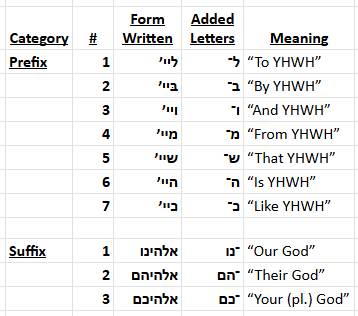
תנו רבנן:
כל הטפל לשם,
בין מלפניו
ובין מלאחריו –
הרי זה נמחק.
A baraita states:
Any letters ancillary (טפל) to the name of God,
whether as a prefix preceding the name
or as a suffix succeeding the name --
this addition may be erased.
Seven Prefixes: ל־, ב־, ו־, מ־, ש־, ה־, כ־
לפניו כיצד?
״ליי׳״ –
ל׳ נמחק;
״ביי׳״ –
ב׳ נמחק;
״ויי׳״ –
ו׳ נמחק;
״מיי׳״ –
מ׳ נמחק;
״שיי׳״ –
ש׳ נמחק;
״היי׳״ –
ה׳ נמחק;
״כיי׳״ –
כ׳ נמחק.
Preceding it, how so?
If one wrote the Tetragrammaton with the prefix lamed, meaning: To YHWH,
the lamed may be erased;
the Tetragrammaton with the prefix beit, meaning: By YHWH,
the beit may be erased;
the Tetragrammaton with the prefix vav, meaning: And YHWH,
the vav may be erased;
the Tetragrammaton with the prefix mem, meaning: From YHWH,
the mem may be erased;
the Tetragrammaton with the prefix shin, meaning: That YHWH,
the shin may be erased;
the Tetragrammaton with the prefix heh, meaning: Is YHWH,
the heh may be erased;
the Tetragrammaton with the prefix kaf, meaning: Like YHWH,
the kaf may be erased.
Three Suffixes in ‘Elohei + -nu/-hem/-khem’
לאחריו כיצד?
״אלהינו״ –
נו נמחק,
״אלהיהם״ –
הם נמחק,
״אלהיכם״ –
כם נמחק.
Succeeding it, how so?
If one wrote Eloheinu, meaning: Our God,
the nun vav suffix may be erased;
Eloheihem, meaning: Their God,
the heh mem suffix may be erased;
Eloheikhem, meaning: Your God, second person plural,
the kaf mem suffix may be erased.
Alternative opinion - Suffix after the divine name is prohibited to erase; the name sanctifies it
אחרים אומרים:
לאחריו אינו נמחק,
שכבר קדשו השם
Aḥerim say:
The suffix succeeding the name of God may not be erased
as the name of God to which it is appended already sanctified it
and it is considered as though it is part of the name.
אמר רב הונא:
הלכה כאחרים.
Rav Huna says:
The halakha is in accordance with the opinion of Aḥerim.
The halachic status of potentially divine names (especially ‘Adonai’ and ’Elohim’) in the Bible in Seven contexts: Abraham, Lot, Naboth, Micah, Gibeah of Benjamin, “Shlomo” in Song of Songs, and “king” in Daniel
All divine names in the context of Abraham are sacred
כל שמות האמורים בתורה באברהם –
קדש
All names that could be understood as the name of God that are stated in the Torah with regard to Abraham --
are sacred and are referring to God
…except Gen 18:3, which is non-sacred (“my lords”)
חוץ מזה --
שהוא חול
שנאמר:
״ויאמר,
אדני
אם נא מצאתי חן בעיניך״
except for this name --
which is non-sacred,
as it is stated:
“And he said:
My lords (adonai),
if I have found favor in your eyes” (Genesis 18:3).
In that passage, Abraham is addressing the angels who appeared to him in the guise of men, not God.
Ḥanina (R’ Yehoshua’s nephew) & R’ Elazar ben Azarya, citing R’ Elazar HaModa’i - Even Gen 18:3 is sacred (Abraham addressing God)
חנינא בן אחי רבי יהושע
ורבי אלעזר בן עזריה
משום רבי אלעזר המודעי
אמרו:
אף זה קדש.
[...]
Ḥanina, son of the brother of R’ Yehoshua,
and R’ Elazar ben Azarya
in the name of R’ Elazar HaModa’i,
say:
This too is sacred.
[...]
All divine names in the context of Lot are non-sacred
כל שמות האמורים בלוט –
חול
All names that could be understood as the name of God that are stated in the Torah with regard to Lot --
are non-sacred and are referring to angels
… except Gen 19:18–19, which is sacred (address to God who can kill/vivify)
חוץ מזה --
שהוא קדש
שנאמר:
״ויאמר לוט אלהם:
אל נא אדני,
הנה נא מצא עבדך חן בעיניך וגו׳״
מי שיש בידו להמית ולהחיות,
זה הקדוש ברוך הוא.
except for this one --
which is sacred,
as it is stated:
“And Lot said to them:
Please, not so Adonai.
Behold your servant has found favor in your eyes, and you have magnified Your mercy that You have performed for me by saving my life” (Genesis 19:18–19).
It is apparent from the context that Lot is addressing He Who has the capacity to kill and to vivify;
that is God.
All divine names in the context of Naboth (1 Kings 21) are sacred
כל שמות האמורים בנבות –
קדש
All names that are stated with regard to Naboth --
are sacred,
e.g., in the verse: “Naboth blasphemed Elohim and the king” (I Kings 21:13)
… in the context of Micah (Judges 17–18): non-sacred (idol)
במיכה –
חול
and those stated with regard to Micah --
are non-sacred
and are referring to the graven image that he fashioned (see Judges, chapters 17–18).
R’ Eliezer - In Micah: Tetragrammaton (‘YHWH’) forms are sacred; ‘Adonai’ forms are non-sacred
רבי אליעזר אומר:
בנבות –
קדש
R’ Eliezer says:
Indeed, all names that are stated with regard to Naboth --
are sacred
במיכה –
יש מהן
חול
ויש מהן
קדש.
אלף למד –
חול,
יוד הי –
קדש;
but those stated with regard to Micah --
some of them
are non-sacred
and some of them
are sacred.
The names beginning with the letters alef lamed, i.e., Elohim,
are non-sacred, as the reference is to the idol that he crafted,
and all the names beginning with the letters yod heh, i.e., the Tetragrammaton,
are sacred
… except Judges 18:31 where ‘Adonai’ is sacred - Judges 18:31
חוץ מזה, שאלף למד והוא קדש:
״כל ימי היות בית האלהים בשילה״.
except for this name that begins with the letters alef lamed and it is sacred:
“All the time that the house of Elohim was in Shiloh” (Judges 18:31).
R’ Eliezer - Divine names in the Gibeah of Benjamin narrative are non-sacred - Judges 20
כל שמות האמורים בגבעת בנימין –
רבי אליעזר אומר: חול,
רבי יהושע אומר: קדש.
All names that are stated in the passage concerning Gibeah of Benjamin1 --
R’ Eliezer says: They are non-sacred, as they were consulting an idol, not God.
R’ Yehoshua says: They are sacred.
R’ Yehoshua - They are sacred; God answered according to what they asked; full consent only the third time
אמר לו רבי אליעזר:
וכי מבטיח ואינו עושה?!
R’ Eliezer said to R’ Yehoshua:
How can you say that those names are sacred? Does God promise and not fulfill the promise?!2
אמר לו רבי יהושע:
מה שהבטיח עשה
R’ Yehoshua said to R’ Eliezer:
That which God promised, He fulfilled.
In each case, He responded to their question:
והם לא ביחנו
אם לנצוח
אם לנצח.
באחרונה שביחנו –
הסכימו על ידן
The first time they consulted God through the Urim VeTummim, but they did not seek to ascertain
if they are to triumph in the war
or if they are to be defeated.
In the last time that they consulted God through the Urim VeTummim, where they sought to ascertain whether they would emerge triumphant --
they consented in Heaven to their endeavor,
Prooftext - Judges 20:28
שנאמר:
״ופנחס בן אלעזר בן אהרן (הכהן) עמד לפניו בימים ההם לאמר:
האוסף עוד לצאת למלחמה עם [בני] בנימן אחי
אם אחדל וגו׳״.
as it is stated:
“And Pinehas, son of Elazar, son of Aaron was standing before it in those days, saying:
Shall I yet again go out to battle against the children of Benjamin my brother,
or shall I cease? And YHWH said: Go up, as tomorrow I will deliver them into your hand” (Judges 20:28).
All appearances of the word “Shlomo” in Song of Songs are sacred—“to the One whose peace is His”
כל ״שלמה״ האמורין בשיר השירים –
קדש,
שיר למי שהשלום שלו;
All mentions of the name Shlomo that are stated in the Song of Songs, such as: “The song of songs that is Shlomo’s” (Song of Songs 1:1) --
are not references to King Solomon; rather, they are sacred,
meaning a song to the One for Whom peace [she-ha-shalom] is His,
... except 8:12 (Solomon himself; “200” for the rabbis) - 8:12
חוץ מזה:
״כרמי שלי לפני, האלף לך שלמה״ –
שלמה לדידיה,
״ומאתים לנטרים את פריו״ –
רבנן.
except for this mention:
“My vineyard, which is mine, is before me; you, Solomon shall have the 1,000,”
i.e., 1,000 are for Solomon himself;
“and 200 for those who guard its fruit” (Song of Songs 8:12),
which is a reference to the rabbis.
Alternate view - Also 3:7 (“bed of Solomon”) is non-sacred
ויש אומרים:
אף זה חול:
״הנה מטתו שלשלמה ששים״.
[...]
And some say:
This verse too is non-sacred:
“Behold, the bed of Solomon; 60 mighty men are around it” (Song of Songs 3:7).
[...]
Shmuel -
[…]
אמר שמואל:
מלכותא דקטלא חד משיתא בעלמא —
לא מיענשא
[…]
Shmuel says:
A monarchy that kills one of every six individuals in the world —
is not punished for doing so,
as that is the prerogative of a monarch
Prooftext - “1,000” = heavenly monarchy; “200” = earthly monarchy - Song 8:12; 3:7
שנאמר:
״כרמי שלי לפני האלף לך שלמה״ –
למלכותא דרקיעא,
״ומאתים לנטרים את פריו״ –
למלכותא דארעא
[...]
as it is stated:
“My vineyard, which is mine, is before me; you, Shlomo shall have the 1,000,”
this is a reference to the monarchy of Heaven;
“and 200 for those who guard its fruit,”
this is a reference to the monarchy of earth.
Of the 1,200 mentioned in the two parts of the verse, 200, or one-sixth, are the prerogative of the earthly monarch.
[...]
All appearances of the word “king” in Daniel are non-sacred
כל מלכיא האמורים בדניאל –
חול
All kings that are stated with regard to Daniel —
are non-sacred
… except 2:37, which is sacred - Daniel 2:37
חוץ מזה --
שהוא קדש:
״אנת מלכא [מלך] מלכיא
די אלה שמיא,
מלכותא
חסנא
ותקפא
ויקרא
יהב לך״.
except for this one --
which is sacred:
“You, O king, king of kings,
unto whom the God of heaven
the kingdom,
the power,
and the strength,
and the glory
has given you ” (Daniel 2:37).
Alternative view - 4:16 is also sacred; “my Lord” (‘Mari’) addressed to God, not Nebuchadnezzar - Daniel 4:16
ויש אומרים:
אף זה קדש
שנאמר:
״מרי
חלמא לשנאך
ופשרה לערך״
למאן קאמר?
אי סלקא דעתך לנבוכד נצר קאמר ליה,
שנאותיה מאי נינהו?
ישראל;
מילט קא לייט להו לישראל?!
[...]
And some say:
This too is sacred,
as it is stated:
“My Lord,
the dream shall be for your enemy
and its interpretation for your foe” (Daniel 4:16).
To whom is Daniel saying this?
If it enters your mind that when Daniel says: “My lord,” it is to Nebuchadnezzar that he is saying it,
“his enemy”, who are they?
They are the Jewish people.
Would Daniel curse the Jewish people?!
[...]
גבעת בנימין.
Steinsaltz explains:
where the rest of the tribes consulted God to determine whether they should go to war against the tribe of Benjamin (see Judges, chapter 20)
For more on this story, see Wikipedia, “Judges 20“, section “Benjaminite War (20:12–48)“:
The war between the tribe of Benjamin against the other tribes of Israel consists of three battles with similar structure of reports in this chapter.
The focus is on how the people of Israel would gradually humble themselves before YHWH (after two losses), so that the goals of Israel and YHWH would coincide (a huge victory against the Benjaminites.
And see also Wikipedia, “Levite’s concubine“, section “The war against Benjamin“.
Steinsaltz explains:
Twice the tribes received the response to go to war against Benjamin, and twice they were vanquished.
In other words, R’ Eliezer presents this as evidence for his view: the erroneous prophecy shows that they must not have been consulting God, but rather an unauthorized oracle.
Notably, the divine name used there is both Elohim, as well as the Tetragrammaton (YHWH). This would mean that according to R’ Eliezer, the Tetragrammaton (YHWH) in this narrative doesn’t technically refer to God. Presumably, according to him, this was a false prophecy in God’s name.
Compare my “Roasted in Nebuchadnezzar’s Furnace: The Fall of Two Minor False Prophets and Joshua the High Priest, based on Jeremiah 29 and Zechariah 3 (Sanhedrin 93a)“, especially section “Sexual Misconduct - Told Nebuchadnezzar’s daughter that God commanded her to have sex with the other - Jeremiah 29:23“, where each (falsely) prophesizes in the name of YHWH, using the traditional opener for prophecy (“so says YHWH”).
The first two consultations in Judges 20—respectively preceding Israel’s initial two defeats by Benjamin—are in verses 18 and 23 (the third consultation in verse 28—which preceded Israel’s final success at vanquishing Benjamin—is cited by the Talmud in the next section):
Verse 18:
ויקמו ויעלו בית אל
וישאלו באלהים
ויאמרו בני ישראל:
מי יעלה לנו בתחלה
למלחמה עם בני בנימן?
ויאמר יהוה:
יהודה בתחלה
They proceeded to Bethel
and inquired of God (אלהים - Elohim);
the Israelites asked:
“Who of us shall advance first
to fight the Benjaminites?”
And YHWH replied:
“Judah first.”
Verse 23:
ויעלו בני ישראל
ויבכו לפני יהוה עד הערב
וישאלו ביהוה לאמר:
האוסיף לגשת למלחמה
עם בני בנימן אחי
ויאמר יהוה:
עלו אליו
For the Israelites went up
and wept before YHWH until evening.
They inquired of YHWH:
“Shall we again join battle
with our kinsmen the Benjaminites?”
And YHWH replied:
“March against them.”