

This is the second and final part of a two-part series. Part 1 is here; the outline of the series can be found at Part 1.
Rav Yehuda bar Idi citing R’ Yoḥanan - Shekhina departed Temple in 10 stages; paralleled by 10 exiles of the Sanhedrin
אמר רב יהודה בר אידי, אמר רבי יוחנן:
עשר מסעות נסעה שכינה,
מקראי,
וכנגדן גלתה סנהדרין,
מגמרא.
§ Rav Yehuda bar Idi said that R’ Yoḥanan said:
The Shekhina traveled 10 journeys,1 i.e., it left the Temple and Eretz Yisrael in ten stages at the time of the destruction of the First Temple (in the year 587 BCE),
as derived from verses.
And corresponding to them the Sanhedrin was exiled (גלתה) in 10 stages at the end of the Second Temple period and after the destruction of the Temple (in the year 70 CE),
and this is known from tradition (גמרא).
Shekhina departed the Temple in 10/11 stages: Ark cover → Cherub #1 → Cherub #2 → Threshold → Courtyard → Altar → Roof → Wall → City → Mountain → Wilderness → Heaven
Table summarizing the following two sections:2
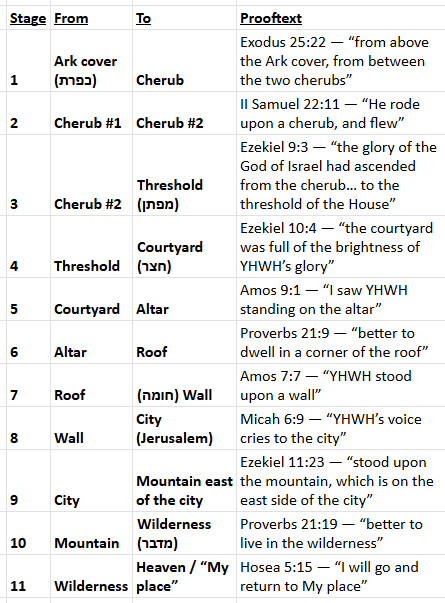
[Temple] Ark cover (כפרת)
[Temple] Cherub #1
[Temple] Cherub #2
[Temple] Threshold (מפתן)
[Temple] Courtyard (חצר)
[Temple] Altar
[Temple] Roof
[Temple] Wall (חומה)
City (=Jerusalem)
Mountain3
Wilderness (מדבר)
עשר מסעות נסעה שכינה,
מקראי:
מכפרת
לכרוב,
ומכרוב
לכרוב,
ומכרוב
למפתן,
וממפתן
לחצר,
ומחצר
למזבח,
וממזבח
לגג,
ומגג
לחומה,
ומחומה
לעיר,
ומעיר
להר,
ומהר
למדבר,
וממדבר
עלתה וישבה במקומה
שנאמר: ״אלך אשובה אל מקומי״.
The Talmud elaborates.
The Shekhina traveled ten journeys,
as derived from verses.
The ten journeys are:
From the Ark cover
to the cherub;
and from one cherub
to the other cherub;
and from the second cherub
to the threshold of the Sanctuary;
and from the threshold
to the courtyard;
and from the courtyard
to the altar;
and from the altar
to the roof;
and from the roof
to the wall of the Temple Mount;
and from the wall
to the city;
and from the city
to a mountain close to Jerusalem;
and from that mountain
to the wilderness;
and from the wilderness
it (=Shekhina) ascended and rested in its place in Heaven, removed from humanity,
as it is stated: “I will go and return to My place” (Hosea 5:15).
Shekhina departed Temple in 10/11 stages - prooftexts
מכפורת לכרוב,
מכרוב לכרוב,
ומכרוב למפתן —
דכתיב: ״ונועדתי לך שם, ודברתי אתך מעל הכפורת״,
וכתיב: ״וירכב על כרוב ויעף״,
וכתיב: ״וכבוד אלהי ישראל נעלה מעל הכרוב, אשר היה עליו, אל מפתן הבית״.
וממפתן לחצר,
דכתיב: ״וימלא הבית את הענן, והחצר מלאה את נגה כבוד ה׳״.
מחצר למזבח,
דכתיב: ״ראיתי את ה׳ נצב על המזבח״.
וממזבח לגג,
דכתיב: ״טוב לשבת על פנת גג״.
מגג לחומה,
דכתיב: ״והנה ה׳ נצב על חומת אנך״.
מחומה לעיר,
דכתיב: ״קול ה׳ לעיר יקרא״.
ומעיר להר,
דכתיב: ״ויעל כבוד ה׳ מעל תוך העיר, ויעמד על ההר אשר מקדם לעיר״.
ומהר למדבר,
דכתיב: ״טוב שבת בארץ מדבר״.
וממדבר עלתה וישבה במקומה,
דכתיב: ״אלך אשובה אל מקומי וגו׳״.
The Talmud cites the sources for each of these stages:
From the Ark cover the Shekhina traveled to the cherub,
and from one cherub to the other cherub,
and from the second cherub to the threshold,
as it is written with regard to Moses in the Tabernacle: “And there I will meet with you, and I will speak to you from above the Ark cover, from between the two cherubs” (Exodus 25:22).
And it is written: “And He rode upon a cherub, and flew” (II Samuel 22:11), which indicates that the glory of the Shekhina can rest upon one cherub.
And it is written: “And the glory of the God of Israel had ascended from the cherub, on which it was, to the threshold of the House” (Ezekiel 9:3), i.e., the Shekhina moved from the cherub to the threshold.
And from the threshold of the Sanctuary the Shekhina went to the courtyard,
as it is written: “And the House was filled with the cloud, and the courtyard was full of the brightness of YHWH’s glory” (Ezekiel 10:4).
From the courtyard to the altar,
as it is written: “I saw YHWH standing on the altar” (Amos 9:1).
And from the altar to the roof,
as it is written: “It is better to dwell in a corner of the roof than in a house together with a contentious woman” (Proverbs 21:9).
From the roof to the wall,
as it is written: “And behold, YHWH stood upon a wall made by a plumb line” (Amos 7:7).
From the wall to the city,
as it is written: “YHWH’s voice cries to the city” (Micah 6:9).
And from the city the Shekhina arose to the mountain nearest the Sanctuary, i.e., the Mount of Olives,
as it is written: “And the glory of YHWH went up from the midst of the city, and stood upon the mountain, which is on the east side of the city” (Ezekiel 11:23).
And from the mountain to the wilderness,
as it is written: “It is better to live in the wilderness than with a contentious and fretful woman” (Proverbs 21:19).
And from the wilderness it ascended and rested in its place in Heaven,
as it is written: “I will go and return to My place until they acknowledge their guilt” (Hosea 5:15).
R’ Yoḥanan - Shekhina lingered in wilderness 6 months hoping Israel would repent; when they did not, it abandoned them - Job 11:20
אמר רבי יוחנן:
ששה חדשים נתעכבה שכינה לישראל במדבר,
שמא יחזרו בתשובה.
כיון שלא חזרו —
אמר: תיפח עצמן,
R’ Yoḥanan said:
For 6 months the Shekhina lingered (נתעכבה) in the wilderness, waiting for the Jewish people,
hoping that perhaps they would repent and it would be able to return to its place.
When they did not repent --
the Shekhina said: Let them despair and be lost,
שנאמר:
״ועיני רשעים תכלינה
ומנוס אבד מנהם
ותקותם מפח נפש״.
as it is stated:
“But the eyes of the wicked shall fail,
and they shall have no way to flee,
and their hope shall be the drooping of the soul” (Job 11:20).
This concludes the discussion of the ten stages of the exile of the Shekhina from the Holy of Holies.
The Exile of the Sanhedrin in 10/11 stages: Chamber of Hewn Stone (in the Jerusalem Temple) → Ḥanut → Jerusalem → Yavne → Usha → Yavne → Usha → Shefaram → Beit She’arim → Tzippori → Tiberias - Isaiah 29:4
Chamber of Hewn Stone
Ḥanut
Jerusalem
Yavne (1st time)
Usha (1st time)
Yavne (2nd time)
Usha (2nd time)
Shefaram
Beit She’arim
Tzippori
Tiberias
וכנגדן גלתה סנהדרין,
מגמרא:
מלשכת הגזית
לחנות,
ומחנות
לירושלים,
ומירושלים
ליבנה,
ומיבנה
לאושא,
ומאושא
ליבנה,
ומיבנה
לאושא,
ומאושא
לשפרעם,
ומשפרעם
לבית שערים,
ומבית שערים
לצפורי,
ומצפורי
לטבריא.
וטבריא עמוקה מכולן,
שנאמר: ״ושפלת מארץ תדברי״.
And corresponding to these ten stages, the Sanhedrin was exiled in ten stages at the end of the Second Temple period and after the destruction of the Temple,
and this is known from tradition:
From the Chamber of Hewn Stone, its fixed seat in the Temple,
to Ḥanut, literally, shop, a designated spot on the Temple Mount outside the Temple proper;
and from Ḥanut
to Jerusalem;
and from Jerusalem
to Yavne;
and from Yavne
to Usha;
and from Usha
it returned to Yavne;
and from Yavne
it went back to Usha;
and from Usha
to Shefaram;
and from Shefaram
to Beit She’arim;
and from Beit She’arim
to Tzippori;
and from Tzippori
to Tiberias.
And Tiberias is lower than all of them, as it is in the Jordan Valley.
A verse alludes to these movements, as it is stated: “And brought down, you shall speak out of the ground” (Isaiah 29:4).
R’ Elazar - 6 exiles of the Sanhedrin - Isaiah 26:5
רבי אלעזר אומר:
שש גלות,
שנאמר:
״כי השח יושבי מרום
קריה נשגבה
ישפילנה
ישפילה
עד ארץ
יגיענה עד עפר״.
R’ Elazar says:
There are 6 exiles, if you count only the places, not the number of journeys,
and a different verse alludes to this, as it is stated:
“For He has brought down (השח) those who dwell high (מרום),
the lofty city (קריה נשגבה)
laying it low (ישפילנה),
laying it low,
to the ground,
bringing it (יגיענה) to the dust” (Isaiah 26:5).
This verse mentions 6 expressions of lowering:
Brought down,
laying it low,
laying it low,
to the ground,
bringing it,
and to the dust.
R’ Yoḥanan - Redemption will begin from the lowest point of exile - Isaiah 52:2
אמר רבי יוחנן:
ומשם עתידין ליגאל,
שנאמר: ״התנערי מעפר קומי שבי״.
R’ Yoḥanan said:
And from there, i.e., from their lowest place of descent,4 they are destined to be redeemed in the future,
as it is stated: “Shake yourself from the dust, arise, sit, Jerusalem” (Isaiah 52:2).
מסעות - literally: “travellings”.
On this word, see Jastrow (modernized):
מַסָּע
(Biblical Hebrew; נָסַע)
removal; journey; station.
Shir HaShirim Rabbah 3:6:2 - ממסע למסע - “from station to station”
and frequently.
Plural: מַסָּעוֹת (feminine).
Sanhedrin 94b:18 - עשר מסעות נסע וכ׳ - “that wicked man (Sennacherib) marched ten journeys in that one day”
Midrash Tanḥuma Bemidbar 2 - ובאה עמהן במסעות - “and it (the well) went with them on their journeys”
Tosefta Rosh Hashanah 3aII (II), 3 - ובמסעות - “and the signal for marching (Numbers 10:2-8)”
and frequently.
Pesikta Rabbati 16:1 - המַסָּעִים - “the marches in the desert”
[Tosefta Rosh Hashanah 2aI (I), 2 מסעות, מסעיות, see מַשּׂוּאָה.]
Note that in Talmudic Hebrew, the plural form is grammatical feminine (מסעות), while in Biblical Hebrew, it’s masculine (eg. מסעי). See Hebrew Academy, “פרשת מסעי – מסעים או מסעות?".
List of “stations”, and prooftexts.
Note that these “ten journeys” of the Shekhina have eleven stations, listed as “[Station 1] to [Station 2]; [Station 2] to [Station 3], etc”. The next list—of the Sanhedrin—is the same.
הר - or: “highlands, mountains, hills”; possibly referring to the Judean Hills.
However, in the next section, Steinsaltz interprets that “mountain” is referring specifically to the Mount of Olives, based on the verse that the Talmud cites from Ezekiel (“the mountain which is on the east side of the city”“):
And from the city the Shekhina arose to the mountain nearest the Sanctuary, i.e., the Mount of Olives,
as it is written:
“And the glory of YHWH went up from the midst of the city,
and stood upon the mountain, which is on the east side of the city” (Ezekiel 11:23).
Presumably referring specifically to Tiberias, noted in the previous section as the final step and the lowest place.