

This is the second and final part of a two-part series. Part 1 is here; the outline of the series can be found at Part 1.
Part 2
R’ Elazar - Tamar’s identifying items were “found again”: Samael separated them; Gabriel brought them together - Genesis 38:25
״היא מוצאת״.
״היא מיתוצאת״ מיבעי ליה!
אמר רבי אלעזר:
לאחר שנמצאו סימניה
בא סמאל
וריחקן,
בא גבריאל
וקירבן.
The verse describes Tamar’s court hearing: “When she was brought forth [mutzet], she sent to her father-in-law, saying: By the man whose these are, am I with child” (Genesis 38:25).
The Talmud comments: It should have stated: When she was mitutzet.
The word mutzet also carries the implication of being found. What then, is taught by the use of that term?
R’ Elazar says:
After her signs, which she was using to prove that she was impregnated by Judah, were brought out,
the evil angel Samael came
and distanced them from each other in an attempt to prevent Judah’s admission and Tamar’s survival, which would enable the birth of King David.
The angel Gabriel then came
and moved the signs closer again.1
Therefore, the word mutzet is used, as it alludes to the signs being found again.
R’ Yoḥanan - Interprets Psalm heading: “yonat eilem reḥokim” = Tamar became like a mute dove when the items were distanced; “mikhtam of David” is read in 3 ways - Psalms 56:1
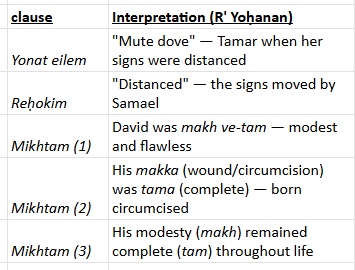
היינו דכתיב:
״למנצח
על יונת אלם רחוקים
לדוד מכתם״,
The Talmud comments: This is as it is written:
“For the leader,
upon yonat eilem reḥokim,
a psalm [mikhtam] of David” (Psalms 56:1).
אמר רבי יוחנן:
משעה שנתרחקו סימניה --
נעשית כיונה אילמת.
R’ Yoḥanan says the verse means:
rom the moment that her signs were distanced [reḥokim] --
she became like a mute dove [yona illemet].
David’s modest/flawless character
״לדוד מכתם״:
שיצא ממנה דוד,
שהיה מך ותם לכל.
And the phrase “a psalm [mikhtam] of David” means:
The one from whom David emerged,
David was born circumcised
דבר אחר:
״מכתם״ —
שהיתה מכתו תמה,
שנולד כשהוא מהול.
Alternatively,
mikhtam --
indicates that makkato, the place on his body that would have required wounding [makka], was complete [tama],
i.e., that David was born circumcised.
David’s lifelong self-effacement before greater figures
דבר אחר:
״מכתם״ —
כשם שבקטנותו —
הקטין עצמו אצל מי שגדול ממנו
ללמוד תורה,
כך בגדולתו.
Alternatively,
mikhtam --
indicates that just as in his youth —
David made himself small in front of one who was greater than him
in order to learn Torah from that person,
so too, when he became great4
Rav Zutra b. Tuviyya citing Rav (and variant attributions: Rav Ḥana b. Bizna citing R’ Shimon Ḥasida; or R’ Yoḥanan citing R’ Shimon b. Yoḥai) - Tamar’s indirect phrasing models the principle: better to accept death than publicly humiliate another - Genesis 38:25
״והיא שלחה אל חמיה לאמר:
לאיש אשר אלה --
לו אנכי הרה״.
The verse concerning Tamar then states: “She sent to her father-in-law, saying:
By the man whose these are --
am I with child” (Genesis 38:25).
ותימא ליה מימר!
אמר רב זוטרא בר טוביה,
אמר רב,
ואמרי לה:
אמר רב חנא בר ביזנא,
אמר רבי שמעון חסידא,
ואמרי לה:
אמר רבי יוחנן,
משום רבי שמעון בן יוחי:
נוח לו לאדם שיפיל עצמו לתוך כבשן האש,
ואל ילבין פני חבירו ברבים.
מנלן?
מתמר.
The Talmud comments: And let her say to him explicitly that she was impregnated by him.
Rav Zutra bar Tuviyya says that
Rav says,
and some say
Rav Ḥana bar Bizna says that
R’ Shimon Ḥasida says,
and some say that
R’ Yoḥanan says
in the name of R’ Shimon ben Yoḥai:
It should be more amenable for a person to throw himself into a fiery furnace if faced with the choice of publicly embarrassing another or remaining silent even if it leads to being burned,
and not humiliate another in public.
From where do we derive this?
From Tamar,
as she was prepared to be burned if Judah did not confess, rather than humiliate him in public.
R’ Ḥama b. Ḥanina - Measure-for-measure in the phrase “haker na” (“discern, please”): Judah used it to his father about Joseph; Tamar uses it to Judah about the signet/cords/staff - Genesis 37:32, 38:25
״הכר נא״.
אמר רבי חמא ברבי חנינא:
ב״הכר״
בישר לאביו
ב״הכר״
בישרוהו
The verse continues: “And she said: Discern,5 please, whose are these, the signet, and the cords, and the staff” (Genesis 38:25).
R’ Ḥama, son of R’ Ḥanina, says:
With use of the word “discern”
Judah informed6 his father that Joseph was lost,
and also with use of the word “discern”
they informed Judah about the signs.
ב״הכר״ בישר:
״הכר נא הכתנת בנך היא״
ב״הכר״ בישרוהו:
״הכר נא למי״
The Talmud explains:
With the word discern he informed
Jacob his father when he brought him the coat of Joseph and said to his father: “And they sent the coat of many colors, and they brought it to their father; and said: This have we found. Discern now whether it is your son’s coat or not” (Genesis 37:32).
With the word discern they informed him:
“And she said: Discern, please, whose are these.”
“Na” is a request-form; Tamar is read as pleading: “please… do not avert your eyes from me” - Genesis 38:25
״נא״.
אין ״נא״
אלא לשון בקשה.
אמרה ליה:
בבקשה ממך,
הכר פני בוראך
ואל תעלים עיניך ממני.
It states: “Discern, please [נא - na].”
The word na is nothing other than a language of request.
The Talmud explains: She said to him:
I request of you:
Discern the image7 of your Creator (=God), which exists in every person,
and do not avert your eyes from me.
Rav Ḥanin bar Bizna citing R’ Shimon Ḥasida - Joseph sanctified God’s name privately and gained an added letter (heh) in his name as written in Psalms, vs. Judah sanctified God’s name publicly; his name incorporates the Tetragrammaton (plus dalet) - Psalms 81:6
״ויכר יהודה
ויאמר: צדקה ממני״.
The verse states: “And Judah acknowledged them,
and said: She is more righteous than I;
forasmuch as I gave her not to Shelah my son” (Genesis 38:26).
היינו דאמר רב חנין בר ביזנא, אמר רבי שמעון חסידא:
יוסף
שקדש שם שמים בסתר —
זכה והוסיפו לו אות אחת משמו של הקדוש ברוך הוא,
דכתיב: ״עדות ביהוסף שמו״.
יהודה
שקדש שם שמים בפרהסיא —
זכה ונקרא כולו על שמו של הקדוש ברוך הוא.
This is the same as Rav Ḥanin bar Bizna says that R’ Shimon Ḥasida says:
Joseph,
who sanctified the name of Heaven in private by not committing adultery with the wife of Potiphar,
merited that one letter from the name of God was added to his name,
as it is written: “He appointed it in Joseph [bihosef ] for a testimony in his name, when He went forth against the land of Egypt” (Psalms 81:6). In this verse the name Joseph is written with an additional letter heh (‘H’), found in the ineffable name of God (=Tetragrammaton, ‘YHWH’)
Judah,
who sanctified the name of Heaven in public,
merited that his entire name is called by the name of God,
for all the letters of the ineffable name of God (=Tetragrammaton, ‘YHWH’) are included within the name of Judah (‘YHWDH’), with the addition of the letter dalet (‘D’).
A bat kol promises reciprocal salvation-from-fire for 3 descendants (Hananiah, Mishael, Azariah) - Genesis 38:26; Daniel 3
כיון שהודה ואמר ״צדקה ממני״,
יצתה בת קול ואמרה:
אתה הצלת תמר ושני בניה
מן האור —
חייך שאני מציל בזכותך שלשה מבניך
מן האור.
מאן נינהו?
חנניה מישאל ועזריה.
When he confessed and said:
“She is more righteous than I,”
a bat kol went forth and said:
You saved Tamar and her two children in her womb
from being burned by the fire.
By your life, i.e., in your merit, I will save 3 of your children
from the fire.
And who are they?
Hananiah, Mishael, and Azariah (see Daniel, chapter 3).
“More righteous than I / from me”(‘Mimeni’): Judah’s certainty is grounded by a bat kol declaring the hidden matter is “from Me” (God) - Genesis 38:26
״צדקה ממני״.
מנא ידע?
יצתה בת קול ואמרה:
ממני יצאו כבושים.
Judah said: “She is more righteous than I [mimeni].”
The word “mimeni” can also be understood as “from me,” with Judah thereby admitting that he is the father.
The Talmud asks: From where did he know that it was in fact from him that Tamar was pregnant?
The Talmud answers: A bat kol went forth and said:
From Me these hidden matters emerged,
and this woman will be the mother of royalty, which requires that Judah be the father.
Shmuel the Elder (father-in-law of Rav Shmuel bar Ami) citing Rav Shmuel bar Ami - “Ve-lo yasaf od leda’atah” is read as “did not cease”: once Judah understood Tamar’s intent was for Heaven, he continued to have sex with her
״ולא יסף עוד לדעתה״.
אמר שמואל סבא חמוה דרב שמואל בר אמי, משמיה דרב שמואל בר אמי:
כיון שידעה —
שוב לא פסק ממנה.
The same verse continues: “And he knew her [leda’atah] again no more [ve-lo yasaf],”
seemingly indicating that Judah did not have sex with Tamar again.
Shmuel the Elder, father-in-law of Rav Shmuel bar Ami, says in the name of Rav Shmuel bar Ami:
The verse actually means that once he knew of her that her intentions were for the sake of Heaven --
he did not desist from having sex with her again,
Prooftext - “ve-lo yasaf” meaning “did not stop” elsewhere - Genesis 38:26; Deuteronomy 5:18
כתיב הכא:
״ולא יסף עוד לדעתה״,
וכתיב התם:
״קול גדול ולא יסף״
as it is written here:
“Ve-lo yasaf od leda’atah,”
and it is written there at the giving of the Torah:
“These words YHWH spoke unto all your assembly in the mount out of the midst of the fire, of the cloud, and of the thick darkness, with a great voice and it went on no more [ve-lo yasaf]” (Deuteronomy 5:18), which is interpreted to mean: A great voice that did not cease.
Appendix 1 - Summary of the sugya’s interpretations, in order of the biblical verses
Genesis 21:33 (“He planted an eshel in Beersheba… and called there…”)
Reish Lakish: Eshel = an orchard with all kinds of sweet produce.
R’ Yehuda / R’ Neḥemya: Dispute: eshel = orchard vs inn; “planted” can mean “pitched (tents)” to support inn.
Reish Lakish: “Va-yikra” is read as “va-yakri”: Abraham caused others to call God’s name (redirecting guests’ blessings to God).
Genesis 38:13 (Judah “went up” to Timnah)
R’ Elazar: “Up” is figurative: Judah is described with ascent because he was elevated there.
R’ Shmuel bar Naḥmani / Rav Pappa: Same solutions as for Samson narrative (two Timnahs; or one slope-town).
Genesis 38:14 (“She sat at the entrance of Enaim”)
R’ Alexandri: “Entrance of Enaim” = the entrance of Abraham’s home, a place “all eyes” look toward.
R’ Ḥanin says Rav: Enaim is a place-name.
R’ Shmuel bar Naḥmani: Einayim is read as “providing eyes/openings for her words,” i.e., verbal positioning that enables Judah’s solicitation.
Genesis 38:15 (“He thought her a prostitute, for she had covered her face”)
R’ Elazar: “Covered her face” refers to Tamar’s prior modesty in Judah’s household, explaining why he failed to recognize her.
Genesis 38:25 (“When she was brought forth [mutzet]… ‘Discern, please…’”)
R’ Elazar: Mutzet hints that the identifying items were “found again”: Samael distanced them; Gabriel brought them close.
R’ Yoḥanan: Psalm 56:1 is read onto this moment: “mute dove” = Tamar’s helplessness; mikhtam is read in 3 ways about David.
Rav Zutra bar Tuviyya said Rav (and variants): Tamar’s indirect message models: better to accept death than publicly humiliate another.
R’ Ḥama bar R’ Ḥanina: Measure-for-measure in “haker na”: Judah used it to Jacob about Joseph; Tamar uses it to Judah.
(Anonymous): Na is read as a plea/request in Tamar’s address.
Genesis 38:26 (“Judah acknowledged… ‘She is more righteous than I’… ‘and he did not continue to know her’”)
Rav Ḥanin bar Bizna said R’ Shimon Ḥasida: Joseph sanctified God’s name privately → added letter in “Yosef” (Psalms 81:6).
Same: Judah sanctified God’s name publicly → his name incorporates God’s name; a bat kol promises salvation-from-fire for 3 descendants (Daniel 3).
(Anonymous): Judah’s certainty is grounded by a bat kol: “From Me these hidden matters emerged.”
Shmuel the Elder in the name of Rav Shmuel bar Ami: “Ve-lo yasaf” is read as “did not cease”: Judah continued to have sex with her, supported by Deuteronomy 5:18.
Appendix 2 - Abraham’s Eshel in Beersheba in Genesis 21:33 (Sotah 10a-10b)
The Talmud discusses Abraham’s Beersheba setting, returning to Genesis 21:33: “he planted an eshel… and called there.” Reish Lakish reads eshel as an orchard and takes “planted” literally: Abraham planted all kinds of delicacies. R’ Yehuda and R’ Neḥemya dispute the noun: one reads eshel as an orchard (pardes), the other as an inn (pundak).
Reish Lakish also homiletically rereads “called” (va-yikra) as “caused to call” (va-yakri): Abraham is depicted as getting travelers to vocalize blessing to God. The sugya supplies a scene: guests eat and drink, rise to bless Abraham, and Abraham redirects them—“did you eat from mine?! you ate from the God of the world”—pushing them to thank, praise, and bless God.
Reish Lakish - “Eshel” in Beersheba: Abraham made an orchard and planted all kinds of sweet produce - Genesis 21:33
״ויטע אשל בבאר שבע״,
אמר ריש לקיש:
מלמד ש
עשה פרדס,
ונטע בו כל מיני מגדים.
The Talmud discusses Abraham’s house: It is written: “And he planted an eshel in Beersheba, and called there on the name of YHWH, the Everlasting God” (Genesis 21:33).
Reish Lakish says:
This teaches that
Abraham made an orchard
and planted in it all kinds of sweet things.
R’ Yehuda / R’ Neḥemya - Dispute: eshel = orchard (pardes) vs inn (pundak)
רבי יהודה ורבי נחמיה:
חד אמר:
פרדס,
וחד אמר:
פונדק.
[...]
The tanna’im R’ Yehuda and R’ Neḥemya disagree as to the meaning of the word “eshel”:
[...]
Reish Lakish - “Va-yikra” should be read as “va-yakri”: Abraham caused others to call God’s name - Genesis 21:33
״ויקרא שם בשם ה׳ אל עולם״.
אמר ריש לקיש:
אל תיקרי ״ויקרא״,
אלא ״ויקריא״.
מלמד ש
הקריא אברהם אבינו לשמו של הקדוש ברוך הוא בפה כל עובר ושב.
The verse there states: “And he planted an eshel in Beersheba, and called there [va-yikra] on the name of YHWH, the Everlasting God” (Genesis 21:33).
Reish Lakish said:
Do not read this word literally as “va-yikra,” and he called,
but rather as va-yakri,
and he caused others to call.
This teaches that
Abraham our forefather caused the name of God to be called out in the mouth of all passersby.
After guests ate, he redirected their blessing to God
כיצד?
לאחר שאכלו ושתו,
עמדו לברכו.
אמר להם:
וכי משלי אכלתם?!
משל אלהי עולם אכלתם!
הודו ושבחו וברכו למי שאמר והיה העולם.
How so?
After the guests of Abraham ate and drank,
they arose to bless him.
He said to them:
But did you eat from what is mine?!
Rather, you ate from the food of the God of the world.
Therefore, you should thank and praise and bless the One Who spoke and the world was created.
In this way, Abraham caused everyone to “call out” to God.
Appendix 3 - David’s “Piety” in Psalms 119 as Discipline, Humility, and Legal Labor (Berakhot 4a)
Levi and R’ Yitzḥak - interpretations of David’s claim “for I am pious (‘hasid’)”, each defining piety against royal norms - Psalms 86:1–2
The Talmud offers two interpretations of David’s claim “for I am pious (‘hasid’)” (Psalms 86:2), each defining piety against royal norms:
One view locates it in discipline: unlike other kings, David rises at midnight to pray (Psalms 119:62).
The other locates piety in humility and legal labor. David sets aside royal dignity to rule on difficult cases of menstrual blood, miscarriage, and placenta in order to permit women to their husbands, and he repeatedly consults his teacher Mefivoshet without embarrassment.
״לדוד,
שמרה נפשי כי חסיד אני״.
לוי ורבי יצחק:
The Talmud further explores King David’s character.
It is said: “A prayer of David…Keep my soul,
for I am pious” (Psalms 86:1–2).
Levi and R’ Yitzḥak debated the meaning of this verse and how David’s piety is manifest in the fact that he went beyond his fundamental obligations.
Unlike other kings, David rises at midnight to pray
חד אמר:
כך אמר דוד לפני הקדוש ברוך הוא:
רבונו של עולם!
לא חסיד אני?!
שכל מלכי מזרח ומערב —
ישנים עד שלש שעות,
ואני —
״חצות לילה אקום להודות לך״.
One said:
David’s declaration of piety referred to his awakening during the night to pray, and so said David before God:
God!
am I not pious?!
As all of the kings of the East and the West10 —
sleep until the 3rd hour of the day (=~9am),
but although I am a king like them —
“At midnight I rise to give thanks” (Psalms 119:62).
Piety in humility and legal labor: David sets aside royal dignity to rule on difficult cases of menstrual blood, miscarriage, and placenta in order to permit women to their husbands
ואידך,
כך אמר דוד לפני הקדוש ברוך הוא:
רבונו של עולם!
לא חסיד אני?!
שכל מלכי מזרח ומערב —
יושבים אגודות אגודות בכבודם,
ואני —
ידי מלוכלכות
בדם
ובשפיר
ובשליא
כדי לטהר אשה לבעלה
And the other Sage said:
David said the following before God:
God!
am I not pious?!
For all of the kings of the East and the West —
sit in groups befitting their honored status,
but I —
sit as a judge who issues rulings for the people. Women come with questions of ritual impurity and my hands become soiled with
their blood as I labor to determine whether or not it is blood of impurity and she has menstruating woman (=niddah) status,
and with a fetus (שפיר) that miscarried at a stage of development before it was clear whether or not it is considered a birth,
and with placenta, which women sometimes discharge unrelated to the birth of a child (see Leviticus 15:19–30 with regard to blood, and 12:1–8 with regard to miscarriage and placenta).
King David went to all this trouble in order to render a woman ritually pure and consequently permitted to her husband.
If, after examination, a Sage declares the woman ritually pure, she is permitted to be with her husband, which leads to increased love and affection, and ultimately to procreation (R’ Yoshiyahu Pinto).
… and he repeatedly consults his teacher Mefivoshet without embarrassment
ולא עוד,
אלא כל מה שאני עושה —
אני נמלך במפיבשת רבי
And not only do I engage in activity considered to be beneath the station of a king,
but with regard to everything that I do —
I consult my teacher, Mefivoshet, son of King Saul’s son, Jonathan,
ואומר לו:
מפיבשת רבי!
יפה דנתי?
יפה חייבתי?
יפה זכיתי?
יפה טהרתי?
יפה טמאתי?
ולא בושתי
I say to him:
Mefivoshet, my teacher!
did I decide (דנתי - “judge”) properly?
Did I convict (חייבתי) properly?
Did I acquit (זכיתי) properly?
Did I rule ritually pure properly?
Did I rule ritually impure properly?
And I was not embarrassed.
Forgoing royal dignity should make me worthy to be called pious.
Rav Yehoshua b. Idi - Prooftext - “I speak Your testimonies before kings and am not ashamed” - Psalms 119:46
אמר רבי יהושע בריה דרב אידי:
מאי קרא?
״ואדברה בעדתיך נגד מלכים ולא אבוש״.
Rav Yehoshua, son of Rav Idi, said:
What verse alludes to this?
“And I speak Your testimonies before kings and I will not be ashamed” (Psalms 119:46).
This verse alludes both to David’s commitment to Torah, in contrast to the kings of the East and the West, as well as to the fact that he was not ashamed to discuss matters of Torah with Mefivoshet, a descendant of kings. David was not afraid to have his mistakes corrected by Mefivoshet.
“Mefivoshet” = embarrasses David in halakha; David’s son Kilav (also called Daniel) later embarrasses Mefivoshet in return
תנא:
לא ״מפיבשת״ שמו,
אלא ״איש בשת״ שמו,
ולמה נקרא שמו מפיבשת?
שהיה מבייש פני דוד בהלכה,
לפיכך זכה דוד ויצא ממנו כלאב.
It was taught in a Tosefta from a tannaitic tradition:
His name was not Mefivoshet,
but rather Ish Boshet was his name.
Why was Ish Boshet referred to as Mefivoshet?
Because he would embarrass [mevayesh] David in matters of halakha.
According to this approach, Mefivoshet is an abbreviation of boshet panim, embarrassment.
Because David was not embarrassed to admit his errors, he merited that Kilav, who, according to tradition, was exceedingly wise, would descend from him.
ואמר רבי יוחנן:
לא ״כלאב״ שמו
אלא ״דניאל״ שמו,
ולמה נקרא שמו ״כלאב״?
שהיה מכלים פני מפיבשת בהלכה.
R’ Yoḥanan said:
His name was not Kilav;
rather, his name was Daniel,
as it appears in a different list of David’s descendants.
Why was he called Kilav?
Because he would embarrass [makhlim] Mefivoshet, the teacher or authority figure [av] in matters of halakha.
Solomon’s Proverbs is read as celebrating David’s joy in a son who surpasses his teacher - 23:15; 27:11
ועליו אמר שלמה בחכמתו:
״בני!
אם חכם לבך —
ישמח לבי גם אני״,
ואומר:
״חכם בני!
ושמח לבי
ואשיבה חרפי דבר״.
In his book of wisdom, Solomon said about this wise son:
“My son!
if your heart is wise —
my heart will be glad, even mine” (Proverbs 23:15),
as David enjoyed witnessing his son Kilav develop into a Torah luminary to the extent that Kilav was able to respond to Mefivoshet.
And Solomon says about Kilav:
“Be wise, my son!
and make my heart glad,
that I may respond to those who taunt me” (Proverbs 27:11).
Compare the similar motif in my “Talmudic Interpretations of the Book of Esther: Esther 2:20-3:7 (Megillah 13b)“, section “Miraculous Reading of the Chronicles (Esther 6:1-2): Shimshai, an anti-Jewish scribe, tried to erase Mordecai’s deeds, but the angel Gabriel rewrote them“, which similarly features Gabriel intervening to counter-act actions done by someone trying to harm the Jews. I summarize there:
The Talmud explains that Shimshai (שמשי), an anti-Jewish scribe (see Ezra 4:9–10), kept erasing Mordecai’s act of saving the king, but the angel Gabriel continuously rewrote it.
tam.
Steinsaltz here translates this word here as “flawless”. While this is indeed generally a major sense of the word, it clearly isn’t the sense that it’s being used in here. I therefore changed it to “guile-less”. Meaning, “unscheming, simple, straightforward, candid”.
Compare Jastrow, entry “תָּם I”, sense # 2: “simple, innocent, artless”.
And compare the usage of this word in the Bible, to described Jacob, in Genesis 25:27:
ויגדלו הנערים
ויהי עשו איש ידע ציד, איש שדה
ויעקב איש תם, ישב אהלים
[When] the boys grew up,
Esau became a skillful hunter, a man of the outdoors;
[but] Jacob became a mild man (תם), who stayed in camp.
A wordplay on the word mikhtam. Note that the actual meaning of this word is unknown; see Wikipedia, “Miktam“:
Miktam or Michtam (Hebrew: מִכְתָּם) is a word of unknown meaning found in the headings of Psalms 16 and 56–60 in the Hebrew Bible.
These six Psalms, and many others, are associated with King David, but this tradition is more likely to be sentimental than historical.
They may have formed one of several smaller collections of psalms which preceded the present psalter and on which it was based.
Steinsaltz explains:
[When David] was crowned king, he still behaved in this manner [=of lowering himself to learn Torah], so that his modesty, makh, was complete, tam, all of his life.
On this, see the appendix at the end of this piece: “Appendix 3 - David’s “Piety” in Psalms 119 as Discipline, Humility, and Legal Labor (Berakhot 4a)“.
הכר - literally: “recognize” (imperative/command).
בישר - literally: “announced, proclaimed”.
Compare the same literary formula (“with X he proclaimed, with X they proclaimed for him”; i.e., roughly speaking, in modern parlance, “what goes around, comes around”) elsewhere in the Talmud, in my “Pt1 The Death and Burial of Moses in Deuteronomy 31-34 (Sotah 13b-14a)“, section “Measure for Measure: Moses’ Rebuke and God’s Rebuke (Deuteronomy 3:26)“, sub-section “R’ Levi - God’s Denial and the Word ‘rav’ (Numbers 16:7)“
פני - literally: “face”.
pardes - from Persian. See Wikipedia, “Paradise“, section “Etymology and concept history“. For a famous usage of this word, compare Wikipedia, “Pardes (legend)”, and my “Tales of Ben Zoma (Chagigah 14b-15a)”, section “The Story of the Four Tannaitic Sages Who Entered the “Pardes” “.
pundak - from Greek pandokeîon - “inn” (literally: “all-receive, the one that accepts all”).
I.e., all kings (a merism).