

This is the second and final part of a two-part series. Part 1 is here; the outline of the series can be found at Part 1.
Part 2
R’ Yishmael’s School - Speaking lashon hara is equivalent to the three cardinal sins
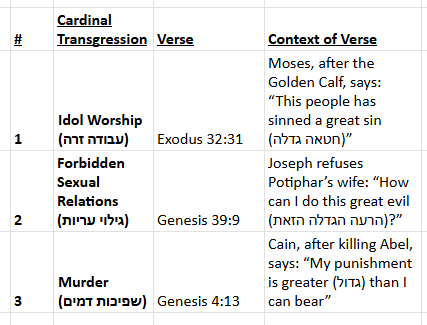
תנא דבי רבי ישמעאל:
כל המספר לשון הרע --
מגדיל עונות כנגד שלש עבירות:
עבודה זרה
וגילוי עריות
ושפיכות דמים.
The school of R’ Yishmael taught:
Anyone who speaks lashon hara --
increases his sins to the degree that they correspond to the three cardinal transgressions:
Idol worship,
and forbidden sexual relations,
and murder.1
Prooftext - via “gadol/gedolot” - Psalms 12:4; Exodus 32:31; Genesis 39:9; Genesis 4:13
כתיב הכא:
״לשון מדברת גדולות״,
וכתיב בעבודה זרה
״אנא חטא העם הזה חטאה גדלה״.
בגילוי עריות כתיב:
״ואיך אעשה הרעה הגדלה הזאת״,
בשפיכות דמים כתיב:
״גדול עוני מנשא״.
[...]
It is written here (i.e. about lashon hara):
“May YHWH cut off all flattering lips, the tongue that speaks great things (גדולות)” (Psalms 12:4).2
And it is written with regard to idol worship:
“And Moses returned to YHWH, and said: Oh, this people have sinned a great sin (גדלה), and have made for themselves a god of gold” (Exodus 32:31).
With regard to forbidden sexual relations it is written
that when Potiphar’s wife attempted to seduce Joseph he responded: “How can I do this great (גדלה) wickedness, and sin against God” (Genesis 39:9).
With regard to murder it is written,
after Cain murdered his brother: “And Cain said to YHWH: My punishment is greater (גדול) than I can bear” (Genesis 4:13).
[...]
“In the West” (Eretz Yisrael) - Lashon Hara kills three people: speaker, hearer, and subject
במערבא אמרי:
לשון תליתאי --
קטיל תליתאי:
הורג
למספרו,
ולמקבלו,
ולאומרין עליו.
In the West, Eretz Yisrael, they say:
“Third speech” (לשון תליתאי), i.e., lashon hara about a third party --
kills three (תליתאי) people:
It kills
the one who speaks lashon hara,
and the one who accepts the lashon hara when he hears it,
and the one about whom the lashon hara is said.
R’ Ḥama b. Ḥanina - the tongue kills
אמר רבי חמא ברבי חנינא:
מאי דכתיב ״מות וחיים ביד לשון״,
וכי יש יד ללשון?!
לומר לך:
מה יד
ממיתה
אף לשון
ממיתה.
R’ Ḥama, son of R’ Ḥanina, says:
What is the meaning of that which is written: “Death and life are in the hand of the tongue” (Proverbs 18:21).
Does the tongue have a hand?!
Rather the verse comes to tell you that
just as a hand
can kill,
so too a tongue
can kill.
... At any distance - Jeremiah 9:7; Psalms 73:9
אי מה יד --
אינה ממיתה אלא בסמוך לה
אף לשון
אינה ממיתה אלא בסמוך לה?
תלמוד לומר: ״חץ שחוט לשונם״.
If you were to claim that just as the hand
kills only from close by,
so too the tongue
kills only from close by,
therefore the verse states: “Their tongue is a sharpened arrow” (Jeremiah 9:7).
The tongue kills like an arrow that is fired from a bow, at a great distance.
אי מה חץ
עד ארבעים וחמשים אמה,
אף לשון
עד ארבעים וחמשים אמה?
תלמוד לומר:
״שתו בשמים פיהם
ולשונם תהלך בארץ״.
[...]
If you say that just as an arrow
can kill only within the distance it can be shot, which is up to about 40 or 50 cubits,
so too a tongue
can kill only from up to 40 or 50 cubits,
therefore the verse teaches:
“They have set their mouth against the heavens,
and their tongue walks through the earth” (Psalms 73:9).
This teaches that lashon hara can reach great distances, even the distance between heaven and earth.
[...]
R’ Shmuel b. Naḥmani citing R’ Yoḥanan - Tzara’at is divine punishment for 7 sins: lashon hara, murder, vain oath, sexual transgression, arrogance, theft, and stinginess
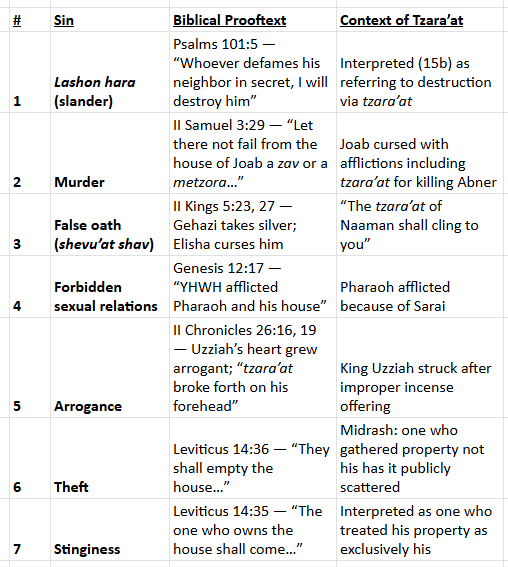
The sugya enumerates seven moral transgressions for which tzara’at serves as punishment, grounding each claim in a specific biblical verse, often with midrashic interpretation linking the affliction to the underlying ethical failing.
Table summarizing:
אמר רבי שמואל בר נחמני, אמר רבי יוחנן:
על שבעה דברים נגעים באין:
על לשון הרע,
ועל שפיכות דמים,
ועל שבועת שוא,
ועל גילוי עריות,
ועל גסות הרוח,
ועל הגזל,
ועל צרות העין.
§ R’ Shmuel bar Naḥmani says that R’ Yoḥanan says:
Tzara’at marks (נגעים) come and afflict a person for seven sinful matters:
For lashon hara,
for murder,
for an oath taken in vain,
for forbidden sexual relations,
for arrogance,
for theft,
and for stinginess.
Prooftexts - Psalms 101:5; II Samuel 3:29; II Kings 5:23–27; Genesis 12:17; II Chronicles 26:16,19; Leviticus 14:35-36
על לשון הרע —
דכתיב: ״מלשני בסתר רעהו — אותו אצמית״.
על שפיכות דמים —
דכתיב ״ואל יכרת מבית יואב זב ומצרע וגו׳״.
ועל שבועת שוא —
דכתיב: ״ויאמר נעמן: הואל קח ככרים״,
וכתיב: ״וצרעת נעמן תדבק בך וגו׳״.
ועל גילוי עריות —
דכתיב: ״וינגע ה׳ את פרעה נגעים וגו׳״.
ועל גסות הרוח —
דכתיב: ״ובחזקתו גבה לבו עד להשחית, וימעול בה׳ אלהיו״,
״והצרעת זרחה במצחו״.
ועל הגזל —
דכתיב: ״וצוה הכהן ופנו את הבית״.
תנא: הוא כונס ממון שאינו שלו, יבא הכהן ויפזר ממונו.
ועל צרות העין —
דכתיב: ״ובא אשר לו הבית״,
ותנא דבי רבי ישמעאל: מי שמיוחד ביתו לו.
The Talmud explains the source for the claim that each of these seven sins is punishable with tzara’at.
For lashon hara one is punished,
as it is written: “Whoever defames his neighbor in secret, I will destroy him; whoever is haughty of eye and proud of heart, I will not suffer him” (Psalms 101:5). The Talmud explained above (15b) that this is referring to tzara’at.3
For murder,
as it is written about Joab, as punishment for murdering Abner: “And let there not fail from the house of Joab a zav, or a metzora, or that leans on a staff, or that falls by the sword, or that lacks bread” (II Samuel 3:29).
And for an oath taken in vain,
as it is written: “And Naaman said: Be content [ho’el], take two talents. And he urged him, and bound two talents of silver in two bags, with two changes of garment, and laid them upon two of his servants; and they bore them before him” (II Kings 5:23).4
When Elisha found out what Gehazi had done he cursed him, and so it is written: “The tzara’at of Naaman shall stick to you and to your children forever. And he went out from his presence a metzora as white as snow” (II Kings 5:27).
And for forbidden sexual relations,
as it is written: “And YHWH afflicted Pharaoh and his house with great afflictions because of Sarai, Abram’s wife” (Genesis 12:17).
And for arrogance,
as it is written with regard to King Uzziah: “But when he was strong his heart became arrogant so that he did corruptly, and he trespassed against YHWH his God; for he went into the temple of YHWH to burn incense upon the altar of incense” (II Chronicles 26:16).
And it states: “Then Uzziah was angry; and he had a censer in his hand to burn incense; and while he was angry with the priests, the tzara’at broke forth in his forehead” (II Chronicles 26:19).
And for theft,
as it is written: “And the priest shall command that they empty the house, before the priest go in to see the mark, that all that is in the house not become impure; and afterward the priest shall go in to see the house” (Leviticus 14:36).
In explanation of this verse, the rabbis taught: He gathered property that is not his, therefore let the priest come and scatter his property..
And for stinginess,
as it is written: “Then he that owns the house shall come and tell the priest, saying: There seems to me to be as it were a mark in the house” (Leviticus 14:35).
And the school of R’ Yishmael taught: The verse calls him the one who owns the house because it is referring to one who was stingy and treated his house as being exclusively his, and did not allow others to share his property.
R’ Anani b. Sason - Priestly garments atone just as offerings do - Leviticus 1-8
R’ Anani bar Sason asks why the Torah places the section on priestly garments (בגדי כהונה) alongside that of Temple offerings (Leviticus 1–8). He posits that just as offerings atone, so too the garments atone.
[...]
אמר רבי ענני בר ששון:
למה נסמכה
פרשת בגדי כהונה
לפרשת קרבנות?
לומר לך:
מה קרבנות
מכפרין
אף בגדי כהונה
מכפרין.
[...]
R’ Anani bar Sason says:
Why were juxtaposed
the passage in the Torah that discusses the priestly vestments (Leviticus 8)
to the passage that discusses offerings (Leviticus, chapters 1–7)?
To tell you that
just as offerings
atone,
so too the priestly vestments
atone.
The sin that each one of the eight priestly garments atones for: murder, forbidden sex, arrogance, sinful thoughts, (corrupt) judgment, idolatry, lashon hara, and brazenness
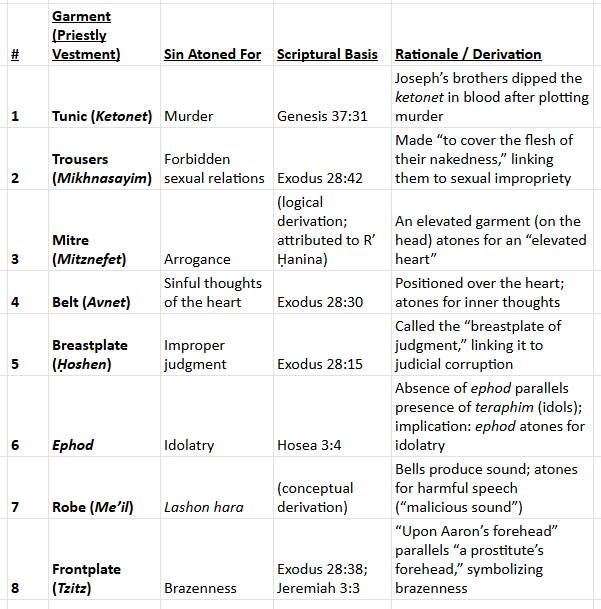
Tunic (כתונת) – atones for murder (Genesis 37:31)
Turban (מצנפת) – atones for arrogance
Belt (אבנט) – atones for sinful thoughts (Exodus 28:30)
Breastplate (חושן) – atones for (corrupt) judgment (Exodus 28:15)
Ephod – atones for idol worship (Hosea 3:4)
Robe (מעיל) – atones for lashon hara
Frontplate (ציץ) – atones for brazenness (Exodus 28:38; Jeremiah 3:3)
כתונת
מכפרת על שפיכות דמים,
דכתיב: ״ויטבלו את הכתנת בדם״.
מכנסים
מכפרים על גילוי עריות,
דכתיב: ״ועשה להם מכנסי בד לכסות בשר ערוה״.
מצנפת
מכפרת על גסי הרוח —
כדרבי חנינא, דאמר רבי חנינא: יבא דבר שבגובה ויכפר על מעשה גובה.
אבנט
(מכפרת) [מכפר] על הרהור הלב,
אהיכא דאיתיה, דכתיב: ״והיה על לב אהרן״.
חושן
מכפר על הדינין —
דכתיב: ״ועשית חשן משפט״.
אפוד
מכפר על עבודה זרה,
דכתיב: ״אין אפוד ותרפים״.
מעיל
מכפר על לשון הרע,
אמר הקדוש ברוך הוא:
יבא דבר שבקול
ויכפר על מעשה הקול.
ציץ
מכפר על מעשה עזי פנים —
כתיב הכא: ״והיה על מצח אהרן״,
וכתיב התם: ״ומצח אשה זונה היה לך״.
[...]
For what does each garment atone?:
The tunic [ketonet]
atones for murder,
as it is written with regard to Joseph’s brothers after they plotted to kill him: “And they killed a goat, and dipped the coat [ketonet] in the blood” (Genesis 37:31).
The trousers
atone for forbidden sexual relations,
as it is written with regard to the priestly vestments: “And you shall make them linen trousers to cover the flesh of their nakedness” (Exodus 28:42).
The mitre
atones for the arrogant,
in accordance with the opinion of R’ Ḥanina, as R’ Ḥanina says: It is logical that an item placed at an elevation, i.e., on the head of a priest, shall come and atone for the matter of an elevated heart.
The belt
atones for thought of the heart.
The Talmud elaborates: The belt atones for the sins occurring where it is situated, i.e., over the heart, as it is written: “And you shall put in the breastplate of judgment the Urim and the Tummim; and it shall be upon Aaron’s heart, when he goes in before YHWH; and Aaron shall bear the judgment of the children of Israel upon his heart before YHWH continually” (Exodus 28:30).
The breastplate of the High Priest
atones for improper judgments,
as it is written: “And you shall make a breastplate of judgment” (Exodus 28:15).
The ephod of the High Priest
atones for idol worship,
as it is written: “And without ephod or teraphim” (Hosea 3:4), that is to say, when there is no ephod, the sin of teraphim, i.e., idol worship, is found. This indicates that if there is an ephod, there is no sin of idol worship.
The robe of the High Priest
atones for lashon hara,
as God says:
Let an item that produces sound, i.e., the bells of the robe,
come and atone for an act of malicious sound, i.e., lashon hara.
Finally, the frontplate of the High Priest
atones for an act of brazenness.
From where is this derived? Here, with regard to the frontplate, it is written: “And it shall be upon Aaron’s forehead” (Exodus 28:38),
and there, with regard to brazenness, it is written: “And you had a prostitute’s forehead” (Jeremiah 3:3).
[...]
R’ Simon citing R’ Yehoshua b. Levi - Murder and lashon hara are atoned for by eglah arufah and Temple incense (respectively)
[…]
אמר רבי סימון, אמר רבי יהושע בן לוי:
שני דברים
לא מצינו להם בקרבנות כפרה,
בדבר אחר מצינו להם כפרה:
שפיכות דמים
ולשון הרע.
[…]
R’ Simon say that R’ Yehoshua ben Levi says:
There are two matters for which
we do not find atonement through offerings,
but we find atonement for them through another matter,
and they are:
murder
and lashon hara.
שפיכות דמים
בעגלה ערופה.
ולשון הרע —
בקטרת
With regard to murder,
its atonement comes from the heifer whose neck is broken.6
And lashon hara
is atoned for through Temple incense
R’ Ḥanina - Temple incense atones (Numbers 17:12)
דתניא רבי חנינא:
למדנו לקטרת שמכפרת,
דכתיב:
״ויתן את הקטרת
ויכפר על העם״,
as R’ Ḥanina taught in a baraita:
We have learned that Temple incense atones,
as it is written in the incident when the Israelites were afflicted with a plague for speaking slanderously against Moses and Aaron:
“And he put on the incense,
and made atonement for the people” (Numbers 17:12).
R’ Yishmael’s School - Temple incense atones for lashon hara
ותנא דבי רבי ישמעאל:
על מה קטרת מכפרת?
על לשון הרע,
אמר הקדוש ברוך הוא:
יבא
דבר שבחשאי
ויכפר
על מעשה חשאי.
[...]
And similarly, the school of R’ Yishmael taught:
For what does incense atone?
For lashon hara.
It is as though God says:
Let come
an item that is sacrificed in private,7
i.e., the Temple incense, which is burnt inside the Sanctuary,
and atone for
an action generally performed in private,
i.e., lashon hara.
[...]
R’ Shmuel b. Nadav (son-in-law of R’ Ḥanina) asking R’ Ḥanina / R’ Yehoshua b. Levi - Metzora “dwells alone” because his speech divided people - Leviticus 13:46
בעא מיניה
רבי שמואל בר נדב מרבי חנינא,
ואמרי לה:
רבי שמואל בר נדב, חתניה דרבי חנינא, מרבי חנינא,
ואמרי לה:
מרבי יהושע בן לוי:
Asked
R’ Shmuel bar Nadav from R’ Ḥanina,
and some say that
it was R’ Shmuel bar Nadav, the son-in-law of R’ Ḥanina, who asked of R’ Ḥanina,
and some say that
he asked it of R’ Yehoshua ben Levi:
מה נשתנה מצורע שאמרה תורה
״בדד ישב
מחוץ למחנה מושבו״?
What is different and notable about a metzora, that the Torah states:
“He shall dwell alone;
outside of the camp shall be his dwelling” (Leviticus 13:46)?
הוא הבדיל
בין איש לאשתו,
בין איש לרעהו,
לפיכך אמרה תורה:
״בדד ישב וגו׳״.
He replied:
By speaking lashon hara, he separated
between husband and wife
and between one person and another;
therefore he is punished with tzara’at, and the Torah says:
“He shall dwell alone; outside of the camp shall be his dwelling.”
R’ Yehuda ben Levi - Metzora brings 2 birds—chattering for chatter - Leviticus 14:4
אמר רבי יהודה בן לוי:
מה נשתנה מצורע
שאמרה תורה יביא שתי ציפרים לטהרתו?
אמר הקדוש ברוך הוא:
הוא --
עושה מעשה פטיט,
לפיכך אמרה תורה --
יביא קרבן פטיט.
R’ Yehuda ben Levi says:
What is different and notable about a metzora
that the Torah states that he is to bring two birds for his purification (Leviticus 14:4)?
God says:
He --
acted by speaking lashon hara with an act of chatter8
therefore the Torah says that
he is to bring an offering of birds, who chirp and chatter all the time.
Note that these three are famously the “cardinal sins” for which one must die rather than transgress; see Wikipedia, “Self-sacrifice in Jewish law“, section “The requirement of self-sacrifice“.
Steinsaltz explains:
This can be derived from a verbal analogy based on the word “great” […]
The Torah describes each of these three cardinal sins with the word “great” in the singular, whereas lashon hara is described with the plural term “great things,” indicating that it is equivalent to all three of the other transgressions together.
In Part 1, section “Rav Ḥisda citing Mar Ukva - One who speaks lashon hara deserves stoning“, sub-section “Prooftexts - Psalms 101:5; Lamentations 3:53“, and ibid., section “Rav Ḥisda citing Mar Ukva - God says about the speaker of lashon hara: “He and I cannot dwell together” “, sub-section “Prooftext - Psalms 101:5“.
Steinsaltz explains:
The rabbis maintain that the term ho’el indicates an oath, and that Naaman requested of Gehazi, to whom this was stated, to take an oath that Elisha had sent him to accept gifts, which Elisha had not done, and Gehazi took the oath.
For more on this story, and this verse, see my recent “Pt2 Elisha Narratives in II Kings 2-8, From Failure to Accompany to Failure to Reprove Gently: Jericho’s Youths, Bethel’s Bears, Gehazi, and the Principle of Measured Rejection (Sotah 46b-47a)“, section “The incident with Elisha - II Kings 5:23, 26“.
מכנסים - “trousers, breeches”, essentially equivalent to modern boxers.
עגלה ערופה.
Steinsaltz explains:
This is referring to a case where a murdered body is found but the murderer is unknown. In such an instance, the Torah mandates that the town nearest the body must break the neck of a heifer as atonement for the transgression (see Deuteronomy 21:1–9).
For more on this ritual, see for example in my “Pt1 The End of an Era: The Mishnah on Societal Decline and the Discontinuation of Rituals (Mishnah Sotah 9:9-15)“, section “Nullification of Biblical Rituals: Impact of Widespread Murder and Adultery in Late Second Temple Period“, and my note there.
חשאי - literally: “secret”.
See Jastrow (modernized):
חֲשַׁאי
(חָשָׁה) whispering, stillness, secret.
Pesachim 56a:8 - להביא בחשאי - “to offer it to her in secret”
Pesachim 56a:8 - שיהו אומרים … בחשאי - “that they say it in a whisper”
Arakhin 16a; Zevachim 88b:11; Yoma 44a:5 - דבר שבחשאי - “something done in secrecy (the offering of frankincense on the inner altar)”
מעשה שבחשאי - “what is committed in secrecy (calumny)”
and frequently.
Plural: חֲשָׁאִים.
Mishnah Shekalim 5:6 - לשכת חשאים - “the Hall of Secret (donations)”
חֲשַׁאי ²
Aramaic - same.
and elsewhere.
פטיט.
On this word, see Jastrow (modernized):
פַּטִּיט
(see פַּטָּטָא) babbler.
Arakhin 16b:11-12 - הוא עושה מעשה פטיט … קרבן פטיט - “he (the metzora) does the work of a babbler (speaks evil of men), therefore the Torah said, let him offer a babbler (a chirping bird) as a sacrifice”
Bereishit Rabbah 93:8 - אני … שפטיט אתה יש באחיך פטיט וכ׳ - “I see, you (yada) are a talker; is there among your brothers a talker like you?!”
Midrash Tanḥuma Vayigash 5 - אני רואה … ואתה פטיט - “I see in my cup that there are older men among your brothers, and yet you are the talker?!”
See דַּבְּרָן.
And compare the seemingly related verb פטפט, see Jastrow (modernized):
פִּטְפֵּט
(see the preceding word, a. פַּטָּטָא)
1) to talk, babble.
Menachot 65a:12 - חוץ מזקן אחד שהיה מְפַטְפֵּט כנגדו - “except one old man who talked (childishly) against him”
2) פטפט ביצרו - to talk or argue with one’s own passion, to conquer one’s self.
Bava Batra 109b:12 (play on בנות פ̇וט̇יאל, Exodus 6:25) - דאתי מיוסף שפטפט ביצרו -”Elazar was a descendant of Joseph, who (is surnamed Putiel, because he) conquered his passion”
Shemot Rabbah 7, end - שהיתה אשתו … יוסף שפטפט ביצרו … שפ̇יט̇ם וכ׳ - “his wife was a descendant of two families, being on one side of the tribe of Joseph who conquered his passion, and on the other of the family of Jethro who fattened etc.”, see פָּטַם;
פַּטְפִּט
Aramaic same
, to talk.
Bereishit Rabbah 98:13 (referring to Judges 15:16 a. Judges 15:18) - דמְפַטְפֵּט צחי - “he who talks gets thirsty”
And see Hebrew Wiktionary here and here, and sections “Etymology” in each.