

This is the second and final part of a two-part series. Part 1 is here; the outline of the series can be found at Part 1.
Attempted Proof #2 - from Terah’s family (c. 20th century BCE)
See family tree at Hebrew Wikipedia, “תרח”, section “עץ משפחה”; screenshot of the relevant part:

Table:
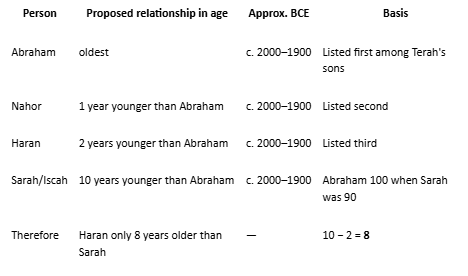
If Abram was 2 years older than Haran, and Sarah/Iscah was Haran’s daughter and 10 years younger than Abraham, Haran must have fathered Sarah at age 8 - Genesis 11:27, 29: 17:17
אלא מהכא:
״אלה תולדת תרח:
תרח הוליד
את אברם
את נחור
ואת הרן״.
Rather, it is from here that one can deduce that in earlier generations men fathered children at the age of 8, as it is written:
“And these are the generations of Terah:
Terah fathered1
Abram,
Nahor,
and Haran” (Genesis 11:27).
ואברהם גדול מנחור שנה,
ונחור גדול מהרן שנה.
נמצא אברהם גדול שתי שנים מהרן.
And Abraham was at least 1 year older than Nahor,2
and Nahor was 1 year older than Haran,
so it turns out that Abraham was 2 years older than Haran.
R” Yitzhak - Iscah is Sarah
(See footnote.)3
וכתיב:
״ויקח אברם ונחור להם נשים וגו׳״.
ואמר רבי יצחק:
״יסכה״ זו שרה
And it is written:
“And Abram and Nahor took wives for themselves;
the name of Abram’s wife was Sarai and the name of Nahor’s wife was Milka, daughter of Haran, father of Milka and father of Iscah” (Genesis 11:29).
And R’ Yitzḥak says:
Iscah is in fact Sarah.
Sarah was called Iscah because she perceived through the Holy Spirit - Genesis 11:29; 21:12
ולמה נקרא שמה ״יסכה״?
שסוכה ברוח הקדש.
והיינו דכתיב:
״כל אשר תאמר אליך שרה שמע בקלה״.
And why was she called Iscah?
Because she envisioned [she-sokha] hidden matters by means of Holy Spirit.
And this explains what is written:
“In all that Sarah has said to you,
hearken to her voice” (Genesis 21:12).
Alternatively, Sarah was called Iscah because everyone gazed upon her beauty
דבר אחר:
״יסכה״
שהכל סכים ביופיה.
Alternatively,
Sarah was also called Iscah,
because all gazed [sokhim] upon her beauty.
וכתיב:
״ויפל [אברהם] על פניו ויצחק
ויאמר בלבו וגו׳״.
And it is written:
“And Abraham fell upon his face, and laughed,
and said in his heart:
Shall a child be born to him that is 100 years old?!
And shall Sarah, who is 90 years old, give birth?!” (Genesis 17:17).
כמה קשיש אברהם משרה?
עשר שנין.
וקשיש מאבוה תרתין שנין.
How much older was Abraham than Sarah?
He was 10 years older than her
And, as stated above, he was 2 years older than her father, Haran.
אשתכח
כי אולדה הרן לשרה --
בתמני אולדה.
It turns out then that
when Haran fathered Sarah --
he fathered her at the age of 8.
Rejection of the proof from Haran: Abraham may actually have been the youngest brother, with Scripture listing Terah’s sons according to wisdom rather than age - Genesis 11:27

ממאי?
דלמא אברהם זוטא דאחוה הוה,
ודרך חכמתן קא חשיב להו.
The Talmud refutes this proof: From where do you prove this?
Perhaps Abraham was the youngest of the brothers, and not the oldest among them.
The fact that Abraham is listed first is no proof that he was the oldest, as perhaps the verse listed them in the order of their wisdom
and therefore Abraham, being the wisest, was mentioned first.
Proof that biblical sibling lists need not follow birth order from Noah’s sons
תדע דקא חשיב להו קרא דרך חכמתן,
Know that it is true that the verse sometimes lists brothers not according to their birth order, but in the order of their degrees of wisdom,
If Shem were oldest the chronology would make him 102 when Arpachshad was born, whereas Scripture says he was 100; Shem was listed first because of wisdom, not age - Genesis 5:32: 7:6; 11:10
וכתיב:
״ויהי נח בן חמש מאות שנה
ויולד נח
את שם
את חם
ואת יפת״.
as it is written:
“And Noah was 500 years old;
and Noah fathered
Shem,
Ham,
and Japheth” (Genesis 5:32).
שם גדול מחם שנה,
וחם גדול מיפת שנה.
נמצא שם גדול מיפת שתי שנים.
According to this, Shem was at least 1 year older than Ham,
and Ham 1 year older than Japheth,
so it turns out that Shem was 2 years older than Japheth.
וכתיב:
״ונח בן שש מאות שנה והמבול היה מים על הארץ״.
וכתיב:
״(ואלה) תולדת שם
שם בן מאת שנה
ויולד את ארפכשד שנתים אחר המבול״.
בן מאה שנה?!
בר מאה ותרתין שנין הוה!
And it is written:
“And Noah was 600 years old when the Flood of waters was upon the earth” (Genesis 7:6).
And it is written:
“These are the descendants of Shem;
Shem was 100 years old,
and fathered Arpachshad 2 years after the Flood” (Genesis 11:10).
If Shem was the oldest brother, how could he be only 100 years old?!
He must have been at least 102 years old,
as Noah was 500 years old when his third son was born, and he was 600 years old at the time of the Flood.
אלא,
דרך חכמתן קא חשיב להו.
הכא נמי,
דרך חכמתן קא חשיב להו.
Rather,
the verse listed them in the order of their degrees of wisdom, Shem being the wisest. With regard to his age, Shem was the youngest of the brothers, having been born when Noah was 502 years old. Shem fathered his son 100 years later, which was 2 years after the Flood.
Here too, then, with regard to the sons of Terah,
it can be argued that the verse lists them in the order of their degrees of wisdom.
Rav Kahana citing Rav Zevid of Neharde’a - rather than deriving Shem’s younger status by chronological calculation, his tradition derives it directly from the description of Shem as “the brother of Japheth the elder,” showing Japheth was older - Genesis 10:21
אמר רב כהנא:
אמריתה לשמעתא קמיה דרב זביד מנהרדעא.
אמר לי:
אתון מהכא מתניתו,
ואנן מהכא מתנינן לה:
״ולשם ילד גם הוא
אבי כל בני עבר
אחי יפת הגדול״.
יפת הגדול שבאחיו הוה.
Rav Kahana says:
I stated this discussion before Rav Zevid of Neharde’a.
When he heard it, he said to me:
You learn that Shem was not Noah’s oldest son from there,
and we learn it from here:
“And to Shem,
to him also were children born
the father of all the children of Eber,
the brother of Japheth the elder,” (Genesis 10:21).
This verse indicates that Japheth, rather than Shem, was the oldest of the brothers.
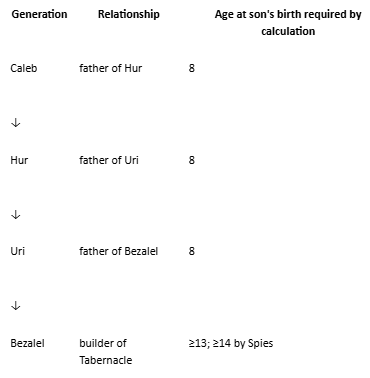
Attempted Proof #3 - Proof from Caleb, Hur, Uri, and Bezalel (c. 13th century BCE): Bezalel was at least 13 when he made the Tabernacle, and 14 when the spies were sent Caleb was then 40; Subtracting Bezalel’s 14 years and 2 years for 3 pregnancies leaves 24 years for 3 generations, so each generation fathered a child at age 8 - Exodus 38:22; I Chronicles 2:19-20; Exodus 36:4; Joshua 14:7, 10
אלא מנלן?
מהכא:
״ובצלאל בן אורי בן חור, למטה יהודה״,
וכתיב:
״ותמת עזובה אשת כלב, ויקח לו כלב את אפרת, ותלד לו את חור״.
The Talmud asks: Rather, from where do we derive that in earlier generations men fathered children at the age of 8?
From here, as it is written:
“And Bezalel, son of Uri, son of Hur, of the tribe of Judah, made all that YHWH commanded Moses” (Exodus 38:22).
And it is written:
“And Azubah died, and Caleb took for himself Ephrat, who bore him Hur. And Hur fathered Uri, and Uri fathered Bezalel” (I Chronicles 2:19–20).
Baraita - Moses made the Tabernacle in the 1st year after the Exodus; in the 2nd year he erected it and sent the Spies
וכי עבד בצלאל משכן בר כמה הוי?
בר תליסר,
דכתיב:
״איש איש ממלאכתו אשר המה עשים״.
And when Bezalel made the Tabernacle how old was he?
He must have been at least 13 years old,
as it is written:
“And all the wise men that carried out all the work of the sanctuary, came every man (איש) from his work that they did” (Exodus 36:4),4
ותניא:
שנה ראשונה
עשה משה משכן,
שניה
הקים משכן
ושלח מרגלים.
And it is taught in a baraita:
In the 1st year following the Exodus from Egypt
Moses made the Tabernacle;
in the 2nd year
he erected the Tabernacle
and sent out the spies.
וכתיב:
״בן ארבעים שנה אנכי בשלח משה עבד ה׳ וגו׳״,
״ועתה הנה אנכי היום בן חמש ושמנים שנה״.
כמה הויא להו?
ארבעין.
דל ארביסר דהוה בצלאל,
פשא להו עשרים ושית.
דל תרתי שני דתלתא עיבורי,
אשתכח דכל חד וחד בתמני אוליד.
And it is written that Caleb, Bezalel’s great-grandfather, said to Joshua:
“I was 40 years old when Moses the servant of YHWH sent me from Kadesh Barnea to spy out the land” (Joshua 14:7).
And he added: “And now, behold, I am this day 85 years old” (Joshua 14:10).
How many years old was Caleb when he was sent off with the Twelve Spies?
He was 40.
Subtract 14 years, as Bezalel was at least 14 years old when Caleb was sent to spy out the land.5
This leaves 26 years.
Subtract 2 more years for 3 pregnancies,6
It turns out that 3 generations were born in 24 years, and that each and every parent fathered a child at the age of 8.
הוליד - literally: “birthed”, grammatical masculine. Steinsaltz uses the archaic translation “begot”.
Presumably based on 9 months pregnancy, rounding up to a year. And compare the Talmud later: “Subtract 2 years for 3 pregnancies”; i.e. 9 months of pregnancy, multiplied by 3, is 27 months, which is roughly two years, rounding down.
This passage is paralleled elsewhere in the Talmud, see my “Pt1 The Seven Prophetesses of Israel (Megillah 14a-b)“, section “Sarah (Genesis 11:29)“.
And see also my “Biblical Figures in the Talmud: Counts, Contexts, and Index“, section “Additional Selected entries (figures who <20 times in the Talmud; a list of ~20 figures), With Index“, list item “Iscah“, and note there (ff. 39).
Steinsaltz explains:
and one who is less than 13 is not called a “man”
I.e., since the age of majority is from age 13; someone younger than that age is considered a minor/child.
Steinsaltz:
This is known because [the Spies’] mission took place a year after the Tabernacle was erected.
And, as noted previously, Bezalel was at least 13 years old when he made the Tabernacle.
For a detailed chronology, see my “Pt1 The Origins of Tisha B’Av and the Chronology of Numbers 10-14: the Date of the Destructions of the Both Temples and the Biblical Spies Episode (Taanit 29a)“.
Steinsaltz glosses (I added line-splits and numbering):
one preceding the birth of Hur, son of Caleb,
one preceding the birth of Uri, son of Hur,
and one preceding the birth of Bezalel, son of Uri.