

This is the second part of a three-part series. Part 1 is here; the outline of the series can be found at Part 1.
Part 2
Distilling the 613 commandments to a few fundamental principles: David - 11, Isaiah - 6, Micah - 3, Isaiah - 2, Amos and/or Ḥabakkuk - 1
(See footnote.)1
David distilled to 11 traits for dwelling with God - Ps 15
בא דוד והעמידן על אחת עשרה,
דכתיב
״מזמור לדוד
[ה׳] מי יגור באהלך?
מי ישכן בהר קדשך?
King David came and established the 613 mitzvot upon 11 mitzvot,
as it is written:
“A Psalm of David.
YHWH, who shall sojourn in Your Tabernacle?
Who shall dwell upon Your sacred mountain?
הולך תמים
ופועל צדק
ודבר אמת בלבבו,
לא רגל על לשנו
לא עשה לרעהו רעה
וחרפה לא נשא על קרבו.
נבזה בעיניו נמאס
ואת יראי ה׳ יכבד
נשבע להרע ולא ימר.
כספו לא נתן בנשך
ושחד על נקי לא לקח
עשה אלה לא ימוט לעולם״.
He who walks wholeheartedly,
and works righteousness,
and speaks truth in his heart.
Who has no slander upon his tongue,
nor does evil to his neighbor,
nor takes up reproach against his relative.
In whose eyes a vile person is despised,
and he honors those who fear YHWH;
he takes an oath to his own detriment, and changes not.
He neither gives his money with interest,
nor takes a bribe against the innocent.
He who performs these shall never be moved” (Psalms, chapter 15).
Eleven attributes that facilitate one’s entry into the World-to-Come appear on this list.
Table summarizing the Talmud’s interpretation in the next section:
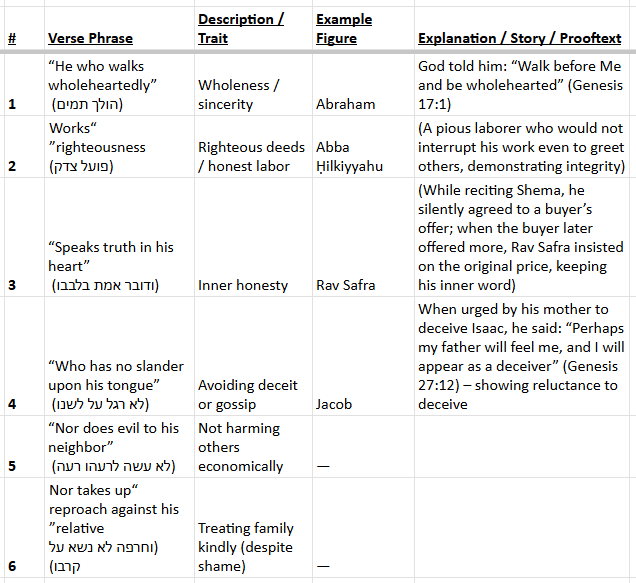
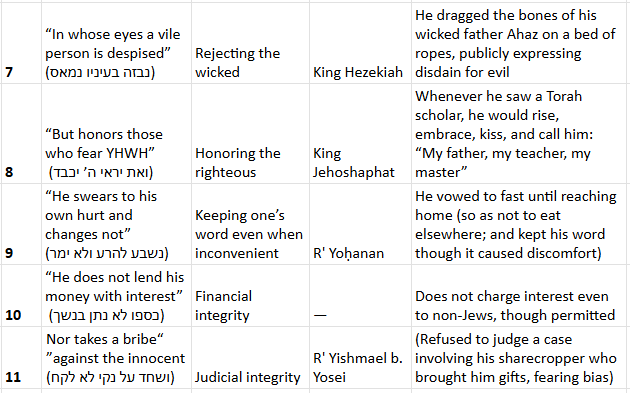
״הולך תמים״ –
זה אברהם,
דכתיב: ״התהלך לפני, והיה תמים״.
״פועל צדק״ –
כגון אבא חלקיהו.
״ודובר אמת בלבבו״ –
כגון רב ספרא.
״לא רגל על לשנו״ –
זה יעקב אבינו,
דכתיב: ״אולי ימשני אבי, והייתי בעיניו כמתעתע״.
״לא עשה לרעהו רעה״ –
שלא ירד לאומנות חבירו.
״וחרפה לא נשא על קרבו״ –
זה המקרב את קרוביו.
״נבזה בעיניו נמאס״ –
זה חזקיהו המלך,
שגירר עצמות אביו במטה של חבלים.
״ואת יראי ה׳ יכבד״ –
זה יהושפט מלך יהודה,
שבשעה שהיה רואה תלמיד חכם, היה עומד מכסאו, ומחבקו ומנשקו, וקורא לו: ״אבי אבי, רבי רבי, מרי מרי״.
״נשבע להרע ולא ימר״ –
כרבי יוחנן, דאמר רבי יוחנן: אהא בתענית עד שאבא לביתי.
״כספו לא נתן בנשך״ –
אפילו (ב)רבית גוי.
״ושחד על נקי לא לקח״ –
כגון רבי ישמעאל ברבי יוסי.
The Talmud analyzes these verses:
“He who walks wholeheartedly” --
this is referring to one who conducts himself like our forefather Abraham,
as it is written concerning him: “Walk before Me and be wholehearted” (Genesis 17:1).
“Works righteousness” --
this is referring to one such as Abba Ḥilkiyyahu, a laborer who would not pause from his labor even to greet people; he righteously continued working.
“And speaks truth in his heart” --
this is referring to one such as Rav Safra, who was reciting Shema when a person approached him to purchase an item. He intended to accept the man’s offer, but he was unable to respond because it is prohibited to interrupt the recitation of Shema. The buyer misinterpreted Rav Safra’s silence and concluded that Rav Safra demanded a higher price, so he raised his offer. Rav Safra insisted on selling him the item for the sum that he was offered initially.
“Who has no slander upon his tongue” --
this is referring to one who conducts himself like our forefather Jacob,
who did not want to mislead his father in order to receive his blessings, as it is written: “Perhaps my father will feel me, and I will be in his eyes like a fraud” (Genesis 27:12).
“Nor does evil to his neighbor” --
this is referring to one who did not infringe upon another’s trade, constituting illegal competition.
“Nor takes up reproach against his relative” --
this is referring to one who draws his relatives near, and does not distance them when they embarrass him.
“In whose eyes a vile person is despised” --
this is referring to one who conducts himself like King Hezekiah,
who dragged the bones of his evil father, King Ahaz, in a bed of ropes,2 because he despised those considered vile by God.
“And he honors those who fear YHWH” --
this is referring to one who conducts himself like Jehoshaphat, king of Judea,
who when he would see a Torah scholar would arise from his throne and hug him and kiss him, and call him: My father, my father, my teacher, my teacher, my master, my master.
“He takes an oath to his own detriment, and changes not” --
this is in accordance with the conduct of R’ Yoḥanan, as R’ Yoḥanan would say in the form of a vow when seeking to refrain from eating in another’s home: I shall fast until I will come to my house. He would fulfill that vow and refrain from eating, even though he took the vow only to avoid eating in that place.
“He neither gives his money with interest” --
meaning he does not lend money with interest even to a non-Jew, which is permitted by Torah law.
“Nor takes a bribe against the innocent” --
this is referring to one such as R’ Yishmael, son of R’ Yosei, who refused to sit in judgment in a case involving his sharecropper. Since the latter would bring him a basket of fruit, he was concerned that he might unconsciously favor him.
Anecdote - When Rabban Gamliel would reach this verse in Psalms 15, he would cry
כתיב ״עשה אלה לא ימוט לעולם״ –
כשהיה רבן גמליאל מגיע למקרא הזה --
היה בוכה,
אמר:
מאן דעביד להו לכולהו –
הוא דלא ימוט,
הא חדא מינייהו –
ימוט.
[...]
At the conclusion of the verses, it is written: “He who performs these shall never be moved.”
The Talmud relates: When Rabban Gamliel would reach this verse --
he would cry,
and he said:
It is one who performed all these actions
who shall never be moved;
but if he performed only one of them --
he shall be moved.
[...]
Isaiah distilled to 6 traits: walk righteously, speak uprightly, reject unjust gain, avoid bribe, stop ears from blood, avert eyes from evil - Isa 33:15–16
בא ישעיהו והעמידן על שש,
דכתיב
״הלך צדקות
ודבר מישרים
מאס בבצע מעשקות
נער כפיו מתמך בשחד
אטם אזנו משמע דמים
ועצם עיניו מראות ברע״.
R’ Simlai’s exposition continues: Isaiah came and established the 613 mitzvot upon 6,
as it is written:
“He who walks righteously,
and speaks uprightly;
he who despises the gain of oppressions,
who shakes his hands from holding of bribes,
who stops his ears from hearing blood,
and shuts his eyes from looking upon evil” (Isaiah 33:15).
Table summarizing the Talmud’s interpretation in the next section:

״הלך צדקות״ –
זה אברהם אבינו,
דכתיב ״כי ידעתיו למען אשר יצוה וגו׳״.
״ודבר מישרים״ –
זה שאינו מקניט פני חבירו ברבים.
״מאס בבצע מעשקות״ –
כגון רבי ישמעאל בן אלישע.
״נער כפיו מתמך בשחד״ –
כגון רבי ישמעאל ברבי יוסי.
״אטם אזנו משמע דמים״ –
דלא שמע בזילותא דצורבא מרבנן ושתיק,
כגון רבי אלעזר ברבי שמעון.
״ועצם עיניו מראות ברע״ –
כרבי חייא בר אבא, דאמר רבי חייא בר אבא: זה שאינו מסתכל בנשים בשעה שעומדות על הכביסה.
The Talmud elaborates:
“He who walks righteously” --
this is referring to one who conducts himself like our forefather Abraham,
as it is written concerning him: “For I have known him, that he will command his children…to perform righteousness and justice” (Genesis 18:19).
“And speaks uprightly” --
this is referring to one who does not shame another in public.
“He who despises the gain of oppressions” --
this is referring to one such as R’ Yishmael ben Elisha, who refused to sit in judgment in a case involving one who gave him priestly gifts, to avoid the appearance of impropriety.
“Who shakes his hands from holding of bribes” --
this is referring to one such as R’ Yishmael, son of R’ Yosei, who, as explained above, refused to sit in judgment in a case involving his sharecropper.
“Who stops his ears from hearing blood” --
this is referring to one who would not hear derision of a Torah scholar and remain silent,
such as R’ Elazar, son of R’ Shimon, who was well known for this.
“And shuts his eyes from looking upon evil” --
is to be understood in accordance with the statement of R’ Ḥiyya bar Abba, as R’ Ḥiyya bar Abba says: This is referring to one who does not look at women when they stand over the laundry at the river. The women would lift the garments they were wearing to keep them out of the water, and thereby expose part of their bodies.
וכתיב: ״הוא מרומים ישכון״.
And it is written with regard to one who performs these matters: “He shall dwell on high; his fortress shall be the munitions of rocks; his bread shall be given, his waters shall be sure” (Isaiah 33:16).
Micah distilled to 3: do justice, love kindness, walk humbly with God - Mic 6:8
בא מיכה והעמידן על שלש,
דכתיב
״הגיד לך אדם מה טוב
ומה ה׳ דורש ממך
כי אם
עשות משפט
ואהבת חסד
והצנע לכת עם (ה׳) אלהיך״.
Micah came and established the 613 mitzvot upon three,
as it is written:
“It has been told to you, O man, what is good,
and what YHWH does require of you;
only
to do justly,
and to love mercy,
and to walk humbly with your God” (Micah 6:8).
״עשות משפט״ –
זה הדין.
״אהבת חסד״ –
זה גמילות חסדים.
״והצנע לכת״ –
זה
הוצאת המת
והכנסת כלה.
The Talmud elaborates:
“To do justly” --
this is justice (דין);
“to love mercy” --
this is an allusion to acts of loving-kindness;3
“and to walk humbly with your God” --
this is an allusion to
taking the indigent dead out for burial
and accompanying a poor bride to her wedding canopy,
both of which are to be performed without fanfare glorifying the doer.
והלא דברים קל וחומר:
ומה דברים שאין דרכן לעשותן בצנעא,
אמרה תורה ״והצנע לכת״,
דברים שדרכם לעשותם בצנעא –
על אחת כמה וכמה!
The Talmud notes: And are these matters not inferred a fortiori?:
If, with regard to matters that tend to be conducted in public, e.g., funerals and weddings,
the Torah states “walk humbly” when doing them,
then in matters that tend to be conducted in private, e.g., charity and Torah study,
all the more so should they be conducted in private.
Isaiah distilled to 2: keep justice, do righteousness - Isa 56:1
חזר ישעיהו והעמידן על שתים,
שנאמר
״כה אמר ה׳:
שמרו משפט
ועשו צדקה״.
Isaiah then established the 613 mitzvot upon two,
as it is stated:
“So says YHWH:
Observe justice
and perform righteousness” (Isaiah 56:1).
Amos distilled to one: “Seek Me and live” - Amos 5:4
בא עמוס והעמידן על אחת,
שנאמר
״כה אמר ה׳ לבית ישראל:
דרשוני וחיו״.
[...]
Amos came and established the 613 mitzvot upon one,
as it is stated:
“So says YHWH to the house of Israel:
Seek Me and live” (Amos 5:4).
[...]
Ḥabakkuk distilled to one: “The righteous will live by his faith” - Hab 2:4
בא חבקוק והעמידן על אחת,
שנאמר ״וצדיק באמונתו יחיה״.
Habakkuk came and established the 613 mitzvot upon one,
as it is stated: “But the righteous person shall live by his faith” (Habakkuk 2:4).
The literary formula for each of these is as follows:
בא [X - נביא] והעמידן על [Y - מספר],
דכתיב [...]
[X - biblical prophet] came and established them [העמידן - literally: “stood them up”, i.e. the commandments] upon [Y - number] [commandments],
as it is written: [verse]
My splitting of the verses in the following sections into numbered lists is based on the Talmud’s ensuing interpretations.
According to Steinsaltz, the first section presented here should be read as a direct continuation of R’ Simlai’s statement concluding Part 1 of this series, see ibid., section “R’ Simlai - There are 613 mitzvot: 365 prohibitions, 248 positive commandments“.
Superlative example figures listed in the following sections:
Biblical figures:
Abraham - Wholeness / sincerity, and conducts himself in righteousness
Jacob - Avoiding deceit or gossip
King Hezekiah - Rejecting the wicked
King Jehoshaphat - Honoring the righteous
Rabbinic (Tanaitic) figures:
Abba Ḥilkiyyahu - Righteous deeds / honest labor
Rav Safra - Inner honesty
R’ Yoḥanan - Keeping one’s word even when inconvenient
R’ Yishmael b. Yosei - Judicial integrity
R’ Yishmael b. Elisha - Refuses any situation resembling a bribe or personal interest
R’ Elazar b. Shimon - Will not listen silently to the shaming or derision of a Torah scholar
This is mentioned also in the Mishnah, see my “The Biblical King Hezekiah’s Six Controversial Actions: Three Approved, Three Not (Mishnah Pesachim 4:9)“, section “Three Approved“, list item #1:
גרר עצמות אביו על מטה של חבלים
Due to King Hezekiah’s father’s wickedness, he dragged the bones of his father Ahaz on a bier of ropes and did not afford him the respect due to a king,
There is no explicit biblical verse that describes Hezekiah literally dragging Ahaz’s bones.
See 2 Chronicles 28:27 that Ahaz’s body “was not brought to the tombs of the kings of Israel“, implying that he was intentionally not given an honorable burial:
וישכב אחז עם אבתיו
ויקברהו בעיר, בירושל͏ם
כי לא הביאהו לקברי מלכי ישראל
וימלך יחזקיהו בנו תחתיו
Ahaz slept with his fathers
and was buried in the city, in Jerusalem;
his body was not brought to the tombs of the kings of Israel.
His son Hezekiah succeeded him as king.
And see 2 Kings 18:3–4, re Hezekiah’s radical rejection of his father’s idolatry:
ויעש הישר בעיני יהוה
ככל אשר עשה דוד אביו
הוא הסיר את הבמות
ושבר את המצבת
וכרת את האשרה
וכתת נחש הנחשת אשר עשה משה
כי עד הימים ההמה היו בני ישראל מקטרים לו
ויקרא לו נחשתן
He did what was pleasing to YHWH,
just as his forefather David had done.
He abolished the shrines (במות)
and smashed the pillars (מצבת)
and cut down the sacred post (אשרה)
He also broke into pieces the bronze serpent that Moses had made,
for until that time the Israelites had been offering sacrifices to it;
it was called Nehushtan.
גמילות חסדים.
On this term, see these pieces of mine, and my notes on them:
“Pt1 Tripartite Aphorisms: From The Men of the Great Assembly to Rabban Gamaliel’s Dynasty (Mishnah Avot 1:1-2:4)“, section “Shimon HaTzadik - The world stands on 3 things: Torah, Temple service, and acts of kindness (1:2)“
“Pt2 The Death and Burial of Moses in Deuteronomy 31-34 (Sotah 13b-14a)“, “Appendix 1 - ‘Following God’ Through Emulation of His Attributes (Sotah 14a)“, section “‘Walking After God’ Means Imitating His Deeds (Genesis 3:21, 18:1, 25:11; Deuteronomy 34:6): Clothing the Naked, Visiting the Sick, Comforting Mourners, and Burying the Dead“.