

This is the second and final part of a two-part series. Part 1 is here; the outline of the series can be found at Part 1.
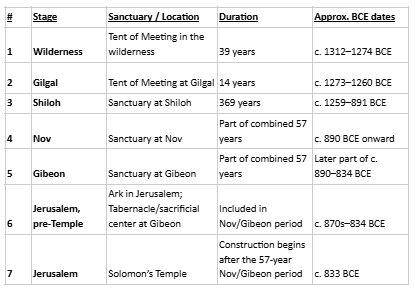
Baraita - The Tabernacle stood 39 years in the Wilderness, 14 at Gilgal, 57 at Nov/Gibeon, leaving 369 years for Shiloh - I Kings 6:1
Table (note that dates are according to the traditional rabbinic chronology, rather than modern historical dating):

תנו רבנן:
ימי אהל מועד שבמדבר –
ארבעים שנה חסר אחת.
ימי אהל מועד שבגלגל –
ארבע עשרה;
שבע שכבשו,
ושבע שחלקו.
ימי אהל מועד שבנוב וגבעון –
חמשים ושבע.
נשתיירו לשילה שלש מאות ושבעים חסר אחת.
§ With regard to the duration of the different periods mentioned in the Mishnah, a baraita states:
The days of the Tent of Meeting in the wilderness
were 40 years, less one year.
The days of the Tent of Meeting that were in Gilgal
were 14 years:
7 years during which the Jews conquered the land
and 7 years during which they divided the land among the tribes.
The days of the Tent of Meeting that were in Nov and Gibeon
were 57 years, until the Temple in Jerusalem was constructed.
Since the Temple was constructed 480 years after the Exodus from Egypt (see I Kings 6:1), it follows that there remain for the period of the Tabernacle in Shiloh 370 years less one.
Prooftext that the Tabernacle stood 39 years in the Wilderness: it was constructed in the 1st year after the Exodus, and erected in the 2nd
ימי אהל מועד שבמדבר –
ארבעים חסר אחת.
מנלן?
דאמר מר:
שנה ראשונה –
עשה משה את המשכן,
שניה –
הוקם המשכן
ושלח משה מרגלים.
The Talmud asks: From where do we derive that the days of the Tent of Meeting that were in the wilderness were 40 years less one?
As the Master said in a baraita:
In the 1st year after the Exodus from Egypt --
Moses constructed the Tabernacle;
in the 2nd year --
the Tabernacle was erected,
and Moses sent spies.
Because of the sin of the Spies, the Jewish people remained in the Wilderness for 40 years. It follows that the Tabernacle in the wilderness stood for 39 years.
Prooftext that the conquest of Canaan lasted 7 years: Caleb was 78 years old when Israel crossed the Jordan, and 85 when the conquest ended - Joshua 14:7, 10
שבגלגל ארבע עשרה –
שבע שכבשו
ושבע שחלקו.
מנלן?
דקאמר כלב:
״בן ארבעים שנה אנכי בשלח משה עבד ה׳ אותי מקדש ברנע לרגל את הארץ, ואשב אותו דבר כאשר עם לבבי״;
וכתיב:
״ועתה, הנה אנכי היום בן חמש ושמנים שנה״.
The baraita stated that the Tabernacle remained in Gilgal for 14 years:
7 years during which the Jews conquered the land
and 7 years during which they divided it
From where do we derive that?
As Caleb, son of Jephunneh, said to Joshua at the conclusion of the period of conquest before the land was divided:
“40 years old was I when Moses, the servant of YHWH, sent me from Kadesh Barnea to spy out the land; and I brought him back word as it was in my heart” (Joshua 14:7),
and it is written:
“And now, I am this day 85 years old” (Joshua 14:10).
כי עבריה לירדן, בר כמה הוי?
בר שבעין ותמני,
When the Jewish people crossed the Jordan, how old was Caleb?
He was 78 years old
The spies were sent by Moses in the 2nd year after the Exodus from Egypt, and in the 40th year they crossed the Jordan.
וקאמר: ״בן חמש ושמונים שנה״;
הרי שבע שכבשו.
And at the time of the division of the Land, he said that he was 85 years old.
This indicates that it was 7 years during which the Jews conquered the land.
Prooftext for the 7 years of division
Possible prooftext #1 - The division of the land is assumed to have lasted 7 years, matching the 7 years of conquest
ושבע שחלקו מנלן?
איבעית אימא:
מדשבע שכבשו,
שבע נמי שחלקו;
The Talmud asks: And from where do we derive that there were 7 years during which they divided the land?
If you wish, say:
Since it was a period of 7 years in which they conquered the land,
it was presumably also a period of 7 years in which they divided the land.
Possible prooftext #2 - inferred from the chronological requirements of Ezekiel’s reference to the 14th year after Jerusalem’s destruction and the Jubilee cycle - Ezekiel 40:1
ואיבעית אימא:
מדלא משכחת לה בארבע עשרה שנה ״אחר אשר הכתה העיר״.
And if you wish, say instead:
Because otherwise, you do not find any plausible explanation for the date mentioned by the prophet Ezekiel in the verse: “In the beginning of the year, on the 10th day of the month, in the 14th year after that the city was smitten” (Ezekiel 40:1).
This indicates that it was a Jubilee Year, unless capturing and dividing the land took a total of 14 years, after which point they began to calculate Sabbatical and Jubilee Years.
Baraita - Shiloh was destroyed when Eli died and the Tabernacle moved to Nov; Nov was destroyed when Samuel died and it moved to Gibeon - I Samuel 4:18
אהל מועד שבנוב וגבעון –
חמשים ושבע.
מנא לן?
דכתיב:
״ויהי כהזכירו את ארון האלהים״;
§ The baraita stated that the period of the Tent of Meeting that was in Nov and Gibeon was 57 years.
The Talmud asks: From where do we derive this?
As it is written in the description of the death of Eli the High Priest, upon being informed that the Ark was captured by the Philistines:
“And it came to pass, when he made mention of the Ark of God,
that he fell from off his seat backward by the side of the gate, and his neck broke, and he died” (I Samuel 4:18).
ותנא:
כשמת עלי הכהן –
חרבה שילה,
ובאו לנוב;
כשמת שמואל הרמתי –
חרבה נוב,
ובאו לגבעון.
And a tanna taught:
When Eli the priest died --
Shiloh was destroyed
and the Jews arrived at Nov, where they erected the Tabernacle. At that time, Samuel began to lead the people.
When Samuel from Rama died --
Nov was destroyed by Saul (see I Samuel 22:19)
and they arrived at Gibeon, where the Tabernacle remained (see I Chronicles 16:39).
The 20 years associated with the Ark at Kiriath Jearim comprise 10 years of Samuel alone, 1 of Samuel and Saul, 2 of Saul alone, and 7 of David at Hebron - I Samuel 7:2; I Kings 2:11
וכתיב:
״ויהי מיום שבת הארון בקרית יערים,
וירבו הימים ויהיו עשרים שנה,
וינהו כל בית ישראל אחרי ה׳״;
The Talmud determines the number of years from when the Ark was captured by the Philistines and Shiloh was destroyed:
And it is written:
“And it came to pass, from the day that the Ark abode in Kiriath Jearim that the time was long;
for it was 20 years;
and all the house of Israel yearned after YHWH” (I Samuel 7:2).
The Ark was returned by the Philistines to Kiriath Jearim 7 months after it was captured, and it remained there for 20 years, until David brought it to Jerusalem.
Table visualizing:
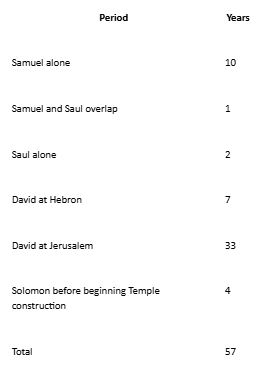
הני עשרים שנה –
עשר שנה שמלך שמואל בעצמו,
ושנה שמלך שמואל ושאול,
ושתים שמלך שאול,
ושבע דדוד –
The Talmud explains that these 20 years are calculated as follows:
10 years that Samuel reigned alone, from the death of Eli until the coronation of Saul,
and 1 year that Samuel and Saul reigned, i.e., Saul reigned for one year during the lifetime of Samuel,
and 2 years that Saul reigned alone after the death of Samuel.
And in addition to these 13 years, there were the 7 years of David’s reign in Hebron, before the years of his reign in Jerusalem.
דכתיב:
״והימים אשר מלך דוד על ישראל – ארבעים שנה;
בחברון מלך שבע שנים [וגו׳]״.
As it is written:
“And the days that David reigned over Israel were 40 years:
7 years he reigned in Hebron,
and 33 years he reigned in Jerusalem” (I Kings 2:11).1
Adding David’s Jerusalem reign and Solomon’s first years yields 57 years for Nov/Gibeon; subtracting all other periods from 480 years leaves 369 for Shiloh - II Chronicles 3:2; I Kings 6:1
ובשלמה כתיב:
״ויחל לבנותו בשנת ארבע למלכותו״.
נשתיירו לשילה שלש מאות ושבעים חסר אחת.
And with regard to the construction of the Temple in the time of Solomon, it is written:
“And he began to build it in the 2nd day of the 2nd month, in the 4th year of his reign” (II Chronicles 3:2),
which was the 480th year following the Exodus (see I Kings 6:1).
there remain for Shiloh 370 less one years in which the Tabernacle stood there.2
Baraita - “Rest” means Shiloh and “inheritance” means Jerusalem; their separation in the verse permits private altars during the intervening Nov/Gibeon period - Deuteronomy 12:9
באו לנוב וגבעון [וכו׳].
מנא הני מילי?
דתנו רבנן:
״כי לא באתם עד עתה אל המנוחה ואל הנחלה״;
§ The Mishnah teaches that when Shiloh was destroyed and they arrived at Nov and Gibeon, private altars were permitted and offerings of lesser sanctity could be eaten in any city in Eretz Yisrael.
The Talmud asks: From where are these matters derived?
they are derived as a baraita states:
The Jewish people were told that when they enter Eretz Yisrael they would be permitted to sacrifice on private altars, “for you have not as yet come to the rest and to the inheritance” (Deuteronomy 12:9),
during which time those altars would be prohibited.
״אל המנוחה״ –
זו שילה,
״נחלה״ –
זו ירושלים.
למה חלקן?
כדי ליתן היתר בין זה לזה.
[...]
The Talmud interprets the verse:
“To the rest”;
this is a reference to Shiloh.
“The inheritance”;
this is a reference to Jerusalem.
One may ask: Why does the verse divide them into two terms, i.e., “rest” and “inheritance”?
It is in order to give permission to sacrifice on private altars during the period between this one and that one.
Therefore, it was permitted to sacrifice on private altars during the period of Nov and Gibeon.
[...]
R’ Yehuda - “Rest” is Shiloh and “inheritance” is Jerusalem - Deuteronomy 12:9
באו לירושלים [וכו׳].
תנו רבנן:
״כי לא באתם עד עתה אל המנוחה ואל הנחלה״
״מנוחה״
זו שילה,
״נחלה״
זו ירושלים.
§ The Mishnah teaches that when they arrived at Jerusalem, private altars were prohibited and there was no subsequent period in which they were permitted. And the Temple in Jerusalem was characterized as “inheritance.”
With regard to this, a baraita states:
The verse that discusses the permissibility of private altars states: “For you have not as yet come to the rest and to the inheritance” (Deuteronomy 12:9).
The baraita interprets:
With regard to “rest,”
this is a reference to Shiloh,
and with regard to “inheritance,”
this is a reference to Jerusalem.
Prooftexts - Jeremiah’s description of Jerusalem as God’s “inheritance” - Jeremiah 12:7–9
ואומר:
״היתה לי נחלתי כאריה ביער״,
ואומר:
״העיט צבוע נחלתי לי?! העיט סביב עליה?!״.
דברי רבי יהודה.
And similarly, the verse that relates a prophecy with regard to Jerusalem states:
“I have forsaken My house, I have cast off My inheritance…My inheritance has become to Me as a lion in the forest” (Jeremiah 12:7–8).
And additionally, in that same prophecy the verse states:
“Is My inheritance to Me as a speckled bird of prey?! Are the birds of prey against her round about?!” (Jeremiah 12:9).
This is the statement of R’ Yehuda.
R’ Shimon - “Rest” is Jerusalem and “inheritance” is Shiloh
רבי שמעון אומר:
״מנוחה״
זו ירושלים,
״נחלה״
זו שילה.
By contrast, R’ Shimon says:
With regard to “rest,”
this is a reference to Jerusalem,
and with regard to “inheritance,”
this is a reference to Shiloh.
Prooftexts - Psalms explicitly describes Zion/Jerusalem as God’s resting place - Psalms 132:13–14
ואומר:
״זאת מנוחתי עדי עד, פה אשב, כי אויתיה״,
ואומר:
״כי בחר ה׳ בציון, אוה למושב לו״.
[...]
And this is evident from the verse that says:
“This is My resting place forever; here will I dwell, for I have desired it” (Psalms 132:14).
And it states in the previous verse:
“For YHWH has chosen Zion; He has desired it for His habitation” (Psalms 132:13), which indicates that the verses are referring to Jerusalem.
[...]
R’ Yishmael’s School - Both “rest” and “inheritance” refer to Shiloh; R’ Shimon ben Yoḥai - Both “rest” and “inheritance” refer to Jerusalem
תנא דבי רבי ישמעאל: זו וזו שילה.
רבי שמעון בן יוחי אומר: זו וזו ירושלים.
§ With regard to the words “rest” and “inheritance” in the aforementioned verse,
the school of R’ Yishmael taught that this and that, i.e., both terms, are a reference to Shiloh.
R’ Shimon ben Yoḥai says: This and that are a reference to Jerusalem.
Appendix 1 - Chronology of the Sanctuaries at Shiloh, Nov, Gibeon, and Jerusalem according to the sugya
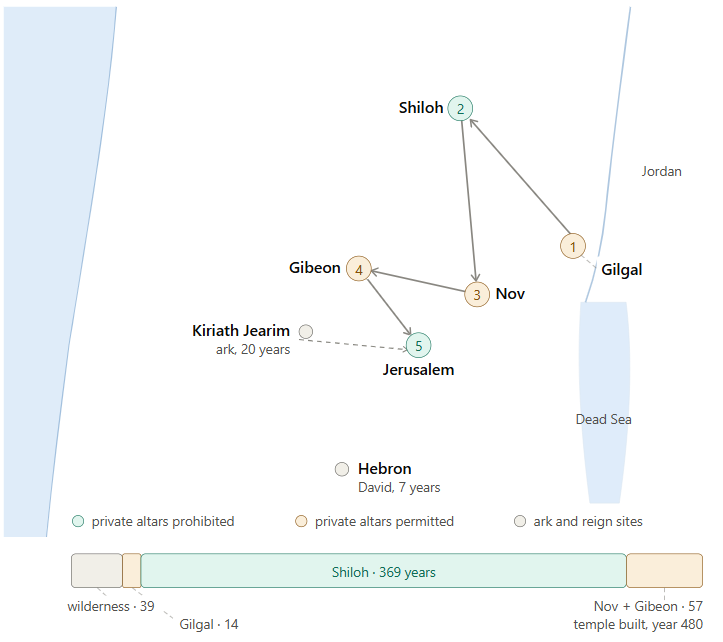
Appendix 2 - Schematic geographical map of the movements of the Sanctuary, according to the sugya
Steinsaltz explains:
In the 1st year that David reigned in Jerusalem, he brought the Ark there from Kiriath Jearim. The Ark was therefore in Kiriath Jearim for 20 years. When the 33 years of David’s reign in Jerusalem are added to these, there are a total of 53 years from the destruction of Shiloh. During all of these years, and at the beginning of Solomon’s reign, the Tabernacle was in Nov and Gibeon (see I Kings 3:4).
Steinsaltz explains:
When the 40 years in the wilderness, the 14 years that the Tabernacle stood in Gilgal, and the 57 years that the Tabernacle stood in Nov and Gibeon, which totals 111 years, are subtracted from the 480