

This is the third and final part of a three-part series. Part 1 is here, Part 2 is here; the outline of the series can be found at Part 1.
Several dangerous medical states - fever, stings, thorns, eye pain, after bloodletting, etc
Rav Yehuda - Lists several dangerous medical states and dangerous or beneficial combinations involving fever, stings, thorns, eye pain, bloodletting, fish, and certain foods - A list of 5 medical states
אמר רב יהודה:
זיבורא,
ודחרזיה סילוא,
וסמטא,
ודכאיב ליה עינא,
ואתי עילויה אישתא —
כולהו בי בני סכנתא.
Rav Yehuda says:
With regard to
one who suffers from the sting of a hornet,
or the prick of a thorn [silva],
or an abscess,
or one whose eye pains him,
or one overcome by a fever,
bathing in a bathhouse is a life-threatening danger for all of these.
Several dangerous and beneficial pairings are listed
Table summarizing:1
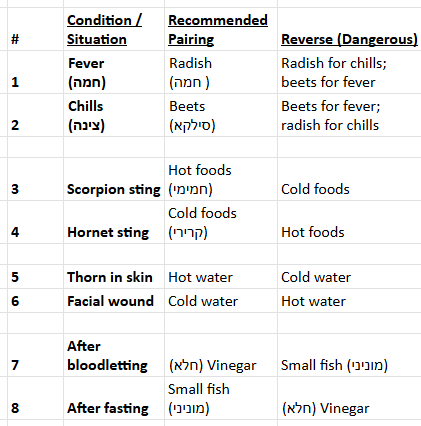
1 - Fever/radish; chills/beets
חמה
לחמה,
וסילקא
לצינא,
וחילופא --
סכנתא.
Additionally,
eating radish [ḥamma]
is good for a fever [ḥamma],
and eating beets [silka]
is good for chills [tzina],
but the reverse, i.e., eating radish when one has chills or beets when one has a fever --
poses a danger.
2 - Scorpion/hot foods, hornet/cold foods
חמימי
לעקרבא
וקרירי
לזיבורא,
וחילופא --
סכנתא.
Similarly,
eating hot foods
is good for the sting of a scorpion,
and cold foods
are good for a hornet sting,
but the reverse --
poses a danger.
3 - Thorn/hot water, facial wound/cold water
חמימי
לסילוא
וקרירי
לחספניתא,
וחילופא --
סכנתא.
Hot water
is good for a thorn embedded in one’s skin,
and cold water
is good for facial wounds2
but the reverse --
presents a danger.
4 - Vinegar after bloodletting, and small fish after fasting
חלא
לסיבורי,
ומוניני
לתעניתא,
וחילופא --
סכנתא.
Vinegar
is good for one to consume after bloodletting3
and eating small fish (מוניני)
is good for one who has completed a fast,
but the reverse --
is a danger.
After bloodletting
Additional dangerous combinations are listed involving bloodletting together with cress, fever, or eye pain
תחלי וסיבורא
סכנתא,
אישתא וסיבורא
סכנתא,
כאיב עינא וסיבורי
סכנתא.
Eating cress and then undergoing bloodletting
poses a danger.
With regard to one who suffers from a fever and undergoes bloodletting,
this poses a danger to his life.
Similarly, one who suffers from pain of the eye and undergoes bloodletting
endangers to his life.
A timing rule is given for fish and bloodletting: each is safe on the second day after the other, but dangerous on the third day
שני לדג
דם,
שני לדם
דג,
שלישי לו
סכנתא.
On the 2nd day after eating fish
one may let blood,
and on the 2nd day after letting blood
one may eat fish.
With regard to eating fish on the 3rd day after letting blood, or letting blood on the 3rd day after eating fish,
both of these actions pose a danger.
Baraita - after bloodletting, one should not eat milk, cheese, onions, or cress
תנו רבנן:
המקיז דם —
:לא יאכל
חגב״ש
§ The Talmud presents a series of health-related statements.
A baraita states:
One who lets blood —
may not eat the following foods, corresponding to the acronym:
ḥet,
gimmel,
beit,
Shin.
לא חלב,
ולא גבינה,
ולא בצלים,
ולא שחלים.
That is, he may consume
neither milk [ḥalav],
nor cheese [gevina],
nor onions [betzalim],
nor cress [sheḥalim].
Abaye - a corrective treatment for someone who ate forbidden foods after bloodletting
אם אכל,
אמר אביי:
נייתי רביעתא דחלא
ורביעתא דחמרא,
ונערבבינהו בהדי הדדי
ונישתי.
If he ate one of these,
Abaye said:
He should bring 1/4th-log of vinegar
and 1/4th-log of wine
and mix them together
and drink the mixture.
… and defecate only to the east of the city, because of the strong odor
וכי מפנה —
לא מפנה אלא למזרחה של עיר,
משום דקשה ריחא.
And when he defecates,
he should defecate only toward the east of the city,
because the odor of the excrement after that treatment is offensive.4
Since the wind does not usually blow from the east, it is less likely to spread the stench.
Unkali (אונקלי - displaced rib-edge near the heart)
R’ Yehoshua ben Levi - one may lift the unkali on Shabbat
אמר רבי יהושע בן לוי:
מעלין אונקלי בשבת.
R’ Yehoshua ben Levi says:
One may lift the unkali on Shabbat.
R’ Abba - unkali is a displaced rib-edge near the heart
מאי אונקלי?
אמר רבי אבא:
איסתומכא דליבא.
The Talmud asks: What is the unkali?
R’ Abba said:
Remedy for unkali - A mixture of cumin, caraway, mint, wormwood, satureja, and hyssop
מאי אסותא?
מייתי
כמונא
כרוייא
וניניא
ואגדנא
וציתרי
ואבדתא.
The Talmud asks: What is the cure for one whose unkali has been bent?
He should take
Remedies for the Heart, Wind-Related Ailments, and Childbirth: for the heart - with wine, for “wind” - with water, and for childbirth - with beer, each with a Biblical verse
Table summarizing:

לליבא --
בחמרא,
וסימנך: ״ויין ישמח לבב אנוש״.
לרוחא --
במיא,
וסימנך: ״ורוח אלהים מרחפת על פני המים״.
לכודא --
בשיכרא,
וסימנך: ״וכדה על שכמה״.
This remedy is beneficial for several ailments, and the Talmud presents each of these in turn:
For curing the heart --
the above combination should be taken with wine,
and your mnemonic for this is the verse: “And wine that makes glad the heart of man” (Psalms 104:15).
For curing an ailment that arises due to the wind [ruḥa] --
one drinks the mixture in water,
and your mnemonic for this is the verse: “And the spirit [ruaḥ] of God hovered over the face of the waters” (Genesis 1:2).
For childbirth9 --
a woman in labor drinks the mixture with beer [shikhra],
and your mnemonic for this is the verse: “With her pitcher [ve-khadah] upon her shoulder [shikhmah]” (Genesis 24:15).10
Anecdote re Rav Aḥa b. Rava - way of preparing and taking the herbal unkali remedy
רב אחא בריה דרבא שחיק להו לכולהו בהדי הדדי,
ושקיל ליה מלא חמש אצבעתיה,
ושתי ליה.
Rav Aḥa, son of Rava, ground all of these together
and took a handful of the mixture
and drank it.
Anecdote re Rav Ashi - way of preparing and taking the herbal unkali remedy
רב אשי שחיק כל חד וחד לחודיה,
ושקיל
מלא אצבעיה רבתי
ומלא אצבעיה זוטרתי.
Rav Ashi ground each and every one of the herbs separately
and he took
all that he could hold between his large finger
and his small finger
and drank it.
Anecdote re Rav Pappa - he tried all the unkali remedies without success
אמר רב פפא:
אנא עבדי לכל הני
ולא איתסאי,
Rav Pappa said:
I tried all these remedies
and I was not healed
... until an Arab gave him a different one - water in a new jug with honey added at night and drunk the next day; that cured him
עד דאמר לי ההוא טייעא:
אייתי כוזא חדתא
ומלייה מיא,
ורמי ביה תרוודא דדובשא דתלי לה בי כוכבי,
ולמחר אישתי.
עבדי הכי ואיתסאי.
until a certain Arab said to me:
Bring a new jug
and fill it with water
and place in it a ladle [tarvada] of honey that is suspended among the stars, i.e., add the ladle at night,
and drink it on the next day.
Rav Pappa concludes: I did this and I was healed.11
Pattern: There are four parts to this statement, each with two sub-parts. Each ailment or condition has a specifically matched remedy; applying the opposite pairing is consistently described as dangerous (חילופא — סכנתא).
חספניתא.
On this word, see Jastrow (modernized), entry “חַסְפְּנִיתָא”:
(חֲסַף)
1) scaly skin.
Bamidbar Rabbah 19; Kohelet Rabbah 7:23 - רגלוי … לחספניתא דנונא - “the feet of chickens resemble (as to their covering) the scale-covered skin of the fish”, see חַרְסְפִיתִין.
2) scab, eruption.
Shabbat 133b, sq. - האי מאן דמשי … ליה חספניתא (Manuscript Munich: חוספנתא) - “he who washes his face and does not dry it well, will get a scab”
Avodah Zarah 28b, sq. (Rashi: חוספניתא).
סיבורי.
On this word, see Jastrow (modernized), entry “סִיבּוּרָא”:
(סְבר III)
blood-letting.
Avodah Zarah 29a:2 (interchangeable with סִיבּוּרֵי, סִבּ׳ plural:).
Ketubot 39b:3 - תרפתא דסיבורי Arukh ed. Kohelet (other editions: דסיכורי, a Variant to רבדא דכוסילתא, see Rashi there,) - “the scar from blood-letting”
And see ibid., entry “סְכַר II”:
Pa’el סַכַּר a. Po’el סוֹכַר (compare סְבַר III a. כְּרֵי)
[to bore, dig,] to let blood.
Gittin 67b:13 - לשימשא … בת תרי יומי סַכּוּרֵי - “for sunstroke … on the second day blood-letting is indicated” (some editions: סִיכּוּרֵי plural noun).
and elsewhere.
קשה - literally: “heavy, difficult”. In this context, it may mean “dangerous”.
איסתומכא - istumkha - from Greek - “stomach”.
Steinsaltz explains:
which sometimes bend inward, in which case they must be lifted and straightened into their proper position.
The word unkali is from Greek, see Hebrew Wiktionary, “אנקל“. The word appears a few times already in the Mishnah, where it means “hook”.
And see Jastrow (modernized), entry “אוּנְקְלַי I”:
אָנְקְלַי feminine
(אנק, with ל format.; = אוּנְקַי; corresponding to Biblical Hebrew לוּלַי; Greek adaptation ἀγκολη [ankolē], Septuagint Exodus 26:10; compare אוֹנִי as to contact of the two languages) prop. little (camel’s) neck, hence
1) hook, rack
[…]
2) [compare ἀγκαλίς [ankalís - “sickle”] in S.] the load carried on the hook, the farmer’s load of sheaves or bunches; compare בלונקי.
[…]
3) Transferred sense: (medical) bent cartilage, especially the cartilage (cartilage ensiformis) at the end of the sternum which, being bent inside, presses on the stomach and creates nausea etc.
Avodah Zarah 29a:4 - מעלין אונקלי וכ׳ - “you are permitted to lift the cartilage on the Sabbath” (by means of a bandage etc.).
Ibid. - מאי אונקלי וכ׳ - “what unklay is meant? [Answer:] the cartilage in front of the heart”; see אִיסְתּוֹמְכָא.
ἀγκολή (ankolē) is a Greek noun meaning “loop, noose”, from ankúlē - “loop, noose“. In the Septuagint (Exodus 26:10), it is used to render Hebrew terms for loops or fastenings in the Tabernacle curtains; i.e., small looped connectors, consistent with the semantic range “curved/loop-like.”
אגדנא.
Compare elsewhere, where wormwood is referred to as ירנקא or אפסינתין, see my “Pt2 Uncovered Liquids and Ritual Boundaries: Gentile Wine and the Risk of Snake Venom (Avodah Zarah 30a-31b)“, section “Wine-Based Drinks: R’ Yehoshua ben Levi and Rav Ḥama on Sharp, Bitter/Sour, and Sweet Flavored Wines“.
On this word, see Jastrow (modernized), entry “צִתְרֵי”:
(compare צוּתְרָא)
Satureia, savory
(see Löw, ‘Aramäische Pflanzennamen’ p. 325, a. Smith, ‘Dictionary of Greek and Roman Antiquities’ under the word Thymbra).
Shabbat 128a:15 (explaining סִיאָה, not פיאה) צתרי (Manuscript Munich: צרתי; Manuscript Oxford: צַעְתִּירֵי);
Jerusalem Talmud Terumot 10:2:7 - מי צתרי - “water in which savory (of terumah) has been steeped”
Avodah Zarah 29a - ציתרי (Manuscript Munich: בתרי, correct accordingly).
Compare also Wiktionary, “زعتر“ [saʕtar], section “Etymology“:
Assumed to be from Aramaic צתרא (ṣaṯrā, ṣāṯrā) / ܨܬܪܐ (ṣaṯrā, ṣāṯrā) […]
And see Wikipedia, “Za’atar“:
Za’atar […] is a versatile herb blend and family of wild herbs native to the Levant, central to Middle Eastern cuisine and culture.
The term refers both to aromatic plants of the Origanum and Thymbra genera (including Origanum syriacum, known as Bible hyssop) and to the prepared spice mixture of dried herbs (traditionally Origanum syriacum), toasted sesame seeds, sumac, and salt.
With roots stretching back to ancient Egypt and classical antiquity, za’atar has been used for millennia as a seasoning, folk remedy, and cultural symbol.
The spice blend varies regionally, with Lebanese versions emphasizing sumac’s tartness, while Palestinian varieties may include caraway […]
The linguistic origins of za’atar trace back to ancient Semitic languages.
Assyriologist Ignace Gelb identified the Akkadian word sarsar as potentially referring to a spice plant, which may represent an early cognate.
This term appears related to the Syriac satre (ܨܬܪܐ) and Arabic za’atar (زعتر, alternatively spelled sa’tar, صعتر).
Scholars suggest these terms may have influenced the Latin Satureia, referring to plants in the Satureja genus.
The species Satureja thymbra demonstrates this linguistic connection through its various vernacular names across cultures: known as “Persian za’atar” in some contexts, while Arabic sources refer to it as za’atar rumi (Roman hyssop) and za’atar franji (European hyssop).
In Modern Hebrew, the term za’atar (זעתר) was adopted as a direct loanword from Arabic.
כודא.
On this word, see Jastrow (modernized), entry “*כּוּדָא”:
(= כבדא, compare Syriac כודא, כודתא, Payne Smith, ‘Thesaurus Syriacus’ 1690 sq., a. קָשָׁה)
suffering in child-birth.
Avodah Zarah 29a:5 - לכודא בשיכרא - “for a woman in child-birth the mixture is made with beer”
Playing on the similarity between כודא / כדה and שיכרא / שכמה.
The subsequent parts of this sugya have parallels elsewhere, and I discuss those passages elsewhere, therefore I elide them here, see my “Pt2 Sensory Delights and Echoes of the Divine: The Talmud on Pleasures, Omens, Health and Microcosms (Berakhot 57b)“, sections “List of 6/7 Healing Foods“, “List of 10/12 Relapse Triggers”, and “R’ Yishmael’s School - Harmfulness of cucumbers”.