

This is the first part of a three-part series. The outline of the series is below.
This sugya contains an extended discussion about medical diseases and treatments, particularly around the ailments of teeth, gums, boils, abscesses, ear pain, as well as others.1
Outline
Outline
The Passage
Tzafdina (צפדינא)
Anecdote re R’ Yoḥanan - Suffers from tzafdina, gets a remedy from a non-Jewish (Roman) aristocratic woman after swearing not to reveal it, then publicly teaches the remedy anyway
The symptoms of tzafdina are that when something is placed between the teeth, blood comes from the gums
Tzafdina is caused by very cold wheat foods, very hot barley foods, and leftovers of fried fish
R’ Aḥa b. Rava - remedy for tzafdina: leaven-water with olive oil and salt
Mar bar Rav Ashi - remedy for tzafdina - goose fat applied with a goose feather
Anecdote re Abaye - tried all the standard tzafdina remedies without success, until an Arab gave him a different treatment that cured him
The remedy: burn less-than-1/3-ripe olive pits on a new hoe and apply them along the gums
Gash (פדעתא)
Shmuel - a gash is life-threatening and therefore overrides Shabbat
The remedy for a gash - stopping the bleeding - cress in vinegar
... To regrow flesh: a salve of yavla scrapings and thornbush scrapings, or worms from the trash
Grapelike boils (עינבתא)
Rav Safra - grapelike boils are a forerunner of death
The remedy for grapelike boils - Tigna soaked in honey, or parsley soaked in wine; while that is being prepared, rub the boil with a grape matching its color and size
Abscess (סימטא)
Rava - an abscess is a forerunner of fever
The remedy for an abscess is to snap it repeatedly and tear it crosswise
Qualification - if the top has whitened, it is no longer dangerous
Part 2
Hemorrhoids (פיקעא)
Anecdote - R’ Ya’akov suffers from hemorrhoids, and R’ Ami or R’ Asi instructs him in a treatment - Burn the specified bundle of 7 red ice-plant seeds and spread the ashes on the sores; in the meantime place a bramble kernel “crevice against crevice”
The treatment for hemorrhoids is distinguished between the “upper” and “lower” crevice; For the lower crevice - Melted fat of a goat that has not given birth
Alternatively - ashes of shade-dried pumpkin leaves
Alternatively - snail shells
Alternatively - oil-and-wax spread on worn cloth and applied to the area
Ear pain
Anecdote - R’ Abbahu has ear pain; R’ Yoḥanan, or the study hall, instructs him in a remedy
Abaye citing his mother - kidney fluid is especially beneficial for the ear
Rava citing Minyumi the physician - most liquids are bad for the ear, except kidney fluid
Remedy - Tepid fluid extracted from a heated goat kidney and placed in the ear
Alternatively - melted beetle fat
Alternatively - oils, wicks, flame-based treatment
Alternatively -
Alternatively - fibers
Alternatively - a salted, burned reed tube placed in the ear
A mnemonic is given for ear treatment: moist remedies for dry conditions, dry remedies for moist conditions
Dislocated jaw (אזנים - “ears”)
Rabba bar Zutra citing R’ Ḥanina - Permits setting the dislocated jaw/“ears” on Shabbat
Rav Shmuel bar Yehuda - one version allows doing so by hand and not medicine, another says the reverse
The reason given for forbidding manual setting is the concern that one might injure the area
Dangerous eye disease (עין שמרדה - “eye that rebelled”)
Rav Zutra bar Toviyya citing Rav - one may apply kohl on Shabbat on an “eye that rebelled”
R’ Ya’akov citing Rav Yehuda - Qualifies that for this eye danger, even grinding the medicine on Shabbat and carrying it through the public domain is permitted
Anecdote - Rav Yehuda permits eye treatment on Shabbat; Rav Shmuel bar Yehuda criticizes him
... but later when he himself gets eye pain and asks, Rav Yehuda pointedly refuses him personally while maintaining the general leniency
Anecdote - Shmuel’s female slave’s eye became infected on Shabbat
... no one treated her, and her eye was ruined
the next day Shmuel publicly taught that such an eye may be treated on Shabbat
The reason for permitting treatment of a dangerously diseased eye on Shabbat is that the eye’s tendons are linked to the heart (making it life-threatening)
Rav Yehuda - which eye conditions count as dangerous enough to justify Shabbat desecration, and which do not - A list of 6 eye conditions
It excludes from the category of danger: the final stage of a fading infection and treatments meant only to improve eyesight
Part 3
Several dangerous medical states - fever, stings, thorns, eye pain, after bloodletting, etc
Rav Yehuda - Lists several dangerous medical states and dangerous or beneficial combinations involving fever, stings, thorns, eye pain, bloodletting, fish, and certain foods - A list of 5 medical states
Several dangerous and beneficial pairings are listed
fever/radish; chills/beets
... scorpion/hot foods, hornet/cold foods
... thorn/hot water, facial wound/cold water
... vinegar after bloodletting, and small fish after fasting
After bloodletting
Additional dangerous combinations are listed involving bloodletting together with cress, fever, or eye pain
A timing rule is given for fish and bloodletting: each is safe on the second day after the other, but dangerous on the third day
Baraita - after bloodletting, one should not eat milk, cheese, onions, or cress
Abaye - a corrective treatment for someone who ate forbidden foods after bloodletting
Defecate only to the east of the city, because of the strong odor
Unkali (אונקלי - displaced rib-edge near the heart)
R’ Yehoshua ben Levi - one may lift the unkali on Shabbat
R’ Abba - unkali is a displaced rib-edge near the heart
Remedy for unkali - A mixture of cumin, caraway, mint, wormwood, satureja, and hyssop
For the heart - with wine; for “wind” - with water; and for childbirth - with beer; each with a Biblical verse
Rav Aḥa b. Rava - way of preparing and taking the herbal unkali remedy
Rav Ashi - way of preparing and taking the herbal unkali remedy
Anecdote re Rav Pappa - he tried all the unkali remedies without success
... until an Arab gave him a different one - water in a new jug with honey added at night and drunk the next day; that cured him
The Passage
In ChavrutAI begins at: Avodah_Zarah/28a#5
Tzafdina (צפדינא)
Anecdote re R’ Yoḥanan - Suffers from tzafdina, gets a remedy from a non-Jewish (Roman) aristocratic woman after swearing not to reveal it, then publicly teaches the remedy anyway
רבי יוחנן חש בצפדינא,
אזל לגבה דההיא מטרוניתא,
עבדה חמשא ומעלי שבתא.
R’ Yoḥanan suffered from the illness tzafdina, which affects the teeth and gums.
He went to a certain non-Jewish Roman matron2 who was a well-known healer.
She prepared a medicine for him on Thursday and Friday.
אמר לה: למחר מאי?
אמרה ליה: לא צריכת.
אי צריכנא מאי?
אמרה: אשתבע לי דלא מגלית.
אישתבע לה: ״לאלהא ישראל לא מגלינא״.
גלייה ליה
למחר נפק דרשה בפירקא.
[...]
R’ Yoḥanan said to her: What shall I do tomorrow, on Shabbat, when I cannot come to collect the medicine from you?
She said to him: You will not need it.
R’ Yoḥanan asked her: If I do need it, what shall I do?
She said to him: Take an oath to me that you will not reveal the remedy, and I will tell you, so that you can prepare it yourself should you need it.
R’ Yoḥanan took an oath to her: To the God of the Jews,3 I will not reveal it.
She revealed the remedy to him.
On the following day R’ Yoḥanan went out and taught it publicly, revealing the secret of the remedy.4
[...]
The symptoms of tzafdina are that when something is placed between the teeth, blood comes from the gums
מאי סימניה?
רמי מידי בי ככי,
ומייתי דמא מבי דרי.
The Talmud inquires: What are the symptoms5 of tzafdina?
If one places an item between his teeth,
blood flows from the rows of teeth.
Tzafdina is caused by very cold wheat foods, very hot barley foods, and leftovers of fried fish
ממאי הוי?
מקרירי קרירי דחיטי,
ומחמימי חמימי דשערי,
ומשיורי כסא דהרסנא.
From what does it result?
It results from the consumption of very cold6 wheat foods,
and from very hot barley foods,
and from remains of fried fish [kasa de-harsena].
R’ Aḥa b. Rava - remedy for tzafdina: leaven-water with olive oil and salt
מאי עבדא ליה?
אמר רבי אחא בריה דרבא:
מי שאור
ושמן זית
ומלח,
With what remedy did the Roman matron treat R’ Yoḥanan?
R’ Aḥa, son of Rava, said:
It was
water in which leaven (שאור) was steeped,
olive oil,
and salt.
Mar bar Rav Ashi - remedy for tzafdina - goose fat applied with a goose feather
ומר בר רב אשי אמר:
משחא דאווזא בגדפא דאווזא.
And Mar bar Rav Ashi said:
She smeared goose fat over his gums with a goose feather.
Anecdote re Abaye - tried all the standard tzafdina remedies without success, until an Arab gave him a different treatment that cured him
אמר אביי:
אנא עבדי כולהו
ולא איתסאי,
Abaye said:
I prepared all of these medicines
and was not cured from this ailment
Remedy: burn less-than-1/3-ripe olive pits on a new hoe and apply them along the gums
עד דאמר לי ההוא טייעא:
אייתי קשייתא דזיתא דלא מלו תילתא,
וקלנהו אמרא חדתא,
ודביק (ביה) [אבי] דדריך.
עבדי הכי ואיתסאי.
[...]
until a certain Arab told me the remedy for it:
Take olive seeds that are less than 1/3rd ripe,
and burn them in a fire on top of a new hoe,
and stick them along the row of gums.
I did this and was cured.7
[...]
Gash (פדעתא)
Shmuel - a gash is life-threatening and therefore overrides Shabbat
אמר שמואל:
האי פדעתא --
סכנתא היא,
ומחללין עליה את השבת.
§ The Talmud lists a series of afflictions and their remedies.
Shmuel said:
This gash (פדעתא) caused by a sword --
is considered a danger to one’s life,
and one may desecrate Shabbat for its treatment.
The remedy for a gash - stopping the bleeding - cress in vinegar
מאי אסותא?
למיפסק דמא —
תחלי בחלא,
The Talmud asks: What is the remedy for this wound?
To stop the blood flow --
one should consume cress soaked in vinegar.
... To regrow flesh: a salve of yavla scrapings and thornbush scrapings, or worms from the trash
לאסוקי —
גרדא דיבלא
וגירדא דאסנא,
או ניקרא מקילקלתא.
To cause flesh to emerge (לאסוקי) over the gash --
one applies a salve made of yavla scrapings
and thornbush scrapings,
or a salve made from the worms (ניקרא) of the trash (קילקלתא).
Grapelike boils (עינבתא)
Rav Safra - grapelike boils are a forerunner of death
אמר רב ספרא:
האי עינבתא --
פרוונקא דמלאכא דמותא היא.
Rav Safra said:
These grapelike (עינבתא) boils --
are the forerunners8 of the Angel of Death,
i.e., they often precede one’s death.
The remedy for grapelike boils - Tigna soaked in honey, or parsley soaked in wine; while that is being prepared, rub the boil with a grape matching its color and size
מאי אסותא?
טיגנא בדובשא,
או כרפסא בטילייא.
אדהכי והכי,
ליתי עינבתא בת מינא
וניגנדר (עילוי) [עילויה],
חיורתי לחיורתי
ואוכמתי לאוכמתי.
The Talmud asks: What is the remedy?
The remedy is either a tigna plant soaked in honey
or parsley soaked in wine.
In the meantime, while the plants are soaking,
one should bring a grape of the same size
and rub it on the boil,
a white grape for a white boil,
and a black grape for a black boil.
Abscess (סימטא)
Rava - an abscess is a forerunner of fever
אמר רבא:
האי סימטא --
פרוונקא דאשתא היא,
Rava said:
This abscess [simta] --
is the forerunner of fever.
The remedy for an abscess is to snap it repeatedly and tear it crosswise
מאי אסותא?
למחייה שיתין איתקוטלי,
וליקרעיה שתי וערב
The Talmud asks: What is the remedy?
One should snap9 the boil 60 times with his fingers, i.e., click one’s fingers on the boil,
and then he should tear it vertically and horizontally10
Qualification - if the top has whitened, it is no longer dangerous
והני מילי דלא חיור רישיה,
אבל חיור רישיה —
לית לן בה.
The Talmud comments:
And this statement applies only in a case where the head of the abscess has not whitened,
but if its head has whitened —
we have no problem with it,
i.e., it is in the process of healing, and it does not pose any danger.
On this topic, compare my 3-part series on the sugya of remedies in tractate Gittin, final part: Pt3. And see my intro there, much of which is relevant here in our sugya as well.
Note that the rabbis in the sugya are primarily Babylonian. Rav Yehuda, Shmuel, and Abaye are especially prominent, as is typical with regards to medical statements throughout the Bavli.
Unrelated, note the recent updates to the ChavrutAI website, as documented at the Changelog page:
Mishnah Headers & Citations in Talmud Bavli:
Mishnah and Gemara markers (מתני׳ / גמ׳ in Hebrew, Mishnah / Talmud in English) are now styled as distinct section headers with a larger serif font, darker color, and a subtle underline
Each Mishnah section in the Talmud now shows a citation identifying the specific Mishnah reference — e.g., “Mishnah (Berakhot 1:2)” instead of just “Mishnah”
The citation is hyperlinked to the corresponding Mishnah page on Sefaria
Section headers appear on separate lines when copy-pasting text
Jastrow Dictionary: Internal Links & Bullet Points:
Talmud Bavli, Yerushalmi, Mishnah, and Bible references in dictionary entries now link directly to the corresponding ChavrutAI pages instead of Sefaria
Each dictionary entry headword is now hyperlinked to its source page on Sefaria
Bullet points in dictionary entries now render as proper HTML lists and copy-paste with correct formatting
For example, screenshot of the new Mishnah Headers & Citations in Talmud Bavli, at https://chavrutai.com/talmud/Berakhot/2a#1, where the header links to https://www.sefaria.org.il/Mishnah_Berakhot.1.1:
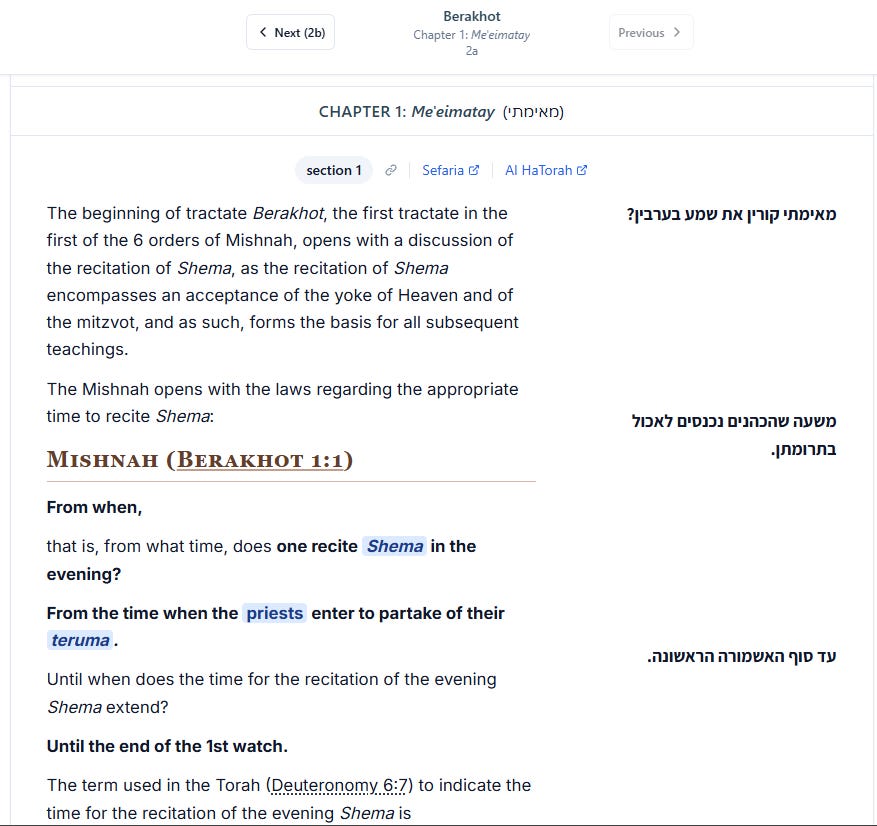
The mapping is the same as that used in the Mishnah-Talmud Mapping page.
מטרוניתא.
On this term, see my “Tales of Temptation: Sages’ Encounters with Roman Noblewomen (Kiddushin 39b-40a)“, and the note there.
לאלהא ישראל - literally: “to the God of Israel”.
The Talmud goes on to discuss why R’ Yohanan revealed it, from a halachic and ethical perspective. I elide that here.
סימניה - literally: “sign”.
קרירי קרירי - the linguistic doubling indicates “very”.
The Talmud further questions halachic aspects of the anecdote of R’ Yohanan, and recounts an additional anecdote re R’ Abbahu and the healer Jacob the Heretic. I discuss those anecdotes elsewhere, in my “Appendix - “Let Me Die with the Philistines”: Self-Sacrificial Violence and the Limits of Medical Trust on Shabbat (Avodah Zarah 28a)”.
פרוונקא - parwanaka - literally: “messenger”; from Persian.
On this word, see my note in “Pt1 Thief-Catching, Corpulence, and Virility: Stories of R’ Elazar ben Shimon and R’ Yishmael ben Yosei (Bava Metzia 83b-84a)“, on section “R’ Elazar ben Shimon’s Appointment by the Romans as a Thief-Catcher“.
למחייה שיתין איתקוטלי.
On the word itkutlei, see Jastrow (modernized), entry “אִסְקוּטְלָא I”:
(Ispe’el: or Itpe’el: of קוטל = גודל thumb)
snapping with thumb and middle finger, flipping.
Taanit 25a:14 - טרק לי באסקוטלא אאפותי - Arukh (ed. מחיין … אפו׳; Manuscript Munich: אאפותאי) - “he stirred me up by snapping on my forehead”
Plural: אִסְקוּטְלֵי.
Avodah Zarah 28a:15 - מחייה שתין אסקוטלי - Arukh (ed. אית׳) - “snap thereon (on the swelling) sixty times”
שתי וערב - literally: “warp and woof”, i.e., crosswise.