

This is the fourth and final part of a four-part series. Part 1 is here, Part 2 is here; Part 3 is here; the outline of the series can be found at Part 1.
Beit Shammai vs. Beit Hillel re the relationship of Creation days 1-3 to days 4-6 - 2 vs 3 days
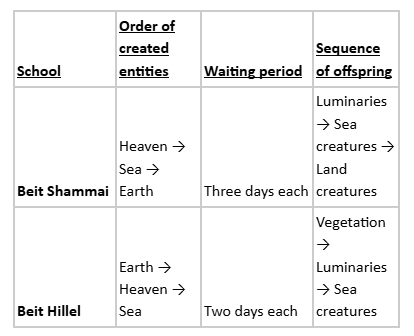
According to Beit Shammai, heaven, sea, and earth each wait three days before producing their offspring - Genesis 1
Beit Shammai: Three-Day Gestation Pattern:

Heaven - Day 1
שמים בראשון כבית שמי עשה שלשה ימים.
ועשו תולדות ראשון ושיני ושלישי.
ברביעי: יהי מאורות.
According to Beit Shammai: the heaven after the 1st [day] waited 3 days -- 1st, 2nd, 3rd -- to have offspring.
On the 4th: there shall be lights (Genesis 1:14)
Sea - Day 2
ים בשיני כבית שמי עשה שלשה ימים.
ועשה תולדות שיני ושלישי ורביעי.
בחמישי: ישרצו המים.
According to Beit Shammai, the sea after the 2nd [day] waited 3 days -- 2nd, 3rd, 4th -- to have offspring.
On the 5th: the waters shall teem (Genesis 1:20)
Earth - Day 3
ארץ בשלישי כבית שמי עשת שלשה ימים.
ועשת תולדות שלישי ורביעי וחמישי.
בשישי: ותוצא הארץ.
According to Beit Shammai, the earth after the 3rd [day] waited 3 days -- 3rd, 4th, 5th -- to have offspring.
On the 6th: the earth shall produce (Genesis 1:24)
According to Beit Hillel, earth, heaven, and sea each wait two days before producing theirs - Genesis 1
Beit Hillel: Two-Day Gestation Pattern:

Earth - Day 1
ארץ בראשון כבית הלל עשת שני ימים.
ועשו תולדות ראשון ושיני.
בשלישי: תדשא הארץ.
According to Beit Hillel, the earth after the 1st [day] waited two days -- 1st and 2nd -- to have offspring.
On the 3rd: the earth shall be covered with grass.
Heaven - Day 2
שמים בשיני כבית הלל עשו שני ימים.
ועשו תולדות שיני ושלישי.
ברביעי: יהי מאורות.
According to Beit Hillel, the heaven after the 2nd [day] waited two days -- 2nd and 3rd -- to have offspring.
On the 4th: there shall be lights
Sea - Day 3
ים בשלישי כבית הלל עשה שני ימים.
ועשה תולדות שלישי ורביעי.
בחמישי: ישרצו המים.
According to Beit Hillel, the sea after the 3rd [day] waited two days -- 3rd and 4th -- to have offspring.
On the 5th: the waters shall teem.
R’ Shimon b. Yoḥai - Heaven and earth were created simultaneously, like a pot and its lid - Isaiah 48:13
אמר רבי שמעון בן יוחי:
תמיה אני היאך נחלקו אבות העולם על ביריית העולם?!
שאני אומר:
שמים וארץ לא נבראו אלא כלפס הזה וככיסויה.
מה טעם?
אף ידי יסדה ארץ
וימיני טיפחה שמים.
R’ Shimon ben Yohai said:
I wonder how the fathers of the world could disagree about the creation of the world?!
Heaven and earth were only created like a pan1 and its cover.
What is the reason?
Also My left hand founded the Earth
and My right hand tended the Heavens (Isaiah 48:13)
R’ Elazar b. Shimon - Since the Bible sometimes mentions heaven first and sometimes earth first, the two are equal in rank
אמר רבי לעזר בירבי שמעון:
אם כדעת הזו שאמר אבא:
פעמים שהוא מקדים שמים לארץ.
פעמים שהוא מקדים ארץ לשמים.
אלא מלמד ש:
שניהן שקולים זה בזה.
R’ Elazar ben R’ Shimon said:
following this, my father’s opinion:
Sometimes [in the Bible] heaven precedes earth,
sometimes earth precedes heaven,
which teaches that:
they are equivalent one to another.
Appendix - Homilies on the letters Yod and Heh (Menachot 29b)
Menachot/29b#7 thru #13
This sugya interprets specific scribal features of Hebrew letters as theological symbols. It begins with Rava’s rule that seven letters require three crowns.2 Rav Ashi then reports that the exacting scribes of Rav’s study hall shaped two letters with particular care: they added a stroke to the roof of the letter ח and suspended the left leg of the letter ה.
The sugya explains these visual details homiletically. The ח points to God as חי, “living,” in the heights of the universe. The ה becomes the central object of interpretation, connected to Isaiah 26:4 and to the creation of the two worlds through the divine name “Yah” ( יה).
The sugya then develops a sustained interpretation of י and ה as the letters through which God created the World-to-Come and this world. R’ Yehuda bar R’ Elai derives from Genesis 2:4, reading בהבראם as בה״י בראם, that this world was created with the letter ה. The shape of ה explains the moral structure of this world: it is open below like a portico, so a person may “leave,” meaning descend into sin. Its suspended leg indicates that return remains possible through repentance, though reentry comes through a different opening. Its crown signifies that God crowns the repentant sinner.
The sugya then turns to the letter י, the smallest Hebrew letter, as the letter of the World-to-Come. Its smallness corresponds to the small number of righteous people who attain it. Its bent head reflects the righteous bowing in recognition that even among them there are differences of spiritual rank.
Rava - Seven letters require three crowns: שעטנ״ז ג״ץ
אמר רבא:
שבעה אותיות צריכות שלשה זיונין,
ואלו הן:
שעטנ״ז ג״ץ.
§ The Talmud continues its discussion of the crowns on letters of the Torah: Rava says:
7 letters require 3 crowns [ziyyunin],
and they are the letters
shin,
ayin,
tet,
nun,
zayin;
gimmel
and tzadi.
Rav Ashi - Exacting scribes of Rav’s study hall added a stroke to the roof of ḥet and suspended the leg of heh
אמר רב אשי:
חזינא להו לספרי דווקני דבי רב,
דחטרי להו לגגיה דחי״ת,
ותלו ליה לכרעיה דה״י.
Rav Ashi says:
I have seen that the exacting3 scribes of the study hall of Rav
would put a hump-like stroke on the roof of the letter ḥet
and they would suspend the left leg of the letter heh,
i.e., they would ensure that it is not joined to the roof of the letter.
The ḥet-stroke signifies that God lives “in the height of the world”
חטרי להו לגגיה דחי״ת,
כלומר:
חי הוא ברומו של עולם,
The Talmud explains:
They would put a hump-like stroke on the roof of the letter ḥet
as if to thereby say:
He [=God] lives [ḥai] in the heights of the universe.
R’ Yehuda Nesia asking R’ Ami; R’ Ami responding - One who trusts in God has refuge in this world and the World-to-Come - Isaiah 26:4
ותלו ליה לכרעיה דה״י,
כדבעא מיניה רבי יהודה נשיאה מרבי אמי:
מאי דכתיב:
״בטחו ביי עדי עד
כי ביה יי
צור עולמים״?
And they would suspend the left leg of the letter heh,
as R’ Yehuda Nesia asked R’ Ami:
What is the meaning of that which is written:
“Trust in YHWH forever,
for in YHWH [be-Yah] is God,
an everlasting [olamim] Rock” (Isaiah 26:4)?
אמר ליה:
כל התולה בטחונו בהקדוש ברוך הוא --
הרי לו מחסה בעולם הזה ולעולם הבא.
R’ Ami said to him:
Anyone who puts their trust in God --
will have Him as his refuge in this world and in the World-to-Come.
This is alluded to in the word “olamim,” which can also mean: “worlds”
אמר ליה:
אנא הכי קא קשיא לי,
מאי שנא דכתיב: ״ביה״
ולא כתיב: ״יה״?
R’ Yehuda Nesia said to R’ Ami: I was not asking about the literal meaning of the verse;
this is what poses a difficulty for me:
What is different about that which is written: “For in Yah [be-YH],”
and it is not written: For Yah [YH]?
R’ Yehuda b. Elai - the two worlds were created with the letters yod and heh
כדדרש רבי יהודה בר רבי אילעאי:
אלו שני עולמות שברא הקדוש ברוך הוא,
אחד בה״י
ואחד ביו״ד,
ואיני יודע
אם
העולם הבא ביו״ד
והעולם הזה בה״י,
אם
העולם הזה ביו״ד
והעולם הבא בה״י.
Rav Ashi responded:
It is as R’ Yehuda bar R’ Elai taught:
The verse “For in YHWH [beYah] is God, an everlasting Rock [Tzur olamim]” is understood as follows: The term “Tzur olamim” can also mean Creator of worlds. These letters yod and heh that constitute the word yah are referring to the two worlds that God created;
one with [be] the letter heh
and one with [be] the letter yod.
And I do not know
whether
the World-to-Come was created with the letter yod
and this world was created with the letter heh,
or whether
this world was created with the letter yod
and the World-to-Come was created with the letter heh.
This world was created with heh, as “be-hibare’am” is read as “with heh He created them” - Genesis 2:4
כשהוא אומר:
״אלה תולדות השמים והארץ בהבראם״,
אל תקרי ״בהבראם״ אלא:
בה״י בראם.
When the verse states:
“These are the generations of the heaven and of the earth when they were created [be-hibare’am]” (Genesis 2:4),
do not read it as be-hibare’am, meaning: “When they were created”
Rather, read it as be-heh bera’am, meaning: “He created them with the letter heh”
This verse demonstrates that the heaven and the earth, i.e., this world, were created with the letter heh, and therefore the World-to-Come must have been created with the letter yod.
This world was created with heh because it resembles an open portico: whoever wants to leave may leave
ומפני מה נברא העולם הזה בה״י?
מפני שדומה לאכסדרה,
שכל הרוצה לצאת --
יצא.
And for what reason was this world created specifically with the letter heh?
It is because the letter heh, which is open on its bottom, has a similar appearance to a portico,4 which is open on one side.
And it alludes to this world, where anyone who wishes to leave --
may leave,
i.e., every person has the ability to choose to do evil.
The suspended leg allows return through repentance
ומאי טעמא תליא כרעיה?
דאי הדר בתשובה --
מעיילי ליה.
[...]
And what is the reason that the left leg of the letter heh is suspended, i.e., is not joined to the roof of the letter?
It is because if one repents --
he is brought back in through the opening at the top.
[...]
The crown of the heh signifies that if a sinner returns, God ties a crown for him
ומאי טעמא אית ליה תאגא?
אמר הקדוש ברוך הוא:
אם חוזר –
אני קושר לו קשר.
The Talmud asks: And what is the reason that the letter heh has a crown5 on its roof?
The Talmud answers: God says:
If a sinner returns --
repenting for his sin, I tie a crown for him from above.
The World-to-Come was created with yod because the righteous in it are few
מפני מה נברא העולם הבא ביו״ד?
מפני שצדיקים שבו מועטים.
The Talmud asks: For what reason was the World-to-Come created specifically with the letter yod, the smallest letter in the Hebrew alphabet?
The Talmud answers: It is because the righteous of the world are so few.
The bent head of the yod reflects the righteous bowing their heads because their deeds differ in rank
ומפני מה כפוף ראשו?
מפני שצדיקים שבו כפוף ראשיהם מפני מעשיהן,
שאינן דומין זה לזה.
And for what reason is the left side of the top of the letter yod bent downward?
It is because the righteous who are in the World-to-Come hang their heads in shame,
since the actions of one are not similar to those of another.
In the World-to-Come some of the righteous will be shown to be of greater stature than others.
לפס - from Greek.
שעטנ״ז ג״ץ. On this, see Hebrew Wikipedia, “אותיות סת”ם”, section “התגים”.
דווקני.
On this word, see Jastrow (modernized), entry “דַּוְקָנָא”:
(דּוּק) calculating, accurate scholar.
Avodah Zarah 10a:1 - ספרא דוקנא - “an accurate scribe” (paying attention to exact historical dates).
Plural: דַּוְקָנֵי, דַּוְו׳.
Menachot 29b:6 - ספרי דווקני - “careful copyists of the Bible”
Yevamot 43a:10 - משום דמסיימי בה דווקני זו וכ׳ - “because exact scholars report a traditional addition (to the Halacha in question), ‘These are the words of R’ Shimon’ “
אכסדרה - from Greek.
תאגא.
On this word, see Jastrow (modernized), entry “תָּגָא”, sense #2:
2) crownlet on letters.
Menachot 29b:12 - מ”ט אית ליה תאגא - “why has the letter ה a crownlet?”
Shabbat 104a:4-7 - מ”ט … תָּגֵיה דקו”ף וכ׳ - “why is the crownlet of the Kof turned towards the Resh?”
Plural: תָּגִין, תָּגי.
Tractate Soferim 9:1 - ב׳ דבראשית … ת׳ - “the Beth of b’reshith (Genesis 1:1) requires four crownlets”